Coming up: The Month of LibreOffice, May 2019!

LibreOffice is made by hundreds of people around the world: volunteers working from home, certified developers who are part of our commercial ecosystem, and other supporters and users. Throughout the year, they add new features to the software, test them, and help us to make each release polished and reliable. We’re incredibly appreciative of their efforts!

Now, if you’re a regular user of LibreOffice, you can give us a hand! In May 2019, we’re running a Month of LibreOffice – a campaign to credit all contributions to the software and community. Everyone who helps out can claim an awesome sticker pack, and this time round we have an extra bonus: 10 contributors will be chosen at random at the end, and will receive an exclusive LibreOffice glass mug:

While your help is important for the LibreOffice project, it’s also good for you as well! If you’re interested in a possible future career in software – such as programming, QA, user interface design, documentation, user support and other topics – then joining the Month of LibreOffice is great for you too:

  • Build up your skills
  • Get experience in a well-known software project
  • Make new contacts
  • Put it all on your CV!

So, what happens next? Well, on May 1st we’ll post full details on this blog about how you can get involved – so stay tuned! And follow us on Mastodon, Twitter, Facebook and Reddit for more updates. See you soon!

Next C++ workshop: Linked Lists / Stack Classes; PQs and Heaps, 25 April at 18:00 UTC

Boost your C++ skills with the help of LibreOffice developers! We’re running regular workshops which focus on a specific topic, and are accompanied by a real-time IRC meeting. For the next one, the topic is Linked Lists / Stack Classes; PQs and Heaps. Start by watching this presentation:

Please confirm that you want to play a YouTube video. By accepting, you will be accessing content from YouTube, a service provided by an external third party.

YouTube privacy policy

If you accept this notice, your choice will be saved and the page will refresh.

And check out the suggested EasyHacks.

Then join us for a discussion via our #libreoffice-dev IRC channel. You can ask experienced LibreOffice developers questions, and learn more about the language. See you then!

The Document Foundation releases LibreOffice 6.2.3

Berlin, April 18, 2019 – The Document Foundation announces LibreOffice 6.2.3, the third bug and regression fixing release of the LibreOffice 6.2 family, targeted at tech-savvy individuals: early adopters, technology enthusiasts and power users.

LibreOffice’s end users are helped by a global community of volunteers: https://www.libreoffice.org/get-help/community-support/. On the website and the wiki there are guides, manuals, tutorials and HowTos. Donations help us to make all of these resources available.

LibreOffice users are invited to join the community at https://www.libreoffice.org/community/get-involved/, to improve LibreOffice by contributing back in one of the following areas: development, documentation, infrastructure, localization, quality assurance, design or marketing.

LibreOffice 6.2.3 provides over 90 bug and regression fixes over the previous version, contributed by a thriving community of developers, which are described in the change log pages: https://wiki.documentfoundation.org/Releases/6.2.3/RC1 (changed in RC1) and https://wiki.documentfoundation.org/Releases/6.2.3/RC2 (changed in RC2).

Enterprise Deployments

LibreOffice 6.2.3 represents the bleeding edge in term of features for open source office suites, and as such is not optimized for enterprise class deployments, where features are less important than robustness. Users wanting a more mature version can download LibreOffice 6.1.5, which includes some months of back-ported fixes.

Value-added services for enterprise class deployments – related to software support, migrations and training – should be sourced from certified professionals (https://www.libreoffice.org/get-help/professional-support/). In addition, the LTS (Long Term Supported) version provided by two TDF Advisory Board members offers specific characteristics and features targeted to enterprise deployments (https://www.documentfoundation.org/governance/advisory-board/).

Sourcing enterprise class software and/or services from the ecosystem of certified professionals are the best support options for organizations deploying LibreOffice on a large number of desktops. In fact, these activities are contributed back to the project under the form of improvements to the software and the community, and trigger a virtuous circle which is beneficial to all parties, including users.

Availability of LibreOffice 6.2.3

LibreOffice 6.2.3 is immediately available from the following link: https://www.libreoffice.org/download/. Minimum requirements for proprietary operating systems are Microsoft Windows 7 SP1 and Apple macOS 10.9. Builds of the latest LibreOffice Online source code are available as Docker images: https://hub.docker.com/r/libreoffice/online/.

LibreOffice Online is fundamentally a server service, and should be installed and configured by adding cloud storage and an SSL certificate. It might be considered an enabling technology for the cloud services offered by ISPs or the private cloud of enterprises and large organizations.

LibreOffice users, free software advocates and community members can support The Document Foundation with a donation at https://www.libreoffice.org/donate.

LibreOffice 6.2.3 is built with document conversion libraries from the Document Liberation Project: https://www.documentliberation.org.


Next C++ workshop: Linked Lists, 11 April at 18:00 UTC

Another workshop is coming up! Improve your C++ skills with the help of LibreOffice developers: we’re running regular workshops which focus on a specific topic, and are accompanied by a real-time IRC meeting. For the next one, the topic is Linked Lists. Start by watching this presentation:

Please confirm that you want to play a YouTube video. By accepting, you will be accessing content from YouTube, a service provided by an external third party.

YouTube privacy policy

If you accept this notice, your choice will be saved and the page will refresh.

And check out the suggested EasyHacks.

Then join us for a discussion via our #libreoffice-dev IRC channel. You can ask experienced LibreOffice developers questions, and learn more about the language. See you then!

Community Member Monday: Biraj Karmakar

India has 23 official languages according to the country’s constitution, but over 750 other languages are spoken there as well. Today we talk to Biraj Karmakar, who helps to translate LibreOffice into Bengali, and is a passionate supporter of other free and open source software projects:

Where do you live, and can we follow you on social media or IRC?
I’m based in Kolkata, India, and I’m active on Twitter: @birajkarmakar. I always try to help people through social media. Other than that I am available on IRC (biraj) and Telegram (@birajkarmakar).

What do you do when you’re not working on LibreOffice?

Basically I am a professional linguist – I work from my own office. Also, I am a digital marketing consultant, helping small business to grow in online markets. Other than that I run many social entrepreneur activities like Digital Literacy for Kids and Women, and I am a pure hardcore open source supporter. I have been contributing to open source projects like Mozilla, DuckDuckGo, GNOME, SaifishOS, VLC etc from 7 years. There I generally do localisation (l10n) and community events, along with quality assurance (QA) activities.

What do you do in the LibreOffice project? What are you working on?

Basically I am the bn-IN (Bengali) locale leader in the LibreOffice project, trying to complete the pending translation. Also I have done some translation for two marketing videos. I am planning to organize one translation workshop for bn-IN language very soon. Then there’s one QA event in my list.

How did you get involved? Was it a good experience?

Actually, I knew about LibrepOffice when I started using Linux. It looked good to me because we got it free for our office-related work. As I am an open source fan, I thought: why not get involved in this project? Then a few community members introduced me to the LibreOffice community!

What does LibreOffice need most right now?

I think the LibreOffice community is growing – But we don’t have much exposure in India. It would be great if we could arrange meet-ups in India where we recruit new community members, especially in colleges and university campuses, who can help us to promote the software in India.

Thanks to Biraj for his time and contributions! Learn more about localising LibreOffice here – and, of course, there are many other ways to get involved as well!

Announcing the First Latin America LibreOffice Conference

This is the first ever LibreOffice conference covering Latin America, a rapidly-growing area for free and open source software.

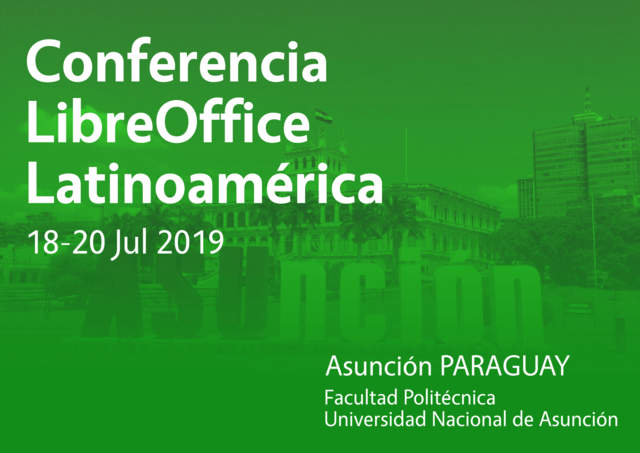
Berlin, April 2nd, 2019 – The Document Foundation announces the LibreOffice Latin America Conference 2019, held at the Facultad Politécnica de Universidad Nactional de Assunción (FPUNA) in Asunción, Paraguay on July 19th (Friday) and 20th (Sat).

LibreOffice Latin America Conference will be the first event gathering LibreOffice users, advocates and contributors (not only development, but also localization, PR/marketing, documentation, quality assurance, … etc.) from different countries in Latin America, to exchange and share experiences and knowledge.

An exclusive translation sprint to Guarani will be held in parallel during the event with supervision of LibreOffice volunteer developers.

During the conference, we will discuss LibreOffice related business such as supporting and training, migrating to LibreOffice and the ODF true standard format, developing, and any other community activity in Latin America. In addition, we will have guests from the core team at The Document Foundation, which is a charitable foundation and the home of LibreOffice.

“The event will be an important opportunity for the consolidation of LibreOffice and free open source software in the region, bringing experiences from other countries for discussions and software development in Latin America” commented Alcides Javier Torres Gutt, professor at FPUNA. “FPUNA is proud to host the event for the Paraguayan FOSS communities, as well as advancing in the creation of a real LibreOffice with Guarani user interface”.

“The Document Foundation is a global organization, and as such wants to tighten the relationship with local communities in areas like Latin America, where there are huge growth opportunities for free open source software. A conference is the best way of putting together LibreOffice advocates, and sharing experiences and best practices at continental level” said Italo Vignoli, Marketing and Communication specialist at the Document Foundation.

Contact the conference organizers at mail address latinoamerica@global.libreoffice.org.

The Document Foundation All Rights Reserved 2025
Proudly powered by WordPress | Theme: Refined Magazine Pro by Candid Themes.