Month of LibreOffice, May 2020 – Two weeks in!

Two weeks ago, we started a new Month of LibreOffice, saying thanks to contributors from our worldwide community. Everyone who helps out with our projects this month can claim a cool sticker pack at the end – and also has a chance to win a hoodie, T-shirt or mug!

So far 259 sticker packs have been awarded – click the link to see if your name/username is in the list. If not, read on and find out what you can do, to take part!

How to get your stickers

There are many ways you can help out – and you don’t need to be a developer. For instance, you can be a…

  • Handy Helper, answering questions from users on Ask LibreOffice. We’re keeping an eye on that site so if you give someone useful advice, you can claim your shiny stickers.
  • First Responder, helping to confirm new bug reports: go to our Bugzilla page and look for new bugs. If you can recreate one, add a comment like “CONFIRMED on Windows 10 and LibreOffice 6.4.3”.
  • Drum Beater, spreading the word: tell everyone about LibreOffice on Twitter or Mastodon! Just say why you love it or what you’re using it for, add the #libreoffice hashtag, and at the end of the month you can claim your stickers.
  • Globetrotter, translating the user interface: LibreOffice is available in a wide range of languages, but its interface translations need to be kept up-to-date. Or maybe you want to translate the suite to a whole new language? Get involved here.
  • Docs Doctor, writing documentation: Whether you want to update the online help or add chapters to the handbooks, here’s where to start.

We’ll be posting regular updates on this blog and our Mastodon and Twitter accounts over the next two weeks – stay tuned!

Annual Report 2019: The Document Foundation’s activities

(Note: this is a section from The Document Foundation’s Annual Report 2019, which will be published in full in the coming weeks.)

2019 was a busy year for The Document Foundation, with elections for the Chairperson and Deputy, new staff members, and other activities.

Election of new TDF Board of Directors

The Board of Directors (or “BoD”) is the Foundation’s Board of Directors, the main administration of the Foundation’s projects and teams. Directors are directly elected by Community Members. The Board of Directors consists of seven (7) members and two (2) deputies. The Board of Directors may launch any other teams or committees ad hoc if necessary. In December, an election was held for a new Board.

Gabriele Ponzo, Chairman of TDF’s Membership Committee, announced the results:

The vote preliminary results were in conflict with § 8 IV of our statutes, as three candidates – Michael Meeks, Cor Nouws and Jan Holešovský – have the same affiliation. The elected candidates and the membership committee discussed the options to resolve the conflict and Jan Holešovský decided to not accept the role. The Membership Committee would like to thank Kendy for his support in this and especially for his longtime work in the board!

Elected as member of the Board of Directors, in this order, were: Michael Meeks, Thorsten Behrens, Franklin Weng, Daniel Armando Rodriguez, Cor Nouws, Lothar Becker and Emiliano Vavassori. Elected as deputies of the Board of Directors were: Nicolas Christener and Paolo Vecchi.

Advisory Board members and meetings

The Document Foundation relies on its Advisory Board Members in order to receive advice and support. The Advisory Board’s primary function is to represent The Document Foundation’s supporters and to provide the Board of Directors with advice, guidance and proposals. Members are the Free Software Foundation Europe (FSFE), Software in the Public Interest (SPI), UK Government Digital Services (joined in 2019), City of Munich (Landeshaupstadt München), BPM-Conseil, Kopano b.v., GNOME, Google, Adfinis SyGroup (joined in 2019), RPA RusBITech, KDE e.V., the Free Software Foundation (FSF), Collabora, CIB Software and Red Hat.

Throughout the year, TDF had regular calls with representatives of the Advisory Board. Staff and Board members at TDF provided updates on the foundation, software and community, and described plans for the future. Advisory Board members were invited to provide valuable feedback on TDF’s activities, and various ideas and proposals were discussed. TDF would like to express its thanks to all Advisory Board members for their help.

New staff members

In 2019, two new staff members joined The Document Foundation’s team. Ilmari Lauhakangas (aka “buovjaga”) was well known in the community for his work in Bugzilla, and joined TDF as a Development Mentor. He described his work and plans in an interview here on the blog.

In addition, Stefan Ficht joined as an Administrative Assistant, helping Florian Effenberger (Executive Director) and the rest of the team with various tasks.

Highlights of activities

Throughout the year, TDF supported various campaigns and events, via this blog and our social media channels. For instance, on February 14 we joined the Free Software Foundation Europe’s campaign “I love Free Software”. This is “the perfect opportunity to say thank you to the contributors of the various Free Software we love: developers, translators, designers, testers, or documentation writers, of huge software projects – or smaller ones.”

Similarly, we backed International Women’s Day on March 8, raising awareness against bias. Free Software projects tend to be heavily male-dominated, but our community is trying to be more open and inclusive.

In May, the Organization for the Advancement of Structured Information Standards (OASIS) announced “Open Projects”, the first-of-its-kind program that creates a more transparent and collaborative future for open source and standards development. Open Projects gives communities the power to develop what they choose–APIs, code, specifications, reference implementations, guidelines– in one place, under open source licenses, with a path to recognition in global policy and procurement. TDF supports this effort, along with OpenDocument Format (ODF) Advocacy.
October 12 was the International Day Against DRM – Digital “Rights” Management, but many argue it should be called Digital Restrictions Management.

DRM is the practice of imposing technological restrictions that control what users can do with digital media. When a program is designed to prevent you from copying or sharing a song, reading an ebook on another device, or playing a single-player game without an Internet connection, you are being restricted by DRM. In other words, DRM creates a damaged good; it prevents you from doing what would be possible without it. If we want to avoid a future in which our devices serve as an apparatus to monitor and control our interaction with digital media, we must fight to retain control of our media and software. The Document Foundation supports “Defective by Design”, a broad-based anti-DRM campaign that targets Big Media, unhelpful manufacturers and DRM distributors.

So much of this was made possible thanks to your generous donations. If you find LibreOffice useful, support us with a donation so that we can continue to build our community, share knowledge, and improve LibreOffice for everyone!


LibreOffice Tuesday T&T: Windows Installation Issues

According to our estimates, worldwide there are around 150 million LibreOffice users on Windows. And when we say worldwide we mean worldwide, as according to the origin of downloads we have users in every continent including Antarctica.

As a consequence, we get a large amount of questions related to LibreOffice on Windows. Many of these questions are about the installation process, because there are several issues which prevent the user to get the expected positive user experience. Unfortunately, the majority of these questions are related to Windows issues and not to LibreOffice issues.

When a issue is related to Windows, the Microsoft operating system will show a specific message, under the form of either an error number (for instance, “Error 1303”) or a specific sentence (for instance, “The program can’t start because api-ms-win-crt-runtime-l1-1-0.dll is missing from your computer”).

Of course, over the years we have built a small knowledge base on the subject, and we have published the results on one page on the wiki, in the area of frequently asked questions: https://wiki.documentfoundation.org/Faq/General/General_Installation_Issues_(Windows). Another useful resource is the Ask LibreOffice website (https://ask.libreoffice.org/en/questions/), where users can search for a solution.

The best resources, though, are provided by Microsoft, and are all multilingual, and are the Microsoft Support website (https://support.microsoft.com/) and the Microsoft Community website (https://answers.microsoft.com/en-us). For instance, a search for “Error 1303” provides around 20 answers, with comments, on the Ask LibreOffice website, and hundreds or even thousands of answers on the two Microsoft websites.

LibreOffice is a hot target for the Google Season of Docs 2020

For the second year in a row, The Document Foundation has been accepted as an organization in the Google Season of Docs, a programme whose goals are to give technical writers an opportunity to participate in contributing to open source projects, and to give open source projects an opportunity to engage the technical writing community.
This year we offer a wide range of projects for technical writers, and we’re extending the reach by providing projects for e-learning, mathematical documentation and code-oriented documentation.

During the programme, technical writers will spend a few months working closely with the LibreOffice community, bringing their technical writing expertise to the project’s documentation, and at the same time learning about the open source project and new technologies. Similarly, LibreOffice documentation team members will work with the technical writers to improve the project’s documentation and processes.

LibreOffice is an advanced office suite covering many areas of knowledge, from maths and sciences, engineering, financials, editing, drawing, printing and more. LibreOffice is also an application that is used cross-industry – so it’s a very rich opportunity for technical writing.

Olivier Hallot, LibreOffice’s documentation coordinator, will lead the GSoD project, supported by Ilmari Lauhakangas and members of the LibreOffice documentation team.

All information about the Google Seasons of Docs is on the GSoD website. An outline of the project’s different steps is available on the GSoD timeline. The next deadline is June 8, as we we need to find interested technical writers to discuss our ideas, which are summarized on the following TDF wiki page. The list includes some of our project’s permanent challenges, but should not be limited to these items. Technical writers must read the technical writer page of the programme.

LibreOffice contributors who are interested in becoming a mentor for the GSoD project should get in touch with Olivier Hallot by sending him a message. We look forward to hearing from you!

Community Member Monday: Marco Marinello

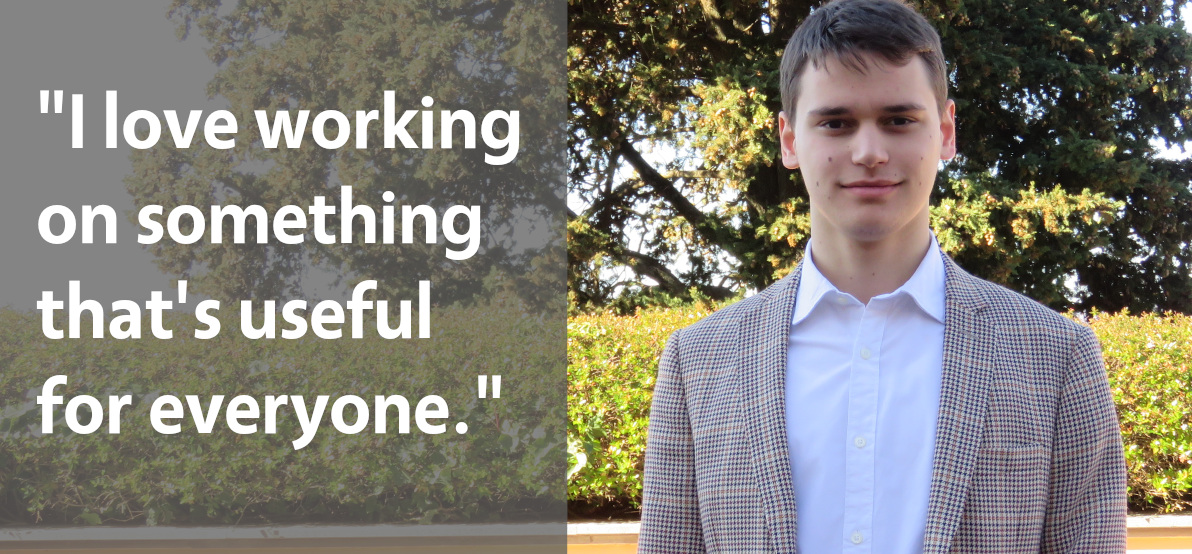
Today we’re talking to Marco Marinello from the Italian LibreOffice community, who recently became a member of The Document Foundation, the non-profit entity behind LibreOffice…

Tell us a bit about yourself!

I live in Bolzano, which is a small city in the northernmost part of Italy. My main interests are robotics and computer technology. In my spare time I often enjoy going for a ride with the bike, which I use almost every day to get around. In the summer I spend my holidays sailing with my family and some friends.

Why did you decide to become a member of TDF?

During SFScon – the Free Software Conference in Bolzano – I met Marina Latini, former Chairperson of the Board. We talked about the work I did on LibreOffice Online, and she encouraged me to send the application and become a member of TDF.

I share the values of TDF, and I love working on something that’s useful for everyone.

What exactly are you working on right now?

Mostly, I’m working on the documentation for LibreOffice Online, but I’m even submitting some changes. Documenting features that have already been implemented well is the first goal which I have set myself.

Anything else you plan to do in the future?

If I became more skilled in C++, I would like to get more involved with developing LibreOffice. I think a solid and compact group of members who really care about the product and the strategies is the strength of TDF.

Thanks to Marco for all his contributions! Everyone is welcome to join our friendly community, develop skills and meet new people. We look forward to meeting you!

Join the first Bug Hunting Session for LibreOffice 7.0!

LibreOffice 7.0 is being developed by our worldwide community, and is due to be released in early August 2020 – see the release notes describing the new features here. Of course, there’s still a lot more development to come, so more features will be added to that page in the coming months!

In order to find, report and triage bugs, the LibreOffice QA team is organizing the first Bug Hunting Session for LibreOffice 7.0 on Monday May 11, 2020. Tests will be performed on the first Alpha version, which will be available on the pre-releases server a few days before the event. Builds will be available for Linux (DEB and RPM), macOS and Windows, and can be installed and run in parallel along with the production version.

Mentors will be available from 07:00 UTC to 19:00 UTC for questions or help in the IRC channel #libreoffice-qa and the Telegram QA Channel. Of course, hunting bugs will be possible also on other days, as the builds of this particular Alpha release (LibreOffice 7.0.0 Alpha1) will be available until end of May. Check the Release Plan.

During the day there will be a dedicated session to test the ongoing work in the SKIA Graphics Engine integration from 14:00 and 16:00 UTC.

All details of the first bug hunting session are available on the wiki. LibreOffice is a volunteer-driven community project, so please help us to test – we appreciate it!