Announcing elections for the next TDF Membership Committee

Franklin Weng from The Document Foundation’s Board of Directors writes:

Dear Community,

we hereby officially announce the upcoming elections for the next Membership Committee of The Document Foundation.

As per § 12 II of our statutes (binding version in German and non-binding translation), the Membership Committee’s term lasts two years. The current Membership Committee started its duty on September 19, 2018. Therefore, the old Membership Committee remains in charge until the end of September 18, 2020, so the new MC will be in charge the day after that, which is September 19, 2020.

That upcoming term will then (regularly) end on September 18, 2022, so the next election of the Membership Committee will take place before.

As per § 6 III, only members of the Board of Trustees of The Document Foundation, as well as current members of any of its bodies, are eligible to be elected into the Membership Committee, and the election is overseen by the Board of Directors (§ 12 II).

The active electoral right is reserved to those who have been members of the Board of Trustees before this announcement (§ 12 II).

§ 6 III also states that members of the Board of Directors or their substitute members may not be members of the Membership Committee and vice versa.

There is one more notable limitation: Per § 8 IV of the statutes, a maximum of 1/3 members of the Membership Committee is allowed to work on an employment basis for the same company, organization, entities, affiliates or subdivisions.

Nomination of candidates fulfilling the above requirements, as well as self nomination is welcome. In total, at least five members of the Membership Committee are required, and given there are enough candidates, up to four substitute members can be elected based on the last board decision on this matter.

Re-election of current members of the Membership Committee is explicitly permitted (§ 12 II).

Please send nominations and self-nominations via e-mail to elections@documentfoundation.org (which reaches the Board of Directors in private) and also (!) to board-discuss@documentfoundation.org (which is a public mailing list).

We kindly ask nominees who would like to stand for elections to provide a statement of up to 75 words – longer statements will be cut off at the maximum – on their candidacy as continuous text (so no bullet lists or multiple paragraphs). In addition, you have to provide your full name, e-mail address and your corporate affiliation, if any, and please announce that you will provide information on all future changes as soon as possible. Specifically, it is necessary to indicate all information regarding § 8 IV of the statutes.

Discussions with the candidates and questions to them as well as questions about the elections should take place on the public board-discuss@documentfoundation.org mailing list. For details on how to use the mailing list, see https://www.libreoffice.org/get-help/mailing-lists/

Eligible voters will receive further details via e-mail prior to the start of elections, including a summary of the candidates, details on how to access the voting system, and instructions on how to independently verify the vote count. Please ensure we have your recent and correct e-mail address on file. For questions, you can reach the Board of Directors in private at elections@documentfoundation.org

Following the time line set forth in § 12 II, requiring a 45 day advance notice, we hereby announce the following time line for the elections:

(00:00 is beginning of the day, 24:00 is end of the day)

  1. (no later than) Friday, 2020-07-17: announcement of the election; and start of the nomination phase
  2. Thursday, 2020-08-27, 24:00 CEST/UTC+2: end of the nomination phase (one week before the election starts, as per § 12 II)
  3. Friday, 2020-09-04, 00:00 CEST/UTC+2: official start of the elections (at least 45 days after announcement of the election, as per § 12 II)
  4. Thursday, 2020-09-10, 24:00 CEST/UTC+2: end of the election
  5. Friday, 2020-09-11: announcement of the preliminary results and acknowledgement of role
  6. Saturday, 2020-09-12, 00:00 CEST/UTC+2: start of the challenging phase
  7. Tuesday, 2020-09-15, 24:00 CEST/UTC+2: end of the challenging phase
  8. afterwards: official announcement of the final results
  9. Saturday, 2020-09-19: new Membership Committee officially in charge, and election of a Chairperson from among its members

Be advised that the newly elected Membership Committee will only be in charge beginning from September 19, 2020.

Challenges to this election announcement with respect to the deadlines outlined have to happen no later than seven (7) days after this announcement, via e-mail to elections@documentfoundation.org (which reaches the Board of Directors in private).

Challenges to the preliminary results of the election have to happen until the deadline set forth above, via e-mail to elections@documentfoundation.org (which reaches the Board of Directors in private).

On behalf of the Board of Directors,
Franklin Weng

Marketing plan draft: Discussion about options available, and timetable

Lothar Becker, Chairman of The Document Foundation’s Board of Directors, writes:

Dear community,

thanks for the feedback on the marketing plan draft via different channels so far. We want to let you know and have you take part, as the board is discussing the options now available with that draft.

In the meantime, some more feedback will be integrated in the document already and will be published on next Monday. This is still not the last chance for a change for version 7.0.0, but we will reach that point soon.

The last change for all strings and tags would be possible the latest by Monday, July 20. With some preliminary phase for decision making of the board the public feedback phase on all this will end by the time of the next public board call, i.e. Friday, July 17, 1300 Berlin time.

What are the realistic options so far:

  • Variant 1: Implementation of a marketing plan would be postponed to V7.1, as no UI changes can be made in minor releases. This would imply a longer discussion period.

OR

  • Variant 2: Implementation of the marketing plan draft with V7.0.0 with flavour tags.

At the moment it looks like, this would be called “Community Edition” (in change to the RC1) and with the introduction of the umbrella brand “Enterprise Edition” with explanations and pointer to ecosystem partner offerings.

The feedback here we still need until the mentioned Friday, July 17, 1300 Berlin time is about all strings and tags (e.g. “Community Edition”), you can give that on the board-discuss mailing list, or on Bugzilla.

OR

  • Variant 3: As variant 2 above and further tweak all strings and tags for V7.1, after gaining experience and more feedback with it from V7.0.

We encourage all the community to bring in your opinions further, also on the public board call (Friday, July 17, 1300 Berlin time), and all the other channels. Please be aware, that any sort of decision of the board must be made the latest at the dates stated above.

Thanks so much for your input so far! All the best, and keep healthy!

Lothar,
Chairman of the Board

Board statement on the LibreOffice 7.0 RC “Personal Edition” label

Dear LibreOffice Community, supporters and friends,

Thanks to the hard work put in by many individual and ecosystem contributors, working together as a team in different fields, such as development, QA, design, marketing, localisation, release engineering, infrastructure, just to mention some, in a few weeks’ time we will be welcoming our LibreOffice 7.0 milestone.

At the same time, we are discussing our vision for the next five years, with a starting point being marketing and branding. See our marketing and board-discuss mailing lists.

Due to draft and development work in the area of branding and product naming, some speculation, in particular related to the “Personal Edition” tag shown in a LibreOffice 7.0 RC (Release Candidate), has started on several communication channels. So let us, as The Document Foundation’s Board of Directors, please provide further clarifications:

 1. None of the changes being evaluated will affect the license, the availability, the permitted uses and/or the functionality. LibreOffice will always be free software and nothing is changing for end users, developers and Community members.

 2. Due to the short time frame we are working with, the tagline appeared on the RC and we apologise if this caused some of you to think we unilaterally implemented the change. Rest assured that the consultation with the Community is still ongoing.

 3. This “Personal Edition” tag line is part of a wider 5 year marketing plan that we are preparing, and it has the purpose of differentiating the current, free and community-supported LibreOffice from a LibreOffice Enterprise set of products and services provided by the members of our ecosystem. The marketing plan is still under development and discussion so we are eager to receive and evaluate your feedback!

 4. Any feedback (in an appropriate way) to our marketing plan is welcome. There are several ways to send feedback to the Board of Directors: the most preferred way is to subscribe to the “board-discuss” mailing lists (e-mail here to subscribe), in which many of the discussions will take place in public and be archived. Besides the mailing list, we have a regular time slot (around 10-15 minutes maximum) in our Board meeting public section, for which we welcome all the community members to join and raise their questions. The Board meetings are held every two weeks and are announced in a timely fashion on the board-discuss mailing list.

 5. We are strongly opposed to any form of harassment, on any medium. Feedback itself is not an harassment, but personal attacks are. Please stay focused on the objective and be polite in your conversations!

 6. The team of editors for the marketing plan is weighting all the input, as it is important to get the feedback to define a clear strategy supported by the entire Community. We encourage everybody to support the Board, the marketing team and the Community working out the details; certainly we don’t want to make any decisions that is backed only by a small minority.

 7. This is a complex decision involving many overlapping concerns. We encourage people to read the detailed background slide-deck that Italo has produced, so that they can contribute to the current state of the discussion.

Apologies again if misunderstandings arose! We would very much appreciate your feedback and support!

Best Regards,

From all of The Document Foundation Board members

Annual Report 2019: LibreOffice Conference

(Note: this is a section from The Document Foundation’s Annual Report 2019, which will be published in full in the coming weeks.)

The LibreOffice Conference is the annual gathering of the community, our end-users, developers, and everyone interested in free office software. Every year, it takes place in a different country and is supported by members of the LibreOffice commercial ecosystem.

In 2019, the conference was organized in Almeria by the Spanish community, and took place from Tuesday, September 10 to Friday, September 13. Most of the conference took place in the Universidad de Almeria, next to the sea, but some social events and meetups were held in the city itself.

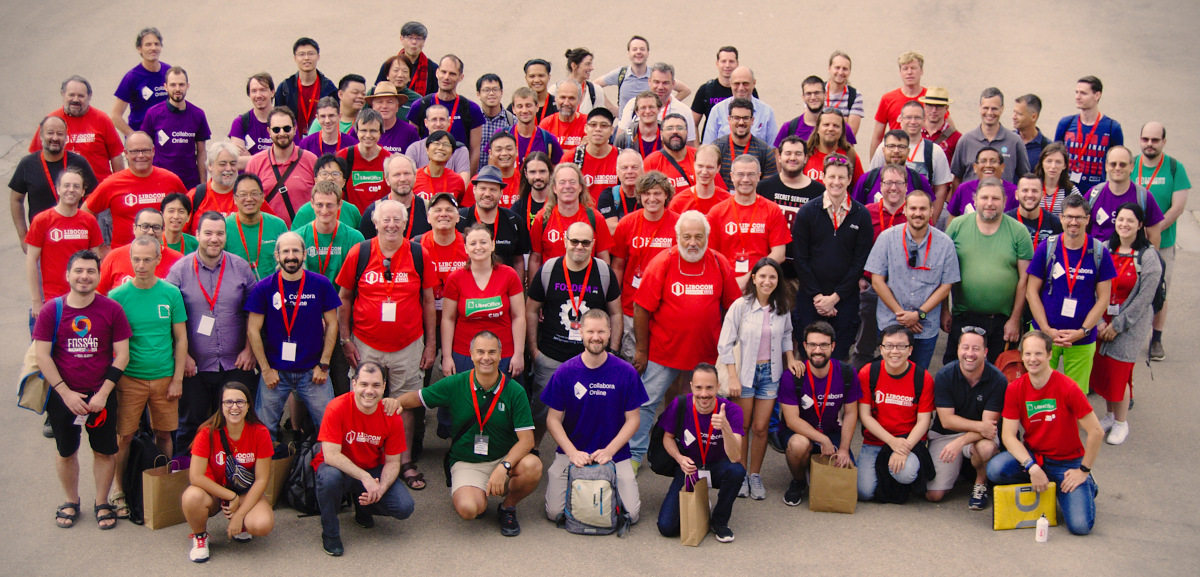
Over 100 people from across the globe attended the conference; for several people, it was their first LibreOffice Conference and therefore the first time they could meet other community members in-person.

On Tuesday, before the main conference presentations got underway, there was a community meeting. Various members of the LibreOffice community joined for informal talks about marketing and localisation of the software, and what we can do to bring more people into the project.

Conference Tracks

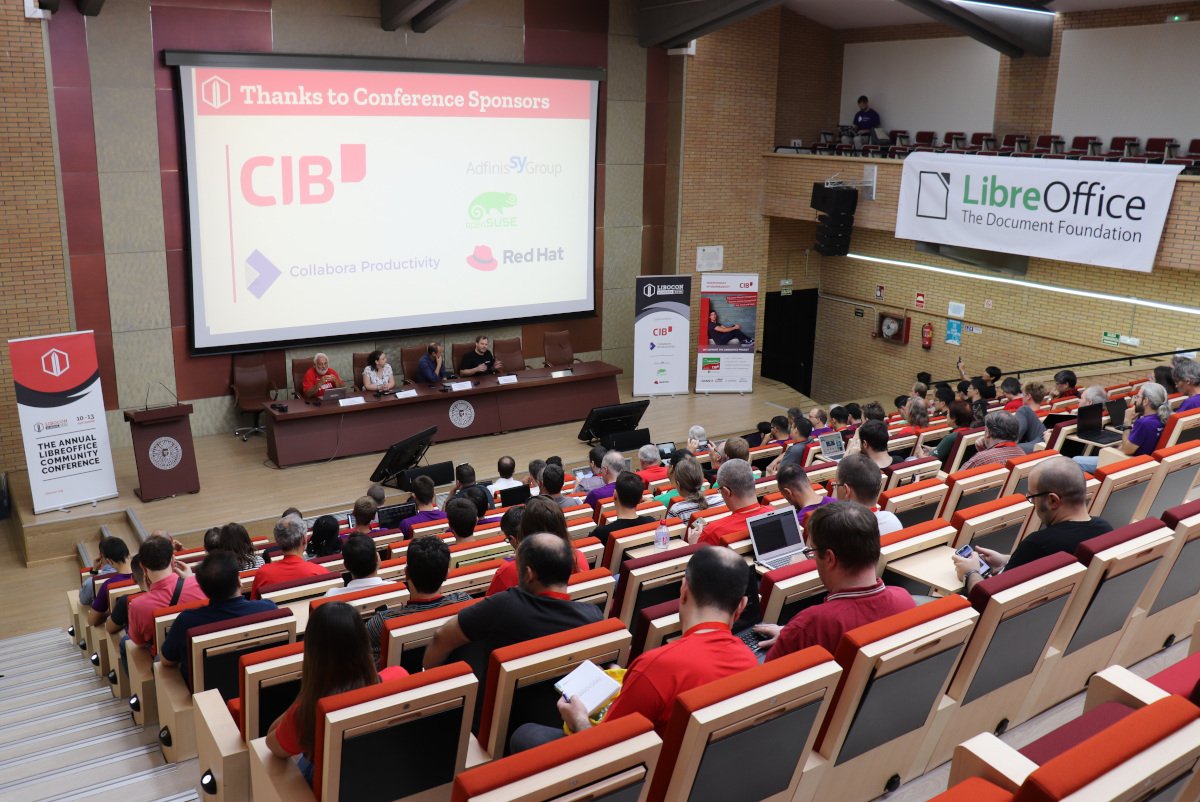
Wednesday kicked off with the opening session: a welcome and introduction from the university’s staff; the “state of the project” (summarising the last 12 months of activity in LibreOffice); quick introductions to the TDF team, Board of Directors and Membership Committee; and messages from the sponsors.

During the conference, there were over 70 talks, workshops and feedback sessions on all manner of topics. Some talks focused on technical aspects, such as continuous integration, build systems and debugging, while others were geared towards the community and other non-technical matters – for instance, getting new contributors, how the Membership Committee works, and reports from events in Asia.

In addition, community members and developers gave talks about LibreOffice Online, the PDF export feature, SmartArt editing in Impress, reproducible builds, and a neural machine translation plugin for the suite. Videos of most of the presentations – and a quick summary of the whole conference – are available on TDF’s YouTube channel as a playlist:

Please confirm that you want to play a YouTube video. By accepting, you will be accessing content from YouTube, a service provided by an external third party.

YouTube privacy policy

If you accept this notice, your choice will be saved and the page will refresh.

Additional Events

Outside of the conference tracks, various social events and meetups took place over the four days. On Tuesday evening we had a welcome party outside the accommodation, with drinks and light snacks. A beach dinner party was held on Wednesday, with more great local food to try, while a hackfest took place on Thursday, giving developers the opportunity to work shoulder-to-shoulder and discuss ideas in person.

On Friday, the conference organisers took us on a visit to the Alcazaba – the city’s castle – parts of which date back around 1,000 years. We had an entertaining guided tour with excellent views over the city as the sun set. Once the tour had finished, many people headed back into the city to sample tapas. Finally, on Saturday there was another guided tour, this time through the city’s historical downtown area.

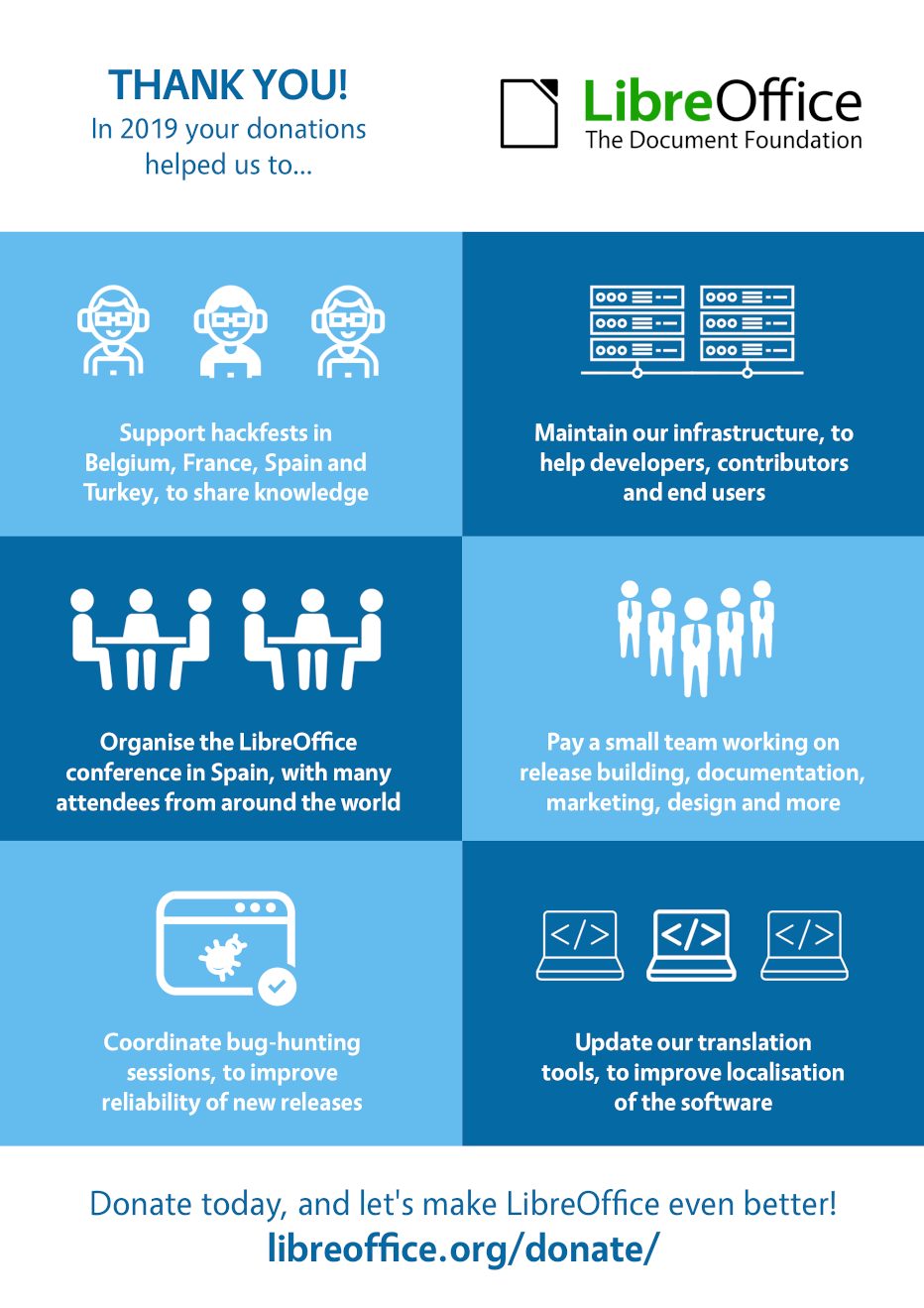
So much of this was made possible thanks to your generous donations. If you find LibreOffice useful, support us with a donation so that we can continue to build our community, share knowledge, and improve LibreOffice for everyone!

Annual Report 2019: The Document Foundation’s activities

(Note: this is a section from The Document Foundation’s Annual Report 2019, which will be published in full in the coming weeks.)

2019 was a busy year for The Document Foundation, with elections for the Chairperson and Deputy, new staff members, and other activities.

Election of new TDF Board of Directors

The Board of Directors (or “BoD”) is the Foundation’s Board of Directors, the main administration of the Foundation’s projects and teams. Directors are directly elected by Community Members. The Board of Directors consists of seven (7) members and two (2) deputies. The Board of Directors may launch any other teams or committees ad hoc if necessary. In December, an election was held for a new Board.

Gabriele Ponzo, Chairman of TDF’s Membership Committee, announced the results:

The vote preliminary results were in conflict with § 8 IV of our statutes, as three candidates – Michael Meeks, Cor Nouws and Jan Holešovský – have the same affiliation. The elected candidates and the membership committee discussed the options to resolve the conflict and Jan Holešovský decided to not accept the role. The Membership Committee would like to thank Kendy for his support in this and especially for his longtime work in the board!

Elected as member of the Board of Directors, in this order, were: Michael Meeks, Thorsten Behrens, Franklin Weng, Daniel Armando Rodriguez, Cor Nouws, Lothar Becker and Emiliano Vavassori. Elected as deputies of the Board of Directors were: Nicolas Christener and Paolo Vecchi.

Advisory Board members and meetings

The Document Foundation relies on its Advisory Board Members in order to receive advice and support. The Advisory Board’s primary function is to represent The Document Foundation’s supporters and to provide the Board of Directors with advice, guidance and proposals. Members are the Free Software Foundation Europe (FSFE), Software in the Public Interest (SPI), UK Government Digital Services (joined in 2019), City of Munich (Landeshaupstadt München), BPM-Conseil, Kopano b.v., GNOME, Google, Adfinis SyGroup (joined in 2019), RPA RusBITech, KDE e.V., the Free Software Foundation (FSF), Collabora, CIB Software and Red Hat.

Throughout the year, TDF had regular calls with representatives of the Advisory Board. Staff and Board members at TDF provided updates on the foundation, software and community, and described plans for the future. Advisory Board members were invited to provide valuable feedback on TDF’s activities, and various ideas and proposals were discussed. TDF would like to express its thanks to all Advisory Board members for their help.

New staff members

In 2019, two new staff members joined The Document Foundation’s team. Ilmari Lauhakangas (aka “buovjaga”) was well known in the community for his work in Bugzilla, and joined TDF as a Development Mentor. He described his work and plans in an interview here on the blog.

In addition, Stefan Ficht joined as an Administrative Assistant, helping Florian Effenberger (Executive Director) and the rest of the team with various tasks.

Highlights of activities

Throughout the year, TDF supported various campaigns and events, via this blog and our social media channels. For instance, on February 14 we joined the Free Software Foundation Europe’s campaign “I love Free Software”. This is “the perfect opportunity to say thank you to the contributors of the various Free Software we love: developers, translators, designers, testers, or documentation writers, of huge software projects – or smaller ones.”

Similarly, we backed International Women’s Day on March 8, raising awareness against bias. Free Software projects tend to be heavily male-dominated, but our community is trying to be more open and inclusive.

In May, the Organization for the Advancement of Structured Information Standards (OASIS) announced “Open Projects”, the first-of-its-kind program that creates a more transparent and collaborative future for open source and standards development. Open Projects gives communities the power to develop what they choose–APIs, code, specifications, reference implementations, guidelines– in one place, under open source licenses, with a path to recognition in global policy and procurement. TDF supports this effort, along with OpenDocument Format (ODF) Advocacy.
October 12 was the International Day Against DRM – Digital “Rights” Management, but many argue it should be called Digital Restrictions Management.

DRM is the practice of imposing technological restrictions that control what users can do with digital media. When a program is designed to prevent you from copying or sharing a song, reading an ebook on another device, or playing a single-player game without an Internet connection, you are being restricted by DRM. In other words, DRM creates a damaged good; it prevents you from doing what would be possible without it. If we want to avoid a future in which our devices serve as an apparatus to monitor and control our interaction with digital media, we must fight to retain control of our media and software. The Document Foundation supports “Defective by Design”, a broad-based anti-DRM campaign that targets Big Media, unhelpful manufacturers and DRM distributors.

So much of this was made possible thanks to your generous donations. If you find LibreOffice useful, support us with a donation so that we can continue to build our community, share knowledge, and improve LibreOffice for everyone!