The Document Foundation welcomes allotropia to its Advisory Board

Berlin, July 1, 2021 – The Document Foundation (TDF) announced today that allotropia – a German company that provides services, consulting and products around LibreOffice and related open source projects – has joined TDF’s Advisory Board.

Founded in late 2020 with five long-time LibreOffice developers, allotropia’s stated mission is to bring LibreOffice to shine – in as many different shapes and forms as necessary, to serve the modern needs of office productivity software. allotropia was spun off from CIB, another long-time provider of LibreOffice-based products and services (and also a member of the Advisory Board).

Lothar Becker, Chairman of the Board of Directors at TDF, says:

allotropia joining the Advisory Board, as a new and valuable ecosystem partner for LibreOffice, is a great achievement and help for TDF. The mix of “innovation style” of a start up, as well as the staff and management – who are well known in our community for years – will bring synergy effects for both sides. We warmly welcome allotropia as a new ecosystem partner, and wish them all the best and good luck in their business activities.

Thorsten Behrens, CEO and owner of allotropia software GmbH, adds:

We are super excited to be working with the LibreOffice community in this new setup. There are many areas where innovation is needed and we are investing, for example in running LibreOffice client-side in a browser. On the other hand, with the experienced team we have here, it is a privilege to serve our existing customers and help them to run LibreOffice securely and conveniently.

About the Advisory Board

TDF’s Advisory Board’s primary function is to represent supporters of the project, and to provide the Board of Directors (BoD) with advice, guidance and proposals. In addition, the AB is at the kernel of the LibreOffice ecosystem, and as such is key to the further development of the project.

Links

Annual Report 2020: Attracting new contributors to LibreOffice

Bringing new community members on board and helping them get started is an essential part of our work. Here’s what we did in 2020

(This is part of The Document Foundation’s Annual Report for 2020 – the full version is here.)


Onboarding tools and sites

Joining a large and established project like LibreOffice can be daunting for many. The software has a large codebase, and its sub-projects use a wide array of tools. In recent years, we’ve made efforts to simplify the onboarding process by linking more services together with SSO (single sign-on), thereby reducing some of the complexity. In addition, we’ve created Easy Hacks and similar “bite size” projects in other areas, so that newcomers can get involved quickly and achieve something – without months of work.

Currently, we have two websites that function as starting points for new contributors: What Can I Do For LibreOffice and Get Involved. The former was set up by LibreOffice’s Albanian community, and lets users click through topics of interest, until they find something they want to do. The latter is a regular page, with a list of sub-projects inside LibreOffice, and quick steps to make initial contact.

Throughout 2020, we posted regular “Community Member Monday” interviews on this blog. In many cases, we emphasised how these contributors started off as regular LibreOffice users, but wanted to “scratch an itch” and start to make changes to the software. We highlighted the ways in which other community members helped newcomers to start working on projects, and used these as “success stories” on our social media accounts, encouraging others to make the step-up from being a user to an active contributor.

Volunteer platforms

Also in 2020, we used a number of online volunteering platforms to “recruit” new community members. These are websites which link people who are keen to volunteer with projects that may interest them. Users can browse organisations and projects in their country/region, see the list of open tasks, and then get in contact. We found that many people were volunteering because they wanted to do something for the public good, outside of their work – while others were looking to bridge gaps between jobs.

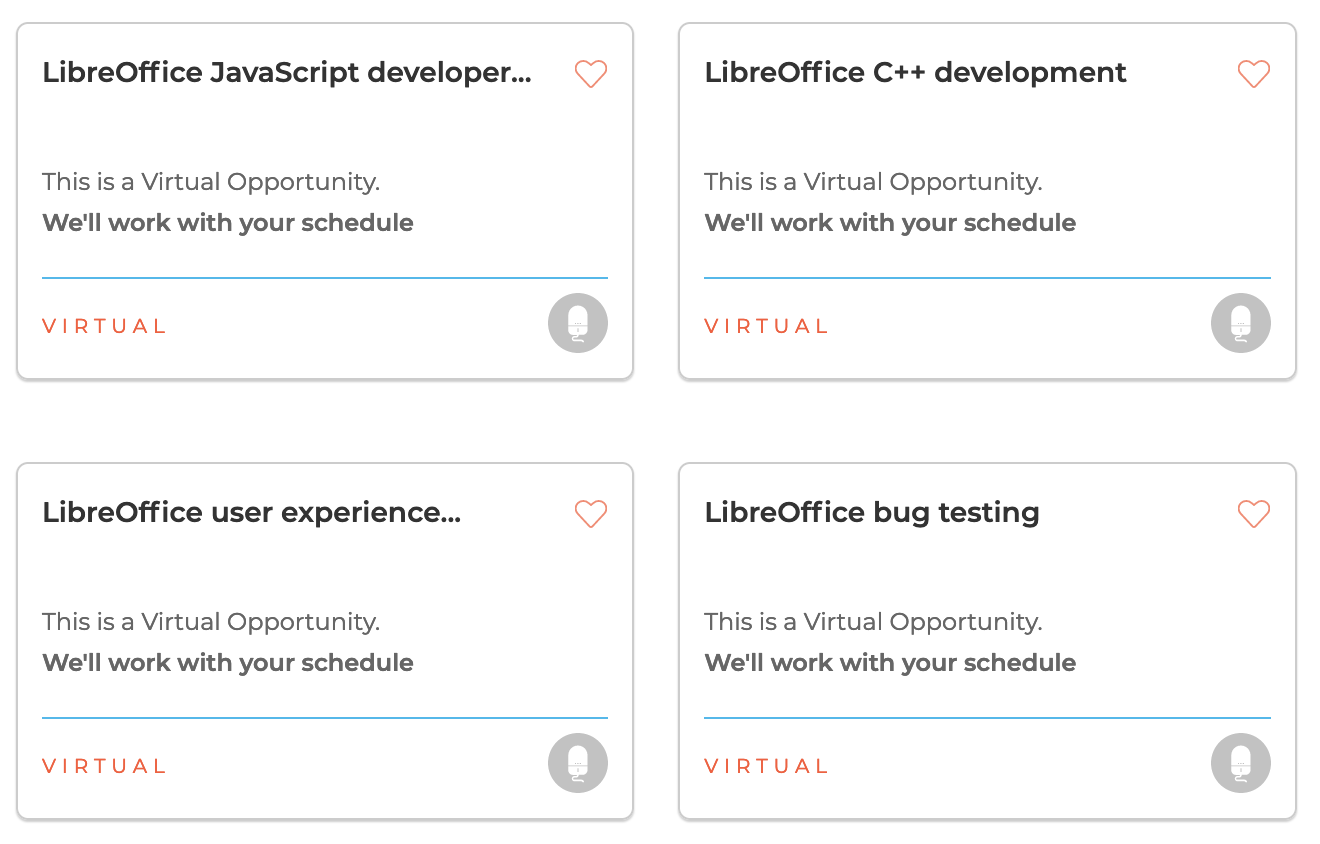
We set up accounts and listed projects on various volunteering platforms, including VolunteerMatch and Idealist (English), Vostel (German), Vapaaehtoistyo (Finnish), TuDu (Polish) and HeroClan, Um sem um tam and Zapojim se (Czech). Here’s what our projects look like on VolunteerMatch:

In terms of results, we received messages from various volunteers throughout 2020. For instance, one person reached us via Idealist and expressed interest in helping out with the LibreOffice website redesign. Although he didn’t have time to contribute in the long run, he introduced us to Christine Louie who took the redesign efforts further, and started to work (with other volunteers) on design concepts, user profiling and other tasks. So this was an example of a volunteering platform creating a network of helpers.

In the German community, we were contacted by Sabine Achilles who offered to help out with translations of the software and website content. She worked on translating various blog posts from English to German, which we posted on our German blog.

In 2021, we continue to explore other volunteering platforms. Ilmari Lauhakangas, responsible for Development Marketing at TDF, also schedules interviews with new contributors to give them personal contact from the start, and explain our tools and processes.

Like what we do? Support the LibreOffice project and The Document Foundation – get involved and help our volunteers, or consider making a donation. Thank you!

Annual Report 2020: Website, blogs and social media

We use our website, blogs and social media channels to raise awareness about our work, share information and encourage new contributors to join the LibreOffice community

(This is part of The Document Foundation’s Annual Report for 2020 – the full version is here.)


Social media

In January 2020, our Twitter account had 29,340 followers; by the end of the year, we had grown this to 36,996. Our most popular tweets were for major releases, but we also tweeted customised images for “Community Member Monday” interviews with short quotes, encouraging more users to get involved with LibreOffice projects.
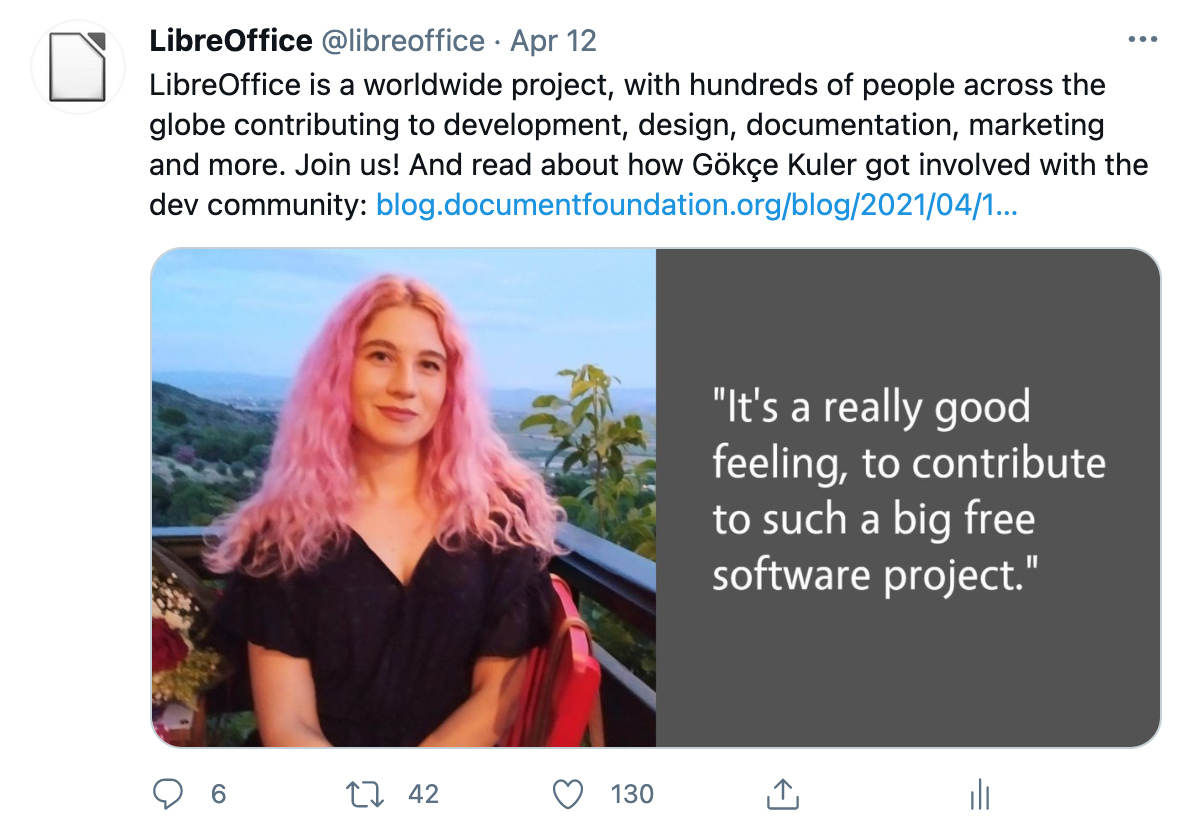
In addition, we focused not only on our own tweets, but also retweeting announcements from the LibreOffice ecosystem and community members. We liked and retweeted messages of support from end users – many of whom were surprised and thankful that a large project would show them support. To keep the content flowing, we used automatic tweeting tools to post daily LibreOffice tips, using the same content from the “Tip of the day” box in the app itself.

On other social media platforms, we focused on growing our account on Mastodon, a Twitter-like open source, federated and self-hosted microblogging service. In 2019 we set up https://fosstodon.org/@libreoffice and started “tooting” content, often more focused on technical users, compared to our tweets and Facebook posts. In 2020 we worked more on expanding our activities here, and from January to December, we grew our follower base from 3,297 to 4,879.
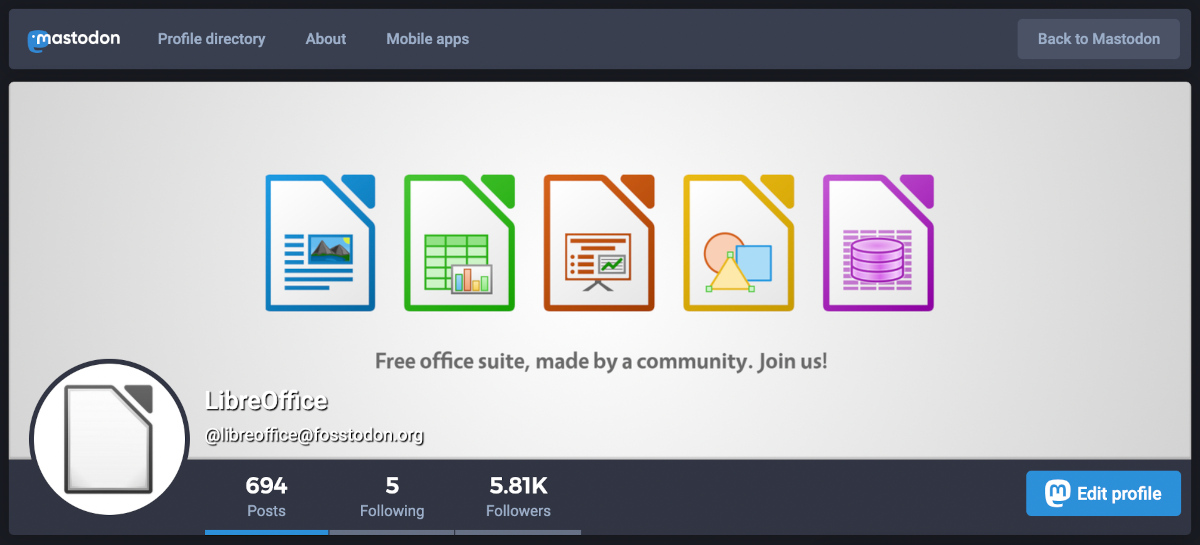
Our Facebook page growth was smaller, from 56,095 page likes to 58,516. We’ve noticed a gradual reduction in activity on Facebook over the last few years, which reflects its changing audience, and the move towards newer mobile applications. Nonetheless, Facebook still provides a good opportunity to interact with end users of LibreOffice, and every day we checked in to answer questions, get feedback, and post announcements/tips about the software.


YouTube channel

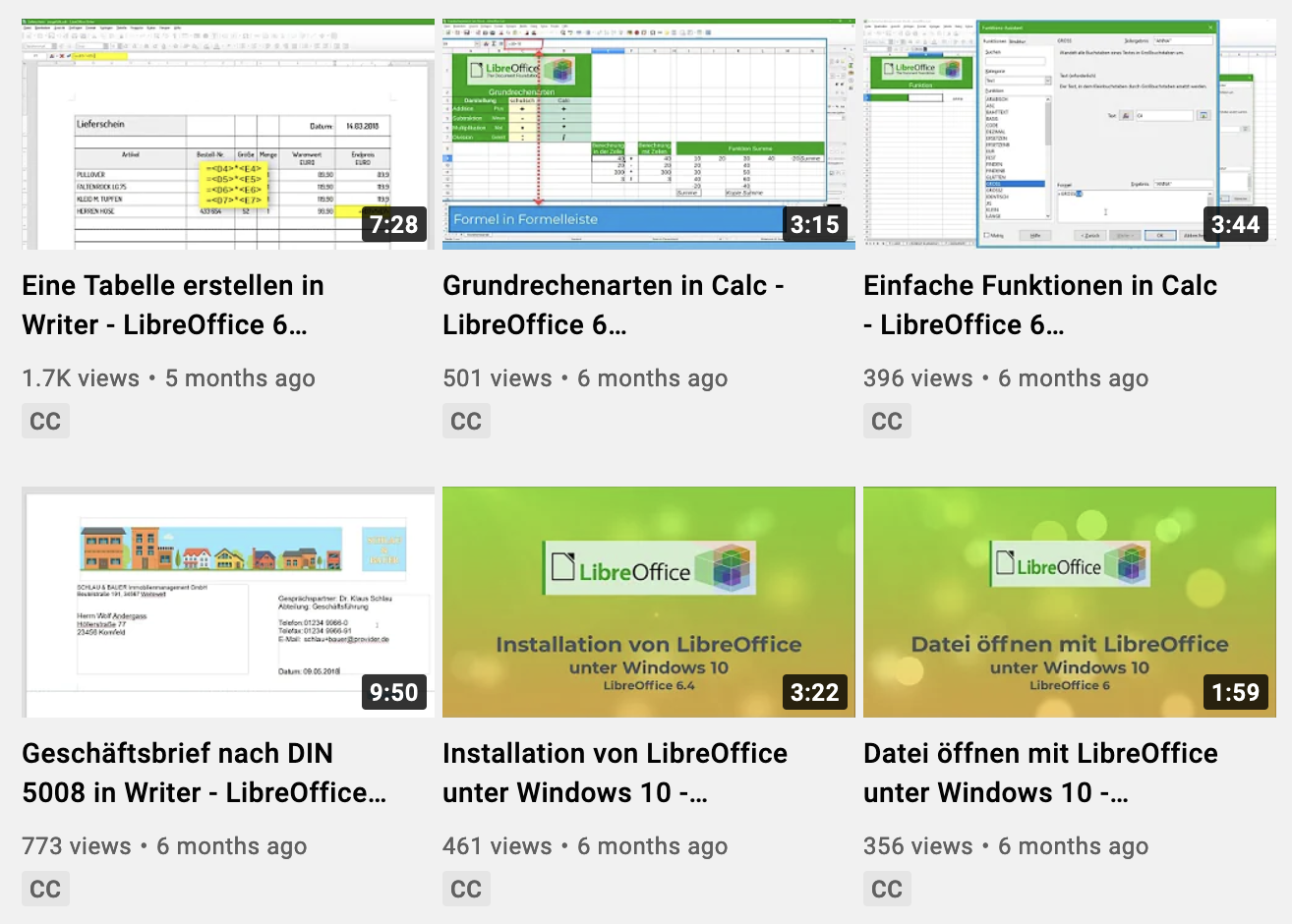
Our YouTube channel grew from 9,975 subscribers and 1,587,341 video views in January 2020 to 12,807 subscribers and 2,042,731 video views by the end of the year. The LibreOffice 7.0: New Features video (a fantastic production by the Indonesian community) amassed over 120,000 views – while the video for LibreOffice 6.4 had over 60,000. We also added some presentation videos from the LibreOffice Conference 2019.

Meanwhile, our community helped out with tutorial videos – in particular Harald Berger of the German community, who produced a series of professional-looking step-by-step guides to installing and using LibreOffice.

TDF website (documentfoundation.org)

The Document Foundation’s website provides general information about the foundation (overview, statutes, code of conduct, financials and reports) and its governance (board of directors, membership committee, members, advisory board, and engineering steering committee), and about LibreOffice certification, including a list of certified developers, and professionals for migrations and trainings.

During 2020, the website was visited 146,261 times, with 196,802 page views. Continent-wise, the largest chunk of visits were from Europe (57%), followed by North America (22.8%) and Asia (12.4%). And for operating systems: the most visits were from PCs using the Windows (64.1%) operating system, followed by macOs (9.2%) and GNU/Linux (9.0%), while for browsers: Chrome had (38.4%), followed by Firefox (22.1%) and Microsoft Edge (14%).


LibreOffice website (libreoffice.org)

The LibreOffice website provides information about the office suite and the document format, the various download options, how to get help, how to contribute to the project, events where users can get to know LibreOffice, and how to make a donation to support the project and the community.

In 2020, we added a language selector to the top-right bar of the website. This was implemented in response to a demand from the native language projects: many website visitors, using languages across the world, thought that the site was only available in English.

Even though we have a dedicated page listing the native language projects and their respective websites, it’s hard to find. So we added a bar at the top, with some of the most-used languages to attract attention, and a link to a page listing all language versions of the website.

Meanwhile, work progressed on a redesign of the website. LibreOffice’s current website has been largely the same for several years, and while initially it looked fresh and modern, it needs to be updated – especially to remove clutter and complexity, and work better on mobile devices. Volunteer Christine Louie helped to push this forward, and other volunteers joined in with designs and collecting feedback from users. We hope to show the results of this work in 2021.

During 2020, the English LibreOffice website was visited 19,939,066 times, with 47,589,717 page views. Most visits were from Europe (53.4%), followed by Asia (16.7%), North America (15.8%) and South America (10.3%), from PCs using the Windows operating system (83.1%), followed by macOS (6.6%) and Linux (3.7%), and the Chrome browser (49.3%), followed by Microsoft Edge (18.4%) and Firefox (17.9%).


Blogs

TDF’s blogs (such as this one) are essential for communicating activities inside and around the project, including new releases of LibreOffice, community events and support for other free and open source initiatives. In 2020, they were used to post regular interviews with community members and provide updates from team members about documentation, marketing, QA, design and more.

Blogs were also maintained by various native language communities including Japanese, French, Spanish, German and others. Thanks to the hard work of community members, we had press releases, tips and other articles translated into many languages, and picked up by local media organisations.

These native language blogs complement the information provided by the main blog in English, and by the two blogs managed by members of the design and the quality assurance projects, which provide updates about activities for the upcoming major releases.

In 2020, the blog had 184,538 page views (146,170 unique page views). The press releases for LibreOffice 6.4 and 7.0 were the most popular posts, followed by posts for minor bugfix releases.

Like what we do? Support the LibreOffice project and The Document Foundation – get involved and help our volunteers, or consider making a donation. Thank you!

Hossein Nourikhah joins the TDF team as Developer Community Architect

Next week, Hossein Nourikhah will join the team at The Document Foundation, the non-profit behind LibreOffice, as Developer Community Architect. Hossein is a developer, university lecturer and FOSS advocate. He writes programs, teaches programming to students, and is an advocate for the use of free software applications, because they have a huge positive impact on the quality of our life by providing the essential freedoms that we all deserve.

Hossein has a B.Sc. in Computer Engineering (Software) from Isfahan University of Technology, and a M.Sc. and a Ph.D. in Information Technology from Amirkabir University of Technology, also called the Tehran Polytechnic. Since 2016 he has been an instructor at the Amirkabir University of Technology, teaching various courses including C/C++ programming, operating systems, software design, and many others.

Hossein started programming in BASIC and Pascal when he was 12, and after two and a half decades he is still involved in programming for fun and profit. He has worked with several programming languages, including C/C++, Java, Pascal, PHP and many more.

Industry experience

In addition to the university activities, including teaching and research, Hossein has several years of experience in the industry, working at various software/hardware companies as a C/C++/Java programmer – and lately as a software team manager and lead developer.

Hossein’s work experience ranges from web development with PHP to industrial application development with C++/Qt. He considers Qt a great platform for C++ software development, and he likes it very much as a clean and lovely tool.

Hossein has worked with many programmers as mentor, helping them to improve and reach their potential in software development by better understanding programming languages, libraries and tools. He feels great when he can empower other people, also because this helps him to expand his knowledge and understand things much better than before.

As Developer Community Architect, Hossein will be responsible for attracting new contributors to the LibreOffice project by identifying and onboarding new potential developers, building relationships between them and the community, and introducing them to TDF’s communication channels – where they will meet fellow co-hackers. He will encourage everyone’s contribution, and show community members ways to grow by bringing the more skilled contributors in contact with existing experts in the various fields for even deeper learning.

We’re happy to have him on board, and look forward to working with him!

100 Paper Cuts as a new student mentoring activity

Just before the pandemic, the Board of Directors of The Document Foundation approved a budget to launch an educational program targeted to universities, where students at selected tech schools would receive an economic incentive to promote LibreOffice amongst their peers, with the objective of increasing the number of young contributors both in source code development and in other areas. Unfortunately, the pandemics has forced all universities to stop all collateral activities, and this has resulted in the program being frozen for over one year.

Although the situation is not yet back to normal, we have the opportunity to mentor a student in Turkey. Muhammet Kara, a member of the MC and a Collabora full time developer, will mentor Ahmet Hakan Çelik, an undergraduate computer science student at Çanakkale Onsekiz Mart University, who will be working on 100 Paper Cuts – a list of bugs and enhancement requests relating to LibreOffice’s user experience – during June and July, trying to solve as many issues as he can. The target is to collect 10 points.

This is a first step in the direction set before the pandemic. We are planning to make similar announcements soon.

After the summer, if the academic activities will be back to normal – although the recover will be slow, and will have to cope with entirely new regulations – The Document Foundation will be able to get back in touch with the universities to start the planned Ambassador Program.