LibreOffice Online Guide translated into Czech

the LibreOffice Online Guide was created as part of the Google Season of Docs programme, and released in December 2019. Today we’re announcing that the Czech LibreOffice community has finished translating the guide, and it can be downloaded here. (See this page for English documentation.)

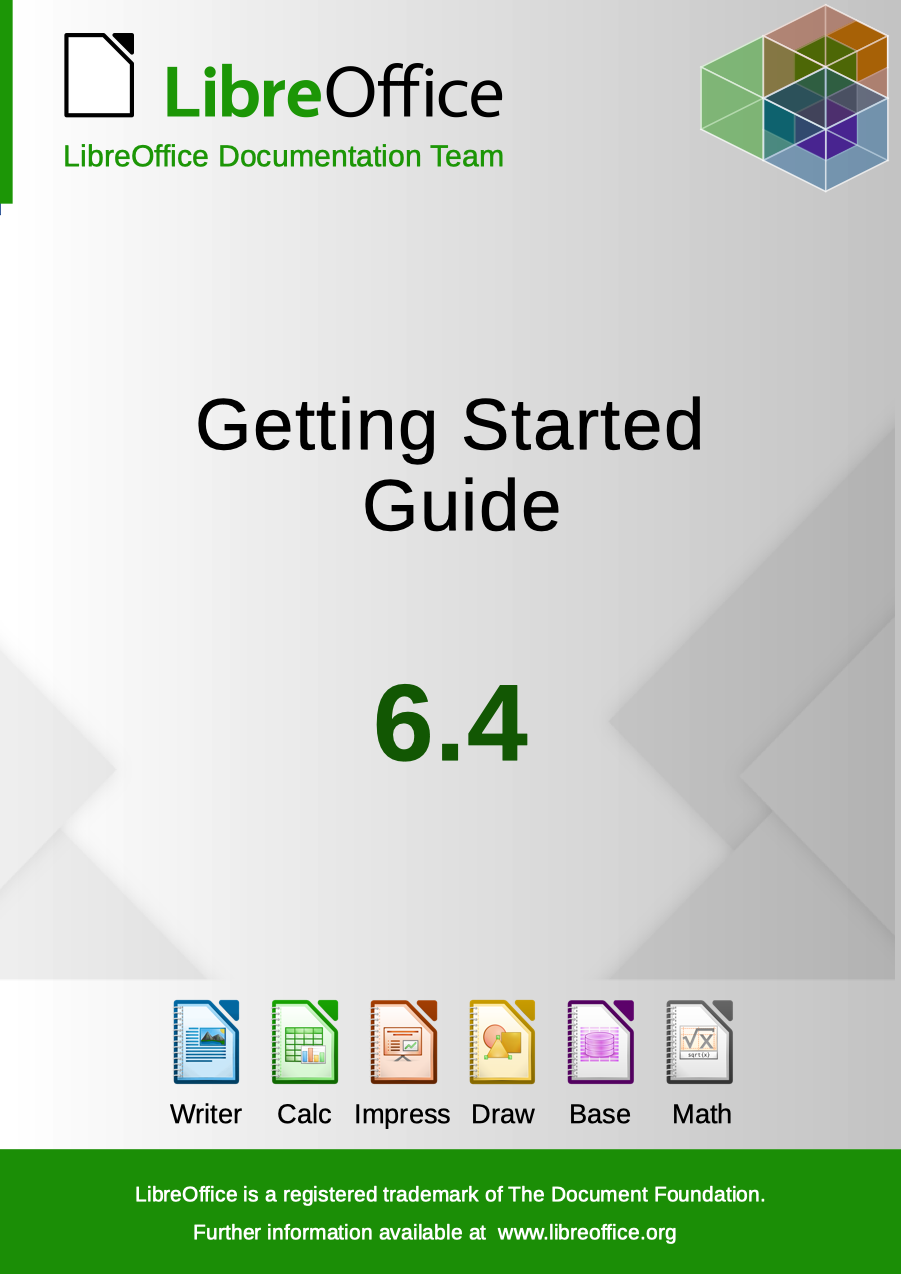
It was a team effort, and participants were Petr Kuběj, Zuzana Pitříková, Zdeněk Crhonek, Roman Toman, Tereza Portešová, Petr Valach and Stanislav Horáček. Thanks to all volunteers! The Czech team continues with the translation of the Getting Started Guide, and is always open for new volunteers, translators and correctors. Give them a hand!

Document Freedom Day 2020

Document Freedom is based on Open Formats, such as ODF or Open Document Format, the ISO standard native file format of LibreOffice and other FOSS office suites.

What is an Open Format?

When you save a document on your computer, it is stored in a computer file. Whether it is a text file, a picture, a video or any other kind of work, it is saved with a specific coded structure, known as the file format.

To be able to share data, software programs must be able to communicate with each other. It implies that no barrier whatsoever may hinder the exchange of data and the related write or read operations. For such a seamless exchange to be possible, software programs are required to be “interoperable”.

Interoperability is guaranteed when it relies on open standards, i.e. public technical specifications, freely usable by everyone, without restriction nor compensation, and maintained by an open decision-making process. File formats based on these open standards are “Open Formats”.

Where software interoperability is set aside, or if a program editor does not give access to the key information for interoperability or if the file design recipe is kept undisclosed, or if the file design recipe is available but is not followed by the program, file formats are considered to be “closed” and do not allow interoperability. For a software user, choosing between an Open File Format or a closed one has a deep impact on the ownership of and the access to his/her own data and their availability over time.

What are the benefits of Open Formats?

  • Open Format documents are readable and writable, by oneself or by third parties.
  • Open Format document readability is guaranteed over time as the format evolves without disruptions.
  • Open Formats have the advantage of being freely usable by many software programs, enabling interoperability.
  • Open Formats support freedom of choice as they do not promote any company’s specific format. They help avoid the monopolistic position of software editors who aim at locking users through their own proprietary formats.

Free Software and open formats, the perfect duo!

Free Software are programs that offer four freedoms to users: the liberty to copy and to distribute the software to others, the right to use it for every kind of use, the right to study it in order to know its functioning, and the right to modify in order to improve it. Free Software designers usually favour existing Open Formats, and contribute to their evolution.

Furthemore, as Free Software developers publish their source code (the software design recipe), recording methods and format descriptions used are de facto distributed with the software.

Open Formats and Free Software share the same goals: to be at the service of eveyone and to ensure users the full ownership and control over their data as well as perennial availability of those data.

Let’s celebrate Document Freedom Day 2020 by sharing with other people the information about the importance of Open Formats. Create your own DFD Dove.

[This text is almost entirely based on a document developed by April (https://www.april.org/en) for a previous Document Freedom Day, and released under Creative Commons Attribution Share Alike 2.0 License]

Community Member Monday: Tomoyuki Kubota

Today we’re talking to Tomoyuki Kubota (aka himajin100000), who is active in the Japanese LibreOffice community and recently became a member of TDF

To start with, tell us a bit about yourself!

I live in Tsurumi Ward, Yokohama City, Kanagawa Prefecture, Japan. Though it’s not as advanced as central Tokyo, Yokohama is one of the major cities near Tokyo, so it’s relatively easy to reach big stores.

One of my hobbies is, of course, reading the source code of LibreOffice via OpenGrok (for symbol-based searches) or via GitHub (sometimes, for text based search), to try to find out the cause of trouble I sometimes see on someone’s tweets when I search for the term “LibreOffice” on Twitter.

Sometimes I watch videos on www.nicovideo.jp, mainly Voiceroid and CEVIO commedy drama series made by others, and videos on the games I played in my childhood with Super Nintendo, such as Romancing SaGa 2, Kirby’s Dream Course (known as Kirby Bowl in Japan) etc. Sometimes, I enjoy watching videos on Human Resource Machine played by newbies’ to computer programming!

Why did you decide to become a member of TDF?

I was invited by Ilmari Lauhakangas, who is in charge of Development Marketing at TDF.

What are you working on in the LibreOffice project right now?

Honestly speaking, my main focus varies drastically, frequently at a whim, sometimes driven bya bug’s difficulties. I was planning to work on this bug and also this one, but what I did in the end was research on:

  • Ask LibreOffice questions (and this one (copying the content in just one whole cell entails a new line character as the row separator, isn’t this behaviour inconvenient?)
  • this tweet (in what rule, bar graph axis starts with a number other than zero?)
  • Behaviour of ‘Date Acceptance Patterns’
  • ‘Python Macros’ dialog has a ‘Create’ button, but it’s grayed out. (Possibly caused by ‘Creatable’ flags not set? BeanShell and JavaScript relies on the same script providers made in Java.)

Still not tackled enough: this tweet (printing company said they can’t guarantee the output if fonts are embedded in PDF with their encoding being ‘built-in’. Workaround is to use Microsoft Print To PDF, which sets identity-H, but the pseudo-driver does not have a UI for changing page size!)

After doing research on other matters to a certain degree, I want to return to my initial purpose – the bugs I mentioned at the start of this answer.

What does LibreOffice really need?

After meeting with Naruhiko Ogasawara, Shinji Enoki and Jun Nagota of the Japanese LibreOffice community, I noticed that event attendees are often developers, or who already know about LibreOffice to a certain degree, so not very successful in welcoming new end users.

Aside from that, IMHO, people new to LibreOffice are often even newbies to computer science itself, and don’t have concrete ideas on what application software is, how files are managed,
etc, and for those people, I think, before giving inpus on LibreOffice, helping them to get that knowledge first would be easier for them to start using LibreOffice.

Thanks to Tomoyuki for all his help! Stay tune to the blog for more community member interviews…

LibreOffice at InstallFest 2020, Prague, 29 February – 1 March

Our Czech LibreOffice community attends events around the country, spreading the word about LibreOffice, free software and open standards. Today, Petr Valach reports back from InstallFest, which took place on 29 February and 1 March. InstallFest focuses on GNU/Linux, helping new users to install the operating system, but also has lectures and stands for many other free and open source software projects…


For the first time this year, the LibreOffice community attended the InstallFest conference. The following is a summary of the knowledge and insights we gained there…

The vast majority of visitors were from younger generations – often high school or even elementary school pupils. The new mobile application from Collabora, released just a few days before – and surprisingly, almost no one knew about it – aroused great interest. Collabora Office Mobile has proven to be a highly featureful and functional alternative for the desktop version – although it has a limited range of features, but its capabilities are surprising.

One of the questions was about handling ODF files with embedded fonts. Experiments have shown that if the file contains text written in non-traditional fonts, and these are inserted into the file, it will display correctly in the mobile application. The only problem is with the file size, because LibreOffice does not allow you to embed font subsets – it embeds whole fonts. On the other hand, it ensures full compatibility when editing a file on another device; all characters defined in the font are inserted in the file.

LibreOffice Online has also gained great interest. It enables collaboration within a corporation, which can have thousands and tens of thousands of users (and it works, as we know from foreign deployments). There is a certain obstacle to the need to install the application as a cloud service – the method of installation is not widely known (solved by the documentation team, as the LibreOffice Online manual is published, and the Czech documentation team completes its Czech version).

Some users complained about several problems, for instance: scrolling doesn’t work on the touch screen, instead of text. It is a bug inherited from OpenOffice.org, not solved under number 85677.

One requirement also involved inserting the name of any worksheet in the Calc list into the selected cell, and dynamically linking it to the worksheet, to change the content of that cell when the worksheet name changes. Currently, only the name of the current worksheet can be inserted into the cell, either by field or by function:

= MID (CELL ("filename"); FIND ("# $"; CELL ("filename")) + 2; LEN (CELL ("filename")))

Now it is not possible to insert the name of any sheet in the list – it is not solved in bug 94975. (This is not possible in Microsoft Excel, by the way.)

Defender Folder Access Control in Windows 10 blocks LibreOffice installation. You must disable this feature before installing LibreOffice. For more information, see the LibreOffice wiki page.

We also learned from other visitors at the event about other schools and companies that use LibreOffice. We will address them shortly.


A big thanks to Petr and the whole Czech community for their work! And to anyone reading this who’d like to attend local events and help to spread the word about LibreOffice, join our marketing mailing list and drop us a line. We’ll point you in the right direction!

Announcing Open Badges for LibreOffice contributors!

LibreOffice is made by volunteers and certified developers across the globe, and today we’re announcing a new system to credit their work and show appreciation: Open Badges. So what are they?

In a nutshell, Open Badges are PNG images that are awarded to contributors for reaching a certain threshold – such as a number of commits to the codebase, or answering questions on Ask LibreOffice. But these images are something special: they contain metadata describing the contributor’s work, which can be verified using an external service. Open Badges are used by other free software projects, such as Fedora.

We at The Document Foundation – the non-profit entity behind LibreOffice – will start issuing customised badges to contributors, who can then proudly display them on websites or social media. And because of the embedded metadata, contributors can use the badges as proof of their work. If you’ve been a long-time contributor to LibreOffice and are in the job market, use your badge to highlight your involvement in a large open source project!

Starting off: Ask LibreOffice contributors

The first set of badges go to the nine people on Ask LibreOffice, our community assistance website, who’ve posted over 100 answers. We’ll be in touch personally with the badges! Their usernames:

  • Ratslinger
  • ajlittoz
  • Mike Kaganski
  • Opaque
  • Lupp
  • erAck
  • RGB-es
  • ebot
  • JohnSUN

Stay tuned to this blog for more Open Badges awards!

March 8, International Women’s Day

If we must celebrate a day for women, let us celebrate freedom from stereotypes, from expectations, from idolisation, from sacrifice…

Stop congratulating women for being the secret behind a successful man… Start saluting them for being successful.

Stop saying the mother is sacred for all the sacrifices she makes… Try to reduce those sacrifices!

Stop telling women they are beautiful… Try telling them it’s not important to be beautiful!

Stop praising her roles as mother, wife, daughter, sister… Celebrate her as an individual, a person, independent of relationships.

Stop justifying her necessity to multi task… Give her a chance not to!

Stop these constructs which are aimed at making her strive for an impossible balance… Let her be inadequate… And happy!

Stop making her look at herself through a conveniently male viewpoint.

Let her be imperfect, whimsical, irresponsible, boorish, lazy, fierce, opinionated, loud, flabby, ungroomed, adventurous, unpredictable, unprepared, impractical…

LET HER BE

(attribution of these words seem to be impossible, but happy to update it with the original author)