International Women’s Day: #BeBoldForChange

March 8 is the International Women’s Day. The theme for 2017 is #BeBoldForChange.

Amongst the members of The Document Foundation there are only 19 women (10% of the total number): Belinda Dibra (Albania), Christina Roßmanith (Germany), Chrystina Pelizer (Brasil), Eliane Domingos de Sousa (Brasil), Ellen Pape (Germany), Emma Pietrafesa (Italy), Gülşah Köse (Turkey), Irmhild Rogalla (Germany), Jean Hollis Weber (Australia), Jona Azizaj (Albania), Katarina Behrens (Czech Republic,), Marina Latini (Italy), Priyanka Gaikwad (India), Regina Henschel (Germany), Rosemary Sebastian (India), Sigrid Carrera (Germany), Sonia Montegiove (Italy), Sophie Gautier (France) and Vinaya Mandke (India).

Marina Latini is the current ChairWoman of the Board of Directors, while Katharina Behrens is a member of the Membership Committee.

Women active in the LibreOffice and Document Liberation communities are definitely more than 19. They should apply for membership, not only to be recognized for their contributions but also to elect and be elected to the Board of Directors and the Membership Committee. They can find the application form on the website: http://www.documentfoundation.org/governance/members/application/.

Announcing the Getting Started with LibreOffice 5.2 Guide for Immediate Download

Berlin, March 6, 2017 – The Document Foundation’s Documentation Team announces the immediate availability of the new Getting Started with LibreOffice guide version 5.2. The guide was updated to include the developments of LibreOffice 5.2 and previous releases.

The Getting Started guide is an introductory text for end users on using the LibreOffice office suite. It is written for individuals as well as organizations that deploy LibreOffice as their preferred office suite tool. The text allows users to get familiar with the features and resources of LibreOffice and shorten the time to become productive in office document edition.

The guide is written in LibreOffice Writer in Open Document Format (ODF). The team worked to not only update the contents but also to clean the formatting used in the text with a double objective: One is to make the text suitable for computer aided translation (CAT) tools and the other is to generate an online version (XHTML) of the guide.

The documents composing the Guide were formatted using styles only, avoiding direct formatting that has impact on CAT tools and on HTML export. For HTML export, the underneath template of the documents was adapted to handle the unmatched formatting properties between ODT and XHTML. At the end, a unique content source was able to produce the guide in ODT, PDF and XHTML formats.

The Getting Started with LibreOffice guide, its PDF and ODT version can be downloaded or read online by navigating to the page http://documentation.libreoffice.org. The online version of the guide can be accessed through http://documentation.libreoffice.org/en/english-documentation/getting-started-guide/read-online-5-2/

About the Documentation team

The Documentation team is in charge to develop, modernize, update and enhance all form of documentation related to LibreOffice in all languages supported by LibreOffice. It includes the authoring of LibreOffice guides for all modules, the Help system modernization and contents update, and to offer ways and means for the community to contribute to the LibreOffice project. Communities interested in contributing or translating contents can get it touch with the team by sending an e-mail to documentation at libreoffice dot org

February 2017: a record month for donations

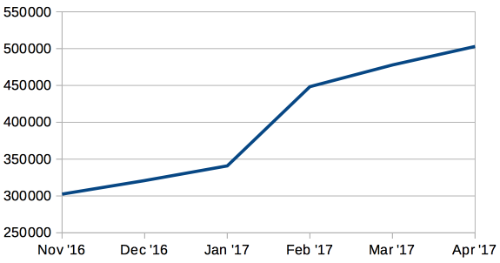
February 2017 has been a record month for donations to The Document Foundation, with 8,556 people supporting the project from every geography. The record has been sparked by the announcement of LibreOffice 5.3 at the very end of January 2017. The new release has been covered in online and print media with an unprecedented number of articles, which have focused on the exciting new features.

57 video presentations from LibreOffice Conference 2016

It has taken a while, but we’ve finally edited and uploaded the last batch of presentations (for which we have video) from last year’s LibreOffice Conference in Brno, Czech Republic. You can see all of the videos in the embedded playlist below – click the list button in the top-left corner to navigate through the videos.

Alternatively, scroll on for a full list of presentations. You can do a search in your browser for topics of interest (eg “ODF” or “LibreOffice Online”), or for presenters. Happy viewing, and we look forward to seeing you at this year’s conference in Rome!

Please confirm that you want to play a YouTube video. By accepting, you will be accessing content from YouTube, a service provided by an external third party.

YouTube privacy policy

If you accept this notice, your choice will be saved and the page will refresh.

Full list of presentations:

LibreOffice contributor interview: Stanislav Horáček

Next up in our regular series of interviews with LibreOffice developers and contributors is Stanislav Horáček, who helps with localization in the Czech native language community.

LibreOffice contributor Stanislav HoráčekWhere are you from, and what is your nickname on IRC?

I am from the Czech Republic, and you can find me on IRC using the nicknames “horacek” or “strepon”.

Do you work for a LibreOffice-related company or just contribute in your spare time?

Just in my spare time – and that’s why there is a gap between my plans and reality 🙂

How did you get involved with LibreOffice?

Several years ago, I tried to set up custom page numbering in Writer, which was described in the built-in Help – but the Help page was written in half Czech, half English. Because I was glad that I discovered the solution of my problem, I decided to complete the page translation. As I found translating quite relaxing, that page was just a beginning…

What areas of the project do you normally work on?

Czech localization mainly; plus some corrections or bug reports for issues that I find when translating. Some time in the future, I would also like to go deeper into coding of extensions. They can be extremely helpful and it’s a pity that they are not widely promoted currently. For instance, I see a nice opportunity to use LibreOffice as a convenient front-end to another tools.

What was your initial experience of contributing to LibreOffice like?

From the beginning, I met helpful and encouraging people and I really appreciate that most of the discussions are constructive, with facts more important than feelings. I think these are the most precious properties that the community has; they made LibreOffice become my number one open source project. On the other hand, whenever I see a lack of them, I image that one more potential contributor could be demotivated…

Moreover, LibreOffice has a great advantage in that it is so widespread. I was – and still I am – impressed that you can really easily make improvements which will appear on screens of millions of people.

Which is your preferred text editor?

For LibreOffice related stuff, I use a universal text editor called Geany. But in general, I like also specialized editors or IDEs.

What do you do when you’re not working on LibreOffice?

I would say my hobbies are typically Czech, like beer drinking 🙂 You can also see me during the holidays in some of the European mountains, amongst lots of other Czech tourists. And who knows, maybe one day contributing to free software will be our national interest as well…

Thanks Stanislav. And to anyone reading this who wants to help out with translation and localisation of LibreOffice, get involved! Your contributions can make a huge difference, and will help to bridge digital divides across the globe.

Updates from events: Turkey, Taiwan and Japan

Today marks five years since The Document Foundation (TDF) was legally incorporated in Berlin, Germany. We want to celebrate this anniversary by highlighting some recent activities and events from our Native Language Projects. These communities have been instrumental to the growth of TDF and LibreOffice, and are one of our most important assets.

Turkey

The Turkish community recently attended the Academic Informatics Conference 2017 in Aksaray, from 8 to 10 of February, with several LibreOffice related activities.

A general presentation was done by Muhammet Kara and Gökhan Gurbetoğlu in the first session (first half of the first day).

In the second half of the first day, the attendees were introduced to the LibreOffice development environment, and the tools used in the process (Gerrit, Vim, Git…). The attendees were walked through the process of joining the LibreOffice community, and building the LibreOffice source code for the first time.

Attendees who had relatively older computers were provided with SSH access to a 32-core machine, courtesy of TUBITAK ULAKBIM. The last session (first half of the second day) was held like a hackfest. Questions from attendees were answered by the speakers.

LibreOffice community members were pleased to see that the participants were eager to learn about the software, and together they established a WhatsApp group for further communication. A more detailed presentation about LibreOffice development activities in Turkey was given by Gülşah Köse and Muhammet Kara on the last day (morning) of the conference.

Taiwan

The first LibreOffice QA Sprint in Taiwan – organized by Software Liberty Association Taiwan and supported by two professors of the Department of Computer Science and Engineer, National Cheng-Kung University: Professor Joseph Chung-Ping Young and Alvin Wen-Yu Su – was held in Tainan City on December 17, 2016. In this four-hour sprint the attendees found and reported many issues. Attendees were students, teachers, employees of enterprises and governments, LibreOffice developers and lecturers, and all four TDF members in Taiwan.

Early in the afternoon, a live video-session with Italo Vignoli, one of the core members of The Document Foundation, gave most of the attendees exposure to the international community for the first time.

Han Lu, a student in NCKU, summarized the issues found by attendees. After the summary, Franklin Weng explained how to report bugs on the LibreOffice Bugzilla. Also, Cheng-Chia Tseng introduced the Pootle translation platform for LibreOffice and gave some tips on how to translate LibreOffice.

Japan

LibreOffice Kaigi 2016.12, Japan’s annual LibreOffice conference, was organized in early December 2016 with great success! The word Kaigi is the Japanese word 会議, which means conference. The name means not only Japanese regional, but also Japanese users-specific.

Around 25 people gathered and enjoyed several talks (migration to Open Document Format in Taiwan, by Franklin Weng, LibreOffice/ODF and styles, maintaining Math and Japanese translation), along with a few lightning talks and a panel discussion.