10/20: LibreOffice 10th anniversary in 2020, a year long celebration

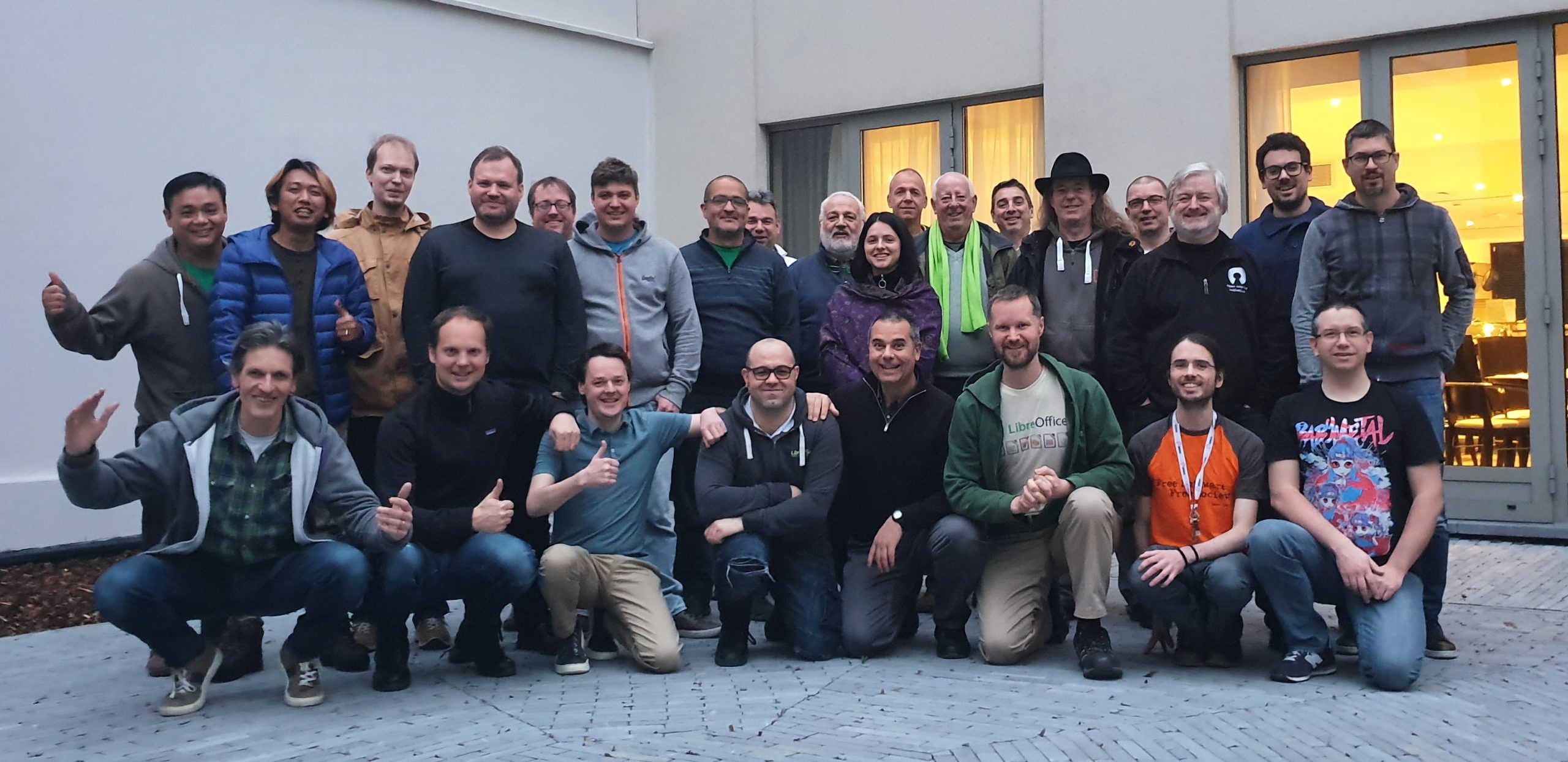
LibreOffice was announced on September 28, 2010, with a positive feedback from tech and business media all over the world (above, two significant titles from eWeek and Linux Gizmos). To celebrate the event, The Document Foundation has organized a year long anniversary project, starting at FOSDEM in Brussels on February 1/2 and ending at POSS in Paris in early December 2020.

LibreOffice community members will attend as many FOSS events as possible, carrying stickers and swag with the anniversary logo. The author is Rania Amina from Indonesia, a member of the LibreOffice community who has already contributed with logos and 2D animations to the success of LibreOffice Indonesia Conference in 2018.

Rania Amina will attend FOSDEM in Brussels, and will also talk about the LibreOffice Theme Changer at the Open Document Editors DevRoom.

So far, in addition to FOSDEM and POSS, events have been confirmed in Nigeria (Open Source Africa), Kosovo (FLOSSK), Croatia (DORS/CLUC), Albania (OSCAL), France (Libre Graphics Meeting and OW2con), Taiwan (COSCUP and LibreOffice Asia Conference), India (Open Source India), Germany (Chemnitzer Linux-Tage, FrOSCon and the LibreOffice Conference), US (All Things Open) and Serbia (PSSOH), but several other are being currently discussed and will be announced as soon as possible.

Stay tuned !!! 2020 will be an exciting time for the LibreOffice community !!!

The LibreOffice Documentation Team Announces the LibreOffice Online Guide

Berlin, December 12, 2019 – The LibreOffice Documentation Team announces the immediate availability of the LibreOffice Online Guide, a major work authored by Aaron Peters under the Google Season of Docs 2019 programme. LibreOffice Online is a web-based version of the office suite, that can be deployed on local infrastructure and connected to a file-sharing system for document collaboration.

LibreOffice Online 6.3 Guide

The guide includes content for end-users – as well as for system administrators – for rapid deployment and start of operation. It covers the basic usage of the word processor, spreadsheet and presentation modules, as well as guides for file handling and – one of the major technological achievements of LibreOffice Online – the collaborative editing capability, that allows several users to work on the same document, spreadsheet or presentation at the same time. Users familiar with LibreOffice on the desktop will quickly grasp the operation of LibreOffice Online, except for some specific differences addressed in the guide.

For the system administrator, the guide covers installation and basic operation, and explains deployment in small and limited environments. Professional support and operation services are strongly recommended for large installations and mission critical deployments, available in the LibreOffice business ecosystem.

“The current version of the Guide is complete and has the necessary information for the targeted audience (technology-savvy enthusiasts and/or small businesses), to be able to get the application, install it alongside a hosting application (NextCloud), use the main modules (Documents, Spreadsheets, and Presentations), and use other desktop and mobile tools to access their LibreOffice Online content,” says author Aaron Peters. “My experience working on this guide was fantastic, and I would urge anyone interested in getting involved with open source to consider documentation as a first step. The Document Foundation’s documentation team in particular has a very well-established process and infrastructure for producing their products, and one of the only things I can think of that would help them is more volunteers.”

“The Google Season of Docs programme was an opportunity The Document Foundation (TDF) could not have miss to add a valuable content to its documentation portfolio. The LibreOffice Online Guide is a document whose time had just come and is here to help the LibreOffice Online software and its professional and volunteer community to increase its usage and benefit of its incredible value,” says Olivier Hallot, TDF mentor and Documentation Coordinator. “And working with Aaron was a pleasure and all commitments were delivered on time, which was very appreciated. Special thank you to Google for the wonderful initiative and to the Season of Docs 2019 team for the support.”

The outline of the new Guide is as follows and gives a good view on what is inside.

  • Preface
  • Chapter 1: Introducing LibreOffice Online
  • Chapter 2: Installing LibreOffice Online
  • Chapter 3: Setting Up LibreOffice Online Before Use
  • Chapter 4: Navigating Your LibreOffice Online Files
  • Chapter 5: Editing, Saving, and Exporting LibreOffice Online Files
  • Chapter 6: The Documents Module
  • Chapter 7: The Spreadsheets Module
  • Chapter 8: The Presentations Module
  • Chapter 9: Integrating with LibreOffice Online

The guide is available for download at the documentation website at https://documentation.libreoffice.org/en/english-documentation/


LibreOffice 6.3.4 available for download

Berlin, December 12, 2019 – The Document Foundation announces LibreOffice 6.3.4, the 4th minor release of the LibreOffice 6.3 family, targeted at technology enthusiasts and power users, who are invited to update their current version. LibreOffice 6.3.4 includes over 120 bug fixes and improvements to document compatibility.

LibreOffice 6.3.4’s change log pages are available on TDF’s wiki: https://wiki.documentfoundation.org/Releases/6.3.4/RC1 (changed in RC1) and https://wiki.documentfoundation.org/Releases/6.3.4/RC2 (changed in RC2).

LibreOffice’s individual users are helped by a global community of volunteers: https://www.libreoffice.org/get-help/community-support/. On the website and the wiki there are guides, manuals, tutorials and HowTos. Donations help us to make all of these resources available.

LibreOffice in business

For enterprise class deployments, TDF strongly recommend sourcing LibreOffice from one of the ecosystem partners to get long-term supported releases, dedicated assistance, custom new features and other benefits, including Service Level Agreements (SLAs). Also, the work done by ecosystem partners flows back into the LibreOffice project, benefiting everyone.

Also, support for migrations and trainings should be sourced from certified professionals who provide value-added services which extend the reach of the community to the corporate world and offer CIOs and IT managers a solution in line with proprietary offerings.

In fact, LibreOffice – thanks to its mature codebase, rich feature set, strong support for open standards, excellent compatibility and long-term support options from certified partners – represents the ideal solution for businesses that want to regain control of their data and free themselves from vendor lock-in.

Availability of LibreOffice 6.3.4

LibreOffice 6.3.4 is immediately available from the following link: https://www.libreoffice.org/download/. Minimum requirements are specified on the download page. TDF builds of the latest LibreOffice Online source code are available as Docker images: https://hub.docker.com/r/libreoffice/online/.

LibreOffice Online is fundamentally a server-based platform, and should be installed and configured by adding cloud storage and an SSL certificate. It might be considered an enabling technology for the cloud services offered by ISPs or the private cloud of enterprises and large organizations.

All versions of LibreOffice are built with document conversion libraries from the Document Liberation Project: https://www.documentliberation.org.

Support LibreOffice

LibreOffice users are invited to join the community at https://ask.libreoffice.org, where they can get and provide user-to-user support. People willing to contribute their time and professional skills to the project can visit the dedicated website at https://whatcanidoforlibreoffice.org.

LibreOffice users, free software advocates and community members can provide financial support to The Document Foundation with a donation via PayPal, credit card or other tools at https://www.libreoffice.org/donate.

The Document Foundation welcomes the release to OASIS of the TC Committee Draft of ODF Version 1.3 for ratification

Editor of the new version of the ODF standard document format sponsored by the Community of ODF Specification Maintainers (COSM) *

Berlin, November 7, 2019 – The Document Foundation welcomes the release to OASIS of TC Committee Draft of ODF Version 1.3 for ratification. At the end of the process, ODF Version 1.3 will be submitted to ISO to become a standard. The final approval is expected in late 2020 or early 2021.

Editing of ODF Version 1.3 Committee Draft has been sponsored by the Community of ODF Specification Maintainers (COSM), a project launched by The Document Foundation in 2017 with the donation of a seed of euro 10,000 to get the COSM project started, plus up to euro 20,000 to match each euro donated by other stakeholders.

So far, the COSM project has been backed by Microsoft, Collabora, the UK Government Digital Services, CIB, the European Commission’s StandICT project and Open-Xchange. The money has been used to pay an editor to finalize the ODF 1.3 specification and manage it through the OASIS review and ratification process.

Major new features of ODF 1.3 are digital signature and OpenPGP-based XML encryption of documents, plus several improvements to features already available in ODF 1.2 like new polynomial and moving average regression types for charts, a new specification for number of decimal digits in number formatting, a special header/footer style for first page of documents, contextual spacing for paragraphs, additional type argument values for the WEEKDAY function, and the new text master template document type. Most of these new features have been contributed by developers at CIB, Collabora, Microsoft and The Document Foundation.

“The third revision of ODF is now well on the way to becoming a ratified standard and confirms that the crowdfunding approach TDF seeded at COSM is an effective way to have the open document standard maintained without needing a deep-pocketed international corporation behind them”, said Thorsten Behrens, TDF board member.

The Document Foundation releases LibreOffice 6.3.3

Berlin, October 31, 2019 – The Document Foundation announces LibreOffice 6.3.3, the third minor release of the LibreOffice 6.3 family, with many quality and compatibility improvements. LibreOffice 6.3.3 “fresh” is targeted at technology enthusiasts and power users, who are invited to update their current version.

LibreOffice’s individual users are helped by a global community of volunteers: https://www.libreoffice.org/get-help/community-support/. On the website and the wiki there are guides, manuals, tutorials and HowTos. Donations help us to make all of these resources available.

LibreOffice 6.3.3’s changelog pages are available on TDF’s wiki: https://wiki.documentfoundation.org/Releases/6.3.3/RC1 (changed in RC1) and https://wiki.documentfoundation.org/Releases/6.3.3/RC2 (changed in RC2).

LibreOffice in business

For enterprise-class deployments, TDF strongly recommends sourcing LibreOffice from one of the ecosystem partners to get long-term supported releases, dedicated assistance, custom new features and other benefits, including Service Level Agreements (SLAs). Also, the work done by ecosystem partners flows back into the LibreOffice project, benefiting everyone.

Also, support for migrations and training should be sourced from certified professionals who provide value-added services which extend the reach of the community to the corporate world and offer CIOs and IT managers a solution in line with proprietary offerings.

In fact, LibreOffice – thanks to its mature codebase, rich feature set, strong support for open standards, excellent compatibility and long-term support options from certified partners – represents the ideal solution for businesses that want to regain control of their data and free themselves from vendor lock-in.

Availability of LibreOffice 6.3.3

LibreOffice 6.3.3 is immediately available from the following link: https://www.libreoffice.org/download/. Minimum requirements are specified on the download page. TDF builds of the latest LibreOffice Online source code are available as Docker images: https://hub.docker.com/r/libreoffice/online/.

LibreOffice Online is fundamentally a server-based platform and should be installed and configured by adding cloud storage and an SSL certificate. It might be considered an enabling technology for the cloud services offered by ISPs or the private cloud of enterprises and large organizations.

All versions of LibreOffice are built with document conversion libraries from the Document Liberation Project: https://www.documentliberation.org.

Support LibreOffice

LibreOffice users are invited to join the community at https://ask.libreoffice.org, where they can get and provide user-to-user support. People willing to contribute their time and professional skills to the project can visit the dedicated website at https://whatcanidoforlibreoffice.org.

LibreOffice users, free software advocates and community members can provide financial support to The Document Foundation with a donation via PayPal, credit card or other tools at https://www.libreoffice.org/donate.

Upcoming Elections for the next Board of Directors of The Document Foundation

Dear Community,

we hereby officially announce the upcoming elections for the next Board of Directors of The Document Foundation.

As per § 7 II of our statutes, [1] the Board’s term lasts two years. The current board started its duty on February 18, 2018. Therefore, it remains in charge until the end of February 17, 2020, so the new board will be in charge the day after that, which is February 18, 2020.

That upcoming term will then (regularly) end on February 17, 2022, so the next elections of the Board of Directors will take place before.

As per § 6 III, only members of the Board of Trustees of The Document Foundation, as well as current members of any of its bodies, are eligible to be elected into the Board of Directors, and the election is overseen by the Membership Committee (§ 7 II).

The active electoral right is reserved to those who have been members of the Board of Trustees before this announcement (§ 7 II).

§ 6 III also states that members of the Board of Directors or their deputies may not be members of the Membership Committee and vice versa. This means that current members of the Membership Committee are eligible to be elected, but with the acceptance of their new role they lose their current role in the MC. For clarification, they have to step down from the Membership Committee, with effect no later than to the beginning of the new term of the Board of Directors, the minute before accepting to become a member of the Board of Directors.

There is one more notable limitation: per § 8 IV of the statutes, a maximum of 1/3 members of the Board of Directors is allowed to work on an employment basis for the same company, organization, entities, affiliates or subdivisions.

Nomination of candidates fulfilling the above requirements, as well as self nomination is welcome. In total, at least seven Board of Directors members are required, and given there are enough candidates, up to three deputies can be elected (§ 7 II). As deputies are on duty quite often, we encourage many candidates to participate.

Re-election of current members of the Board of Directors is explicitly permitted (§ 7 II).

Please send nominations and self-nominations via e-mail to elections@documentfoundation.org (which reaches the Membership Committee in private) and also (!) to board-discuss@documentfoundation.org (which is a public mailing list).

We kindly ask nominees who would like to stand for elections to provide a maximum 75 words statement on their candidacy as continuous text (so no bullet lists or multiple paragraphs). In addition, please also provide your full name, e-mail address and your corporate affiliation, if any. Specifically, please indicate all information regarding § 8 IV of the statutes.

Discussions with the candidates and questions to them as well as questions about the elections should take place on the public board-discuss@documentfoundation.org mailing list. For details on how to use the mailing list, see https://www.libreoffice.org/get-help/mailing-lists/

Eligible voters will receive further details via e-mail prior to the start of elections, including a summary of the candidates, details on how to access the voting system, and instructions on how to independently verify the vote count. Please ensure the Membership Committee has your recent and correct e-mail address on file. For questions, you can reach the Membership Committee in private at elections@documentfoundation.org

Following the time line set forth in § 7 II, requiring a 45 day advance notice, we hereby announce the following time line for the elections:

  • 2019-10-18: announcement of the elections; and start of the nomination phase
  • 2019-11-27, 24:00 CET/UTC+1: end of the nomination phase (one week before the election starts, as per § 7 II)
  • 2019-12-05, 00:00 CET/UTC+1: official start of the elections (at least 45 days after announcement of the elections, as per § 7 II)
  • 2019-12-12, 24:00 CET/UTC+1: end of the elections
  • 2019-12-13: announcement of the preliminary results and acknowledgement of role
  • 2019-12-14, 00:00 CET/UTC+1: start of the challenging phase
  • 2019-12-19, 24:00 CET/UTC+1: end of the challenging phase, followed by the official announcement of the final results

Be advised that the newly elected Board of Directors will only be in charge beginning from February 18, 2020. The current Board of Directors will however include them in the decision making process, to ease up the transition.

Challenges to this announcement with respect to the deadlines outlined have to happen no later than seven (7) days after this announcement, via e-mail to elections@documentfoundation.org (which reaches the Membership Committee in private).

Challenges to the preliminary results of the election have to happen until the deadline set forth above, via e-mail to elections@documentfoundation.org (which reaches the Membership Committee in private).

On behalf of the Membership Committee,
Gabriele Ponzo

[1] https://www.documentfoundation.org/statutes.pdf