Taming the LibreOffice Help System

LibreOffice’s help system needs to evolve and be more effective for users.

LibreOffice’s help system was designed in 2003-2004 and released in 2005. Since then it has not evolved, except for the introduction of an online version hosted in a wiki server (and accessible from LibreOffice when the local help is not installed).

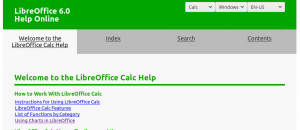
I worked recently to transform our ancient help system into a modern browser-based version. The partial result is available in the (temporary) website at https://helponline.libreoffice.org – please be advised that this is still work in progress.

The XML help pages are transformed into pure, almost static and responsive HTML. This approach has some advantages:

  • Works in every browser
  • Provides the current functionality of the help system
  • Preserves the current development, help authoring, release engineering and translation process as it is
  • You can read the help pages in your mobile phone or tablet
  • It’s easy to add extra markup for better search engine indexing

The disadvantage is an increase in disk storage on the server.

Transforming XML into HTML for every browser

The help pages were designed when the minimal standard HTML was version 3.2 and, since then, many developments have brought us HTML5 in all major browsers. There is little advantage now to keep the current XML, and all of its designed functionality can be replaced and improved by HTML, CSS and JavaScript, for example, adding better navigation and multimedia contents.

The new Help page layout benefits of many modern technologies

(more…)

Help keep the Calc guide up to date

The Documentation Team Meeting will

take place in May 10th at 17:00 CET

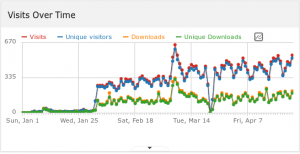
The Calc module of LibreOffice is one of its most complex and extensive applications and one of the most in-demand for documentation, as our measurements of the documentation website clearly show.

Documentation website daily visits over time, since January 1st, 2017.

The latest published Calc Guide is connected to LibreOffice release 4.1. The gap between this guide and the most recent Calc developments has widen and the current publication is outdated. (more…)

Meet the Brazilian LibreOffice 5.3 team

We can assure readers of this blog that LibreOffice 5.3 in Brazilian Portuguese did not simply sprout from the last tropical rainfall. It is the product of a team of volunteers working to make the best free office suite in Portuguese a reality.

Following the experience gained by translating the Getting Started with LibreOffice 5.0 guide, the team began to translate the Help Contents of LibreOffice 5.3 in December 2016. This task involved translating 18,000 words on our Pootle server in two months, due to all the improvements, updates and corrections that went in the software since version 5.2. The work was split into smaller tasks under the supervision of Olivier Hallot, translator leader since 2007 (during the OpenOffice.org days). The LibreOffice 5.3 user interface translation was handled by Olivier in that period.

So, the Brazilian community and the Brazilian users say thanks to Chrystina Pelizer, Túlio Macedo, Raul Pacheco da Silva and Douglas Vigliazi for the new LibreOffice 5.3 and Help system in Brazilian Portuguese.

Chrystina Pelizer “It was like a challenge for me: to actively take part in a collaborative, international software project. Learning and using the tools and techniques that volunteers use to translate the software made me feel more important and met my expectations, because they greatly reduce the effort and we get results very quickly. Also, I am very happy to be part of a project team.” Chrystina Pelizer (Florianópolis – SC)
Raul Pacheco da Silva “I always liked to be part of the LibreOffice community when my professional activities let me do so. Specifically, I like to be part of the translation projects of the software and the documentation. I use all the resources I can to fulfil my duties within the team and I don’t like to miss our weekly team call.” – Raul Pacheco da Silva (Suzano – SP)
Douglas Vigliazi “I took advantage of the fact that my professional duties are related to LibreOffice, and for me, taking part in the LibreOffice project is an opportunity to develop my professional skills, including at an international level. The translation project is one of the opportunities to contribute to the community.” – Douglas Vigliazi (Santos – SP)
Túlio Macedo “I already had translation experience with the Fedora project in Brazilian Portuguese, and that helped me a lot with using the LibreOffice toolset. The translation helped me to get to know LibreOffice in depth, in order to understand the context of the translation I was doing. I also liked very much being part of a team.” – Túlio Macedo (Brasília – DF)
Olivier Hallot “After years of personal commitment to keeping the Brazilian LibreOffice fully translated and with quality, it was a great satisfaction to assemble a team that will be able to keep the project alive by themselves, ensuring part of the translation effort of this wonderful software.” – Olivier Hallot (Rio de Janeiro – RJ)

A big hooray for the team! Click here to discover Native Language Projects in your area

Announcing the Getting Started with LibreOffice 5.2 Guide for Immediate Download

Berlin, March 6, 2017 – The Document Foundation’s Documentation Team announces the immediate availability of the new Getting Started with LibreOffice guide version 5.2. The guide was updated to include the developments of LibreOffice 5.2 and previous releases.

The Getting Started guide is an introductory text for end users on using the LibreOffice office suite. It is written for individuals as well as organizations that deploy LibreOffice as their preferred office suite tool. The text allows users to get familiar with the features and resources of LibreOffice and shorten the time to become productive in office document edition.

The guide is written in LibreOffice Writer in Open Document Format (ODF). The team worked to not only update the contents but also to clean the formatting used in the text with a double objective: One is to make the text suitable for computer aided translation (CAT) tools and the other is to generate an online version (XHTML) of the guide.

The documents composing the Guide were formatted using styles only, avoiding direct formatting that has impact on CAT tools and on HTML export. For HTML export, the underneath template of the documents was adapted to handle the unmatched formatting properties between ODT and XHTML. At the end, a unique content source was able to produce the guide in ODT, PDF and XHTML formats.

The Getting Started with LibreOffice guide, its PDF and ODT version can be downloaded or read online by navigating to the page http://documentation.libreoffice.org. The online version of the guide can be accessed through http://documentation.libreoffice.org/en/english-documentation/getting-started-guide/read-online-5-2/

About the Documentation team

The Documentation team is in charge to develop, modernize, update and enhance all form of documentation related to LibreOffice in all languages supported by LibreOffice. It includes the authoring of LibreOffice guides for all modules, the Help system modernization and contents update, and to offer ways and means for the community to contribute to the LibreOffice project. Communities interested in contributing or translating contents can get it touch with the team by sending an e-mail to documentation at libreoffice dot org

LibreOffice in Guarani

lopy

By Prof. Alcides Torres
Translation: Huber Melli

LibreOffice would be the first office suite translated to Guaraní, a native language from South America spoken by more than 6 million people in this sub-continent. Language is a fundamental tool though which we not only structure, process and understand the world around us, but also communicate and pass information from one generation to the next.

The access to technological tools is a highly significant implement for the development of the peoples. To be able to access information and tools in your mother tongue has a great impact in people’s lives and growth because it facilitates a more profound understanding of them, all of which open a way to a better appropriation and usage.
There is no language unable to grow along with its speakers, in order to express the constantly changing world and the progress of science and technology. What does exist is the prejudice and exclusion.

In a country with a vast majority of Guaraní speakers suffering the existent diglossia, by which Spanish is preferred by the Public administration, service providers, even for the State’s education policies, the translation of LibreOffice to Guaraní represents a turning point. First, because it shatters the bias that Native American languages cannot access areas of technology and Internet. And second, because it will contribute to the Guaraní´s reassessment, to raise the self-esteem of populations that for decades were limited in their capacity to grow and self-develop, as a consequence of a deficient education, using a language that were not even theirs, providing information irrelevant and disconnected to their reality.


LibreOffice documentation: join us in this adventure

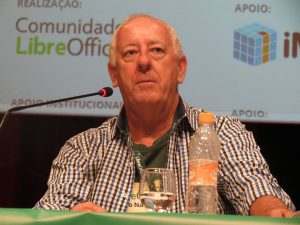
olivier_hallot_07062010_964x1036
The LibreOffice documentation team produces the guidebooks, reference materials, wiki and online help to support users of the software. We’re working hard to add all the exciting new features and functions of recent LibreOffice versions, to show how your office productivity can be improved thanks to the free office suite – and your help would be very much appreciated! Even if you can only spare 30 minutes each week, your contribution would be very valuable, and you’ll also get experience with a big-name open source project. Read on for the full details…

(more…)