New page added: questions and answers about donations

The Document Foundation is very grateful to all contributions to LibreOffice, both in terms of time and money (donations). For the latter, we occasionally receive questions on various topics: the cost of donations, confirmation emails, refunds and rejected credit cards.

Usually we answer these individually, but now we’ve created a dedicated page on this blog with a list of questions and answers:

Click here to view the page

In addition, it can be accessed via the Donate menu in the top-right of the blog. We hope this helps anyone who has issues donating – and once again, a big thank you to everyone who has donated!

LibreOffice German community meeting, 23 – 25 June 2017

LibreOffice and Germany have a strong connection. StarOffice, the proprietary office suite that eventually became OpenOffice.org (and now LibreOffice) came to life in north Germany in the 1980s. Over time, more and more developers got involved, and when the suite became open source a thriving local community was established.

This continues today, and many German-speaking LibreOffice users, developers and supporters keep in touch on the mailing lists. But face-to-face meetings are important as well, so every year the German community meets up to exchange ideas, discuss new features, and make plans for the future.

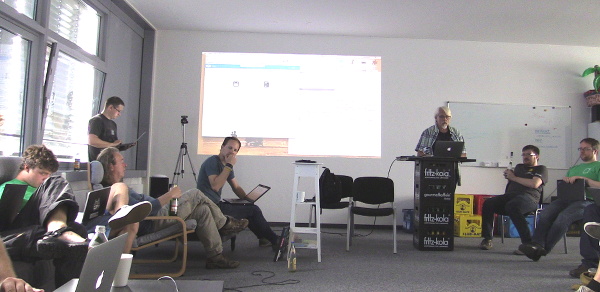
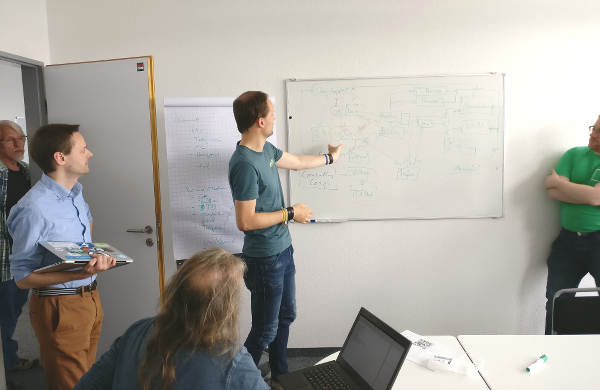
This year, we met in Berlin at Endocode AG, an employee-owned software engineering company that focuses on open source. Its office features a great view of Berlin’s skyline, and – most importantly – plenty of coffee and comfy chairs for meetings and discussions. (Here’s Endocode’s blog post about the event.)

We had 17 participants in the event, and Saturday started with an introduction round. Many familiar faces who’ve been active in LibreOffice and OpenOffice.org for years were present, but there were also some new participants who were eager to get involved and help out. After choosing some discussion topics for the day, we split up into small groups and worked on tackling some issues.

For instance, one group asked the question: how can we convert LibreOffice end users into project contributors? What are the barriers? We noted that the German user mailing list has over 520 subscribers – so maybe we can provide them with some “Easy Hacks” (like in the development project) to get involved. These could be: fixing bugs and typos on the website, making small translation improvements, updating documentation, and confirming bugs. It was noted that due to our existing infrastructure, some of these tasks require good knowledge of English, though.

Other groups looked at strengthening outreach (eg getting LibreOffice into schools) and how the different projects in LibreOffice (development, documentation, QA, marketing etc.) can work together more effectively.

In the afternoon, all participants got together for a wide-ranging discussion. We talked about many things: does LibreOffice need a vision for the future? Or a killer feature? How can we steer development of LibreOffice based on such a vision? And how can we make end users feel more involved?

One idea is to run a survey of end user needs, in the style of the Open Source Survey 2017. Not only would this show that the LibreOffice community listens carefully to end users, but it could also guide the project, showing which things we need to work on, and which ones are already in good shape. (German speakers can find more notes from the discussion on our pad.)

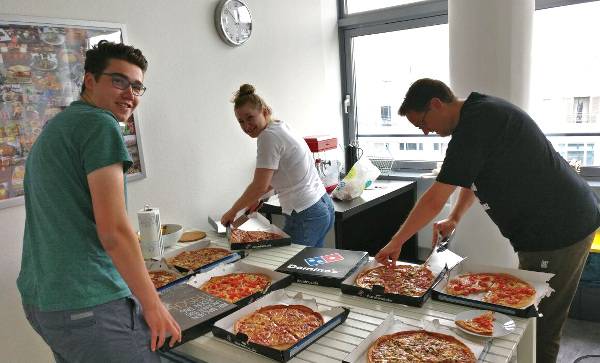
Of course, the meeting wasn’t just about discussions – it was a great opportunity to network as well, over food and drink. We would like to thank our kind hosts from Endocode, Lisa and Mirko, very much for making that meeting possible and offering their office space for the community – we enjoyed it very much and made new friends!

If you’re a German speaker and want to join our community, sign up to the discuss@de.libreoffice.org mailing list. We look forward to hearing from you!

New items in our merchandise shop

As you may know, The Document Foundation has a merchandise shop with clothing, accessories, phone/tablet covers and various other items. Many of the designs feature the LibreOffice logo on its own, but we thought we’d update the shop with some items that highlight the benefits of LibreOffice.

But given limited space, what benefit should really stand out? After discussing this in our marketing community (join in and get involved!), we settled on this: LibreOffice puts you in control. Because it’s free, open source, multi-platform and built on open standards, it gives end users complete control over their documents and data.

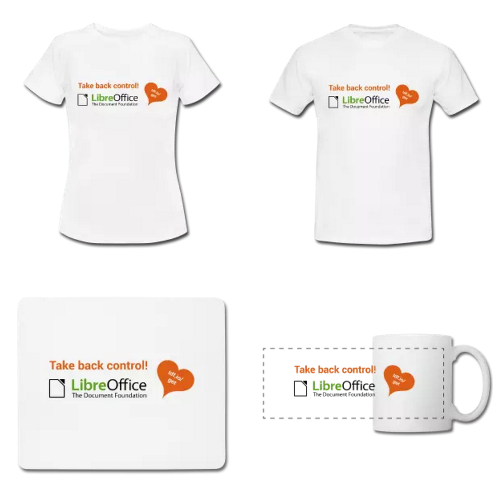
So we’ve added four new items to the shop:

T-shirts for men and women, plus a cool new mug and a mousemat as well. If you love LibreOffice, want to help spread the word and support The Document Foundation, head over to the shop and place your order! If these designs are popular, we may add more items as well — stay tuned…

LibreOffice contributor interview: Daniel A. Rodriguez

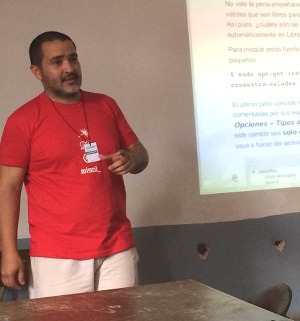
Having concluded our video interviews from FOSDEM, we now return to our regular LibreOffice contributor interviews on the blog. Today we talk to Daniel A. Rodriguez, an Argentinian LibreOffice and Free Software supporter, who helps with marketing, translations and design.

Where do you live, and are you active on social media?

I live in Posadas, the capital of Misiones in the north-east of Argentina. Here’s my Google+ profile.

Do you work for a LibreOffice-related company or just contribute in your spare time?

I use my spare time to contribute.

How did you get involved with LibreOffice?

When the LibreOffice project started (as a continuation of OpenOffice.org) I was still quite a new GNU/Linux user, but wanted to return something to the global community which had helped me many times before. So, I subscribed to mailing lists and – I don’t remember exactly how – in January 2011 I started to translate the LibreOffice website into Spanish.

What areas of the project do you normally work on? Anything else you want to tackle?

I try to stay tuned to marketing, translating press releases, design blog posts and developer blog posts. I maintain several social media profiles as “Comunidad LibreOffice Argentina”:

All of these can, I think, help to attract volunteers to the project. But we must recognize that the Spanish community is fragmented into several geographical regions. And that’s why at the end of 2016, with help from two
other community member (Adolfo Jaime Barrientos and Carlos Parra Saldivar), we started a new blog at The Document Foundation. Now it has another well known LibreOffice user and advocate: Ricardo Berlasso. The goal is to get more people participating, now and then.

Sometimes I work on ideas that others can bring into reality – such as the airport advertisement for the launch of LibreOffice 4.0, or more recently the MUFFIN illustration for the blog post in December.

What was your initial experience of contributing to LibreOffice?

Being able to participate actively in an international community, with the push and motivation that revolves around LibreOffice and Free Software, was – and still is – indescribable.

What does LibreOffice need most right now?

I think that an option for automatic updates, like Firefox has for example, would be great.

Finally, what do you do when you’re not contributing to LibreOffice?

I work the whole day in a secondary school with a technical orientation. My obligations are to maintain the infrastructure on which different systems work: institutional management, Virtual Education Environment, proxy cache, DNS, among others.

Thanks Daniel! And thanks to everyone else involved in marketing and localisation of LibreOffice. If you’re reading this and want to join the friendly, worldwide LibreOffice community, get involved!

LibreOffice Quality Assurance: six months in statistics (part 2)

This is the second part in our blog series about the LibreOffice QA (quality assurance) community – see here for the first part.

Regressions

During the six month period from 23 November 2016 to 21 May 2017, 553 bugs were identified as regressions by 61 people. This means a feature behaved correctly in the past – but a change in the code made it work incorrectly. This is an expected problem in any software project, especially when many changes to the code are done every day. For that reason it’s very important to determine whether a bug is a regression or not – and to identify regressions as soon as possible to maintain the quality of the software.

It’s also important to mention the tremendous amount of effort developers spend on adding new unit tests in order to avoid regressions from being introduced again. More information about that here.

Top 15 regression identifiers:

  1. Xisco Faulí (190)
  2. Buovjaga (81)
  3. Telesto (50)
  4. Áron Budea (35)
  5. Alex Thurgood (32)
  6. Justin L (11)
  7. Cor Nouws (11)
  8. tommy27 (11)
  9. Julien Nabet (9)
  10. Yousuf Philips (jay) (9)
  11. m.a.riosv (9)
  12. V Stuart Foote (7)
  13. Kevin Suo (6)
  14. Luke (6)
  15. Jacques Guilleron (6)

These are the statuses of the bugs identified as regressions:
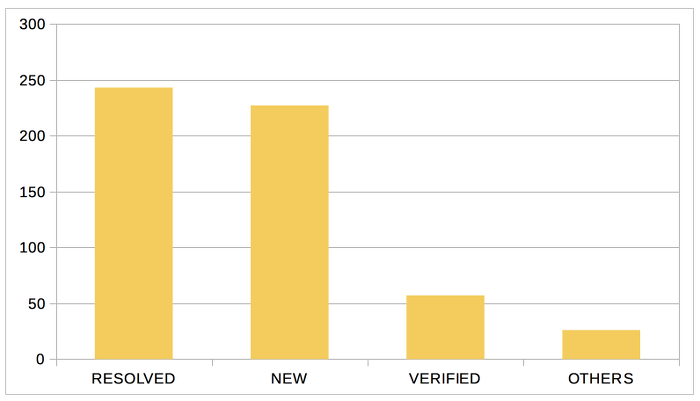
More than half of these bugs have been RESOLVED (243), or resolved and VERIFIED (57) – 54.2% to be exact.

Bisected

Once we identify that a bug is a regression, we can use a tool called bibisect to identify at which point the regression was introduced, allowing us to speed up the process of fixing the bug.

During the last 6 months, 346 bugs have been bisected by 14 people.

Top 14 ‘bisecters’:

  1. Xisco Faulí (186)
  2. Áron Budea (77)
  3. raal (50)
  4. Justin L (10)
  5. Terrence Enger (6)
  6. Michael Stahl (4)
  7. Mike Kaganski (4)
  8. Miklos Vajna (3)
  9. Buovjaga (1)
  10. Kevin Suo (1)
  11. Luke (1)
  12. Jean-Baptiste Faure (1)
  13. Caolán McNamara (1)
  14. Katarina Behrens (1)

And these are the statuses of the bugs bisected:
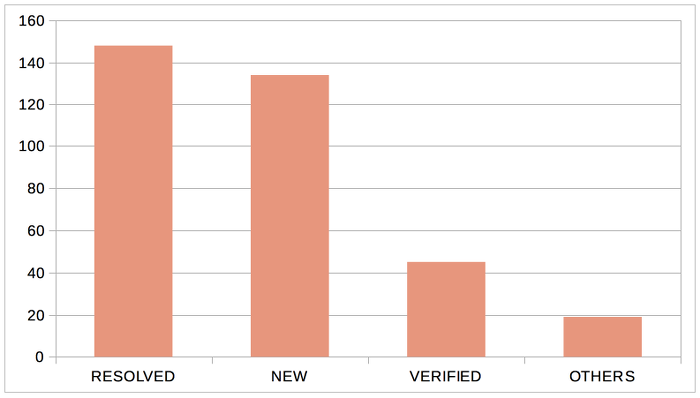
Of the bisected bugs, 55.7% are either RESOLVED (148), or resolved and VERIFIED (45).

Backtraces

Another way to accelerate the fixing process is by providing a debug trace when there’s a crash, slowness or a freeze in the software.

During the last 6 months, a debug trace has been added to 140 bugs by 14 people.

Top 13 debug trace providers:

  1. Julien Nabet (48)
  2. Xisco Faulí (35)
  3. Buovjaga (28)
  4. fiftyigfuci_f_mi (10)
  5. Alex Thurgood (6)
  6. V Stuart Foote (4)
  7. Áron Budea (4)
  8. Telesto (3)
  9. Terrence Enger (3)
  10. Yousuf Philips (jay) (2)
  11. JoNi (2)
  12. Kevin Suo (1)
  13. Cor Nouws (1)

These are the statuses of the bugs with a debug trace:
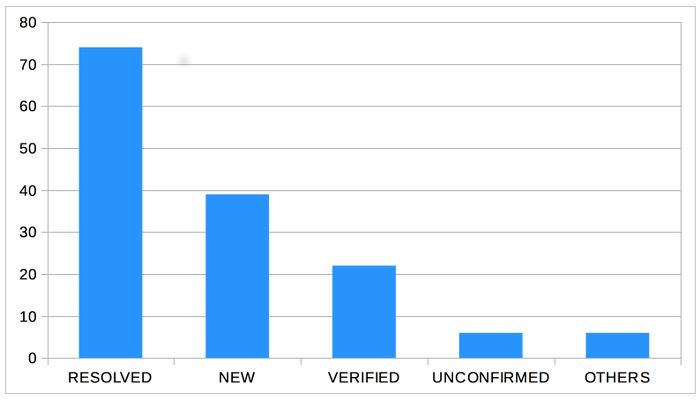
More than two-thirds of these bugs have been RESOLVED (74), or resolved and VERIFIED (22) – 69.4% to be exact.

Duplicate bugs

Knowing that many bugs are reported everyday, it’s important to identify if a certain bug was reported previously and therefore whether it’s a duplicate or has never been reported before.
During the last six months, 757 bugs have been identified as duplicates by 91 people.

Top 20 duplicate identifiers:

  1. Xisco Faulí (142)
  2. Buovjaga (116)
  3. V Stuart Foote (79)
  4. Áron Budea (40)
  5. Telesto (31)
  6. Alex Thurgood (28)
  7. m.a.riosv (27)
  8. Julien Nabet (26)
  9. Heiko Tietze (20)
  10. Timur (19)
  11. Khaled Hosny (18)
  12. Yousuf Philips (jay) (15)
  13. Maxim Monastirsky (14)
  14. Adolfo Jayme (13)
  15. Gábor Kelemen (11)
  16. Mike Kaganski (10)
  17. Cor Nouws (10)
  18. Jacques Guilleron (8)
  19. Bartosz (8)
  20. Regina Henschel (6)

Resolved bugs

The cornerstone of the project is its development work. During the six month period, 955 bugs were set to RESOLVED FIXED by 147 people.

Top 20 fixers:

  1. Caolán McNamara (73)
  2. Miklos Vajna (53)
  3. Eike Rathke (41)
  4. Michael Stahl (39)
  5. Julien Nabet (38)
  6. Justin L (36)
  7. Adolfo Jayme (33)
  8. Heiko Tietze (29)
  9. Samuel Mehrbrodt (29)
  10. Xisco Faulí (26)
  11. Gábor Kelemen (25)
  12. Yousuf Philips (jay) (23)
  13. Maxim Monastirsky (22)
  14. Markus Mohrhard (22)
  15. V Stuart Foote (19)
  16. Zolnai Tamás (18)
  17. Mike Kaganski (18)
  18. Katarina Behrens (17)
  19. Khaled Hosny (16)
  20. Winfried Donkers (15)

Verified fixed bugs

Finally, once a bug has been fixed, it’s important to verify that it has indeed been fixed.

During the last six months, 212 fixes have been verified by 28 people.

Top 15 verifiers:

  1. Justin L (65)
  2. Xisco Faulí (24)
  3. Buovjaga (18)
  4. Timur (16)
  5. m.a.riosv (11)
  6. Julien Nabet (9)
  7. Heiko Tietze (7)
  8. Terrence Enger (7)
  9. Jean-Baptiste Faure (7)
  10. Thomas Lendo (6)
  11. Áron Budea (6)
  12. raal (4)
  13. Yousuf Philips (jay) (4)
  14. Cor Nouws (4)
  15. V Stuart Foote (3)
  16. Kevin Suo (3)
  17. Luke (3)
  18. Jacques Guilleron (3)
  19. Zineta (2)
  20. Alex Arnaud (2)

Get Involved!

So, you’ve seen what the QA team is doing across the LibreOffice project – why not get involved and help out? Even if you only have half an hour of spare time each week, by confirming bugs (and fixes) you can make LibreOffice better for millions of people around the world. And in addition, you build up valuable experience working with a large project and open source community – which could be very useful for a future career! Discover more about the QA team in our video interview with QA engineer Xisco Fauli.

(Notes about this blog post: raw data can be checked here. For more stats, visit the stats page in the QA wiki.)

Month of LibreOffice, May 2017: The results!

So the Month of LibreOffice, May 2017 has come to a close. We’ve had awesome contributions all across the project, from code patches and bug report confirmations, through to translations and user support. Here’s how many stickers have been awarded:

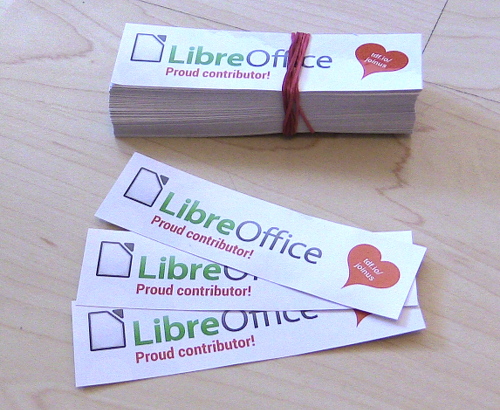
Click the number for the full details. And then, if you see your name (or username) on that page, claim your sticker! Yes, you can get a cool sticker for your laptop or other devices. Simply email mike.saunders@documentfoundation.org with your name (or username) from the wiki page, along with your postal address, and we’ll send you a sticker in the next couple of weeks. It’ll look like this:

(Note that your postal address will only be used for posting the sticker to you, and not be stored afterwards or used otherwise.) Enjoy showing off your sticker, and thanks again for your contribution!

Behind the scenes

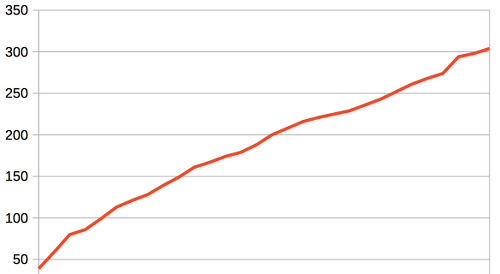
Meanwhile, let’s reflect on the past month. This graph shows how the number of awarded stickers grew over the 31 days of May:

While there was a big jump at the start as new names were added, it was good to see a steady stream of additional LibreOffice contributors over the month. There were no really “quiet” periods – we were monitoring code patches, bug report confirmations, translations, documentation contributions and user support (on Ask LibreOffice), and every day we added new people to the stickers list. This reflects on a healthy and lively project and community, so long may it continue!

And a final word: when you look at the “Contributing code patches” section of the stickers page, note that these are community contributions, on top of the daily work done by paid LibreOffice developers. It’s great to see so many people getting involved, exploring the source code and working on Easy Hacks.

We’ll be running another Month of LibreOffice later in the year – but you can get involved at any time. Join our friendly community, help make LibreOffice even better, and we look forward to your contributions!

The Document Foundation All Rights Reserved 2025
Proudly powered by WordPress | Theme: Refined Magazine Pro by Candid Themes.