LibreOffice contributor interview: Edmund Laugasson

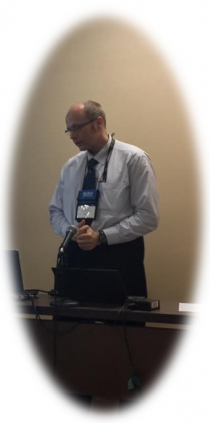
Edmund Laugasson

LibreOffice is being used in governments and companies around the world, and this is largely thanks to support and advocacy from local communities and developers. Today we’re talking to Edmund Laugasson, a member of the Estonian LibreOffice community, who is promoting the software and the Open Document Format (ODF) in his country…

How popular is Free, Libre and Open Source Software (FLOSS) and LibreOffice in Estonia?

To be honest, it has not yet been deeply investigated, but the Estonian Ministry of Economic Affairs and Communications has published a “State Information System Interoperability Framework” (in Estonian) where clearly ODF is the main format suggested to use. The status of OOXML is only “allowed”. OOXML should not be confused with the file formats used by MS Office, which differs from OOXML by several proprietary changes. Even LibreOffice offers two different versions to save, e.g. docx – one is OOXML and the another one is used in MS Word. The same applies also to rest of OOXML, MS Office formats that coexist in LibreOffice. As the status of ODF is “suggested”, it is not mandatory. Despite that, ODF is quite widely used – for instance, educational institutions usually have LibreOffice installed, along with some local authorities.

Research is quite challenging as people usually do not respond to questionnaires, and researchers need to meet people directly in order to get reliable answers to questions.

What is your background and involvement in FLOSS?

I live in a small city called Rapla in Estonia, but I work as a lecturer at IT College, which is part of the Tallinn University of Technology. I am involved in FLOSS in many ways. When teaching, I use FLOSS as much as possible: the operating system in university is Ubuntu Linux, and I use derivates like Linux Mint MATE, all 64-bit and the latest LTS (Long Term Support) versions. The office suite is LibreOffice everywhere under GNU/Linux but under MS Windows next to MS Office. It is very important to have LibreOffice installed on every operating system that is used. Also, at least ODF file formats should be opened by LibreOffice by default. Then it would be much easier to deploy ODF in future when the ground is prepared properly. We have a dual-boot system (Microsoft Windows 10 and Ubuntu Linux 16.04.4), and in one classroom also a triple-boot (with macOS 10.12).

In addition I am involved as a board member of the Estonian Free and Open-Source Software Association, taking care of FLOSS in general in Estonia. Also I am involved in the Network of Estonian Teachers of Informatics and Computer Science (NETICS) as a board member. There I promote FLOSS – LibreOffice in particular – to encourage people to use it.
The next involvement is my doctoral studies at Tallinn University, where the current topic is “Technology approval as a factor of adopting a free software ecosystem”.

Further activities will come when I graduate and can focus more on wider deployments of FLOSS, particularly LibreOffice. I have serious plans to arrange all this, but as people in Estonia are not very cooperative, it takes more time – regardless of the fact that Estonia is small. Lots of people just do not believe in better future full of FLOSS, and those few who still believe, will act towards that goal. So to anyone who feels the FLOSS spark inside: do not hesitate to contact me.

What do you think are the biggest obstacles to wider FLOSS and LibreOffice adoption in Estonia?

My first paper in 2013 (published at the IFIP conference) showed that awareness of FLOSS is still relatively low, but interest in getting more information is quite high. Microsoft is doing relatively strong lobbying work, also in Estonia, and the government has quite weak power regarding FLOSS. There is also sometimes controversial behaviour: five state-arranged procurements in the FLOSS field (four state procurements relating to LibreOffice, one state procurement to create an interoperability framework), but weak activities around FLOSS in general. So I decided to start my doctoral studies to fix this situation in a scientific (weighted) way.

Thanks to Edmund for his time and effort helping the FLOSS cause. Click here to see many more interviews from LibreOffice contributors – and why not become one yourself! Build up skills, join a friendly community, and help to make LibreOffice better for everyone.

LibreOffice monthly recap: March 2018

There’s so much going on in the LibreOffice project – in development, documentation, design, QA, translations and much more. So at the end of each month we’ll be posting summaries of recent activities and updates, to help you get an overview of what’s going on. Here’s what happened in March…

  • LibreOffice 5.4.6 was released, with almost 60 bug and regression fixes. This is part of the 5.4 branch, targeted at mainstream users and enterprises. More information in the press release.
  • The Indonesian community organised a three day conference, supported by The Document Foundation. The website has details (in Indonesian), and below is a video promoting the event – English subtitles are available:

Please confirm that you want to play a YouTube video. By accepting, you will be accessing content from YouTube, a service provided by an external third party.

YouTube privacy policy

If you accept this notice, your choice will be saved and the page will refresh.

  • Meanwhile, we’re already getting excited about the main LibreOffice Conference due later this year, in Tirana. But we’re looking even further ahead, and announced a call for locations for the LibreOffice Conference 2019. The deadline for sending proposals is June 30, so if you want to help out, let us know!
  • Buovjaga from the QA community wrote a blog post describing the importance of quality assurance in open source projects. “QA is acting like neurotransmitters in the body of the project”, he writes, explaining that QA is involved in many different areas.
  • This year’s Google Summer of Code (GSoC) is fast approaching, and we reached out to potential participants. In recent years, GSoC students have contributed many great features and updates to LibreOffice, so we look forward to seeing what will happen this year.

  • Olivier Hallot from the documentation community wrote about rich content arriving in the new help system. “The new help can now access external videos on YouTube or similar services, and also open or download OpenDocument files to support the textual explanations of LibreOffice features in the help pages.”
  • Also in blog news, Lera Goncharuk summarised migrations to LibreOffice in Russia on his blog. These include migrations at the federal government level, along with regional administrations.
  • Finally, development continues on LibreOffice 6.1, which is due to be released in early August. You can see some of the new features in the release notes, such as the ability to sort images anchored to cells in Calc:

Keep in touch – follow us on Twitter, Facebook and Google+. Like what we do? Support our community with a donation – or join us and get involved!

LibreOffice and Google Summer of Code 2018 – get involved!

Google Summer of Code (GSoC) is a yearly programme in which Google funds university students to work on free and open source software projects. LibreOffice has benefited from this – last year 10 students were accepted into GSoC to do various programming jobs, helping to improve the software.

GSoC students are assisted by experienced “mentors” in the LibreOffice community, as 2016 student Jaskaran Veer Singh explains:

Please confirm that you want to play a YouTube video. By accepting, you will be accessing content from YouTube, a service provided by an external third party.

YouTube privacy policy

If you accept this notice, your choice will be saved and the page will refresh.

For 2018, LibreOffice is again an organisation in the GSoC programme, so if you’re a university student and want to get experience working on a well-known free software project, while also being paid for your efforts, get involved! But don’t delay: the application period runs until March 27, so it’s not far off.

To get started, check out some ideas for projects you can work on. Each project describes what’s involved, the skills required, and the mentor you can contact to get help. If you see something you’d like to work on, contact the mentor as soon as possible! Then you can discuss how to proceed.

After that, read the general GSoC 2018 page on our wiki, which provides more information on the GSoC programme and tells you how to apply. So, check out the ideas, talk to the mentors, and good luck with your projects!

How LibreOffice and TDF are helping other open source projects

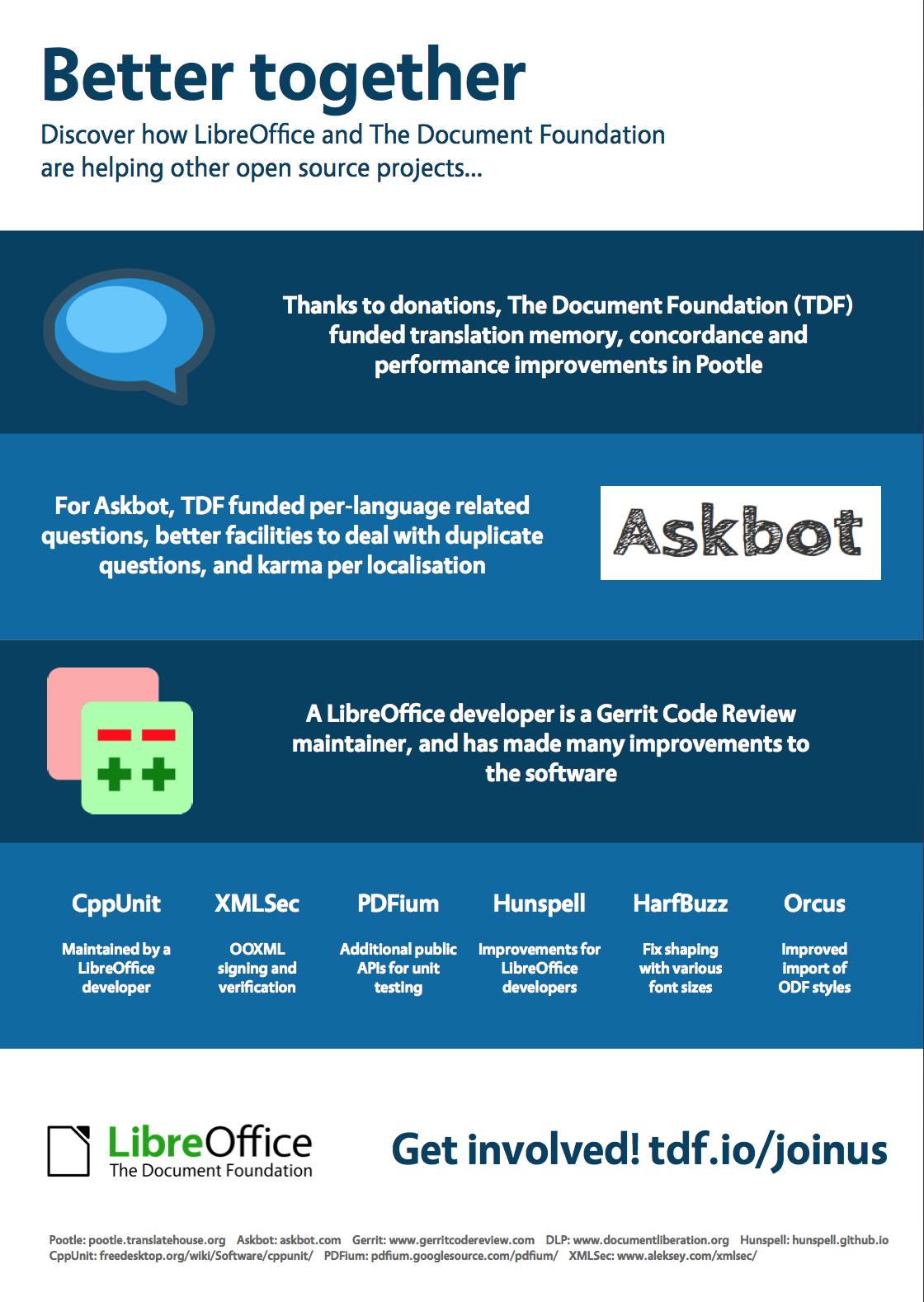
Free and open source software (FOSS) is all about sharing and working together. And while LibreOffice focuses on being the best open source office suite, our community also helps out with other related FOSS projects (just like many other projects help us!). We’ve made an infographic showing “upstream” contributions from LibreOffice developers and The Document Foundation – click to see a bigger version…

Your donations have helped us to achieve much of this – so a big thank you to everyone who has donated to our project and community!

LibreOffice contributor interview: Anxhelo Lushka

This year’s LibreOffice Conference will take place in late September in Albania. One of the organisers is Anxhelo Lushka, a member of the Albanian LibreOffice community – we caught up with him at the last conference to talk about his experiences of building a community, how developers and designers can work together, and what we can look forward to in Tirana…

Please confirm that you want to play a YouTube video. By accepting, you will be accessing content from YouTube, a service provided by an external third party.

YouTube privacy policy

If you accept this notice, your choice will be saved and the page will refresh.

LibreOffice 6.0: Exploring the QA statistics

By Xisco Faulí, Quality Assurance (QA) engineer

LibreOffice 6.0 was released on January 31 and this is what happened during its development in LibreOffice’s Bugzilla, which started when the 5.4 branch was branched off from master on May 18 2017.

Note: This blog post has been created based on bugs in Bugzilla that have the whiteboard ‘target:6.0.0’, which means a commit for that bug is included in the release. Other commits referring to other bug trackers (ofz, coverity, rhbz, bnc, etc…) are not covered here, as well as others commits not having a reference to our bug tracker (ie refactoring commits).

In LibreOffice 6.0, a total number of 926 bugs and 88 enhancements were worked on, of which 747 were reported during 2017 (73%), and 267 (27%) between October 2010 and December 2016. July 2017 and August 2017 were the months with more reports, 104 and 108 respectively.

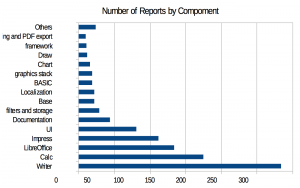
284 reports are related to Writer, 175 to Calc, 134 to LibreOffice in general and 112 to Impress.

This is all thanks to 382 users who reported them.

TOP 10 Reporters

Xisco Faulí ( 74 )

Yousuf Philips (jay) ( 69 )

Telesto ( 59 )

Tamás Zolnai ( 44 )

Aron Budea ( 38 )

Gabor Kelemen ( 26 )

Regina Henschel ( 23 )

Samuel Mehrbrodt (CIB) ( 22 )

Mike Kaganski ( 18 )

Olivier Hallot ( 17 )

Once a report has been created in Bugzilla, a third person needs to jump in, triage and confirm it in order to set it to NEW. This is a very important step as it helps the QA Team to deal with the hundreds of bug reports we receive every week.

Doing it in a short period of time after the bugs are reported guarantees those with more priority get fixed more quickly.

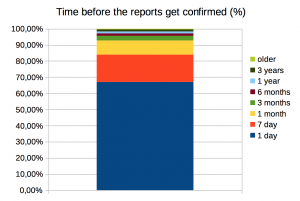
67% of the reports were confirmed within the first day, 84% within the first week and 93% within the first month.

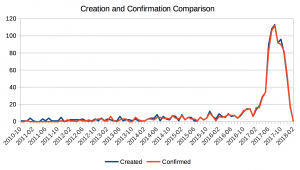
Comparing when the reports were created and when they were confirmed gives a similar chart.

This is all thanks to 113 users who confirmed them.

Top 10 Confirmers

Xisco Faulí ( 225 )

Buovjaga ( 92 )

Yousuf Philips (jay) ( 48 )

Aron Budea ( 42 )

Julien Nabet ( 38 )

raal ( 37 )

Tamás Zolnai ( 28 )

Heiko Tietze ( 28 )

Alex Thurgood ( 25 )

V Stuart Foote ( 23 )

Finally, once the reports have been confirmed and triaged, the developers need to investigate and fix them. Sometimes, it can be trivial fix that takes a few minutes to get fixed – sometimes it takes several man days.

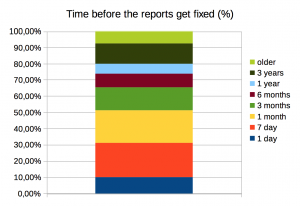
10% of the reports got fixed within one day, 51% within one month and 80% within one year.

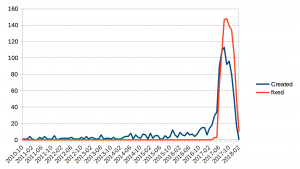
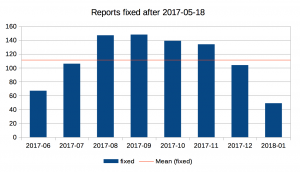
Taking a closer look at the period between 2017-05-18 and the final release, 111 bugs were fixed in average a month, being August 2017, September 2017 and October 2017 the highest, with 147, 147 and 139 reports fixed respectively.

This is all thanks to 100 developers who fixed them.

Top 10 fixers

Caolán McNamara ( 105 )

Tamás Zolnai ( 57 )

Julien Nabet ( 48 )

Eike Rathke ( 46 )

Miklos Vajna ( 43 )

Michael Stahl ( 41 )

Adolfo Jayme ( 41 )

Yousuf Philips (jay) ( 39 )

Justin L ( 31 )

Heiko Tietze ( 28 )

For more QA statistics, please watch my recent talk at FOSDEM 2018:
https://fosdem.org/2018/schedule/event/ode_overview/

Join in, and help our QA community to polish future LibreOffice releases! We’re a friendly and growing project, and there are many ways to get involved: https://wiki.documentfoundation.org/QA/GetInvolved