
 Berlin, 8 May 2026 – Twenty years ago this week, on 3 May 2006, the Open Document Format cleared its Draft International Standard ballot at ISO/IEC JTC 1/SC 34 with unanimous approval. On 30 November 2006 it was published as ISO/IEC 26300. Two decades later, ODF remains what it was on the day of its ratification: the only open, vendor-neutral, freely implementable international standard for office documents in existence.
Everything else on the market is a vendor format with a standards number attached.
That distinction was contested in 2006. It is not contestable in 2026. The competing format pushed through ISO in 2008 – under a fast-track process whose abuses are now part of the documentary record of standards governance – has since splintered into a Strict variant almost no implementation actually uses and a Transitional variant that preserves, by design, the undocumented behaviours of a single vendor’s legacy products. A standard that exists to encode one company’s bugs is not a standard. It is a moat with a certificate.
ODF has no Transitional mode. It has no undocumented behaviours. It has no vendor whose commercial roadmap can quietly rewrite what conformance means. The specification is publicly available at no cost from ISO and from OASIS. The schemas are auditable. The implementations are multiple, independent, and free. This is not advocacy language. It is the working definition of a standard, and ODF is the only office-document format that meets it.
The political weather has finally caught up with the technical reality. Germany’s federal administration has mandated ODF through the Deutschland-Stack. The European Commission’s own services are under sustained pressure – including from this Foundation – to align procurement with the open-standards commitments the Commission itself has signed. Brazil has legislated open formats into its educational system through Lei 15.211/2025. The pattern is the same on every continent where public bodies have stopped to ask the only question that matters: in what format does a society keep its own records, and who decides when that format changes?
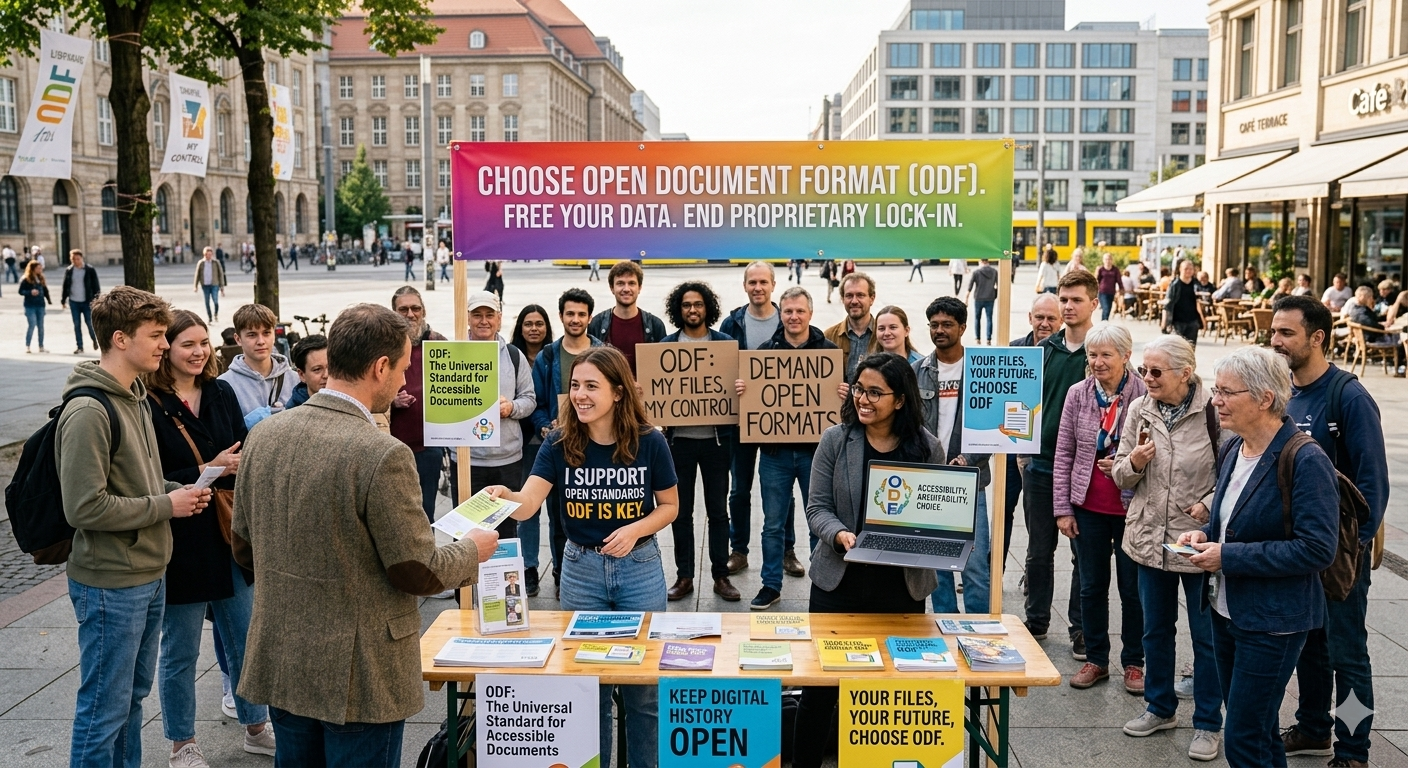 For twenty years, the answer to the second question – for any administration that chose ODF – has been: we do. For any administration that chose the alternative, the answer has been: the vendor does, and the administration will be informed.
“ODF is the document format of a public that has decided not to outsource its memory,” said Florian Effenberger, Executive Director of The Document Foundation. “The governments now mandating ODF are not making a technical choice. They are reclaiming a sovereignty they should never have surrendered.”
The implementation landscape reflects the same divide. LibreOffice, developed by The Document Foundation and a global community of contributors, uses ODF as its native format and is the reference implementation of the standard. Collabora Online extends ODF support to enterprise and cloud deployments. Together they constitute the working core of the ODF ecosystem. Other office suites – including those that market themselves with the vocabulary of openness while defaulting to a competitor’s vendor format – are not part of that ecosystem and should not be confused with it.
The Document Foundation will mark the twentieth anniversary across 2026 with a programme of publications, policy briefs, and community events. The LibreOffice Conference will dedicate a full track to ODF, coordinated with the OASIS Technical Committee, which is currently advancing version 1.4 of the specification. Material on the history, the structural design, and the policy implications of ODF will be published throughout the year on the TDF blog.
A standard is worth what it still does after the people who wrote it have moved on. ODF is read, written, and trusted by software none of its original authors imagined, on hardware none of them could have specified, in jurisdictions none of them lobbied. It has aged the way public infrastructure is supposed to age: quietly, reliably, and in everyone’s hands.
That is the anniversary worth marking. Not the certificate from 2006, but the twenty years of evidence since: evidence that the open-standards bet was the right one, that the alternative was the trap its critics warned it would be, and that the governments now choosing ODF are not innovating. They are catching up.