LibreOffice Community at the Open Source Experience 2021

Sophie Gautier reports from the recent Open Source Experience event in Paris:

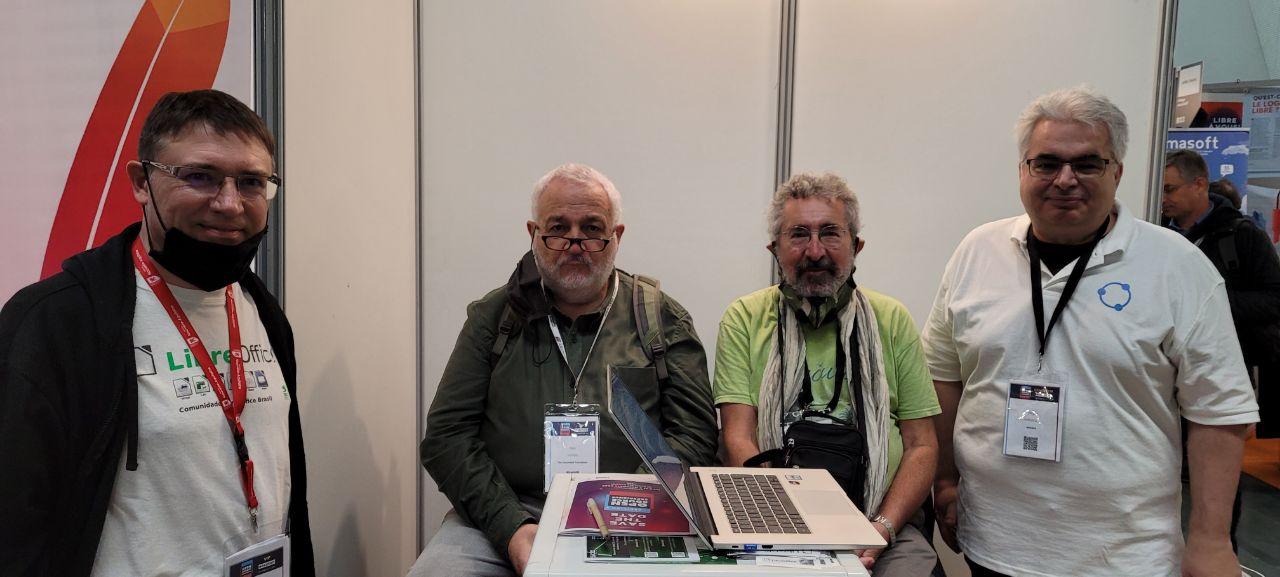
It’s been a long time since we had a LibreOffice booth at a live event, so we really appreciated having the opportunity to meet again in in early November! Jean-Michel Coste, Régis Perdreau, Christophe Cazin, Italo Vignoli and I were present at the booth to answer questions from visitors and companies from the ecosystem. A big thank you to the team for their presence!

Our discussions with other FLOSS associations were fruitful, and the ambiance in the FLOSS Village was full of joy and events (there was a quick where people could win books and even a scooter).

We look forward for the next OSXP in 2022!

Thanks to Sophie and the French-speaking community for taking part! And indeed, hopefully we’ll be able to meet at more in-person events early next year…

Community Member Monday: Nige Verity

Today we’re talking to Nige Verity who’s helping out in the LibreOffice marketing community…

Tell us a bit about yourself!

I’ve been working in IT since the mid 1980s, spread across the aerospace, defence, science and financial services sectors. In the beginning I was mostly coding and testing, but as time went by I found myself working on requirements, designing systems and documenting them as much as doing any actual coding.

I first learned to program using Fortran on a VAX computer running the VMS operating system. Since then I’ve used all sorts of hardware and programming languages, even including a brief spell updating an ancient legacy system written in Algol running on an Elliott computer of late 1960’s vintage, for which the program was loaded from paper tape. This was an experience that gave me enormous respect for the programmers of the past for whom that was hi-tech.

Having worked on some extremely complex systems over the years I have come to value simplicity. When I am developing software for my own use my tool of choice these days is Gambas – an amazing but surprisingly little-known IDE, best described as “Visual Basic for Linux”, only Gambas is far superior to VB and leaves Python for dead in terms of productivity and performance.

Away from IT I am a musician – playing flamenco and blues guitar, and also the piano. In parallel with IT I’ve worked on the fringes of the art world, helping to organise four large-scale public art shows in recent years.

Although originally from London, I am blessed to live in rural South Shropshire, surrounded by farmland and arguably the most beautiful scenery the UK has to offer.

How did you become a LibreOffice enthusiast?

I started using GNU/Linux after years of frustration with the limitations and failings of Windows. My first distro was Xubuntu 8.10 which came with OpenOffice.org as its office software package. Until then I’d never heard of it, but it didn’t take long to discover that it had all the functionality that I’d ever used in MS Office, and a lot more besides.

When LibreOffice was launched as a fork of OO.org I jumped ship to it and have never looked back. I never cease to be astonished at how powerful and stable it has become. In my ideal world I would see Base become much more closely aligned with MS Access, in the way that the other components are close analogs for their MS Office counterparts. At the moment, any organisation with a sizeable investment in the use of Access is really not likely to migrate to LibreOffice.

What are you doing in the LibreOffice project at the moment?

Compared with most contributors I am a total lightweight. While my initial inclination was to get involved with developing the software itself, I felt daunted by the likely learning curve, given the size of the codebase, so it would be a long time before I could become really useful. I decided I might be more effective in helping to spread the word about LibreOffice.

I got myself added to the marketing mailing list and this has proven to be a great way to get involved. You get an inside view of the project and initiatives to expand the userbase. Crucially you get the opportunity to comment on these marketing activities and contribute any ideas you may have.

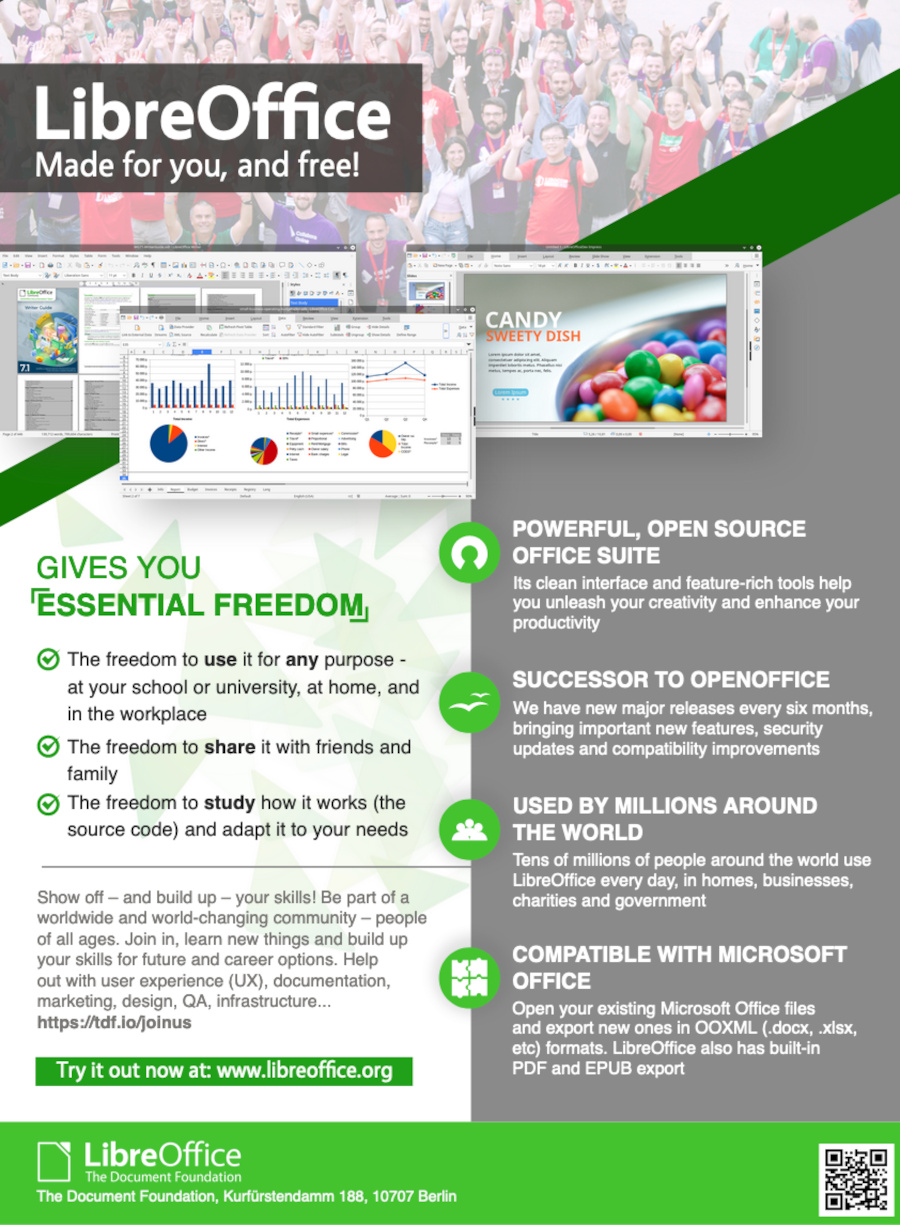
Recently I have been distributing flyers promoting LO around secondary schools and colleges of Further Education in my area, along with the local university campus. My car has a LibreOffice banner displayed in the windscreen. Every email I send includes a promotion for LibreOffice in the signature section. These are minor activities in the scheme of things, but as I see it if every LO user successfully encourages just one other person to try it some of those new users will inevitably be decision makers, in a position to bring many others on board. “From little acorns….” and all that.
By putting myself forward as a LibreOffice point of contact I hope I will be able to help get some prospective new users “across the line”, by helping to resolve any questions or reservations which may be holding them back.

What are some of the challenges/opportunities with promoting LO and free software?

I feel the greatest challenge to the adoption of LibreOffice is simple resistance to change. In organisations where MS Office is already deeply entrenched, and possibly the only software many of their staff ever use at work, migrating from a tool they know very well to another which they may barely have heard of is a big ask. The bigger the organisation, the greater the task of migration is perceived to be. We have to persuade organisations that it is worth the effort.

A great opportunity where the UK is concerned is its highly dynamic business environment, which probably generates more startup companies than any other country in Europe. Some of these are highly professional, well-funded affairs but most involve only one or two people initially, seeking to create a business based on their skills and talents. With the bare minimum of funding and very little in their budget for software, this is where LibreOffice has great potential, if only ways can be found to reach people still in the planning stage of a new enterprise. This has the added advantage that if a startup includes LibreOffice in its workflows from day one, and that new business becomes a success, it is likely to stay with LO as it grows, thereby furthering its adoption.
In my experience of advocating the use of free software, people usually “get” the advantages of open source. They are not difficult to explain. The additional advantages of free software, however, are a much harder sell. If you are not involved in software development they really don’t seem that relevant. Does that really matter, though, as long as the applications people use are indeed free and open source? Does it really matter if the motivation for choosing that free software is the concept of free as in “gratuit” rather than free as in “libre”?

At the level of day-to-day users I don’t think it does all that much, as long as their managers understand that somebody somewhere has paid for their “cost free” software to be developed, in terms of man hours of effort and/or hard cash, and that this can only continue if sufficient numbers of users express their appreciation in financial or other practical ways.

Thanks a lot to Nige for his time and contributions! Everyone is welcome to join our marketing project, mailing list and Telegram group. Let us know your ideas – and we can provide you with materials, to help spread the word!

Nine more videos from the LibreOffice Conference 2021

Here are some more videos from the LibreOffice Conference 2021! Check out the playlist, using the button in the top-right – or scroll down for links to individual videos:

Please confirm that you want to play a YouTube video. By accepting, you will be accessing content from YouTube, a service provided by an external third party.

YouTube privacy policy

If you accept this notice, your choice will be saved and the page will refresh.

Individual links

Note: many of these are also available on PeerTube, and more will be added…

There are just a few videos remaining – we’ll post them very soon!

Announcement of LibreOffice 7.1.7 Community

Berlin, November 4, 2021 – LibreOffice 7.1.7 Community, the seventh minor release of the LibreOffice 7.1 family, targeted to desktop productivity, is available for download from https://www.libreoffice.org/download/.

End user support is provided by volunteers via email and online resources: https://www.libreoffice.org/get-help/community-support/. On the website and the wiki there are guides, manuals, tutorials and HowTos. Donations help us to make all of these resources available.

For enterprise-class deployments, TDF strongly recommends the LibreOffice Enterprise family of applications from ecosystem partners, with long-term support options, professional assistance, custom features and Service Level Agreements: https://www.libreoffice.org/download/libreoffice-in-business/.

LibreOffice 7.1.7 change log pages are available on TDF’s wiki: https://wiki.documentfoundation.org/Releases/7.1.7/RC1 (changed in RC1) and https://wiki.documentfoundation.org/Releases/7.1.7/RC2 (changed in RC2).

LibreOffice Community and the LibreOffice Enterprise family of products are based on the LibreOffice Technology platform, the result of years of development efforts with the objective of providing a state of the art office suite not only for the desktop but also for mobile and the cloud.

LibreOffice Technology based products for Android and iOS are listed here: https://www.libreoffice.org/download/android-and-ios/, while for App Stores and ChromeOS are listed here: https://www.libreoffice.org/download/libreoffice-from-microsoft-and-mac-app-stores/

LibreOffice users, free software advocates and community members can provide financial support to The Document Foundation with a donation via PayPal, credit card or other tools at https://www.libreoffice.org/donate.

LibreOffice 7.1.7 is built with document conversion libraries from the Document Liberation Project: https://www.documentliberation.org.

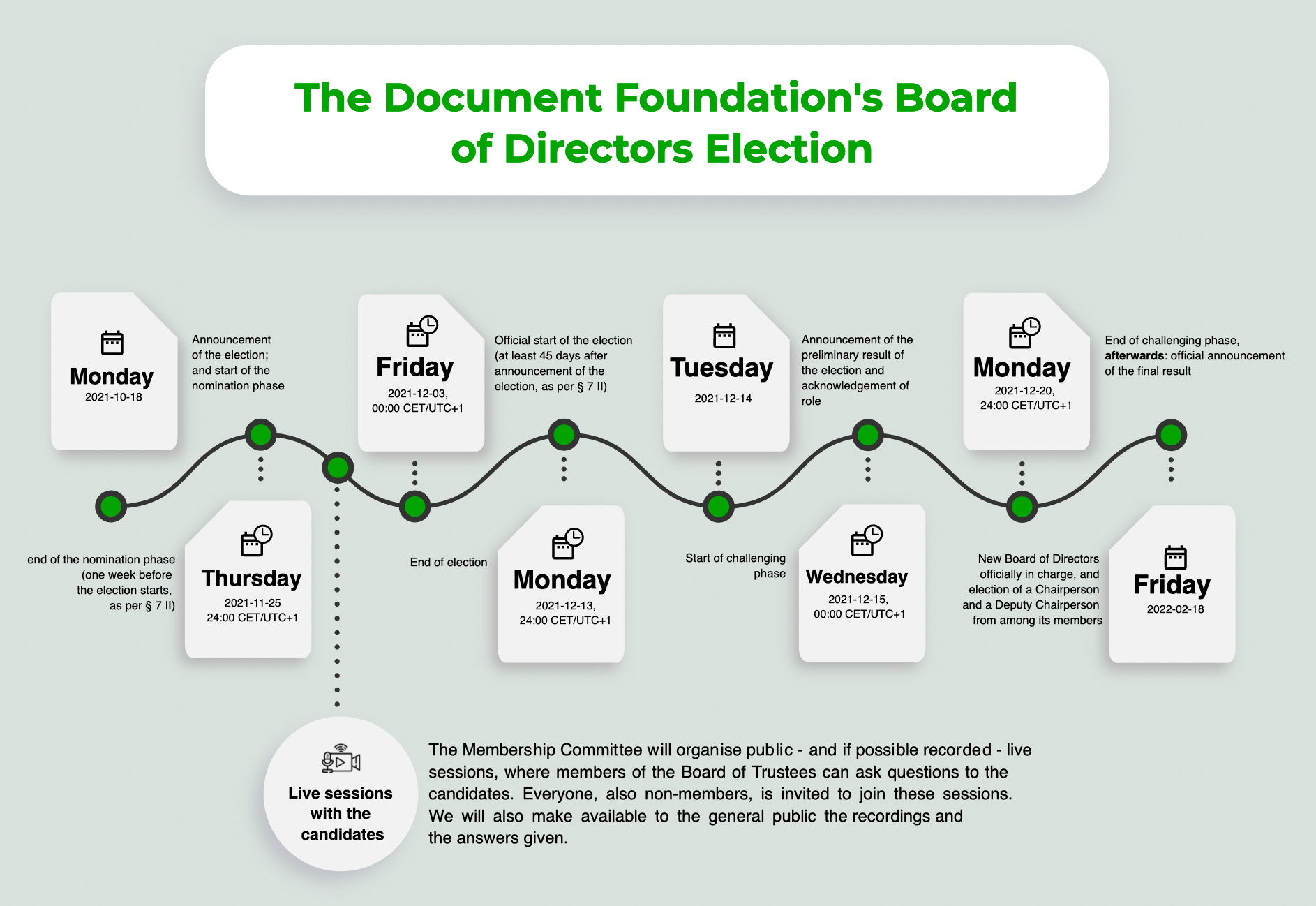
TDF Board elections: Live sessions with the candidates

With elections for The Document Foundation’s Board of Directors running, the Membership Committee is planning to conduct a live Q&A session with the candidates.

The sessions are not mandatory (the candidates can decide whether or not to attend), and TDF members can send the questions to be asked during the live session in advance to this address (which reaches the Membership Committee in private). The Committee will collect questions together, for easier moderation of the sessions.

Then, the sessions will take place in the week between the end of the nomination phase and the start of the votes. Membership Committee members will join the sessions and act as facilitators between the candidates and the local communities.

The Membership Committee would like to give the opportunity to members to have sessions not only in English, and even if only the members send in questions, the live sessions will be open to everyone.

If we get agreement with the candidates attending the sessions, we would like to also record and make available the recordings on PeerTube and YouTube.

Stay tuned to this blog for more updates!

The Month of LibreOffice, November 2021 begins – Join in and get cool merch!

Love LibreOffice? Want to boost your skillset and learn new things? Then join the Month of LibreOffice! The software is a worldwide, community open source project – and many people who help to improve it, actually started out as regular users of the software.

So in November, we want to encourage you to get involved, join our community, and have fun. You can build up valuable skills for a future career – and you don’t need to be a programmer. There are many ways to help make LibreOffice awesome, as we’ll see in a moment.

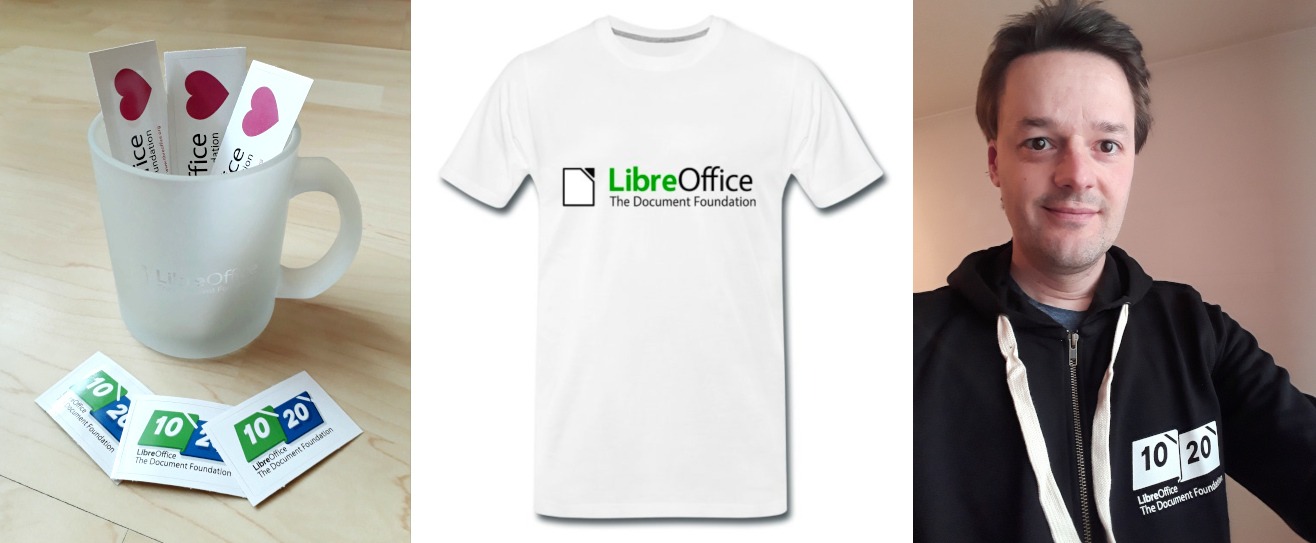
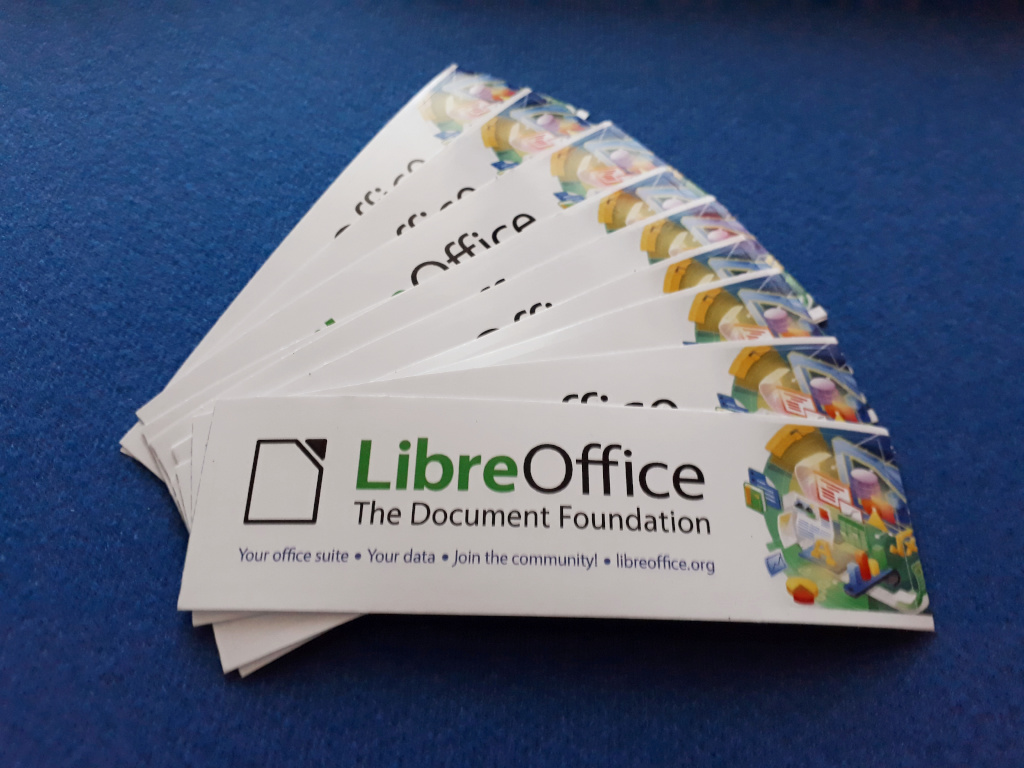
And best of all: everyone who contributes to LibreOffice in the next four weeks can claim a cool sticker pack, and has the chance to win extra LibreOffice merchandise such as mugs, hoodies, T-shirts, rucksacks and more (we’ll choose 10 participants at random at the end):

How to take part

So, let’s get started! There are many ways you can help out – and as mentioned, you don’t need to be a developer. For instance, you can be a…

  • Handy Helper, answering questions from users on Ask LibreOffice. We’re keeping an eye on that site so if you give someone useful advice, you can claim your shiny stickers.
  • First Responder, helping to confirm new bug reports: go to our Bugzilla page and look for new bugs. If you can recreate one, add a comment like “CONFIRMED on Windows 10 and LibreOffice 7.2.2”.
  • Drum Beater, spreading the word: tell everyone about LibreOffice on Twitter or Mastodon! Just say why you love it or what you’re using it for, add the #libreoffice hashtag, and at the end of the month you can claim your stickers.
  • Globetrotter, translating the user interface: LibreOffice is available in a wide range of languages, but its interface translations need to be kept up-to-date. Or maybe you want to translate the suite to a whole new language? Get involved here.
  • Docs Doctor, writing documentation: Whether you want to update the online help or add chapters to the handbooks, here’s where to start.

We’ll be updating this page every few days with usernames across our various services, as people contribute. So dive in, get involved and help make LibreOffice better for millions of people around the world – and enjoy your sticker pack at the end as thanks from us! And who knows, maybe you’ll be lucky enough to win bonus merch as well…

Let’s go! We’ll be posting regular updates on this blog and our Mastodon and Twitter accounts over the next four weeks – stay tuned!