Month of LibreOffice, November 2025 – Half-way point!

Month of LibreOffice banner

We’re just over half-way through the Month of LibreOffice, November 2025. And already, 219 contributors have won cool LibreOffice sticker packs! Details on how to claim them will be provided at the end of the month, but if you don’t see your name (or username) on that page, it’s not too late to join…

How to take part

There are many ways you can help out – and you don’t need to be a developer. For instance, you can be a:

  • Handy Helper, answering questions from users on Ask LibreOffice. We’re keeping an eye on that site so if you give someone useful advice, you can claim your shiny stickers.
  • First Responder, helping to confirm new bug reports: Go to our Bugzilla page and look for new bugs. If you can recreate one, add a comment like “CONFIRMED on Windows 11 and LibreOffice 25.8.3”.
  • Drum Beater, spreading the word: Tell everyone about LibreOffice on Mastodon, Bluesky or X (Twitter)! Just say why you love it or what you’re using it for, add the #libreoffice hashtag, and at the end of the month you can claim your stickers.
  • Globetrotter, translating the user interface: LibreOffice is available in a wide range of languages, but its interface translations need to be kept up-to-date. Or maybe you want to translate the suite to a whole new language? Get involved here.
  • Docs Doctor, writing documentation: Whether you want to update the online help or add chapters to the handbooks, here’s where to start.

So, two more weeks to go! We’ll be posting more updates on this blog and our Mastodon, Bluesky and X (Twitter) accounts…

The role of ODF in digital sovereignty (digital freedom)

Digital sovereignty, or the ability of nations, organisations and individuals to control their own digital destiny, is a fundamental issue of the 21st century. At the heart of this challenge lies a seemingly trivial question: who controls the format of the documents that contain our intellectual property or personal information?

In this context, the standard and open Open Document Format (ODF) – the native format of LibreOffice documents, also supported by other suites – is the fundamental technology for those seeking true digital independence.

Digital sovereignty includes the ability to control access to one’s own information without depending on third parties, to make independent technological choices based on one’s own needs, to ensure independent access to strategic data without depending on the commercial interests of Big Tech, and to maintain this technological self-determination in the face of market consolidation.

When government agencies, businesses, or citizens store their documents in proprietary formats controlled by Big Tech, they surrender part of their sovereignty and depend on these external entities to access their own information.

Why document formats are important for sovereignty

Document formats are infrastructure, which—like roads, power grids, or telecommunications networks—are fundamental to the functioning of modern societies. Consider what happens when strategic documents exist only in formats controlled by a single vendor:

  • Vendor Lock-In: Organisations find themselves trapped, unable to switch to alternative software without costly conversion processes and potential data loss.
  • Loss of Control: formats can and do change without notice and beyond the control of users, increasing the effect of vendor lock-in.
  • Fragility of Access: if the vendor controlling the format changes the format or discontinues support, as was the case with Windows 10, access to documents becomes problematic or impossible.
  • Economic Dependency: The cost of the licence required to perform software updates creates a relationship of economic dependency in order to access one’s own data, and effectively transfers ownership of the data to the vendor that controls the format.

Why ODF is the only tool for digital sovereignty

ODF is governed by OASIS, an international standardisation organisation that protects its transparent development, and is published as ISO/IEC 26300-2015 (and soon ISO/IEC 26300-2025). Unlike proprietary formats, ODF specifications are public and can be freely implemented, are developed through a transparent, multi-stakeholder process, are not controlled by a single government or company, and are subject to international standardisation bodies.

This means that governments and companies can participate in defining the format specifications, rather than being forced to passively accept changes imposed by a single vendor based on its commercial strategies.

Thus, ODF specifications allow anyone to create an office suite that natively supports the format and promotes digital sovereignty, without any authorisation, licence fees or fear of legal action, while supporting the local software industry.

ODF enables true interoperability, not only between different software packages, but also between countries, languages and political systems. A document created in Brazil can be opened and edited in India, Germany or Japan using locally developed software. This breaks down digital barriers and enables the creation of diverse, independent technology ecosystems.

A stack for digital sovereignty

Digital sovereignty requires a multi-layered infrastructure, starting with the ODF open standard format to ensure format independence, moving on to an open source office suite such as LibreOffice to have control over the tool, an open source cloud infrastructure such as Nextcloud to have control over the location of the data, and ending with a legislative framework that defines the requirements for sovereignty.

ODF is at the base of the stack because without an open standard for document format, digital sovereignty is still limited, even with elements such as a law favouring open source software, an open source cloud infrastructure, and an open source office suite.

Challenges for adopting the ODF format

Adopting the open standard ODF format for digital sovereignty is not without its challenges, for several reasons:

  • Migration from proprietary formats requires planning, training and, in many cases, managing interoperability issues due to unnecessary complexities artificially built into the proprietary format.
  • When stakeholders in the organisation continue to use the proprietary format, exchanging documents in ODF format can create interoperability issues, as office suites that do not use ODF as their native format have problems handling ODF files appropriately.
  • Implementing policies focused on digital sovereignty requires a clear commitment from management, which must prioritise long-term independence over short-term convenience.

However, all of these challenges can be managed and tend to diminish over time, while the constraints and costs of dependence on proprietary formats become increasingly severe.

Announcement of LibreOffice 25.8.3

LibreOffice 25.8.3 banner

Berlin, 13 November 2025 – LibreOffice 25.8.3, the third minor release of the free, volunteer-supported office suite for personal productivity in office environments, for Windows, MacOS and Linux, is now available at www.libreoffice.org/download. The new version fixes 70 issues compared to the previous release, which came out in October [1].

LibreOffice 25.8.3 is based on the LibreOffice Technology, which enables the development of desktop, mobile and cloud versions – either from TDF or from the ecosystem – that fully supports the two document format standards: the open ODF or Open Document Format (ODT, ODS and ODP), and the closed and proprietary Microsoft OOXML (DOCX, XLSX and PPTX). Products based on the LibreOffice Technology are available for all major desktop operating systems (Windows, macOS, Linux and ChromeOS), mobile platforms (Android and iOS) and the cloud.

For enterprise-class deployments, TDF recommends the LibreOffice Enterprise optimized versions from ecosystem companies, with dedicated value-added features and other benefits such as SLAs and security patch backports for three to five years (www.libreoffice.org/download/libreoffice-in-business/).

English manuals for the LibreOffice 25.8 family are available for download at https://books.libreoffice.org/en/. End users can get first-level technical support from volunteers on user mailing lists and Ask LibreOffice website: ask.libreoffice.org.

Downloading LibreOffice

All available versions of LibreOffice for the desktop can be downloaded from the same website: www.libreoffice.org/download/. To improve the interoperability with Microsoft 365, we suggest installing the Microsoft Aptos font from this web page: learn.microsoft.com/en-us/typography/font-list/aptos.

LibreOffice enterprise and individual users can support The Document Foundation and the LibreOffice project by making a donation: www.libreoffice.org/donate.

[1] Fixes in RC1: wiki.documentfoundation.org/Releases/25.8.3/RC1. Fixes in RC2: wiki.documentfoundation.org/Releases/25.8.3/RC2.

Update about Font Replacement

Last Saturday, November 8, I have managed a workshop at SFScon on Font management for document interoperability in LibreOffice. The workshop aimed to demonstrate how to configure and manage the LibreOffice font replacement feature, one of the key elements of document interoperability. Although font replacement on the fly is a long-standing LibreOffice feature, it is rather unknown and must be configured and managed properly in order to substitute proprietary fonts, which are standard on Windows and macOS and have been used as a lock-in tool for years, with metrically compatible free fonts.

In September 2020, I wrote the blog post LibreOffice Tips & Tricks: Replacing Microsoft Fonts, which explained how to create a Font Replacement Table (available in Tools > Options > LibreOffice > Fonts) to instantly replace Microsoft’s proprietary fonts with metrically equivalent free fonts, available from Google Fonts and other websites. However, I recommend using Google Fonts for legal compliance, as they provide the font, licence and all other documents from the font designer. This post prompted several responses and inspired Jean-François Nifenecker, a volunteer contributor, to develop the FontsSubstTableExporter extension, which creates an extension embedding the font’s replacement table for easy duplication or backup, as well as the resulting FontSubstTable, which sets the font’s substitution table values.

During the webinar, I used a short LibreOffice Impress presentation to help the audience follow my talk more easily:

SFScon Font Management 2025 Download the Slide Deck


I opened the webinar by showing the 2020 blog post and its associated font replacement table. I then presented the updated table, as Spartan — one of the free fonts — has evolved into League Spartan. I also explained how the situation has changed radically since 2020, as Microsoft has deprecated ClearType fonts (Calibri, Candida, Candara, Consolas, Constantia, Corbel and Segoe for Western languages) and now uses Aptos as the default font for Western languages. Although Aptos is Microsoft proprietary, it has a weaker licence which only prohibits redistribution. As such, it can be downloaded and installed by all users (including Linux users) provided the download is from the official Microsoft Aptos Page.

I also announced that, ideally before the release of LibreOffice 26.2 in February 2026, I will update the FontSubstTable extension to include all Microsoft proprietary fonts with restrictive licences. These are fonts that require replacement as they cannot be installed by Linux users or those without a Microsoft Windows or Microsoft 365 licence. I will also try to generate additional FontSubstTable extensions for the most commonly used fonts in DOCX, XLSX and PPTX files. Thanks to AI, I now have access to a list of these fonts in just a few seconds, which would have taken me weeks to compile manually. These extensions will be available for general use and for specific verticals, such as visual design.

Long-term archiving with ODF: a future-proof strategy

Digital documents in proprietary formats often become inaccessible within a few years due to undocumented changes to the XML schema that are intentionally employed for lock-in purposes. To avoid this problem, it is advisable to use the Open Document Format (ODF) not only for everyday tasks, but also for long-term storage. This ensures that documents remain accessible for years or even generations.

Without this approach, government documents, academic research, legal documents and corporate archives risk becoming true digital orphans — files that exist, but cannot be read. This is not so much because the software that created them is obsolete, but because the XML schema has been modified to make the files readable by a specific version of a single software program. However, the layering of changes makes them unreadable by any software in the long term.

Why is ODF suitable for archiving?

ODF (ISO/IEC 26300 and subsequent versions) is an open standard, managed transparently by OASIS. Its development process and specifications are documented and publicly accessible, unlike proprietary formats, where the process is undocumented and the ISO/IEC specifications do not reflect the reality of the format. This means that even if the current software disappeared, developers could create new programmes compatible with the standard to handle the files and access their content.

Furthermore, ODF files are compressed archives (ZIP) containing XML files based on a schema that can be easily read by non-technical users, enabling anyone to extract and interpret the content. This transparency of format is a fundamental element of its archival value. In contrast, the XML schema of proprietary files is intentionally designed to be unreadable. In this sense, it is a perfect example of how a language created for simplification, such as XML, can become a subtle lock-in tool if used contrary to its nature.

Finally, ODF maintains strong backwards compatibility between versions. This means that all files created with ODF 1.0 in 2005 — immediately after standardisation by OASIS — can be opened without issue by applications released in 2025. This stability is intentional; the format was designed with long-term preservation in mind.

Best practices for archiving in the ODF format

Although newer versions add functionality, the best option for long-term archiving is to use a version recognised by ISO/IEC, such as ODF 1.2 (ISO/IEC 26300-1:2015) or, in the near future, ODF 1.3 (ISO/IEC 26300:2025). This is because it is mature and well documented, and will remain compatible for decades, offering an excellent balance between functionality and breadth of support.

For documents where faithful visual reproduction is important, it is advisable to embed fonts in ODF files to avoid font substitution issues when files are opened years later in a different environment to the one used to create them.

Additionally, all resources related to the documents (images, graphics, etc.) should be embedded in the ODF file rather than linked externally because external links are at risk of breaking over time if the original file is moved, which could render the documents incomplete.

Finally, to enable recognition of the file years later, take advantage of rich metadata support by adding the creation date, author, subject, and any other contextual information that could help understand the document’s purpose and origin. In any case, even when using an open standard format such as ODF for long-term archiving, it is advisable to plan for the periodic migration of archives to the most recent version of the format, and to check the accessibility of files every few years.

ODF, though, cannot be used to archive documents which have to maintain their original format, without the risk of being inadvertently edited. For these documents, a different approach based on PDF/A should be considered. PDF/A is specifically designed for archiving and complements ODF perfectly in a comprehensive archiving strategy, so is ideal for final documents that are not expected to be modified over time.

Since no format can protect against media failure, it is best to keep multiple copies of each file on different storage media and in different locations, following the 3-2-1 backup rule: three copies on two types of media, with one copy off-site. In addition, the archiving processes should be documented and the documentation should be easily accessible, so that people taking on different roles within the company can reproduce and update the process in a manner consistent with the software tools used, as well as with decisions on strategy and formats.

Looking to the future

The digital preservation landscape continues to evolve, but ODF’s commitment to open standards, transparency and vendor independence positions it as the best long-term choice, thanks to its dedication to ensuring information accessibility extends beyond the lifespan of a single organisation.

In a world where planned obsolescence is an increasingly common strategy and is sometimes imposed, as with the end of support for Windows 10 forcing the abandonment of perfectly functioning hardware despite any talk of sustainability and reducing digital waste, this commitment is rare and valuable.

Do something awesome! Join the Month of LibreOffice, November 2025

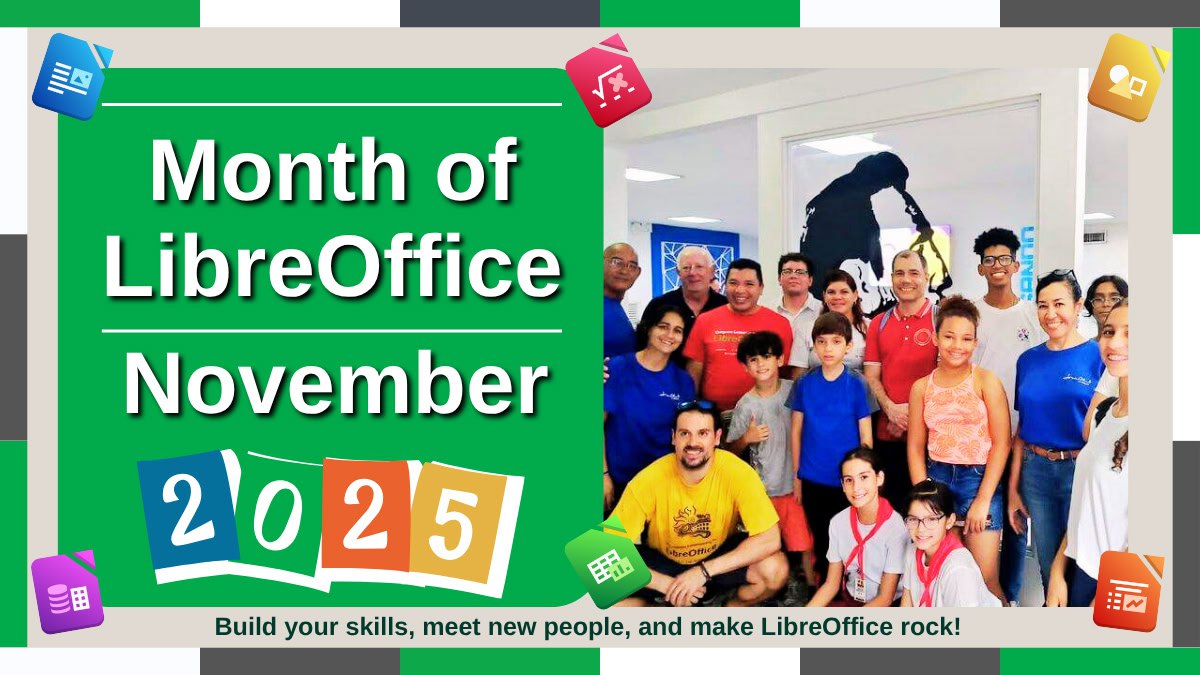
Month of LibreOffice banner, showing community members at events

Love LibreOffice? Join the project and help to make it even better – get involved in the Month of LibreOffice, November 2025! Over the next four weeks, hundreds of people around the world will collaborate to improve the software – and you can help them. There are many ways to get involved, as you’ll see in a second.

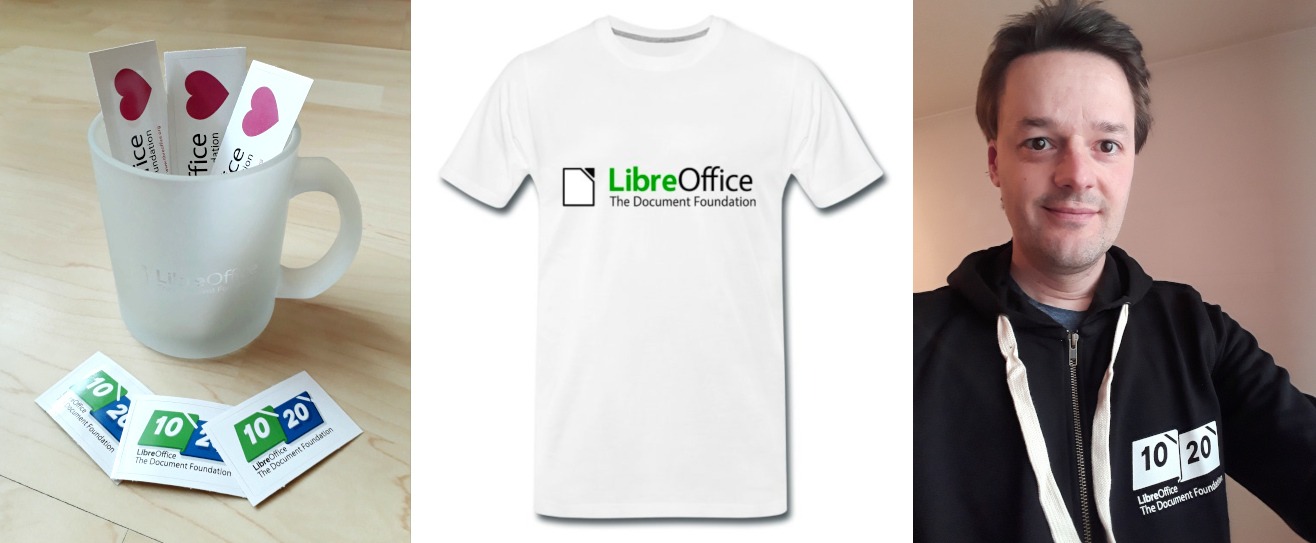
And best of all: everyone who contributes to LibreOffice in November can claim a cool sticker pack, and has the chance to win extra LibreOffice merchandise such as mugs, hoodies, T-shirts, rucksacks and more (we’ll choose 10 participants at random at the end):

How to take part

There are many ways you can help out – and you don’t need to be a developer. For instance, you can be a…

  • Handy Helper, answering questions from users on Ask LibreOffice. We’re keeping an eye on that site so if you give someone useful advice, you can claim your shiny stickers. We also monitor the users@ mailing list.
  • First Responder, helping to confirm new bug reports: Go to our Bugzilla page and look for new bugs. If you can recreate one, add a comment like “CONFIRMED on Windows 11 and LibreOffice 25.8.2”.
  • Drum Beater, spreading the word: Tell everyone about LibreOffice on Mastodon, Bluesky or X (Twitter)! Just say why you love it or what you’re using it for, add the #libreoffice hashtag, and at the end of the month you can claim your stickers.
  • Globetrotter, translating the user interface: LibreOffice is available in a wide range of languages, but its interface translations need to be kept up-to-date. Or maybe you want to translate the suite to a whole new language? Get involved here.
  • Docs Doctor, writing documentation: Whether you want to update the online help or add chapters to the handbooks, here’s where to start.

We’ll be updating this page every few days with usernames across our various services, as people contribute. So dive in, get involved and help make LibreOffice better for millions of people around the world – and enjoy your sticker pack at the end as thanks from us! And who knows, maybe you’ll be lucky enough to win bonus merch as well…

So let’s get going! We’ll be posting regular updates on this blog and our Mastodon, Bluesky and X (Twitter) accounts over the next four weeks – stay tuned…