LibreOffice documentation, help and beyond
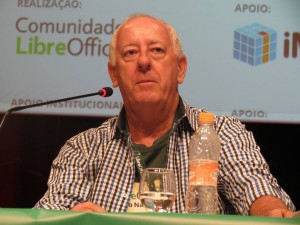 Today, I’d like to talk about what is going on at the LibreOffice documentation project. My name is Olivier Hallot and I am a French national living in Rio de Janeiro, Brazil, since my infancy. Back in 2002, I got involved in the OOo project leading the software translation team for Brazilian Portuguese. My background includes being an executive in two of the major software companies before going on my own and joining the open source community.
The LibreOffice software needs improvements on the documentation process for new features as well as updates or improvements of help contents. This situation has raised my attention, because acceptance in business environments and the quality for the end user can be heavily improved with proper documentation and help.
My presentation at the LibreOffice Conference in Aarhus, in Denmark, was intended to raise the attention of the developers and the community at large, and at the end of 2015, TDF decided to invest into improving the situation of our documentation project.
So here we are, with the challenge to work in many directions:
- get the help content updated and modernized, using a state of the art technology for 2016 and beyond;
- coordinate the literature produced by LibreOffice volunteers, and maintain a set of updated reference book that can be translated to as many languages as possible;
- implement the necessary tooling to make the work of documenting LibreOffice new features the most exciting, for both developers and documentation volunteers.
Of course, all these tasks have to be carried out in a coordinated way with TDF’s mission and objectives.
Working for a Brazilian company, in the future I’ll be supporting the LibreOffice community at large to improve the documentation, and to make it easily accessible to all users. Feel free to poke me on TDF mailing lists as well as on IRC channels in freenode, where I will pop up as ohallot.
Happy documenting!
 March 8 is the International Women’s Day. The theme for 2016 is “Planet 50-50 by 2030: Step It Up for Gender Equality”.
 The Document Foundation has 210 members, but only 20 are women: Belinda Dibra (Albania), Christina Roßmanith (Germany), Eliane Domingos de Sousa (Brasil), Ellen Pape (Germany), Gülşah Köse (Turkey), Irmhild Rogalla (Germany), Jacqueline Rahemipour (Germany), Jean Hollis Weber (Australia), Katarina Behrens (Czech Republic, living in Germany), Linda Martinez (Venezuela), Marina Latini (Italy), Pallavi Jadhav (India), Priyanka Gaikwad (India), Rajashri Bhat Udhoji (India), Regina Henschel (Germany), Sigrid Carrera (Germany), Sonia Montegiove (Italy), Sophie Gautier (France), Surbhi Tongia (India) and Vinaya Mandke (India).
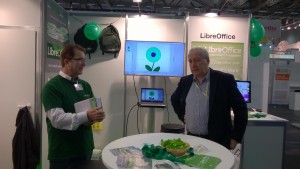 LibreOffice has been exhibiting at Didacta, a large event focused on the education – schools and universities – environment, from February 16 to February 20, 2016, in Koeln (Germany). Booth was attended by Ellen and Walter Pape, and Thomas Krumbein during the week, plus Andreas Mantke on Saturday. Volunteers have answered individual questions (often about compatibility between MS Office and LibreOffice) and have, when it came up, mentioned Libre Logo, Dmaths and the export as a Hybrid PDF.
 We’ve received 200,000 donations in 1030 days, from May 1st 2013 to February 24th 2016, with an average of 194 donations per day. The best day was February 11th 2016 – the day after we announced LibreOffice 5.1 – with 474 donations. Together with volunteers who are contributing their time, and Advisory Board members who are investing in The Document Foundation, individual donors are making the dream of an independent self-sustaining free software-oriented foundation – capable of pushing the best free office suite to the next level of awesomeness – into a solid, enduring reality.