20 Years of the FOSS Office Suite

Twenty years ago, on July 19, 2000, Sun Microsystems announced at O’Reilly Open Source Convention in Monterey, California, the release of the source code of its StarOffice Suite to the open source community. Thus began the history of the community that helped grow the OpenOffice project for nearly ten years, until the announcement of the acquisition of Sun by Oracle.

In September 2010, the same community created The Document Foundation – an organization promised by Sun’s press release, which was always postponed for some reason – to drive the LibreOffice project forward, and continue the story of the best open source office suite while remaining true to the original copyleft license.

Today, we are celebrating 20 years of activity, while preparing for the announcement of LibreOffice 7.0, which will be the first to support Open Document Format 1.3. The passion that we continue to put into all the things we do, including discussions about the future of LibreOffice, is a testament to a daily commitment that has never waned in the last 20 years, and will remain unchanged in the next 20.

HAPPY 20TH BIRTHDAY, FOSS OFFICE SUITE !!!

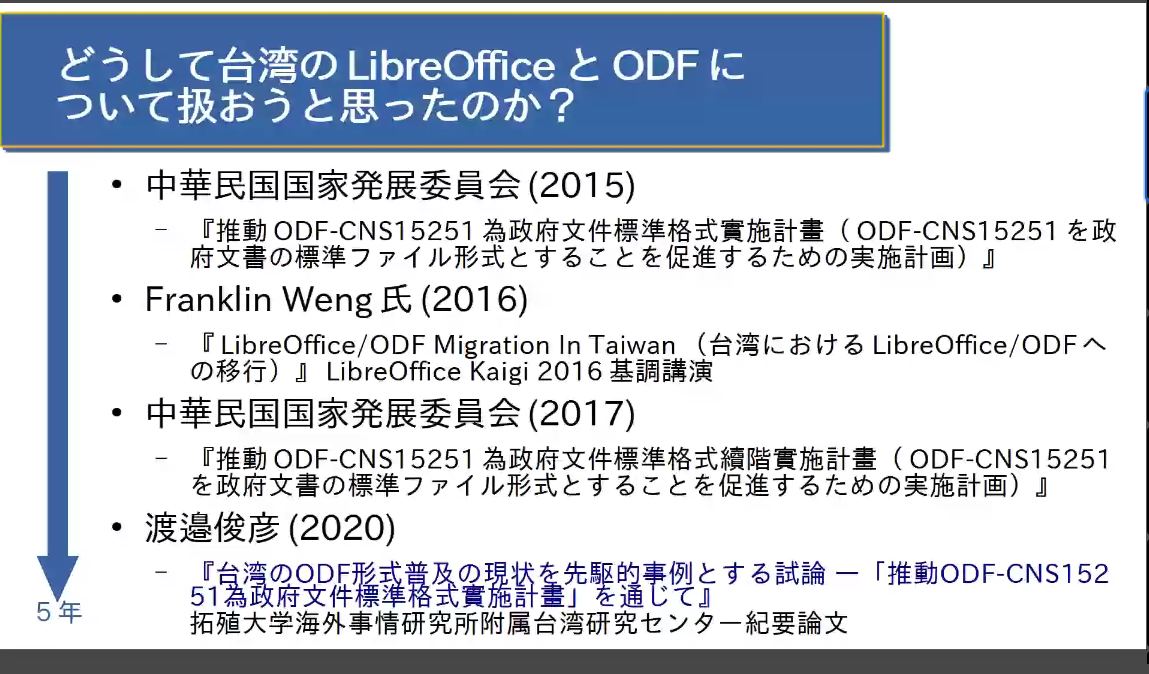
Annual Report 2019: Marketing community activities

(Note: this is a section from The Document Foundation’s Annual Report 2019, which will be published in full in the coming weeks.)

Ongoing Marketing Activities

Marketing at The Document Foundation and LibreOffice is a large team effort, with contractors paid for their activity – thanks to the money made available by our generous donors – and several volunteers, carrying out actions both at global and local levels to increase visibility and brand awareness.

One of the main ongoing projects has been the improvement of the donation page, with several test of page design and wording and of suggested donation amounts. In addition, statistics have been monitored on a daily basis, to trigger a quick reaction to negative fluctuations. As a result, the unexpected low number of donations in February 2019 was counterbalanced by the positive numbers of the following months.

Another ongoing project has been the Community Member Monday Series, with a weekly interview to one or more community members about their contributions to the project, especially within their native language community. Looking at the interviews, it’s rather easy to realize how diverse and geographically spread are the contributors to the LibreOffice project.

The marketing team created a series of New Features videos for the announcement of LibreOffice 6.3 and LibreOffice 6.4, covering the suite as a whole and Writer, Calc and Impress in detail. These videos are a great way to demonstrate new features to end users and are often embedded by news websites. They have also been translated in different languages by volunteers of the localization community. Here’s the 6.3 video:

Please confirm that you want to play a YouTube video. By accepting, you will be accessing content from YouTube, a service provided by an external third party.

YouTube privacy policy

If you accept this notice, your choice will be saved and the page will refresh.

And 6.4:

Please confirm that you want to play a YouTube video. By accepting, you will be accessing content from YouTube, a service provided by an external third party.

YouTube privacy policy

If you accept this notice, your choice will be saved and the page will refresh.

Activities Month by Month

In January, digital currencies support for donations – which was limited to Bitcoin – was extended via CoinGate to other currencies, including: Litecoin, Ethereum, Dash, Nano, Telcoin, Zcash, XRP (Ripple), Augur, Stellar and Decred.

In late January, many LibreOffice contributors and the entire team at The Document Foundation travelled to Brussels for internal meetings and a hackfest, and then to attend FOSDEM, the largest FOSS meeting in Europe, at Université Libre de Bruxelles.

During FOSDEM, we had the opportunity to meet LibreOffice advocates in front of our booth in the main hall of building K where most of the largest projects are based, and at the Open Document Editors devroom. We also had a social dinner at ICAB, where the Italian community cooked pasta for our guests from various FOSS communities.

In early February, we announced LibreOffice 6.2, focusing on social media outreach to support the distribution of the usual announcement in several languages to global media lists. We followed the evolution of journalists, who are increasingly looking at social media as a source of news.

In February we also announced the dates of the LibreOffice Conference 2019 in Almeria (Spain) and those of the First LibreOffice Asia Conference in Tokyo.

In March, we started working on TDF’s Annual Report, creating most of the content and illustrations with LibreOffice, and collecting images from community events for the final version. The final booklet is entirely produced with free software (LibreOffice plus GIMP for tweaking images, Scribus for creating the layout, and the free Croscore fonts: Carlito and Caladea).

On March 15, MITRE announced that The Document Foundation was approved as CVE Numbering Authority (CNA). Common Vulnerabilities and Exposures (CVE) is a reference list of public cybersecurity vulnerabilities, with entries that describe those vulnerabilities and provide references for them.

During the month, we also announced the start of Google Summer of Code activities, we launched the call for papers for LibreOffice Conference 2019 in Almeria (Spain), and we celebrated the Document Freedom Day. Finally, we started posting regular updates on Mastodon, an open source, self-hosted and federated social media platform.

In April, we announced the first Latin America LibreOffice Conference at the Facultad Politécnica de la Universidad Nactional de Assunción (FPUNA) in Asunción, Paraguay, on July 19 and 20.

In May, Mike Saunders organized the “Month of LibreOffice” campaign, which gave contributors the opportunity to thank other members of the community for their work by awarding them stickers and mugs. There have been awesome contributions all across the project, from code patches and bug report confirmations, through to translations and user support, with the award of 355 stickers and 12 glass mugs.

Members of the German LibreOffice community met at Linux Hotel in Essen for a weekend of discussions, ideas, hacking – and great food! The project also announced Adfinis SyGroup as a new member of TDF Advisory Board, and LibreOffice participating in Google Season of Docs to give technical writers and FOSS projects an opportunity to co-operate and better know each other.

In June, we started to concentrate on the announcement of LibreOffice 6.3, cleaning journalist mailings and starting to collect information for the press pack. Over time, we have also increased TDF and LibreOffice presence on social media, by incrementing the number of tweets and posts.

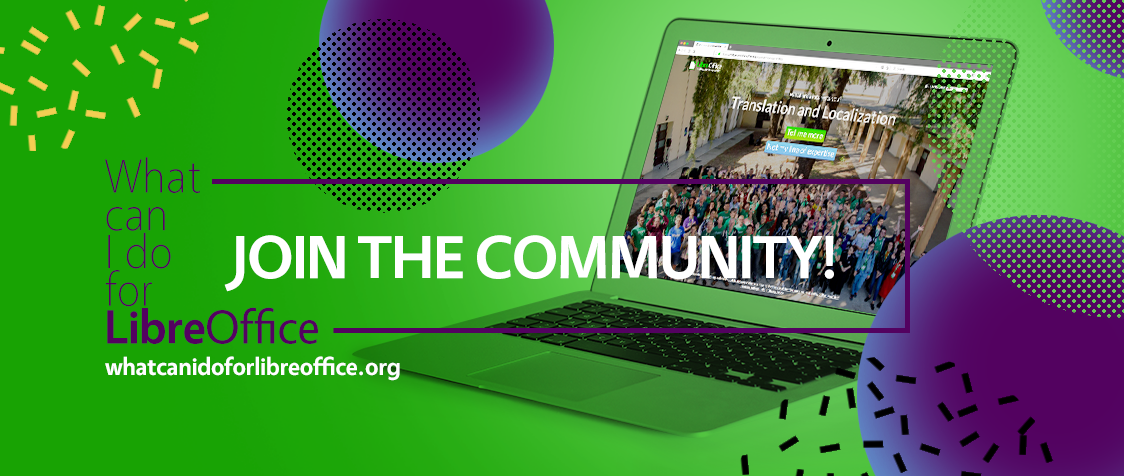
Meanwhile, we announced a cool new website, What Can I Do For LibreOffice, which shows people several ways to contribute to our project and community in a friendly and appealing way, encouraging newcomers to jump on board.

In July, we announced COSM, the Community of ODF Specification Maintainers, to hold funds and to retain editors to work at the ODF Technical Committee, to accelerate the development of ODF 1.3. ODF (Open Document Format) is the native file format of LibreOffice, and is a fully open standard document format, ideal for long-term content storage and sharing.

We also finalized the launch materials for LibreOffice 6.3, with the press kit localized in several languages, thanks to volunteers who contributed the translation in their own language, and the slide deck for press briefings.

At the end of the month, TDF announced that the UK’s Government Digital Service (GDS) has joined the project’s Advisory Board. Back in 2014, the UK Cabinet Office announced the selection of the Open Document Format (ODF) for sharing and viewing government documents, so they are one of the main advocates of the standard.

In August, we announced LibreOffice 6.3, with better performance, many new and improved features, and enhanced interoperability with proprietary document formats. In Europe, members of the German LibreOffice community attended FrOSCon, one of the largest FOSS events in the country.

We started a new marketing campaign highlighting the fact that LibreOffice has no forced registration, subscriptions, payments or vendor lock-in, to underline the difference with the increasing number of software vendors asking for online subscription models.

In September, the community attended the LibreOffice Conference organized by the Spanish community at the University of Almeria, with sessions about development and other topics, and several workshops and meetings. Additional events, like the welcome drinks, the social dinner and the hacknight were hosted in different locations.

In October, The Document Foundation supported the International Day Against DRM 2019, to fight against the technological restrictions that control what users can do with digital media. Later in the month we started the announcement process for LibreOffice 6.4 with the first Bug Hunting Session.

In November, the TC Committee Draft of ODF Version 1.3 was released to OASIS for ratification. At the end of the review process, ODF Version 1.3 will be submitted to ISO for the final approval, which is expected in late 2020 or early 2021. During the month, LibreOffice was also present at two events in the Czech Republic, LinuxDays in Prague and OpenAlt in Brno. Of course, November was another “Month of LibreOffice”, with Mike Saunders awarding 304 stickers and 10 glass mugs to top contributors.

In December we announced the winner of the LibreOffice 10/20 Logo Community Contest. The year 2020 will be the 20th anniversary of the free office suite and the 10th anniversary of LibreOffice (announced on September 28, 2010). To celebrate, we have a special logo for presentations, events and swag.

The Importance of Donations

Donations are key for current operations and future developments of The Document Foundation, as they allow to keep the organization alive, to fund specific activities, to support events and other marketing tasks organized by native language projects, and to maintain a small team working on various aspects of LibreOffice.

Donations are also used to fund local projects such as OSCAL in Albania, LibreOffice Conferences in Asia and Latin America, LibreItalia Conference in Italy, FOSS events in Czech Republic, hackfests in France, activities targeted to schools in Italy, local events in the US, Japan and Turkey, and much more.

In addition, funds from donations have been used to reimburse travel expenses for many community members who have attended events to present LibreOffice and share their knowledge about the project.

If you find LibreOffice useful, support us with a donation so that we can continue to build our community, share knowledge, and improve LibreOffice for everyone!

New Czech translation of Getting Started Guide 6.4

Zdenek Crhonek from the Czech LibreOffice community writes:

The Czech translation of the LibreOffice 6.4 Getting Started guide is now available! The history behind this book is quite long: first, another team translated the version 4.2 guide in 2014, but they never fully finished it (didn’t do corrections, publishing etc.) Then they started to update for version 5.1, but never finished the translation. I was not part of the team in these days, so this is what I’ve found out from the mailing lists. Thanks to the CAT (computer-assisted translation) tool OmegaT, we could used their old translations and build upon it. In 2020 we started translation again with version 6.0, but we quickly jumped to version 6.4 and followed the documentation team’s updates.

The translation was a team effort – a big thanks to:

  • Anna Benc
  • Eliška Rolfová
  • Lucie Studená
  • Marcela Tomešová
  • Miloš Šrámek
  • Petr Kuběj
  • Petr Valach
  • Roman Toman
  • Vendula Crhonková
  • Zdeněk Crhonek
  • Zuzana Kašparová
  • Zuzana Pitříková

Great work! Everyone is welcome to join our documentation community. It’s a great way to build up skills for a potential future career in technical writing…

Announcing elections for the next TDF Membership Committee

Franklin Weng from The Document Foundation’s Board of Directors writes:

Dear Community,

we hereby officially announce the upcoming elections for the next Membership Committee of The Document Foundation.

As per § 12 II of our statutes (binding version in German and non-binding translation), the Membership Committee’s term lasts two years. The current Membership Committee started its duty on September 19, 2018. Therefore, the old Membership Committee remains in charge until the end of September 18, 2020, so the new MC will be in charge the day after that, which is September 19, 2020.

That upcoming term will then (regularly) end on September 18, 2022, so the next election of the Membership Committee will take place before.

As per § 6 III, only members of the Board of Trustees of The Document Foundation, as well as current members of any of its bodies, are eligible to be elected into the Membership Committee, and the election is overseen by the Board of Directors (§ 12 II).

The active electoral right is reserved to those who have been members of the Board of Trustees before this announcement (§ 12 II).

§ 6 III also states that members of the Board of Directors or their substitute members may not be members of the Membership Committee and vice versa.

There is one more notable limitation: Per § 8 IV of the statutes, a maximum of 1/3 members of the Membership Committee is allowed to work on an employment basis for the same company, organization, entities, affiliates or subdivisions.

Nomination of candidates fulfilling the above requirements, as well as self nomination is welcome. In total, at least five members of the Membership Committee are required, and given there are enough candidates, up to four substitute members can be elected based on the last board decision on this matter.

Re-election of current members of the Membership Committee is explicitly permitted (§ 12 II).

Please send nominations and self-nominations via e-mail to elections@documentfoundation.org (which reaches the Board of Directors in private) and also (!) to board-discuss@documentfoundation.org (which is a public mailing list).

We kindly ask nominees who would like to stand for elections to provide a statement of up to 75 words – longer statements will be cut off at the maximum – on their candidacy as continuous text (so no bullet lists or multiple paragraphs). In addition, you have to provide your full name, e-mail address and your corporate affiliation, if any, and please announce that you will provide information on all future changes as soon as possible. Specifically, it is necessary to indicate all information regarding § 8 IV of the statutes.

Discussions with the candidates and questions to them as well as questions about the elections should take place on the public board-discuss@documentfoundation.org mailing list. For details on how to use the mailing list, see https://www.libreoffice.org/get-help/mailing-lists/

Eligible voters will receive further details via e-mail prior to the start of elections, including a summary of the candidates, details on how to access the voting system, and instructions on how to independently verify the vote count. Please ensure we have your recent and correct e-mail address on file. For questions, you can reach the Board of Directors in private at elections@documentfoundation.org

Following the time line set forth in § 12 II, requiring a 45 day advance notice, we hereby announce the following time line for the elections:

(00:00 is beginning of the day, 24:00 is end of the day)

  1. (no later than) Friday, 2020-07-17: announcement of the election; and start of the nomination phase
  2. Thursday, 2020-08-27, 24:00 CEST/UTC+2: end of the nomination phase (one week before the election starts, as per § 12 II)
  3. Friday, 2020-09-04, 00:00 CEST/UTC+2: official start of the elections (at least 45 days after announcement of the election, as per § 12 II)
  4. Thursday, 2020-09-10, 24:00 CEST/UTC+2: end of the election
  5. Friday, 2020-09-11: announcement of the preliminary results and acknowledgement of role
  6. Saturday, 2020-09-12, 00:00 CEST/UTC+2: start of the challenging phase
  7. Tuesday, 2020-09-15, 24:00 CEST/UTC+2: end of the challenging phase
  8. afterwards: official announcement of the final results
  9. Saturday, 2020-09-19: new Membership Committee officially in charge, and election of a Chairperson from among its members

Be advised that the newly elected Membership Committee will only be in charge beginning from September 19, 2020.

Challenges to this election announcement with respect to the deadlines outlined have to happen no later than seven (7) days after this announcement, via e-mail to elections@documentfoundation.org (which reaches the Board of Directors in private).

Challenges to the preliminary results of the election have to happen until the deadline set forth above, via e-mail to elections@documentfoundation.org (which reaches the Board of Directors in private).

On behalf of the Board of Directors,
Franklin Weng

Community Member Monday: Khairul Aizat Kamarudzzaman

Today we’re talking to Khairul Aizat Kamarudzzaman from our Malaysian community. He’s a long-time fan of free and open source software, and is helping with LibreOffice advocacy and marketing…

To start off, tell us a bit about yourself!

I’m from Kuala Lumpur, Malaysia. I started exploring and using FOSS way back in 2004 (Debian, Red Hat, the BSD family and sticking with Ubuntu till today) when I was studying at the university. From there I started exploring and contributing to Ubuntu, which you can find here, and I was accepted to be an Ubuntu Member, Kubuntu Membes (merits as Ubuntu contributor). Finally I was appointed to be part of the Asia Oceania Membership Board.

A a FOSS community member, I work in a few IT companies in Malaysia and was one of the engineers working at Open Source Competency Centre (OSCC) under Malaysian Administrative Modernisation and Management Planning Unit (MAMPU). Now I own my own IT company, namely Informology Sdn Bhd. Not stopping there, I continue actively being a FOSS enthusiast in Malaysia. When the cloud computing era came, I was involved by leading Malaysia OpenStack User Group, and I’ve recently been exploring and leading the Endless OS user group for Malaysia.

What are you working on in the LibreOffice project right now?

I started the LibreOffice Malaysia Group on Facebook, and I’m planning with the group to finish the LibreOffice Malay translation as soon as possible, with guidance from the Indonesian LibreOffice translation team – so that we can have Malay language support in LibreOffice and Collabora Office.

Why did you decide to become a member of The Document Foundation?

It’s in line with what I’ve done since I started using FOSS: open source advocacy targeted at students, teachers, government staff and the open Source community members in Malaysia. I especially focused on Linux, and office automation like LibreOffice and Collabora Office as an alternative to Microsoft Office. Then, last year in 2019, I managed to participate in the Gnome Asia Summit 2019 in Surabaya, Indonesia where I met a lot of FOSS enthusiasts who are advocating and spreading open source in Indonesia, along with a few awesome TDF members (Ahmad Haris), TDF Board member (Franklin Weng) and GNOME Foundation Staff.

So I asked myself… since I already pitching the Open Document Format (ODF) since I was in OSCC, why not start contributing more to LibreOffice by doing translations? So I challenged myself by applying to become a TDF member, with advice from Ahmad Haris and Franklin Weng.

Anything else you plan to do in the future?

Keep spreading and marketing LibreOffice in Malaysia – especially in the government and educational sectors. Give these sectors LibreOffice as an alternative, by not using piracy and a cracked version of Microsoft Office.

Maybe the LibreOffice Malaysia group can suggest to TDF to host the LibreOffice Conference in Malaysia one day in the future!

Thanks Khairul! And indeed to everyone in the Malaysian LibreOffice community. Your work is essential to help spread awareness of LibreOffice across the globe.

Join the LibreOffice community today! Have fun and build up your skillset…