Announcing LibreOffice New Generation

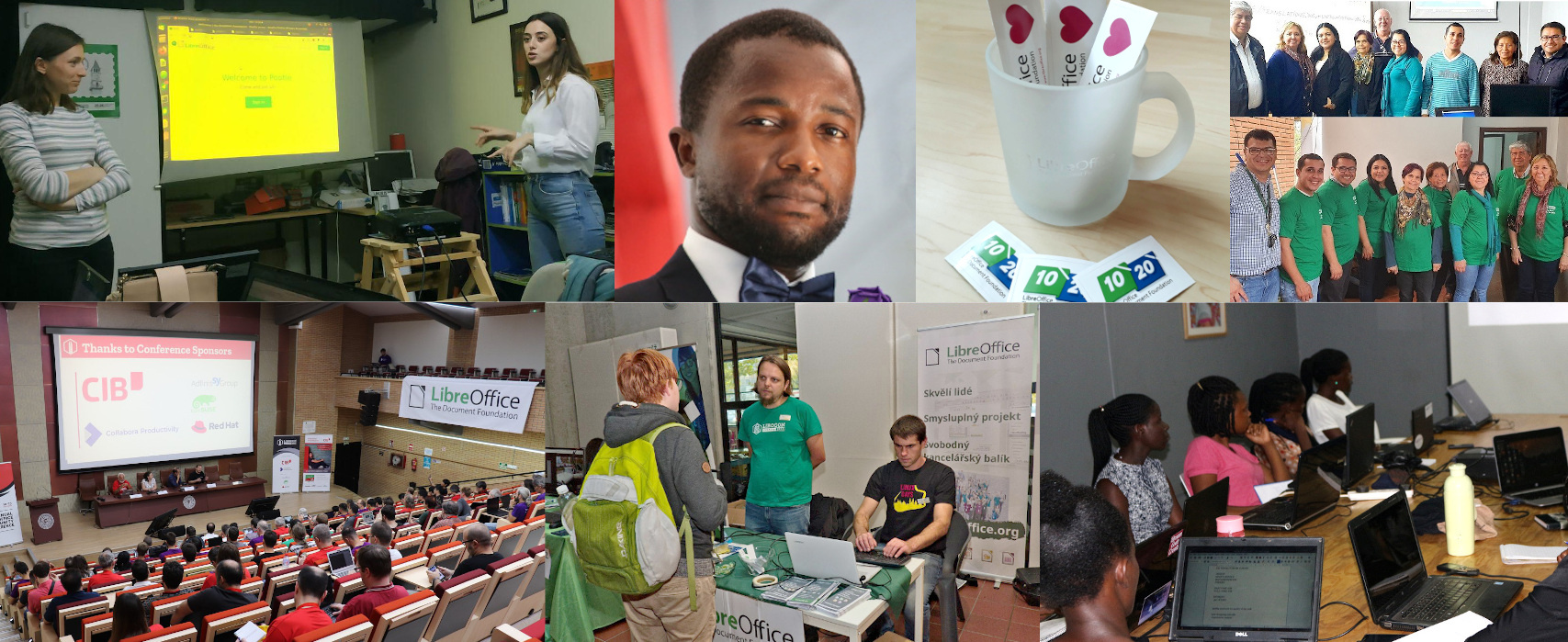
Today we’re announcing a new project: LibreOffice New Generation. This isn’t about the software, but about the people behind it. As you probably know, LibreOffice is made by a worldwide community of certified developers and volunteers, working on the source code, translations, documentation, design, QA, marketing, infrastructure and other areas.

Well, we want to reach out to even more people, so read on to find out more…

What is this?

LibreOffice New Generation is our project to bring new – and especially younger – people into the LibreOffice community. While we’re proud that our community is diverse and has people from all ages, younger people help to bring fresh ideas and approaches to the project. So we want to make it easier for everyone to join, get involved and have fun – regardless of age.

Who can join?

Anyone! If you’re a school or university student and use LibreOffice, we’d love to hear from you. What do you use LibreOffice for? How can it be improved? Can we help you to spread the word? Join us and let’s work together to make LibreOffice even better!

But everyone else is welcome to join too. The Document Foundation is a small non-profit, so we’d appreciate all help with bringing younger contributors into the project and helping them to get involved with our teams.

What will you do?

Many students who contribute to free and open source software projects like to have something which confirms their work. At TDF we’ve been issuing Open Badges for community contributions – these are special badges with metadata inside, showing what someone did. So we’d like to start issuing these to younger and newer community members too.

We have other ideas and projects, but we’d like to hear from you about your experiences! What else can we offer? How can we credit and reward contributors for their work? Let us know what you think…

How can I join?

If you’d like to discuss ways to get more younger people involved in the LibreOffice community, join our Telegram group where we can discuss Open Badges and other ideas for LibreOffice New Generation. (For all other discussions and suggestions for LibreOffice, please see the general group.) If you’d like to suggest something directly, email me (Mike) and we’ll have a chat.

We look forward to meeting you, and hearing your ideas and experiences!

Introducing the ScriptForge Basic Libraries

The arrival of the ScriptForge Libraries will greatly help macro programming in LibreOffice.

By Jean-Pierre Ledure

What is ScriptForge?

ScriptForge libraries are an extensible and robust collection of macro scripting resources for LibreOffice to be invoked from user Basic macros. Users familiar with other BASIC macro variants often face hard times to dig into the extensive LibreOffice Application Programming Interface even for the simplest operations. By collecting most-demanded document operations in a set of easy to use, easy to read routines, users can now program document macros with much less hassle and get quicker results.

ScriptForge abundant methods are organized in reusable modules that cleanly isolate Basic programming language constructs from ODF document content accesses and user interface(UI) features.

What is in ScriptForge?

ScriptForge libraries hold:

  • an extensive set of primitives for array handling, including sorts, set operations and interfaces with csv files
  • an extensive set of primitives for string handling, including replacements, regular expressions, encodings, hashing and localization
  • a Dictionary mapping class
  • a class to help internationalize Basic scripts
  • a coherent error handling for both user and ScriptForge scripts
  • complete FileSystem and TextStream classes for file and directory handling, plus text files read & write
  • detailed context information: platform, operating system, directories, …
  • interconnection between Basic and Python modules

Document-based and UI ready-made examples help overcome LibreOffice Application Programming Interface (API) steep learning curve. They offer easy access to and management of actual windows and documents, with specific modules for automation on Calc sheets, cells and ranges of cells, management of dialogs and their controls and access to data contained in databases, among many other services.

The described features are invoked from user scripts as “Services” that can be extended. ScriptForge libraries build up an extensible ecosystem that combines with standard libraries, libraries published as extensions or libraries distributed as enterprise extensions.

What else?

ScriptForge libraries documentation is undergoing review and translation and will be available from LibreOffice 7.2 onwards, but you can use ScriptForge services and scripts right away with LibreOffice release 7.1. A glimpse of the ScriptForge documentation is already online at this Help page.

A lecture on ScriptForge was delivered by Jean-Pierre Ledure at the LibreOffice 2020 conferenceA PDF presentation document is available for download.

ScriptForge is a community contribution by Jean-Pierre Ledure, Alain Romedenne and Rafael Lima.

Scripting LibreOffice macros with Basic just got easier with ScriptForge libraries!

The round-the-world trip to fix a bug

A little story: The beauty of planet-wide collaborative work in LibreOffice

Mrs. Vera Cavalcante (@veracape), from Brazil, a long-time contributor for the Portuguese documentation on LibreOffice, was reviewing the translation of the Calc Guide and double-checking the translated text, with respect to the current user interface and the Help pages. Vera noticed that the Help pages on conditional formatting were not correct any more, and reported in the Brazilian team Telegram group (Bugzilla is still very hard for non-native English speakers).

The message hit Olivier Hallot (@ohallot) from the LibreOffice documentation coordination team (and Brazilian community member), who reported the bug in LibreOffice’s Bugzilla, for later fixing. LibreOffice’s outstanding quality depends on good quality and numerous errors reports to be submitted properly, for improvements and fixing defects. There is no point leaving a bug unreported.

The topic was of special interest of Roman Kuznetsov (@kompilainenn) from Russia, who already wrote documentation about conditional formatting. Roman wrote the fix, and submitted a patch in Gerrit (the service that controls the code corrections in LibreOffice)…

…and Adolfo Jayme Barrientos (@fitojb) from Mexico reviewed and approved the patch for merging in the main Help code.

End result: LibreOffice’s Help page fixed!

Community Member Monday: Felipe Viggiano and Zhenghua Fong

Today we’re talking to two people who’ve recently decided to become members of The Document Foundation, the non-profit behind LibreOffice. First up, Felipe Viggiano…

Hey Felipe, tell us a bit about yourself!

Hello there! I’m writing from the state of São Paulo, in Brazil. I’m an electrical engineer and have been working with LibreOffice for several years. Despite all this time, I started to contribute only a few months ago.

What are you working on right now?

Right now I’m working with the Documentation Team, mainly on the update of the Calc Guide with the new features in LibreOffice 7.0. Working with the team has been a huge learning opportunity, and the other team members are always there for a little help when needed.

Why did you decide to become a member of TDF?

The reason I applied for membership is to try to contribute a little more to the project in other areas.

Anything else you plan to do in the future?

In the future, I would like to start contributing more with others teams, and with TDF in order to help increase LibreOffice’s success. In my opinion, LibreOffice needs to be better known – we have a great free office solution that attends the majority of the requirements of the general public, but, at least in Brazil, many people are not aware of this!


Next us is Zhenghua Fong, who works on improving LibreOffice’s compatibility with other office suites…

Tell us a bit about yourself!

I’m part of a team of three people from Fuzhou, a coastal city known for its hot springs, in the Fujian province in China. When we are not coding, we like jogging in the nearby park. Every year we have company-wide Half Marathon Run around the main campus. Around 7,000 employees compete in the run and other sporting events.

Why did you decide to become a member of The Document Foundation?

As we’re an education tech company, documents are at the core of our business. LibreOffice works great for us. Recently, we have add a whiteboard feature to our product with the help of LibreOffice Online.

What are you working on in the LibreOffice project right now?

Compatibility is the area we are working on. Because large parts of the population still use Microsoft Office-based document formats, it’s important to our users that they are able to open documents and get them right the first time.

Anything else you plan to do in the future? What does LibreOffice
really need?

Performance. We find the performance of our product has room for improvement, especially when compared against Microsoft Office and WPS from Kingsoft.

Thanks to Felipe and Fong for all their contributions! Our worldwide community is what makes LibreOffice strong – everyone is welcome to join and find out what they can do for LibreOffice!

Join the LibreOffice Team as a Developer Community Architect (m/f/d), 20-40h per week, remote (#202101-01)

The Document Foundation (TDF) is the non-profit entity behind the world’s leading open source office suite, LibreOffice. We are truly passionate about free software, the open source culture and about bringing new companies and people with fresh ideas into our community, especially as we are about to enter the second decade of our project.

To grow the LibreOffice community and to enlarge the associated ecosystem, together working on office productivity for over 200 million users around the globe 🌎, we’re searching for a Developer Community Architect (m/f/d) to start work as soon as possible.

As our future Developer Community Architect, you work with a great team of currently eleven to:

  • Attract new contributors by promoting the LibreOffice project

  • Identify and onboard them, by building relationships between new coders and the community

  • Introduce them to our communication channels where they meet fellow co-hackers

  • Affirm and encourage everyone’s contribution and show community members ways to grow

  • Bring skilled contributors in contact with existing experts in the various fields for even deeper learning

To succeed in this new role, you ideally already have some of the following skills:

  • Previous experience in remote work

  • Self-driven and an excellent team player, who is interested in working as part of our team

  • Patience and kindness to work with potential contributors of various skill levels

  • Been a long-time contributor to one or more FLOSS communities, with coding experience in at least one FLOSS code base – ideally LibreOffice, of course! 🙂

  • Demonstrable C++ coding experience of at least five years, or a comparable language like C#, plus active knowledge of at least one more language used in LibreOffice, like Python or Java

  • Excellent communication abilities, that help you transport your enthusiasm for LibreOffice and our community

  • A quick learner with good self-starting capabilities (demonstrable quick learning is a good compensation for immediate lack of LibreOffice knowledge!)

  • Experience in web development and/or mobile technologies is a plus

  • When possible again, willingness to regularly travel to Hackfests and conferences in Europe and globally. In the meantime, you are excited to create virtual events on a regular basis, with the excellent infrastructure offered by TDF.

  • Fluent written English for e-mail and chat, with good speaking and comprehension is a mandatory requirement. Fluency in another widely-used language like e.g. Spanish or Mandarin would be considered an advantage.

Here’s how a typical day in your new role might look like:

You start your day by looking in Gerrit for unreviewed patches. There, you help to onboard new contributors, by positively reviewing their code contributions, which also involves syncing the coding style of their patches with LibreOffice’s. Your goal is to work with them and help them grow their skills where needed, like C++ programming, design and coding, and encourage them to bring up their own ideas how to implement a new feature or fix a bug in the codebase – in short, you are their guide to make their ideas become a reality. Especially for new contributors, you will introduce them not only to our community culture, but also to our variety of tools, which you regularly review and make proposals to improve or unify them.

One way to attract new contributors is to lower the entry barriers. You design and define easy tasks (“Easy Hacks”) for coders, that help them to learn about the code, our toolchain, the LibreOffice build system and leads them step by step into growing mature in the repository, so that they can ideally work on more advanced tasks.

Apart from the individual mentoring, an important part of your role is about knowledge sharing with the general public by writing and updating our technical documentation, like the developer guide, our wiki articles and also code comments. You master that thanks to your ability to write comprehensive texts for technical people.

The role you will fill gives you a lot of freedom and flexibility to shape our mentoring program. That requires you to work goals-oriented and with a laser-sharp focus to grow excellent LibreOffice core contributors. As our successful Developer Community Architect, you will come up with creative ways of finding and attracting volunteers who will stay in the community!

All jobs at The Document Foundation are remote jobs 🌟, where you can work from your home office or a coworking space. The work time during the day is flexible, apart from very few fixed meetings. The role is offered both as part- or fulltime, with the option to grow the hours later, just as you grow into your role.

Are you interested? Get in touch! We aim to schedule the first interview within two weeks of your application. You can also approach us anytime for an informal chat to learn about the role or in case of questions – and you can directly join our virtual FOSDEM DevRoom on February 7 to see what’s going on in the community!

TDF welcomes applications from all suitably qualified persons regardless of their race, gender, disability, religion/belief, sexual orientation or age. Don’t be afraid to be different, and stay true to yourself. We like you that way!

We are looking forward to receiving your application, including information about you, when you are available for the job, and of course your salary expectations. Please send us an e-mail to mentor.application@documentfoundation.org by February 18, 2021. A final decision for the role will be made by March 18, 2021.

Note: We do not accept agency resumes. Please do not forward resumes to any recruiting alias or employee.