The Brazilian law that changes everything for schools, and why LibreOffice is the right answer

Brazil’s Lei 15.211/2025, also known as the Estatuto Digital da Criança e do Adolescente (EDCA), came into force on 17 March 2026. It is one of the world’s most comprehensive digital child protection laws, with profound implications for the Brazilian education system.

School administrators, IT managers, and education policymakers now have a legal obligation to consider every technology product deployed in classrooms. LibreOffice, the FOSS office suite developed and maintained by The Document Foundation, is uniquely positioned to meet these obligations by design.

What the law actually requires

The EDCA establishes that every IT product or service directed at children and adolescents – or “likely to be accessed” by them – must guarantee their integral protection, prioritise their best interests and maintain the highest level of privacy and data security (Art. 3). Among the law’s key requirements are:

  • Privacy by default and by design. Products must operate at the highest available level of data protection as a default setting, and any reduction in protection must require explicit, informed consent (Art. 7).
  • No behavioural profiling. Any form of automated or manual profiling of minors based on behaviour, preferences, economic status or location is subject to strict limitations (Arts. 2(V) and 26).
  • No predatory commercial exploitation. Techniques that profile children for advertising purposes are explicitly prohibited, as are design patterns intended to encourage prolonged use (Arts. 22, 17).
  • Digital citizenship education. The promotion of the safe, responsible and critical use of technology is listed as one of the foundational principles for all IT products used by minors (Art. 4, VIII).
  • Transparency and accountability: Technology providers must be auditable and have a legal representative in Brazil, as well as publishing transparency reports (Arts. 31 and 40).

Educational software is not exempt from this law. Any office suite, productivity tool or learning application running on school devices is an IT product as defined in Art. 1, and the access standard is deliberately broad.

Why LibreOffice fits natively

LibreOffice was not designed to exploit the attention of its users. It is not a cloud service. It does not collect usage telemetry by default. It does not profile users. It does not display adverts. There are no engagement algorithms optimised to keep students on the platform.

In the language of the EDCA, it is a product whose architecture embodies the principle of privacy by design (Art. 7), and not because it has been retrofitted to comply, but because there is no commercial incentive for it to do otherwise.

Specifically:

No data leaves the classroom without explicit configuration. LibreOffice runs locally on the desktop, and documents are stored wherever the school chooses. There is no background synchronisation with a vendor’s cloud and no automatic transmission of usage patterns to a third party. It is the school, and not a foreign corporation, that controls the data environment.

It is auditable to the source code. According to the EDCA, technology products must be evaluated for their potential impact on the health and safety of children and adolescents (Art. 8, I). LibreOffice’s source code is publicly available under the Mozilla Public Licence, and can be inspected by any school, researcher or public authority. There is no black box.

There are no manipulative design patterns. The law explicitly prohibits features that artificially extend or sustain product use by minors, such as autoplay, reward programs, non-essential notifications and personalised recommendation systems (Art. 17, §4). LibreOffice has none of these features. It opens a document, it helps the user to work with it, and then it closes. This is what neutral, instrumentally focused software looks like.

It supports digital citizenship education. Art. Article 4, Section VIII of the EDCA establishes the promotion of “digital citizenship and critical thinking for safe and responsible technology use” as a foundational principle. Using LibreOffice in schools is a pedagogical act in itself as it teaches students that software is a tool and not a service that monitors them; that their documents belong to them and are stored in open standard formats (ODF), which any compatible application can read; and that technology infrastructure can be based on transparency rather than restriction.

Open Document Format is digital sovereignty. ODF, LibreOffice’s native format, is an ISO-certified open standard. Documents created by Brazilian students today will be readable ten years from now by any application that respects the standard without requiring vendor permissions or subscription fees, and data being routed through a foreign corporate infrastructure. This is not an incidental feature but a material expression of the EDCA’s guarantee of meaningful access to digital technologies (Art. 5, §2).

In plain terms, schools deploying LibreOffice do not need to read a 200-page data processing agreement to understand what happens to their students’ data. They do not need to complete a vendor questionnaire and wait for a legal team in the US to respond, or to negotiate a contractual carve-out for LGPD (Lei Geral de Proteção de Dados) compliance, or worry about whether a new product feature silently changes the default privacy configuration.

The architecture answers the question. Local software, open code, no telemetry, no profiling and no engagement design are not compliance claims that need to be verified. They are structural properties that can be confirmed by any competent system administrator.
Under the EDCA, transparency is not optional. It is what the law demands.

A Call to Action for Brazilian Education

The EDCA came into force on 17 March 2026. Schools and municipalities that have not yet reviewed their technology stack now have a legal obligation, rather than just a policy recommendation, to do so. The Document Foundation invites Brazilian educators, school administrators and public procurement officers to:

  1. Audit existing deployments of proprietary cloud platforms against the EDCA’s requirements for privacy by default, data minimisation and prohibition of behavioural profiling.
  2. Evaluate LibreOffice as a classroom productivity solution, including the enterprise-ready LibreOffice Technology ecosystem for schools requiring centralised administration and support.
  3. Adopt the OpenDocument Format (ODF) as the institutional open standard for document formats to ensure that student work remains portable, open and free from vendor dependency.
  4. Engage with the community. LibreOffice is developed by a global community of active contributors, including many in Latin America. Brazilian schools that adopt LibreOffice are not just consumers, but they can help to shape the tool that their students use.

The Lei da Criança e do Adolescente is a law that protects children in digital environments, and LibreOffice is a software that was never designed to exploit children. This is not a coincidence, but the consequence of a shared understanding of what technology should be in a democratic society: a tool for users, not the other way around.

The Document Foundation is the non-profit organisation behind LibreOffice. LibreOffice is free to download, deploy and use. For information on enterprise deployments and certified support providers, visit https://www.libreoffice.org or write to info@documentfoundation.org.

Dear Europe: Germany has shown the way forward

Germany has made ODF mandatory as the standard format for documents within its sovereign digital infrastructure. The decision is incorporated into the Deutschland-Stack, the framework governing the development, procurement and management of digital systems for public administration at all levels. This is neither a pilot project nor a recommendation from a working group, but a mandate backed by the federal government and the coalition agreement.

The official document has been published by the IT-Planungsrat, the central political steering body comprising the federal government and state governments, which promotes and develops common, user-oriented IT solutions for efficient and secure digital administration in Germany: https://www.it-planungsrat.de/beschluss/b-2026-03-it.

At this point, the question for all other European governments is clear: what are you waiting for? With this decision, the distinction between those who care about digital sovereignty and those who do not becomes stark.

There are no more excuses

Over the years, public administrations in Europe have accumulated a series of tired excuses, long since overtaken by the facts, for not making standard and open document formats mandatory. Let’s examine them one by one.

ODF isn’t mature enough. ODF has been an ISO standard since 2006. It is now at version 1.4, with active development, a broad ecosystem of implementations and adoption by numerous national governments, the European Parliament and major public administrations worldwide. The maturity argument has long been superseded.

Changing the document format requires staff retraining. The explicit principle of Germany’s sovereign stack is to reduce the effects of lock-in. If the objection is the cost of retraining, you are saying that the commercial interests of the dominant supplier outweigh those of citizens and institutions. This is an acceptable position in the private sector, but inadmissible in the realm of public policy.

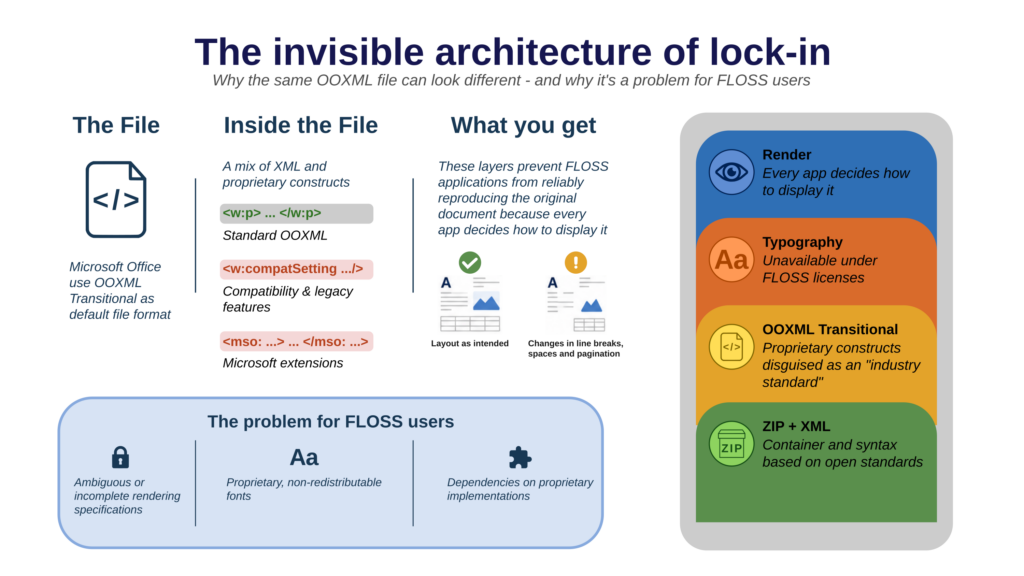
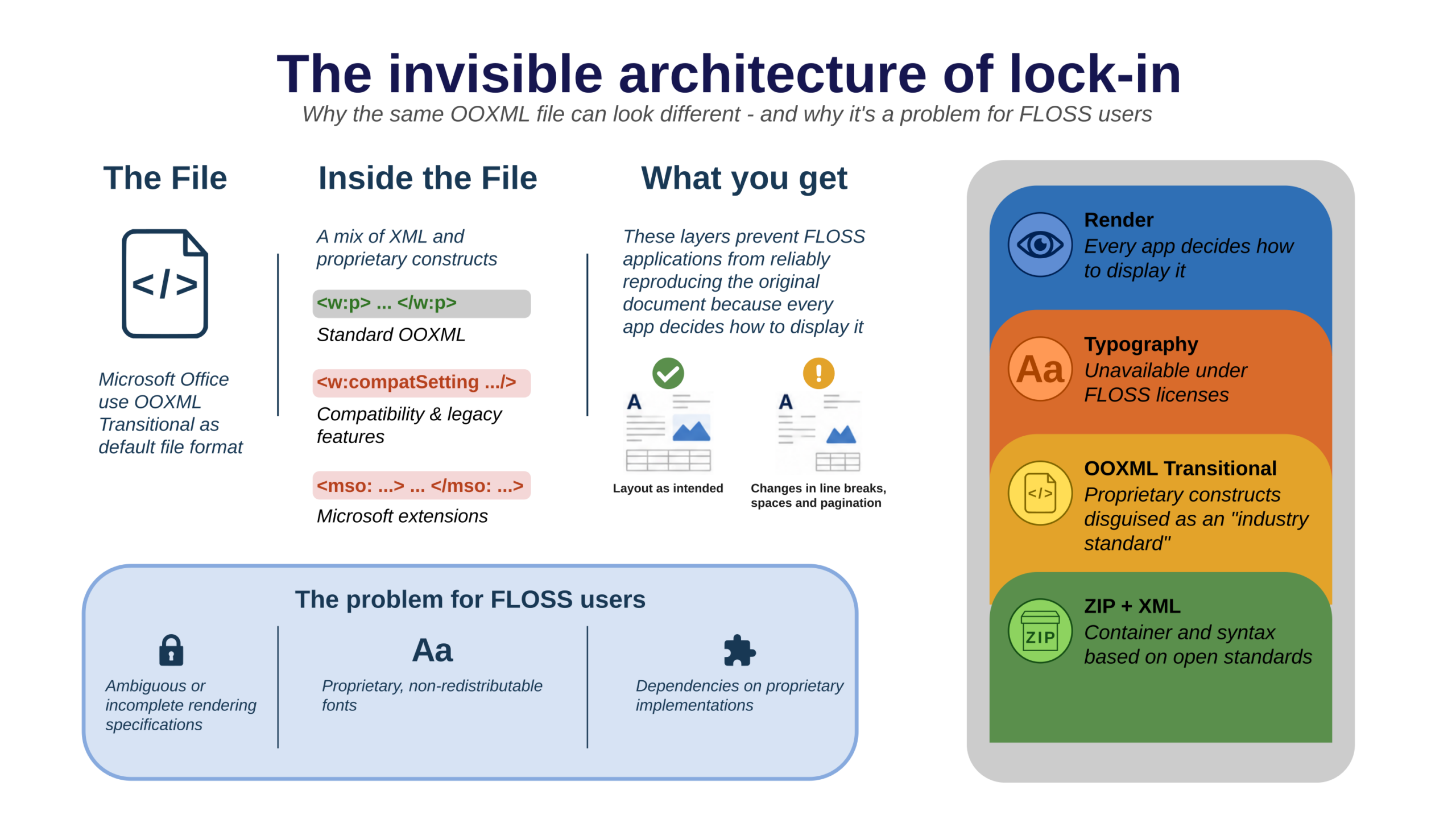
The market standard format guarantees interoperability. The market standard, adopted uncritically by public administrations without any verification of its characteristics, is a proprietary format designed for lock-in rather than interoperability, to the extent that it was approved by ISO under the name OOXML Transitional because it contains proprietary elements. ODF, by contrast, is interoperable by definition, and as such has evolved over the years.

We are bound by existing procurement contracts. Contracts come to an end, whilst regulatory frameworks are renewed, and today, faced with the need to ensure European digital sovereignty, the time has come to integrate open standards into them, without waiting another decade for the next renewal cycle, whilst continuing to pay for access to documents that administrations have created using public money.

Today, none of these objections hold water anymore. Germany’s decision demonstrates that even a large and complex federal government can take an important step in the right direction. The obstacles are political, not technical.

The European policy framework

The transition from proprietary formats to standard, open formats for documents, incidentally, is not a radical choice, but an alignment with decisions already taken by European institutions, contained within various laws or regulations that have already been approved.

The European Interoperability Framework (EIF) – the reference document for interoperability in public services – requires the use of open standards and calls for the avoidance of formats that create dependency on a single supplier. The EIF does not explicitly mention Open Document Format, but the logic of the document leads to the choice of ODF.

The Cyber Resilience Act (CRA), the Network Information Security 2 (NIS2) and the Digital Operational Resilience Act (DORA) state that European digital infrastructure must be built using controllable technologies. Documents are the means by which decisions are recorded and communicated, and form part of the infrastructure; they should therefore be in a standard, open format that is easy to control. This is another example of legislation that does not explicitly mention the Open Document Format, but whose logic leads to the choice of ODF.

Finally, the Interoperable Europe Act (IEA), which came into force in 2024, defines the legal framework for interoperability between EU public administrations and explicitly cites open standards, which – in the context of documents – means ODF and not OOXML, which, even if considered a standard (by a stretch of the imagination), is certainly not open.

Germany has linked these three points. The Deutschland-Stack identifies ODF not as an ideological choice but as a key element of a sovereign, interoperable digital infrastructure aligned with Europe. Other EU governments operating within the same regulatory and political context should apply the same logic.

The current situation in EU countries

Germany is not the only country to have taken steps towards open document standards, although the Deutschland-Stack is the most comprehensive and structurally integrated commitment seen at national level.

France made ODF mandatory in the 2009 Référentiel Général d’Interopérabilité, with subsequent updates strengthening this requirement. The French public administration has a legal obligation to use open formats in its dealings with citizens and between agencies.

The Netherlands, Sweden, Norway and Denmark have all, at different times, adopted policies recommending or requiring open document formats in public administration. In 2014, the United Kingdom made ODF mandatory for government documents, and the decision has never been revoked.

Even the Guidelines for the Digital Administration Code, issued in 2023 by the Italian Government’s Agency for Digital Italy (AGID), would define open standards for documents in such a way that only Open Document Format is included in the list, but these are almost always disregarded without reason by public administrations.

Thus, EU governments that seriously examine the issue tend to reach the same conclusion: ODF is the appropriate standard document format for a sovereign and interoperable public administration. What varies are the levels of implementation, and the willingness to see it through when proprietary vendors put up resistance through intense lobbying.

The Deutschland-Stack raises the bar, integrating the choice of ODF into a comprehensive, cross-cutting sovereign infrastructure framework, based on explicit architectural principles and supported by coordinated decisions at every level of the federal system. This is the model to follow.

Our call to action, which should be that of all EU citizens

If you are a government official, a digital policy advisor, the CIO of a public administration, or a minister responsible for digital transformation in any EU country, this post is for you.

You do not need to invent a new policy, but to apply the logic you already accept (on sovereignty, interoperability, reducing dependence on suppliers, and building a public digital infrastructure that serves citizens rather than Big Tech shareholders) to the documents in your stack.

Germany has done so with determination. France, Italy and other countries have done so clearly, though not quite as resolutely. The European regulatory framework demands it, and the open-source ecosystem – with software that properly supports ODF, which today consists solely of solutions based on the LibreOffice Technology stack – is ready to support it.

The only thing standing between your administration and the ODF mandate is the decision to adopt it. We are ready to help you, not only to make this decision but also to turn it into a successful project.

The Document Foundation is the home of LibreOffice, and one of the leading advocates of open document standards in public administration across Europe and the world. For information on adopting LibreOffice and ODF in public administration, please write to info@documentfoundation.org.

BIG NEWS: Germany has just made the standard Open Document Format (ODF) mandatory

The German federal government has quietly taken an extremely significant step: hidden amongst the technical specifications of the Deutschland-Stack – the rules that will govern the sovereign digital infrastructure supporting public administration at all levels of government, from federal ministries to local council offices – there is a short but highly significant line.

Under the technological pillar “Semantic technologies and real-time analysis”, the document mandates the use of just two document formats: ODF and PDF/UA. That is all. Two open, vendor-neutral formats, defined by international standardisation bodies. OOXML, Microsoft’s closed, proprietary format, is not on the list.

What is the Deutschland-Stack?

The Deutschland-Stack is the German federal government’s project for a sovereign, interoperable digital infrastructure that complies with European standards. It is neither a pilot project nor a policy discussion paper, but the result of a coordinated decision between the Digital Minister, the Federal Chancellery and the Chancellor, backed by the coalition agreement. The document sets out the standards that will govern how all federal public administrations, at all levels, build, procure and manage their digital systems, and envisages concrete implementation by 2028.

It is worth reading its architectural principles carefully. “Made in the EU first.” Reduction of lock-in effects. Open interfaces and local data storage. Open-source development as the default. These are not merely talking points, but the stated governance criteria for Germany’s digital infrastructure. In this context, ODF is not listed as a mere preference or fallback solution, but as a standard document format, alongside PDF/UA for accessibility-compliant documents.

Why this is important beyond Germany

Germany is the European Union’s largest economy, and its decisions have the power to influence the market. Suppliers serving the German public sector will be required to support the ODF standard, and this could serve as an incentive for all other EU Member States that are building compatible infrastructure to follow suit.

The significance of the Deutschland-Stack goes beyond this and represents something extremely important: a formal, high-level political recognition that standard, open document formats are an element of infrastructure rather than a preference; that interoperability is not a secondary feature to be considered later; and that true digital sovereignty requires open standards at every level of the stack, with the document layer being no exception.

The argument about risk is turned inside-out

To date, the adoption of ODF by European public administrations has been hindered by the risks associated with moving away from the most widely used format on the market: there could be problems with document display and workflows, whilst staff might require further training. In this context, the risk of change is always greater than the risk of standing still.

The Deutschland-Stack mandate completely reverses this logic. By choosing ODF as the standard – and not OOXML, ‘the most widely used format’ imposed by the dominant vendor – the German federal government recognises that the greatest risk to interoperability, sovereignty and the long-term public interest lies with the proprietary format.

This is the correct perspective, and has been the correct perspective for years. The OOXML Transitional format – used by all proprietary office suites – is not, due to its characteristics (described in other posts), a stable and vendor-independent foundation for public administration, whereas ODF is.

The burden of proof, as The Document Foundation argued in its comments to the European Commission, does not lie with those who advocate open standards, but with those who advocate maintaining lock-in.

What conclusions can be drawn?

The Deutschland-Stack is a fact, not a conclusion. A mandate in a policy document does not yet equate to implementation on the ground, but the direction is unmistakable. And the alignment with what TDF, civil society organisations and advocates of open standards have been arguing for decades is striking.

Open standards are not ideological positions, but practical prerequisites for an interoperable, sovereign and reliable public digital infrastructure. In this context, documents are not marginal, because they are the means by which public administrations communicate with citizens, with one another and with all other institutions. Therefore, the format of documents matters.

The inclusion of ODF in the Deutschland-Stack is not only a confirmation of all this, but an invitation to other EU Member States, the European Commission and all public administrations still using proprietary formats to ask themselves a question: if Germany is making ODF mandatory for its sovereign digital stack, what is stopping you from doing the same?

The text of the Deutschland-Stack (in German) is available at: https://deutschland-stack.gov.de/gesamtbild/

UPDATE: The official document has been published by the IT-Planungsrat, the central political steering body comprising the federal government and state governments, which promotes and develops common, user-oriented IT solutions for efficient and secure digital administration in Germany: https://www.it-planungsrat.de/beschluss/b-2026-03-it.

Our sincere thanks to everyone whose hard work has contributed to this success: TDF, which has taken up the mantle of the ODF format’s pioneers and carried it forward over the years; the members of the ODF Technical Committee and the ecosystem partners who have contributed to the format’s development; and all those who have promoted the benefits of the ODF format against all odds.

Germany’s Sovereign Digital Stack Mandates ODF: a Landmark Validation of Open Document Standards

The Document Foundation (TDF), the non-profit entity behind LibreOffice, welcomes the inclusion of the Open Document Format (ODF) as a mandated standard format in Germany’s Deutschland-Stack, the federal government’s sovereign digital infrastructure framework for all public administrations.

The Stack, published by the German Federal Ministry for Digital and State Modernisation (Bundesministerium für Digitales und Staatsmodernisierung), establishes the technical standards for a shared, interoperable and sovereign digital infrastructure serving all Germany’s public administrations. Under the framework’s “Semantic Technologies and Real-Time Analytics” pillar, ODF and PDF/UA are explicitly named as the two mandated document formats, to the exclusion of proprietary alternatives.

“This is not a recommendation or a preference, it is a mandate,” said Florian Effenberger, Executive Director of The Document Foundation. “Germany’s decision to anchor ODF at the heart of its national sovereign stack confirms what we have argued for years: open, vendor-neutral document formats are not a niche concern for some technology specialists and FOSS advocates. They are a fundamental infrastructure for democratic, interoperable and sovereign public administrations.”

The Deutschland-Stack is grounded in a set of principles that align with TDF’s long-standing advocacy positions. The framework adopts a “Made in EU first” principle, requires open interfaces and local data storage, mandate open source development where proprietary ownership would otherwise apply, and explicitly aims to reduce vendor lock-in effects. The Stack draws on decisions by the Digital Ministers’ Conference (Digitalministerkonferenz), the Federal Cabinet, and the Prime Ministers’ Conference, and targets concrete delivery of infrastructure components for all levels of government by 2028.

ODF’s inclusion in this framework is no accident. It reflects a consistent direction in European digital policy, from the EIF (European Interoperability Framework) to the CRA (Cyber Resilience Act), that recognises open standards as a prerequisite for interoperability, sovereignty and long-term public value.

“The Stack also calls for reducing lock-in effects and for a European cloud infrastructure built on open standards,” added Florian Effenberger. “ODF’s mandate is the document-layer expression of that principle, as you cannot claim digital sovereignty while allowing your documents to be locked in proprietary formats controlled by a single vendor.”

For the last 20 years, the argument used by proprietary software vendors against ODF adoption in public administrations has been based on a wrong claim. In fact, transitioning away from proprietary formats would reduce the risks of content loss, workflow disruption and incompatibility. The Deutschland-Stack’s mandate confirms this fact, and by naming ODF as the standard, implicitly recognises that the long-term risk for digital sovereignty is represented by proprietary lock-in and not by open standards.

This position is consistent with TDF’s submission to the EU Commission, in which TDF argued that ODF adoption does not introduce content-loss risk, and that the burden of proof must rest with those advocating for OOXML Transitional, a format defined by its own specification as provisional.

Deutschland-Stack text: https://deutschland-stack.gov.de/gesamtbild/ (in German)

UPDATE: The official document has been published by the IT-Planungsrat, the central political steering body comprising the federal government and state governments, which promotes and develops common, user-oriented IT solutions for efficient and secure digital administration in Germany: https://www.it-planungsrat.de/beschluss/b-2026-03-it.

IMPORTANT ODF Template added to CRA Guidance feedback

Last week, the European Commission published the draft guidelines for the CRA and opened a comment session open to all stakeholders until the end of March.

In its first version, the consultation page allowed users to download the draft guidelines and related communication in PDF format, and the feedback template in proprietary XLSX format only.

For this reason, we protested through a post and an open letter to the European Commission, asking that the feedback template also be provided in the open and standard ODS format.

Within 24 hours, officials from DG CONNECT—responsible for the CRA—responded positively to our request and added the template in ODS format.

This is an important first step towards the interoperability that proprietary formats do not allow, and indeed seek to limit by making the DOCX, XLSX, and PPTX formats increasingly different from a standard with the addition of unnecessary complexities.

To all those individuals who insist on considering OOXML a standard because it has been approved by ISO, and to all software that supports OOXML by using it as the default format, we remind you that you are going against not only your own interests but also the interests of all citizens of the world, and first and foremost European citizens.

We would like to express our sincere thanks to the officials of the European Commission’s DG CONNECT, in the hope that this is only the first step towards a future of interoperability and European digital sovereignty, not against technologies developed in other countries but in favor of freedom and awareness of digital technologies, for the benefit above all of future generations and their digital freedoms.

In conclusion, we invite everyone to use the ODS template for their feedback, demonstrating how important the open and standard ODF format is, and how widely it is used by those who truly care about European digital sovereignty.

LibreOffice for Education: Regaining Digital Sovereignty

Every year, millions of students open a laptop and log into Microsoft 365 or Google Workspace, surrendering their digital sovereignty to US Big Tech in the process. Teachers use cloud-based editors to assign homework. School administrators manage documents in proprietary formats. This ecosystem runs smoothly and seemingly without friction, but almost no one questions the cost of this normalisation.

Unfortunately, the cost is quite high.

An invisible resume

Schools don’t just teach maths and history; they also teach mental processes, such as how to do research, think critically and interact with tools and institutions. Software is part of this invisible curriculum. A student who has spent years using Microsoft Word or Google Docs as the archetype of “word processing” or “collaboration” respectively has not developed neutral, transferable skills, but has become a future customer.

This is not a conspiracy, but rather the way markets work. Microsoft and Google both offer heavily discounted or even free licences to educational institutions, knowing that brand loyalty formed in childhood tends to persist into adulthood and the working world. The licence discount is, in commercial terms, the cost of acquiring a new customer, which schools effectively pay on behalf of the seller.

LibreOffice offers an alternative to this approach, teaching students to develop a different type of relationship with their tools.

Privacy and data security

LibreOffice is a free office suite for Windows, macOS and Linux, managed by the non-profit organisation The Document Foundation and developed by a global community of contributors. It offers programs for word processing, spreadsheets, presentations, databases, drawings and mathematical formulas — in other words, all the functions required in a school environment.

Unlike Microsoft 365 or Google Workspace, LibreOffice does not require a subscription or an internet connection. It also does not require the creation of accounts for minors or send data to remote servers. It installs and works locally, so data stays where the user puts it.

For schools operating in areas with poor connectivity — a more widespread reality than one might think — this is not a minor issue, but the difference between a functioning lesson and a frozen loading screen.

For schools concerned about student privacy, the difference is even more significant. Microsoft 365 and Google Workspace collect behavioural and usage data, and the terms of service governing the management, storage and use of this data are opaque, complex and subject to change.

LibreOffice does not collect any data, either user or operational, as no account is required to use it and there is no default telemetry. Therefore, there is no data to lose in the event of a malfunction or system breach.

The lesson of open standards

LibreOffice is based on the Open Document Format (ODF), an ISO standard file format that no company owns or controls. Documents created in ODF today will be readable by any ODF-compatible software, even in 20 or 50 years’ time. This is not because the vendor has decided to maintain backward compatibility, but because the standard is public, documented and independent of any commercial interests.

This is extremely important for schools, which are public services funded by citizens and accountable to communities, not private businesses. The documents they produce, such as curricula, assessments, student records and administrative correspondence, belong to the public sphere to a certain extent. Locking these documents into a proprietary format controlled by a single US company creates a form of digital dependency that is incompatible with the commitment of educational institutions to autonomy and critical thinking.

Teaching students to create and share documents in an open format shows them that technology can be responsible and transparent, and that the tools they use do not have to be ‘black boxes’ owned by a company.

The potential lesson of Linux

LibreOffice is the default office suite in most Linux distributions. A school that adopts LibreOffice is a school that has opened the door to using Linux on its personal computers. This is important for budgetary reasons — Linux significantly extends the useful life of older PCs — but also from an educational perspective.

This is demonstrated by the experience of Italian schools in the province of Bolzano, Italy, which use the Linux distribution FUSS (Free Upgrade for a Digitally Sustainable School). On 20 April 2026, it will celebrate its 20th anniversary with a public event where I will talk about the topics covered in this article.

Linux powers the internet, large research centres such as CERN, the world’s top 50 supercomputers, most smartphones and a large proportion of corporate infrastructure with which students will work when they leave school or university.

Students who have grown up using only Windows or Chromebooks have no practical knowledge of how operating systems work, how software is installed and managed, or how IT infrastructure is structured. However, a student who has used a Linux-based system, even in a school setting, will have at least a basic understanding of the fundamentals of modern computing.

This is not an ideological commitment to open source. It is about training graduates who understand the technological world they are entering and the digital tools they will use throughout their lives.

The pitfalls of proprietary software

A student who uses proprietary software throughout their education may unknowingly absorb a series of misconceptions and misinformation:

  • That documents reside in the cloud or on someone else’s server as if this were normal and natural.
  • Collaboration means sharing access within a supplier’s system.
  • That software is a subscription service which is paid for monthly and whose features or price may change at any time.
  • That the interface of a tool is defined by what a company has decided to build and not by what users need.
  • Lock-in of proprietary formats is an integral part of the system because that’s just how things are.

All of this information is biased and teaches dependency. It serves the long-term commercial interests of suppliers rather than the long-term autonomy of students.

In contrast, LibreOffice lessons teach that software can be free as in freedom, not just free as in price; that file formats can be public standards; that the user community, rather than profit, can be the basis for software development; and that the tools we use can be transparent, modifiable and independent of a single company’s commercial strategies.

An analysis of the counterarguments

Students must learn the tools they will use in the workplace. In theory, this argument has some merit, but in reality, it is inconsistent because the conceptual skills developed with Microsoft 365 — document structuring, formatting, use of styles and spreadsheet formula management — can be transferred to LibreOffice and vice versa. According to the logic of this argument, skills learned on a platform that later changes its interface or mode of delivery from desktop to cloud are not transferable. Microsoft has modified its products several times over the last ten years. The enduring lesson is to learn the concepts, not the menus.

Google Docs facilitates collaboration. This is true within the Google ecosystem. LibreOffice, together with Nextcloud or a similar solution, offers comparable collaboration features without exposing data. However, the problem in this case is the lack of expertise in schools to configure it, which highlights the need for better IT support in education rather than permanent structural dependence on Google.

LibreOffice is more difficult to use. For users who have never used either, the learning curves are comparable, and the perception that Microsoft Office is “easier” largely stems from prior exposure, which itself stems from schools having already made the choice we are questioning.

A concrete proposal

The transition, of course, must not be abrupt or absolute, since this could trigger resistance to change, especially among parents, who in most cases have been victims of the pitfalls of proprietary software.

Schools could start with a few small steps:

  • Adopt ODF as the standard format for all documents, regardless of the software used to create them. This would break the format lock-in without requiring an immediate change in software.
  • Introduce LibreOffice alongside proprietary tools, allowing all students to work with both and understand the differences in approach between proprietary software and FOSS.
  • Migrate administrative workflows to LibreOffice to reduce licensing costs and create institutional familiarity before introducing it in classrooms.
  • Collaborating with local FOSS communities for technical support and training would be a form of civic engagement that would benefit both schools and businesses in the area.

None of these small steps represents a radical choice. Many school systems in Europe have adopted these measures, either fully or partially, and experience shows that the transition can be managed and that the benefits are real.

Conclusion

The dominance of Microsoft 365 and Google Workspace in schools is not the result of these tools being proven to be superior for educational purposes. Rather, it is the result of effective commercial strategies, network effects and institutional inertia. Schools have largely accepted this situation without considering the long-term costs in terms of student data, public budgets, digital sovereignty and the type of digital citizens that schools and universities should be educating.

LibreOffice offers an alternative approach based on open standards, public accountability and independence from commercial platforms. While not perfect, it is a tool that schools can truly own and control.

This is worth much more than a discounted or seemingly free subscription.