Job Search for a Development Mentor

The Document Foundation (TDF), the charitable entity behind the world’s leading free office suite LibreOffice, seeks an individual – or individuals part (or full) time – to be:

a Development Mentor

to start work as soon as possible. The role requires the following:

  • Self-starting, remote working experience
  • Experience contributing to FLOSS communities
  • C++ or LibreOffice coding experience
  • Excellent communication skills

The role is a for a minimum of 10 hours per week, and includes amongst other items:

Supporting existing mentors in the LibreOffice community including:

  • Building relationships between existing mentors and new contributors
  • Identifying and onboarding new contributors
    1. Affirming and encouraging their contribution
    2. Building initial relationships with them
    3. Encouraging them to join IRC to meet the team
    4. Introducing them to domain experts for deeper learning
  • Helping to educate new contributors by
    1. Positively reviewing their code contributions
    2. Introducing them to our tooling & culture
  • Attracting new contributors by promoting the project

Previous experience with such tasks is highly welcome, so is using free software. Speaking and writing English reasonably well is a mandatory requirement.

The work time during the day is flexible, apart from some fixed times when availability is required (e.g. during meetings, which usually take place at 14:00 or 15:00 UTC once per week).

TDF welcomes applications from all suitably qualified persons regardless of their race, sex, disability, religion/belief, sexual orientation or age.

As always, TDF will give some preference to individuals who have previously shown a commitment to TDF, including but not limited to members of TDF. Not being a member, or never having contributed before, does not exclude any applicants from consideration.

TDF is looking forward to receiving your applications, including curriculum vitae, your financial expectations, and the earliest date of your availability, via e-mail to Florian Effenberger at floeff@documentfoundation.org no later than April 11, 2017. You can encrypt your message via PGP/GnuPG.

If you haven’t received feedback by May 16, 2017, your application could not be considered.

International Women’s Day: #BeBoldForChange

March 8 is the International Women’s Day. The theme for 2017 is #BeBoldForChange.

Amongst the members of The Document Foundation there are only 19 women (10% of the total number): Belinda Dibra (Albania), Christina Roßmanith (Germany), Chrystina Pelizer (Brasil), Eliane Domingos de Sousa (Brasil), Ellen Pape (Germany), Emma Pietrafesa (Italy), Gülşah Köse (Turkey), Irmhild Rogalla (Germany), Jean Hollis Weber (Australia), Jona Azizaj (Albania), Katarina Behrens (Czech Republic,), Marina Latini (Italy), Priyanka Gaikwad (India), Regina Henschel (Germany), Rosemary Sebastian (India), Sigrid Carrera (Germany), Sonia Montegiove (Italy), Sophie Gautier (France) and Vinaya Mandke (India).

Marina Latini is the current ChairWoman of the Board of Directors, while Katharina Behrens is a member of the Membership Committee.

Women active in the LibreOffice and Document Liberation communities are definitely more than 19. They should apply for membership, not only to be recognized for their contributions but also to elect and be elected to the Board of Directors and the Membership Committee. They can find the application form on the website: http://www.documentfoundation.org/governance/members/application/.

February 2017: a record month for donations

February 2017 has been a record month for donations to The Document Foundation, with 8,556 people supporting the project from every geography. The record has been sparked by the announcement of LibreOffice 5.3 at the very end of January 2017. The new release has been covered in online and print media with an unprecedented number of articles, which have focused on the exciting new features.

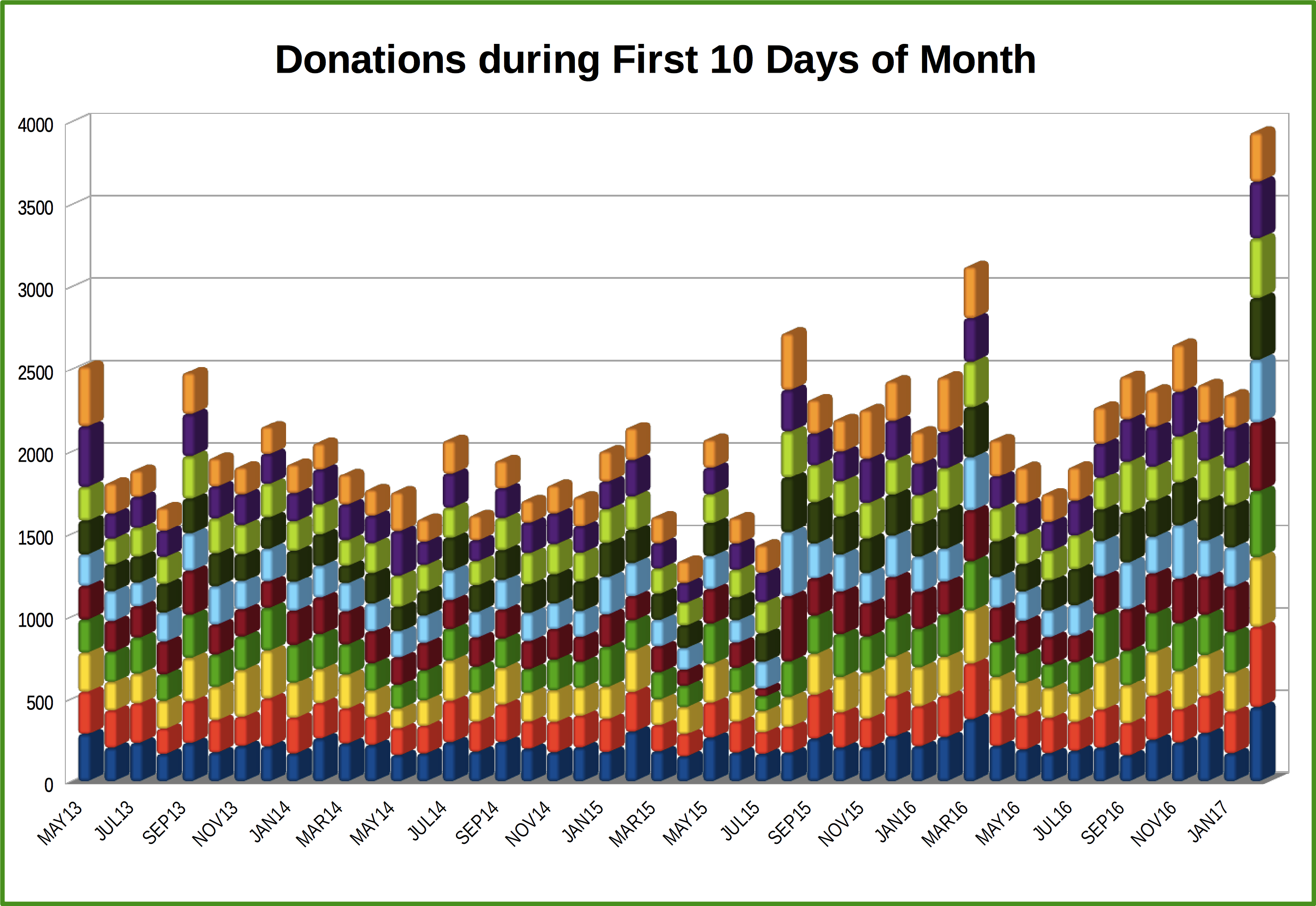
LibreOffice 5.3 triggers a record of donations

In this case, one image is better than 1,000 words, as the histogram represents donations during the first 10 days of each month, since May 2013, and doesn’t need any further comment. LibreOffice 5.3 has triggered 3,937 donations in February 2017, 1,800 more than in March 2016, and over 2,000 – sometimes over 3,000 – more than any other month. Donations are key to the life and the development of the project. Thanks, everyone.


A huge thanks to our donors

Donations to The Document Foundation have been steadily growing for the last three years, thanks to the generosity of many thousands of people around the world.

In 2016, donations have been 82,036 (a 14.2% increase over 2015).

In 2015, donations have been 71,839 (a 9.5% increase over 2014).

In 2014, donations have been 65,579.

Donations are key to our project, as they provide the economic resources to keep the organization and the infrastructure running, to fund activities such as participation of volunteers to FOSDEM and the LibreOffice Conference, and to help local activities organized locally by native language projects.

You can find examples of activities funded by donations money in the annual report: http://tdf.io/report2015.

Without donations, The Document Foundation could not be an independent community led project. Thanks again to all donors.

Mike’s marketing activities, July – December 2016


Donations to The Document Foundation help us to maintain a small team, working on various areas of the project including documentation, user interface design, quality assurance, release engineering and marketing. I help out with the latter, and as we come towards the end of 2016, I want to talk about some of the things I’ve been working on in the last six months. It’s been a really busy time, with a new release of LibreOffice, our conference and many other events and updates. And 2017 promises to be even better! But first, I’d like to provide a bit of background on my typical working day.

The first thing I do is catch up on discussions from the previous day. As you probably know, LibreOffice has many mailing lists covering all aspects of the project and community. I’ve signed up to “digest” subscriptions for some of them – so I get a summary at the end of each day. This is helpful for pinpointing topics of interest. Also useful are minutes from meetings, such as the design team or the Engineering Steering Committee (ESC).

Next, I check our IRC channels to see what’s going on, and what are the hot topics in the community at present. Then I’ll catch up with our social media channels: Twitter, Facebook, Google+ and others. Sometimes there are questions from LibreOffice users that need answering, but in any case, it’s good to see what end users are talking about.

Once I’ve caught up with everything, I turn to my own email inbox in Thunderbird and look at my pending tasks. Sometimes I’ll have a bunch of smaller jobs to take care of (like proofreading and email responses), before I start working on a bigger project for the rest of the day, such as videos, interviews, blog posts, website updates and other jobs. We in the LibreOffice project use Redmine to create and track tickets for tasks that we’re working on, so that we can see how things are progressing and share ideas.


What I’ve done in the last six months

In July we were putting the finishing touches to The Document Foundation’s 2015 Annual Report, of which I wrote many sections, and I helped to translate parts of it into German. Around the same time, we were gearing up for the release of LibreOffice 5.2, so I made a technical preview video for our community, showing some of the new features to help with testing and documentation.

Following that, I produced more polished New Features videos for the world to see on release day – and in total, they received over 100,000 views. Here’s the playlist:

Please confirm that you want to play a YouTube video. By accepting, you will be accessing content from YouTube, a service provided by an external third party.

YouTube privacy policy

If you accept this notice, your choice will be saved and the page will refresh.

Close to the release day, I worked with Italo Vignoli to contact journalists with information about the new version of LibreOffice, offering them to join us in press briefing calls where they can ask questions and speak to members of TDF’s Board of Directors. In addition, I worked on updates for the website, highlighting the new features with extra text and screenshots.

After LibreOffice 5.2 was released in August, we began preparations for our yearly conference, which was held in early September in Brno, Czech Republic. With some of the TDF’s marketing budget (which again, is thanks to generous donations!) I sourced some new video and audio equipment which I took to the conference. Along with various videos from the conference itself, like this wrap-up, I also made some contributor interviews which were also used in our Join the LibreOffice Community video. (And then, our community produced translations in many different languages, which I added to the videos.)

Bringing new people into the community is an important part of my role, so I worked on a redesigned Get Involved page on the LibreOffice website. (I also created a short URL for it: tdf.io/joinus.) This page makes it simpler for potential contributors to dive in to the project, in that they can simply click a topic of interest and get quick pointers on where to start.

Throughout October, I organised a series of LibreOffice Community Weeks on the blog, talking to different projects and exploring how they work. I interviewed contributors, looked at the tools that they use, and explained how to get involved, posting regular updates on social media to generate interest. In the end, we had new contributors in documentation, development and QA, so I plan to repeat these Community Weeks again next year.

November was another Month of LibreOffice, celebrating contributions across the project with badges and barnstars. This caught the attention of the Albanian LibreOffice community, which is running its own Month of LibreOffice throughout December – we’ll post a wrap-up on this blog when it finishes!

And then there were other tasks that I worked on over the last six months, including: updated training certificates, an acknowledgement document for new developers, contributor interviews for the blog, new items on our merchandise shop, and updates to the LibreOffice subreddit.

So with all that, here’s to a great 2017!