LibreOffice 5.2 “fresh” released, for Windows, Mac OS and GNU/Linux

tdf-roadtolo52LibreOffice 5.1.5 “still” announced, for enterprise class deployments

Berlin, August 3, 2016 – The Document Foundation announces LibreOffice 5.2, a feature-rich major release of the best free office suite ever created – targeted to early adopters and power users – with several user interface improvements and enterprise grade features.

At the same time, LibreOffice 5.1.5 has been released, for enterprise class deployments and more conservative office suite users

classificationLibreOffice 5.2 provides document classification according to the TSCP standard, and a set of improved forecasting functions in Calc. In addition, multiple signature descriptions are now supported, along with import and export of signatures from OOXML files.

Interoperability features have also been improved, with better Writer import filters for DOCX and RTF files, and the added support for Word for DOS legacy documents. Additional type argument values for interoperability with other spreadsheets, along with wildcard support in formula expressions for compatibility with XLS/XLSX and ODF 1.2, have also been added.

In term of user experience, a single toolbar mode has been added to Writer and Calc to help users really focus on content, and some icons have been added to the default toolbars to make several frequently used functions – such as hide/show track changes, and freeze the first column or row of a spreadsheet – quicker to access. Also, most of the context menus can now be customized, for even greater control.

LibreOffice has been downloaded 140 million times since the launch in January 2011. The office suite is deployed by large organizations in every continent, with the latest addition being the Lithuanian Police with over 8,000 desktops.

Other New Features of LibreOffice 5.2

  • New drawing tools, including filled curves, polygons and freeform lines, have been added to all program modules.

Writer

  • When printing a document, Print to File is now available in the list of printers.
  • If you use Google Drive for storage, two-factor authentication support has been included.
  • The Save toolbar button includes a quick Save as Template option, so you don’t have to go through the menu.

Calc

  • New functions have been added, along with extensive tooltips that describe what a function does as you type it.
  • Multiple status bar functions can be active at the same time, to provide a quick overview of your data.
  • The currency toolbar icon now includes a drop-down menu to quickly choose the currency you want to use.
  • When removing the border from selected cells, you can also choose to remove the border from adjacent cells as well.

Impress

  • When working with custom animations, you can now quickly add an effect to an element via the sidebar, instead of using a separate dialog box.
  • The list of effects in the sidebar now includes a description of the effect, along with the element name.
  • In the properties sidebar, a new Slide Background panel lets you quickly change the format, orientation and background image of a slide.

A complete list of the better documented new features is available in a separate PDF document (http://tdf.io/lo52features), and on the website at http://www.libreoffice.org/discover/new-features/. Short videos presenting the most significant new features for Writer, Calc and Impress are available at: http://tdf.io/52vids.

LibreOffice 5.2 has also been improved “under the hood,” thanks to the work of hundreds of volunteers (https://people.gnome.org/~michael/blog/2016-08-03-under-the-hood-5-2.html). This translates into an open source office suite which is easier to develop, maintain and debug. Although this is not visible to users, it is extremely important for enterprise deployments.

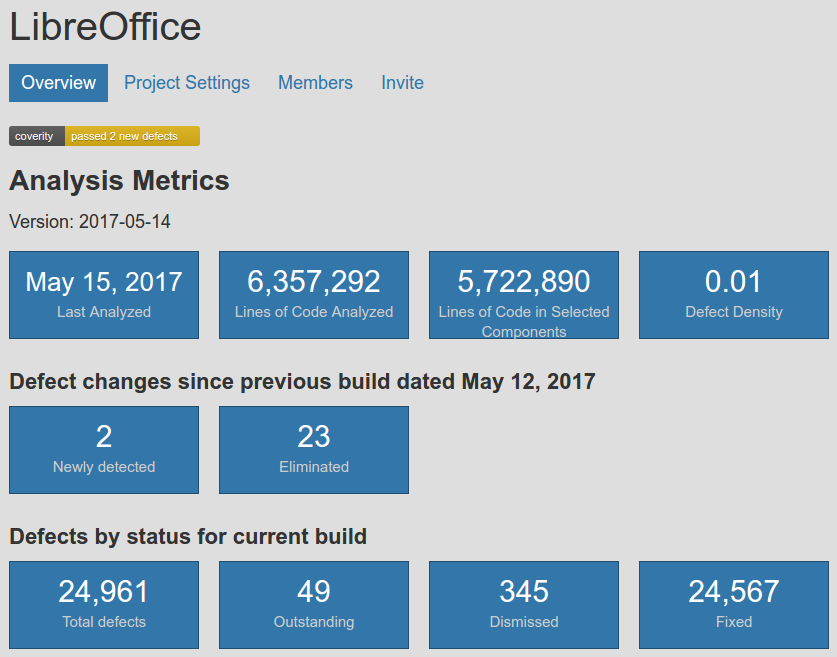
coverityAccording to Coverity Scan, the number of open issues for 1,000 lines of LibreOffice 5.2 source code at the time of release is a record setting 0.00 (for 7,8 million lines of source code), against an industry average of 0.61 for open source software and 0.75 for proprietary software.

“LibreOffice 5.2 is a significant step forward for Free Software on the desktop, and will soon be available as a full featured cloud office suite,” says Michael Meeks, a Director at The Document Foundation (TDF) and a leading developer of LibreOffice Online. “The tight integration between desktop and cloud will provide enterprises a value added experience, with the best of both platforms always available to all users.”

“LibreOffice is growing fast, thanks to distinctive advantages such as the standard document format, which is recognized by a growing number of governments as the best solution for interoperability,” says Thorsten Behrens, a Director at The Document Foundation (TDF) and a member of the OASIS ODF Technical Committee.

Availability and enterprise deployments

LibreOffice 5.2 represents the bleeding edge in term of features for open source office suites. For enterprise class deployments, TDF maintains the more mature 5.1.5 version.

LibreOffice 5.2 “fresh” and LibreOffice 5.1.5 “still” are immediately available from the following link: http://www.libreoffice.org/download/. LibreOffice users, free software advocates and all community members can support The Document Foundation with a donation at http://donate.libreoffice.org.

LibreOffice 5.2 for GNU/Linux is also available in new packaging formats, which make it easier for end users to install and update the application: Flatpak from Red Hat and Snap from Canonical.

In any case, TDF suggests deploying or migrating to LibreOffice with the backing of certified professionals providing Level 3 support, migration or training consultancy according to recognized best practices worldwide (http://www.libreoffice.org/get-help/professional-support/).

Several companies sitting in TDF Advisory Board (http://www.documentfoundation.org/governance/advisory-board/) are providing either value added Long Term Supported versions of LibreOffice or consultancy services for migrations and trainings, based on best practices distilled by The Document Foundation.

LibreOffice 5.2 and LibreOffice 5.1.5 are built with document conversion libraries supporting proprietary document formats from the Document Liberation Project: http://www.documentliberation.org.

Additional technical details

LibreOffice 5.1.5 change logs: https://wiki.documentfoundation.org/Releases/5.1.5/RC1 (fixed in RC1) and https://wiki.documentfoundation.org/Releases/5.1.5/RC2 (fixed in RC2).

LibreOffice 5.2 change logs: https://wiki.documentfoundation.org/Releases/5.2.0/RC1 (fixed in RC1), https://wiki.documentfoundation.org/Releases/5.2.0/RC2 (fixed in RC2), https://wiki.documentfoundation.org/Releases/5.2.0/RC3 (fixed in RC3), and http://wiki.documentfoundation.org/Releases/5.2.0/RC4 (fixed in RC4).

LibreOffice Conference

In 2016, LibreOffice Conference will be hosted by the Faculty of Information Technology at Brno University of Technology, and organized by OpenAlt, from September 7 to 9. Registration for the LibreOffice Conference is open at: http://conference.libreoffice.org/2016/registration/.

Press Kit and Screenshots

The press kit, with press release, infographic, and backgrounds, can be downloaded from: http://tdf.io/lo52presskit. Linux based screenshots can be downloaded from: http://tdf.io/lo52screenshots

The Document Foundation welcomes Canonical to the project Advisory Board

canonical-logo3Berlin, July 26, 2016 – The Document Foundation (TDF) today announced Canonical, the company behind the Ubuntu GNU/Linux operating system, has joined the project Advisory Board.

Canonical is the company behind Ubuntu, the leading operating system for cloud and the Internet of Things. Most public cloud workloads, new smart gateways, self-driving cars and advanced humanoid robots are running on Ubuntu. Additionally, Canonical leads the development of the snap universal Linux packaging system for secure, transactional device updates and app stores.

Since its first release in early 2011, LibreOffice has been the default office suite of the Ubuntu operating system. With the announcement of LibreOffice 5.2 in August 2016, it will be one of the first applications to be available as a snap package which will make LibreOffice easier and simpler for The Document Foundation to maintain.

“Canonical has been an active member of the LibreOffice community since the early days, and one of the most frequent sponsors of the LibreOffice Conference. By becoming a member of the project Advisory Board, Canonical will provide the experience and the insights necessary to improve the presence of free software – and LibreOffice – inside enterprises and public administrations worldwide”, says Marina Latini, Chairwoman of The Document Foundation.

“We are extremely pleased to become a member of the LibreOffice Project Advisory Board and having the opportunity to provide our guidance and insights to help improve LibreOffice for users around the world,” said Will Cooke, Desktop Engineering Manager for Canonical. “At Canonical, we believe in the power of open source software. We are committed to developing it, and will support projects and initiatives that help to promote its benefits to a wider audience.”

The Advisory Board’s (AB) primary function is to represent The Document Foundation’s Sponsors, and to provide the Board of Directors (BoD) with advice, guidance and proposals. In addition, the AB is at the kernel of the LibreOffice ecosystem, and as such is key for the further development of the project.

Elections of the next Membership Committee

Dear Community,

we hereby officially announce the upcoming elections for the next Membership Committee of The Document Foundation.

As per § 12 II of our statutes, [1] the Membership Committee’s term lasts two years. The current Membership Committee started its duty on September 19, 2014. Therefore, the old Membership Committee remains in charge until the end of September 18, 2016, so the new MC will be in charge the day after that, which is September 19, 2016.

As per § 6 III, only members of the Board of Trustees of The Document Foundation, as well as current members of any of its bodies, are eligible to be elected into the Membership Committee, and the election is overseen by the Board of Directors (§ 12 II).

The active electoral right is reserved to those who have been members of the Board of Trustees before this announcement (§ 12 II).

There is one more notable limitation: Per § 8 IV of the statutes, a maximum of 1/3 members of the Membership Committee is allowed to work on an employment basis for the same company, organization, entities, affiliates or subdivisions.

Nomination of candidates fulfilling the above requirements, as well as self nomination is welcome. In total, at least five members of the Membership Committee members are required, and given there are enough candidates, up to four deputies can be elected based on the board decision from June 6.

Re-election of current members of the Membership Committee is explicitly permitted (§ 12 II).

Please send nominations and self-nominations via e-mail to elections@documentfoundation.org (which reaches the Board of Directors in private) and also (!) to board-discuss@documentfoundation.org (which is a public mailing list). We kindly ask nominees who would like to stand for elections to provide a statement of up to 75 words on their candidacy as continuous text (so no bullet lists or multiple paragraphs). In addition, please also provide your full name, e-mail address and your corporate affiliation, if any, and please announce that you will provide information on all future changes as soon as possible.

Discussions with the candidates and questions to them as well as questions about the elections should take place on the public board-discuss@documentfoundation.org mailing list. For details on how to use the mailing list, see http://www.libreoffice.org/get-help/mailing-lists/.

Eligible voters will receive further details via e-mail prior to the start of elections, including a summary of the candidates, details on how to access the voting system, and instructions on how to independently verify the vote count. Please ensure we have your recent and correct e-mail address on file. For questions, you can reach the Board of Directors in private at elections@documentfoundation.org.

Following the time line set forth in § 12 II, requiring a 45 day advance notice, we hereby announce the following time line for the elections:

  1. 2016-07-25: announcement of the elections (this e-mail); and start of the nomination phase
  2. 2016-08-31, 24:00 CET/UTC+2: end of the nomination phase (one week before the election starts, as per § 12 II)
  3. 2016-09-08, 00:00 CET/UTC+2: official start of the elections (at least 45 days after #1, as per § 12 II)
  4. 2016-09-14, 24:00 CET/UTC+2: end of the elections
  5. 2016-09-15: announcement of the preliminary results; and start of the challenging phase
  6. 2016-09-17, 24:00 CET/UTC+2: end of the challenging phase
  7. 2016-09-18: official announcement of the final results
  8. 2016-09-19: new Membership Committee officially in charge

Be advised that the newly elected Membership Committee will only be in charge beginning from September 19, 2016.

Challenges to this election announcement with respect to the deadlines outlined have to happen no later than seven (7) days after this announcement, via e-mail to elections@documentfoundation.org (which reaches the Board of Directors in private).

Challenges to the preliminary results of the election have to happen until the deadline set forth above, via e-mail to elections@documentfoundation.org (which reaches the Board of Directors in private).

On behalf of the Board of Directors,
Marina Latini, Chairwoman of The Document Foundation

[1] http://www.documentfoundation.org/satzung.pdf (binding version) and http://www.documentfoundation.org/statutes.pdf (non-binding translation)

Improving LibreOffice User Experience (UX)

g4hDOEET

Effective from May 2016, Heiko Tietze has started working as a consultant to drive LibreOffice UX one step further.

Heiko has been one of the most active UX volunteers during the last few years, and has been instrumental in a rather large number of the user interface improvements since LibreOffice 4.4.

In addition, he has coordinated UX focused research, which has – amongst other results – led to the development of the human interface guidelines (HIG), and to incremental UI changes to menus and toolbars. Currently, the focus is on the improvement of the LibreOffice Draw user interface.

Most of Heiko’s and other UX volunteers’ activities are reflected in the TDF Design blog, where Heiko has extensively reported about the research and the most significant UX improvements, such as the reorganization of toolbars and the new application specific-menus launched in LibreOffice 5.1.

Heiko’s main objectives will be to work with developers to find out what is technically possible and makes sense to improve LibreOffice UX, to grow the UX and design contributor base, and help with UX-related bugs.

Heiko Tietze has a degree and a doctorate in psychology at the University of Jena, where he has also worked as researcher in general psychology. In his professional career, he has worked with neurophysiological methods like electroencephalogram (EEG) and eye tracking (EOG) on different topics, such as vigilance in traffic and the outcome of automation.

On top of his strong methodological and statistical background, he has developed the skills to write software code to deal with large bulks of data, and has specialized in computer science. In the last ten years, he has focused on usability for different customers, with projects from embedded systems to complex desktop software.

In addition to LibreOffice, Heiko is also a long time contributor to the KDE project and a member of the visual design group (VDG).

LibreOffice 5.1.4 available for download

noun_23937Berlin, June 23, 2016 – The Document Foundation (TDF) announces LibreOffice 5.1.4, the fourth minor release of the LibreOffice 5.1 family, targeted at individual users and enterprise deployments. Users of previous LibreOffice releases should start planning the update to the new version.

For enterprise deployments, The Document Foundation suggests the backing of professional support by certified developers, migrators and trainers (the full list is available at: http://www.libreoffice.org/get-help/professional-support/).

People interested in technical details about the release can access the change log here: https://wiki.documentfoundation.org/Releases/5.1.4/RC1 (fixed in RC1) and https://wiki.documentfoundation.org/Releases/5.1.4/RC2 (fixed in RC2).

LibreOffice Conference

In 2016, LibreOffice Conference will be hosted by the Faculty of Information Technology at Brno University of Technology, and organized by OpenAlt, from September 7 to 9.

Details of Call for Papers, open until July 15, 2016, are available at: https://blog.documentfoundation.org/blog/2016/04/08/libreoffice-brno-conference-call-for-paper/. Registration for the conference is open at: http://conference.libreoffice.org/2016/registration/.

Download LibreOffice

LibreOffice 5.1.4 is immediately available for download from the following link: http://www.libreoffice.org/download/libreoffice-fresh/.

LibreOffice users, free software advocates and community members can support The Document Foundation with a donation at .

The Document Foundation and GNOME Foundation to tighten their relationship, by exchanging seats in their Advisory Boards

gnome-logosBerlin, June 16, 2016 – The Document Foundation and GNOME Foundation have decided to tighten their relationship, in a move intended to create stronger ties between the two communities, and to foster the integration between LibreOffice and one of the most popular desktop environments for Linux.

The GNOME Foundation is a non-profit organization that furthers the goals of the GNOME Project, which is composed of both volunteers and paid contributors, helping it to create a free software computing platform for the general public that is designed to be elegant, efficient, and easy to use.

GNOME is a desktop environment that is composed entirely of free and open source software, targeting Linux but also supported on most derivatives of BSD. Since the release of GNOME 3.0, the GNOME Project has focused on the development of a set of programs known as the GNOME Core Applications, for the adherence to the current GNOME HUD guidelines and the tight integration with underlying GNOME layers.

“The GNOME Foundation oversees one of the cornerstones of the FLOSS desktop, and we are extremely happy to work with them on an organizational level to improve the desktop software experience and user interface. We can also learn from each other, as we are both based on volunteer-driven governance,” says Michael Meeks, Director, The Document Foundation.

“GNOME and LibreOffice both aim to bring competitive Free Software products to as many people as possible. Our growing partnership will help us to further this mission, by increasing cooperation and sharing information, expertise and best practices. We’re excited about this new chapter in the relationship between the two projects!”, says Shaun McCance, President of the Board of GNOME Foundation.

About GNOME Foundation

The nonprofit GNOME Foundation is an independent organization committed to supporting the advancement of the GNOME Project and software freedom. It provides financial, organizational and legal support to the GNOME Project and helps determine its vision and roadmap. GNOME software is used by millions of people around the world. More information about GNOME and the GNOME Foundation can be found at www.gnome.org.