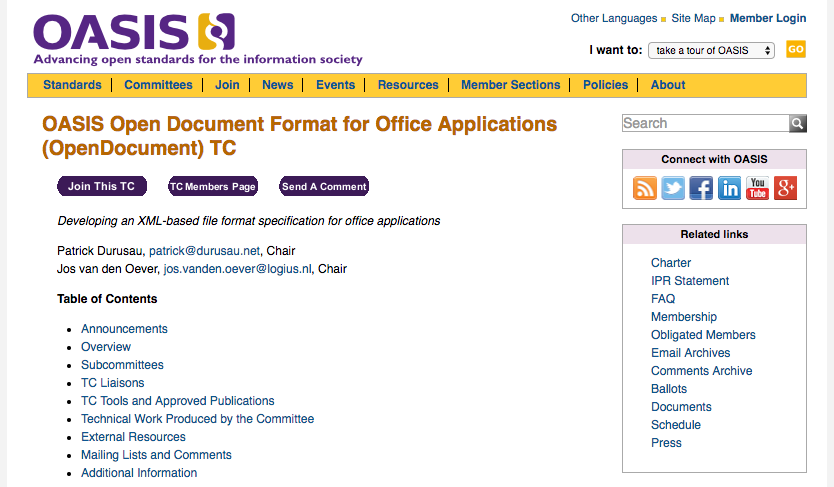
The website of the OASIS Open Document Format (ODF) for Office Applications Technical Committee is a fundamental resource for all people advocating the standard or deploying it within organizations of any size.
The home page provides the following contents: Announcements from the ODF TC, Overview of the standard document format, ODF TC subcommittees,
TC Liaisons, TC Tools and Approved Publications, Technical Work Produced by the Committee, External Resources, and Mailing Lists and Comments.
In addition, the home page provides links to the ODF TC Charter, Sun’s IPR Statement, FAQs, List of ODF TC Members, Email and Comment Archives, Results of Ballots, and Documents.
Berlin, December 14, 2016 – The Document Foundation announces the new Extensions & Templates website, which offers an improved user experience to both developers and end users: https://extensions.libreoffice.org. The resource is now based on the latest version of the Plone open source Content Management System, and has been both coordinated and developed by Andreas Mantke, deputy member of the board at The Document Foundation.
“Two of LibreOffice’s most distinctive characteristics are the possibility of adding features through extensions, and improving quality and consistency of documents thanks to templates”, says Andreas Mantke. “After six years, we decided to refresh the existing resource, to make it easier for developers to upload their files, and for end users to search and download them. I’d love to see an increasing number of contributors uploading extensions and templates”.
LibreOffice Extensions & Templates website offers 304 extensions, with 678 different releases, and 339 templates, with 376 releases. The three most popular extensions are: “Clipart gallery of danger signs”, “Copy only visible cells” and “LanguageTool”. The three most popular templates are: “Personal Budget Template”, “Simple FAX Template” and “LibreOffice Presentation Templates”. A large number of available resources have been contributed by end users.
LibreOffice users, free software advocates and community members can support The Document Foundation with a donation at http://donate.libreoffice.org.
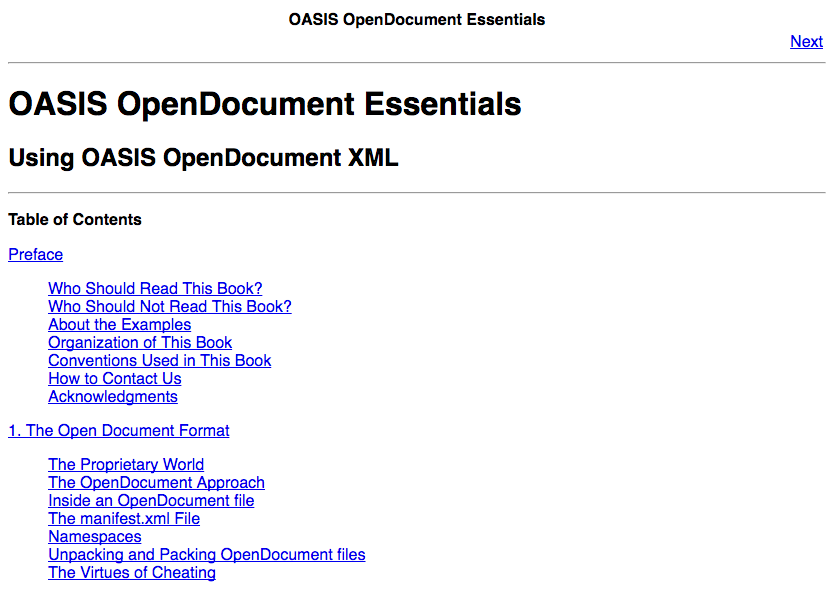
OASIS OpenDocument Essentials is a comprehensive book about the Open Document Format (ODF), published by O’Reilly under the terms of the GNU Free Documentation License.
The book covers the following topics: the Open Document Format; the meta.xml, styles.xml, settings.xml, and content.xml Files; Text Document Basics; Text Documents, Advanced; Spreadsheets; Drawings; Presentations; and Charts.
The book helps to understand how to extract data from Open Document files or how to convert data to Open Document Format, or simply find out how the format works.
Donations to The Document Foundation help us to maintain a small team, working on various areas of the project including documentation, user interface design, quality assurance, release engineering and marketing. I help out with the latter, and as we come towards the end of 2016, I want to talk about some of the things I’ve been working on in the last six months. It’s been a really busy time, with a new release of LibreOffice, our conference and many other events and updates. And 2017 promises to be even better! But first, I’d like to provide a bit of background on my typical working day.
The first thing I do is catch up on discussions from the previous day. As you probably know, LibreOffice has many mailing lists covering all aspects of the project and community. I’ve signed up to “digest” subscriptions for some of them – so I get a summary at the end of each day. This is helpful for pinpointing topics of interest. Also useful are minutes from meetings, such as the design team or the Engineering Steering Committee (ESC).
Next, I check our IRC channels to see what’s going on, and what are the hot topics in the community at present. Then I’ll catch up with our social media channels: Twitter, Facebook, Google+ and others. Sometimes there are questions from LibreOffice users that need answering, but in any case, it’s good to see what end users are talking about.
Once I’ve caught up with everything, I turn to my own email inbox in Thunderbird and look at my pending tasks. Sometimes I’ll have a bunch of smaller jobs to take care of (like proofreading and email responses), before I start working on a bigger project for the rest of the day, such as videos, interviews, blog posts, website updates and other jobs. We in the LibreOffice project use Redmine to create and track tickets for tasks that we’re working on, so that we can see how things are progressing and share ideas.
What I’ve done in the last six months
In July we were putting the finishing touches to The Document Foundation’s 2015 Annual Report, of which I wrote many sections, and I helped to translate parts of it into German. Around the same time, we were gearing up for the release of LibreOffice 5.2, so I made a technical preview video for our community, showing some of the new features to help with testing and documentation.
Following that, I produced more polished New Features videos for the world to see on release day – and in total, they received over 100,000 views. Here’s the playlist:
Please confirm that you want to play a YouTube video. By accepting, you will be accessing content from YouTube, a service provided by an external third party.
If you accept this notice, your choice will be saved and the page will refresh.
Close to the release day, I worked with Italo Vignoli to contact journalists with information about the new version of LibreOffice, offering them to join us in press briefing calls where they can ask questions and speak to members of TDF’s Board of Directors. In addition, I worked on updates for the website, highlighting the new features with extra text and screenshots.
After LibreOffice 5.2 was released in August, we began preparations for our yearly conference, which was held in early September in Brno, Czech Republic. With some of the TDF’s marketing budget (which again, is thanks to generous donations!) I sourced some new video and audio equipment which I took to the conference. Along with various videos from the conference itself, like this wrap-up, I also made some contributor interviews which were also used in our Join the LibreOffice Community video. (And then, our community produced translations in many different languages, which I added to the videos.)
Bringing new people into the community is an important part of my role, so I worked on a redesigned Get Involved page on the LibreOffice website. (I also created a short URL for it: tdf.io/joinus.) This page makes it simpler for potential contributors to dive in to the project, in that they can simply click a topic of interest and get quick pointers on where to start.
Throughout October, I organised a series of LibreOffice Community Weeks on the blog, talking to different projects and exploring how they work. I interviewed contributors, looked at the tools that they use, and explained how to get involved, posting regular updates on social media to generate interest. In the end, we had new contributors in documentation, development and QA, so I plan to repeat these Community Weeks again next year.
November was another Month of LibreOffice, celebrating contributions across the project with badges and barnstars. This caught the attention of the Albanian LibreOffice community, which is running its own Month of LibreOffice throughout December – we’ll post a wrap-up on this blog when it finishes!
And then there were other tasks that I worked on over the last six months, including: updated training certificates, an acknowledgement document for new developers, contributor interviews for the blog, new items on our merchandise shop, and updates to the LibreOffice subreddit.
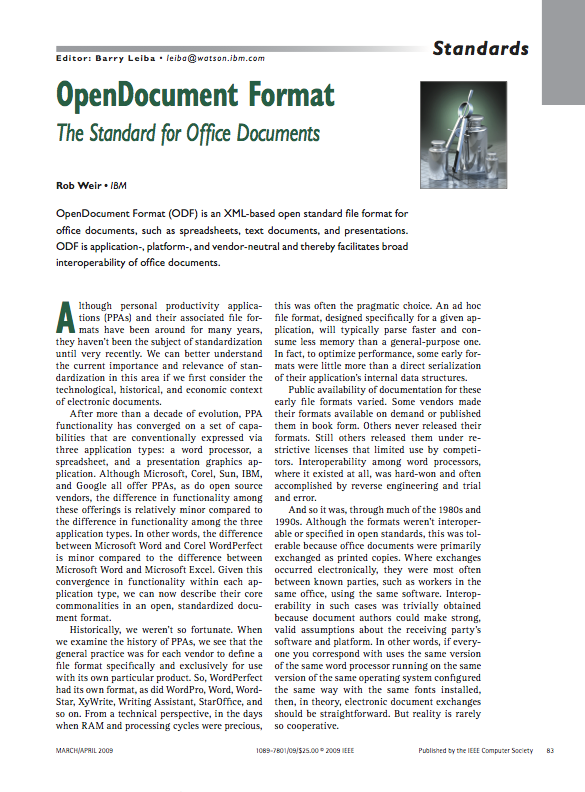
Open Document Format (ODF) is the native file format of LibreOffice, and of many other enterprise and personal productivity applications. ODF is an XML-based open standard file format for office documents, such as spreadsheets, text documents, and presentations. ODF is application-, platform-, and vendor-neutral, and thereby facilitates broad interoperability of office documents.
ODF is the only true standard file format for office documents, but is still lesser known than proprietary file formats, although countries such as UK, France, the Netherlands and Sweden in Europe and Taiwan in Asia have recognized it as the preferred file format for government documents. If you want to get an overview of ODF characteristics, this article from Rob Weir is one of the best starting points.
Rob Weir has been a leading member of the ODF Technical Committee (TC) at OASIS. In 2009, when he has published the article, he was co-chair of the OASIS ODF TC, as well as a member of the OASIS ODF Adoption TC and the OASIS ODF Interoperability and Conformance TC, and a representative in ISO/IEC JTC 1 SC34 for the US.
Andy Updegrove is a standards advocate, and has supported ODF since its inception. He is the author of Consortium Info, and of the related blog about standards.
Between November 2007 and January 2008 he has summarized in a series of five blog posts what he has defined “a standards war of truly epic proportions: the ongoing (at the time), ever expanding, still escalating conflict between ODF and OOXML, a battle that is playing out across five continents and in both the halls of government and the marketplace alike”.
It is an interesting reading, especially if you are involved in ODF today and miss the historic background:

 The website of the OASIS Open Document Format (ODF) for Office Applications Technical Committee is a fundamental resource for all people advocating the standard or deploying it within organizations of any size.