
LibreOffice Community Smiles #2

Björn Michaelsen, developer
Björn Michaelsen, developer
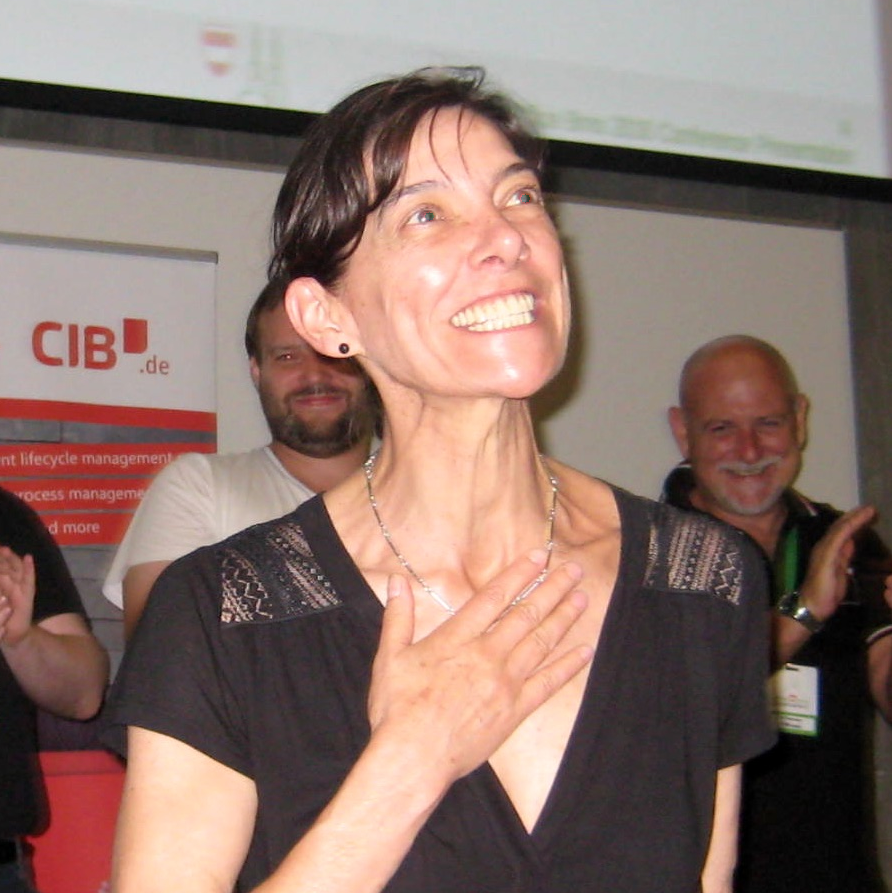
Getting close to the end of the year, we want to remember everyone how much fun we have for being members of The Document Foundation, by showing our best smiles. We start with Sophie Gautier, who doesn’t need any introduction, as she’s always been around since the early days of OOo and LibreOffice.

The Month of LibreOffice, November 2017 has finished – and what a great month it has been. There have been contributions all across the project, including source code patches, bug report confirmations, user interface translations and documentation updates. Not to mention user support on Ask LibreOffice, along with LibreOffice promotion on Twitter! Here’s how many stickers have been awarded:
Click the number for the full details. And if you see your name (or username) on that page, claim your sticker for your laptop, PC or other devices! Simply email mike.saunders@documentfoundation.org with your name (or username) from the wiki page, and “Sticker claim” in the subject line, along with your postal address. We’ll send you a sticker in the next couple of weeks – and it’ll look like this:
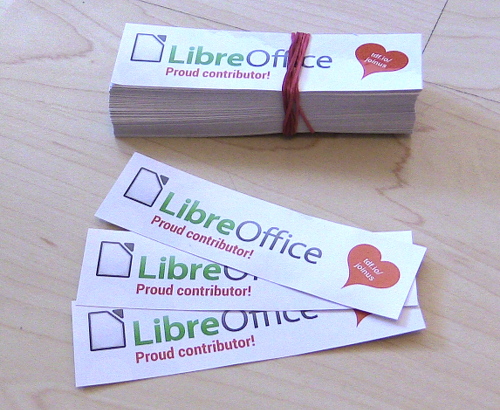
(Note that your postal address will only be used for posting the sticker to you, and not be stored afterwards or used otherwise.) Enjoy showing off your sticker, and thanks again for your contribution!
So what happened over the month? Let’s go through the sections on the stickers page. The first, code patches, shows source code contributions from community members. It has been great to get fixes, updates and new features from the community – and note that this list doesn’t include people who are paid to work on the code on a daily basis! See here for a full list of recent development activity.
Next up we have bug report confirmations. This is an important job, and our QA community works hard to categorise and check new bug reports as they come in. It’s also a way for anyone to get involved, even if you’re not a developer: just find a new report on our bug tracker, see if it affects you as well (with the latest LibreOffice version), and confirm it if so. This helps our QA team to narrow down the cause of a bug.
Then we had translations of the LibreOffice interface – lots of fantastic work there! One of the goals of LibreOffice is to make the software accessible to everyone, regardless of location or language, so it’s great to see so many contributions here. Next we give credit to people who help other users on Ask LibreOffice, which isn’t always an easy task, but the answers can be very useful for other people in the future.
Finally, we had documentation contributions and people spreading the word on Twitter. A huge thanks once again to everyone who took part, and don’t forget to claim your sticker! We’ll run another Month of LibreOffice next year – but you can get involved at any time. Join our friendly community, help make LibreOffice even better, and we look forward to your contributions!
Following the recent decision by Munich’s City Council to step back to closed source and proprietary software, at a large cost to taxpayers, a group of free and open source software (FOSS) supporters have created a website explaining the importance of FOSS in public administrations.
The German website, called München bleibt frei (Munich stays free), lists numerous benefits of FOSS, including:
The Document Foundation supports this position. Our previous statement on the situation in Munich can be found here.
 I have organized the LibreOffice Conference in 2013 (Milan) and 2017 (Rome), after having organized the OOo Conference in 2009 (Orvieto). So, I am qualified for the creation of a conference organization checklist to help future organizers in carrying out their tasks.
Of course, I give for granted that the entire team is familiar with both the Call for Locations and the proposal, because there are some details which could represent a major issue getting close to the events, if ignored. I am referring to the fact that the organization of the conference has to be entirely managed by the community including activities such as handling sponsorships and sending out invitation letters to attendees requiring a VISA to enter the country.
So, let’s manage the checklist as a 12 month countdown, starting from the previous LibreOffice Conference. In fact, the location will be announced during the closing session, when all the future organizing team will be called on stage to get a virtual handover from the leaving one.
12 Months
Set the event date and location in stone. If the location is a public administration building, ask to organize a meeting with the people responsible for the ceremonial as soon as possible, to go over all event details. The later the meeting, the higher the chances that something will go wrong at the very last minute.
11 Months
Start thinking about specific responsibilities for each member of the organization team. Of course, this can be decided at a later time, but it is definitely better to get each member on his own agenda as soon as possible. A well coordinated team will result in a lower effort, especially if volunteers are not experienced event planners (I have organized events for over 30 years of my professional life, from the small meeting to the large exhibition, so organizing the LibreOffice Conference has never been a real issue, but I have a peculiar background for FLOSS).
10 Months
Start thinking about conference planning. Write down a tentative program, based on what you know at the time: (1) there will be TDF BoD, MC and team meetings before and/or after the conference; (2) there will be a community day on Tuesday, with at least a half day meeting of people active in native language communities, to discuss localization and marketing activities; (3) the opening session will be Wednesday morning; (4) tracks, at least three, will run concurrently from Wednesday afternoon until Friday early afternoon; (5) the closing session, with all remaining confernce attendees, will be on Friday late afternoon. Every other event will have to fit this schedule: in general, there should be a community dinner, and a “hacknight” for people to work together on common tasks (hacking is not just for hackers, but also for other volunteers involved in the project).
9 Months
Once the conference tentative schedule is set, it is time to start studying sponsor packages to leverage all the opportunities in the program: general sponsorships to cover the entire event, but also specific sponsorships for collateral events, and for food. At the end, based on past experiences, all sponsors will choose different levels of general sponsorships, but all other options will give the organizing team more flexibility while discussing with sponsor prospects (and in some cases will be instrumental to attract small local sponsors).
8 Months
Based on the expected level of sponsorships, start to design a tentative budget, detailing all items and giving each one of them a figure (based on experience, or on average market prices). Also, give each budget item a rate, as you will have to confirm them based on the amount of money available. The budget should foresee the following items: location, technical equipment for presentations and recording of sessions, network connection, conference bag and t-shirt, light food and drinks for lunches, and community dinner and hacknight. Leave some money for last minute expenses, which will always happen.
7 Months
Provide contents for the conference website: how to get the VISA (for those who need a VISA), how to reach the city and the conference location, what to do (apart from attending the conference), where to stay (hotels, apartments, and other kind of accommodations, from the medium expensive to the unexpensive), where to eat (and what to eat, keeping in mind that we have a community with different eating habits, from vegan to vegetarian to omnivore, and food allowances based on the religion, with people not eating cow and pork meat).
6 Months
Once the website is ready, start meeting potential conference suppliers to brief them. They should be able to make the best possible proposal at the first attempt, to avoid the inevitable loss of time which results from endless budget reviews. At that time, you should be able to have all details under control, even if nothing has been set in stone (because you will probably be missing sponsorships, which are instrumental to confirm services, based on their importance).
5 Months
Organize the meeting with TDF team representatives, to show them the venue and go over all conference details. In general, the meeting will be with Sophie Gautier and Italo Vignoli, who are the two people coordinating the conference effort for TDF, but Florian Effenberger could join as well (or replace Italo Vignoli, according to their availability).
4 Months
Based on the outcome of the meeting with TDF representatives, you can start making your final plans for the conference. At this point in time, you should be able to have a complete picture of the event including collaterals. You should be talking to potential sponsors too, to get their confirmation as soon as possible, although – based on experience – the last sponsors will confirm during the last two months. Because of this, you should explain the situation to conference suppliers, as they should be prepared to act immediately after the budget confirmation.
3 Months
Several people will start asking for a letter of invitation, which is often needed to get a VISA. At this point, you should be very familiar with the immigration law of your country, and of specific situations which might reduce the chances of getting a VISA (for instance, today it is impossible for Indians to get a business VISA to Italy, and vice versa, so the suggestion is to ask for a tourist VISA instead of a business VISA).
2 Months
The call for papers will be closed, and the presentation schedule will be published to allow people to finalize their travel schedule and book their accommodations in due time. VISA requests will increase. Sponsors will confirm their commitments. As usual, everything will come together at the last minute, so the team should be prepared to handle this sharp increase in activities.
1 Month
If you have planned the event in the proper way, the last month will be spent by confirming the services and checking that suppliers are sticking with the schedule. Of course, there will be some last minute emergencies, but they should not create any disruption to the program. During last week, the team should work at last time details, and at preparing the conference kit (badge, bag, t-shirt, sponsor materials, and other stuff).
During the Conference
Try to have fun. Of course, taking care of the entire program and check all details will ask for a lot of energy, but there should be space for some fun as well. Every conference attendee will have a specific question to ask, but don’t take this as an issue. In fact, it is an opportunity to get to know everyone in the community-
After the Conference
Pay all the bills, and have some rest.
Yes, we’re into the final week of this Month of LibreOffice, which gives thanks (and stickers) to our great worldwide community for all their hard work! Here’s how many stickers have been awarded so far:
Click the number to see if your (user)name is on the list – and if so, you’ll soon be able to get a shiny sticker for your computer kit! Here they are, waiting to be claimed:
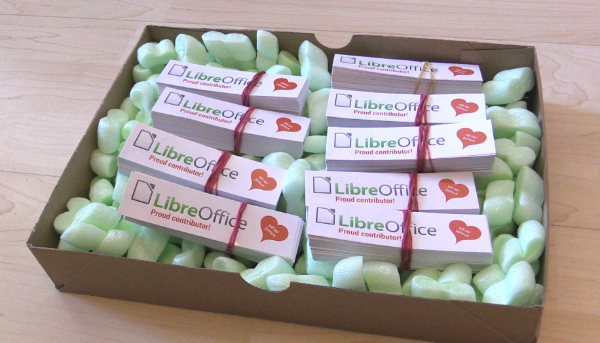
But if you’re not yet on the list, you still have time to get involved with LibreOffice, help make the software better for millions of users around the world, and grab a sticker from us as thanks for your work. Plus, you build up experience of working in a friendly and well-known open source project! Read on to see ways you can help…