
Category: LibreOffice
LibreOffice 24.8.5 is available for download
Berlin, 20 February 2025 – LibreOffice 24.8.5, the fifth minor release of the LibreOffice 24.8 family of the free open source, volunteer-supported office suite for Windows (Intel, AMD and ARM), MacOS (Apple and Intel) and Linux, is available on our download page.
LibreOffice is the only office suite that respects the privacy of the user, ensuring that the user is able to decide if and with whom to share the content they create. It even allows deleting user related info from documents. In addition, it has a feature set comparable to the leading product on the market.
Also, LibreOffice offers a range of interface options to suit different user habits, from traditional to modern, and makes the most of different screen sizes by using all the space available on the desktop to put the maximum number of features just a click or two away.
The biggest advantage over competing products is the LibreOffice Technology engine, the single software platform on which desktop, mobile and cloud versions of LibreOffice – including those from ecosystem companies – are based.
This allows LibreOffice to produce identical and fully interoperable documents based on two ISO standards: the open and neutral Open Document Format (ODT, ODS, ODP) and the closed and fully proprietary Microsoft OOXML (DOCX, XLSX, PPTX), which hides a large amount of artificial complexity, and can cause problems for users who are confident that they are using a true open standard.
End users looking for manuals can download the LibreOffice 24.8 guides from the following link: books.libreoffice.org/.
LibreOffice for Enterprise
For enterprise-class deployments, TDF strongly recommends the LibreOffice Enterprise family of applications from ecosystem partners, with three or five year backporting of security patches, other dedicated value-added features and Service Level Agreements: www.libreoffice.org/download/libreoffice-in-business/.
Every line of code developed by ecosystem companies for enterprise customers is shared with the community on the master code repository and improves the LibreOffice Technology platform. Products based on LibreOffice Technology are available for all major desktop operating systems (Windows, macOS, Linux and ChromeOS), mobile platforms (Android and iOS) and the cloud.
In fact, LibreOffice’s mature code base, rich feature set, strong support for open standards, excellent compatibility and LTS options make it the ideal solution for organisations looking to regain control of their data and break free from vendor lock-in.
LibreOffice 24.8.5 availability
LibreOffice 24.8.5 is available from www.libreoffice.org/download/. Minimum requirements for proprietary operating systems are Microsoft Windows 7 SP1 (no longer supported by Microsoft) and Apple MacOS 10.15. Products for Android and iOS are at www.libreoffice.org/download/android-and-ios/.
 End users can get first-level technical support from volunteers on mailing lists and the Ask LibreOffice website: ask.libreoffice.org. They can support the project by donating at www.libreoffice.org/donate.
Enterprise deploying LibreOffice can also donate, although the best solution for their needs would be to look for the enterprise optimized versions of the software (with Long Term Support for security and Service Level Agreements to protect their investment) at www.libreoffice.org/download/libreoffice-in-business/.
Changelogs
LibreOffice 24.8.5 RC1 https://wiki.documentfoundation.org/Releases/24.8.5/RC1, LibreOffice 24.8.5 RC2 https://wiki.documentfoundation.org/Releases/24.8.5/RC2.
Community Member Monday: Ndidi Folasade Ogboi

Tell us a bit about yourself!
I live in Lagos, Nigeria, and I spend my time dabbling into user experience design with research, although these days, I’m diving deeper into research. I’m a big fan of books, especially well-written fiction. Music is also a huge part of my life. Let’s just say I love anything that sounds good and sing-alongs during work.
What are you working on in the LibreOffice project right now?
I am an Outreachy intern working on improving the LibreOffice Writer templates with guidance from my mentor, Heiko Tietze. I have spent the last month understanding the community’s pain points by carrying out a survey, analysing their responses and working to create functional templates that they need. Currently, I am iterating on priority templates like DIN 5008 Business Letter, resume and academic writing templates.
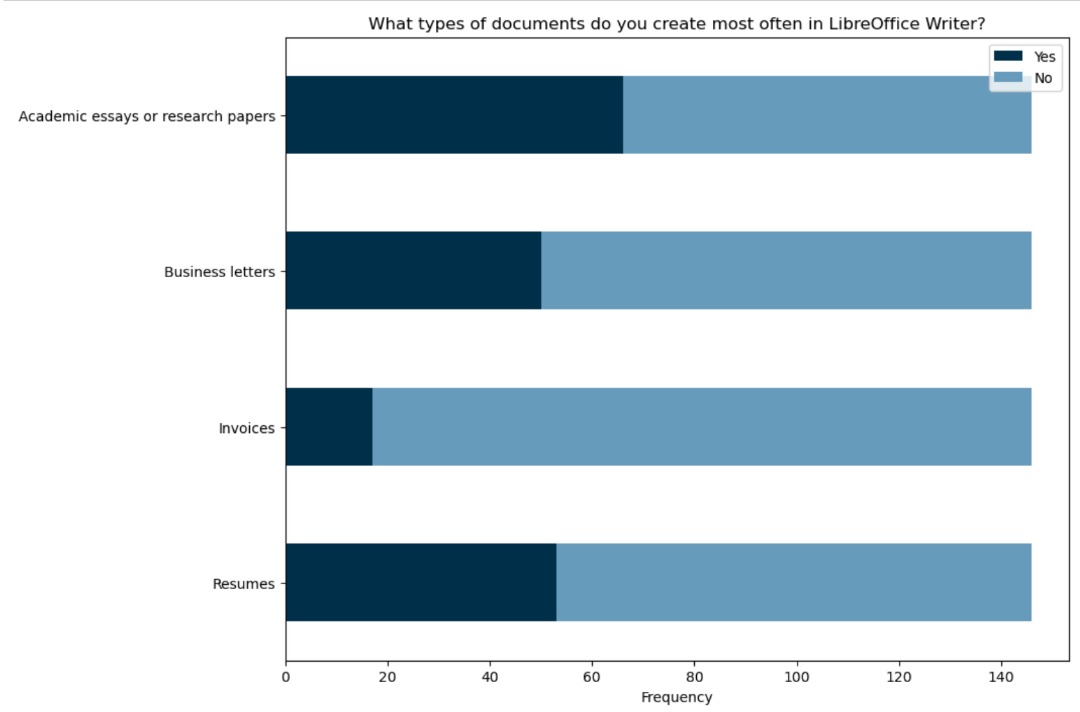
I am also doing some more research on template standards and reflecting on how to create templates that would help users. My top priority is to understand styling and implement it in the templates I am creating and also curate template contents that fits into prospective user preferences.
Why did you choose to join the project, and how was the experience?
During my Outreachy contribution phase, I had a list of open-source projects I could choose from, but at the time, I wanted to test the limits of my capacity. As a UX designer with no coding background, the first task for this project was to submit a patch on Gerrit.
Every other contributor left the task obviously because of the task complexity and I remember one of my mentors, Ilmari telling me that the competition had become less tense due to the number of contributors dropping the project. It was a challenge that pushed me out of my comfort zone as it was my first time interacting with code. That was it for me. Completing that task gave me a sense of achievement and made me even more excited to continue with the project.
Ah, it was challenging at first. I also dealt with anxiety because there was so much to do and I didn’t know where to start but later, the bits started coming together. Luckily for me, I have a mentor who has been supportive since I started the project back in December and who has made my experience seamless. Whenever I face a blocker, I know I have a mentor who is always ready to provide me with resources and connect me with other members of the community that have resources that would be useful for each project phases.
Anything else you plan to do in the future? What does LibreOffice really need?
I have decided to continue contributing to adding more templates to Writer and helping improve other aspects of user experience through user research and design after my internship ends. I like it here. Working on templates in Writer is challenging no doubt – but I think I like the way it stretches me, and helps me expand my skills in the area of research and thinking about a broader user audience.
Speaking from a UX perspective, I think LibreOffice could greatly benefit from a modernized UI mostly to improve accessibility and efficiency. When I started using the Writer interface, it was quite hard for me to navigate at first; there were no modal pop-ups to help sort of onboard me into the whole experience and so having to navigate all alone made me reluctant to use the Writer tool. I also look forward to the implementation of AI because seriously, it just makes navigation and usability way easier. For example, the implementation of AI-powered suggestions for formatting would make LibreOffice feel more modern.
Thanks to Ndidi for all her contributions! 😊
LibreOffice 25.2: The first week, in statistics

One week ago, we announced LibreOffice 25.2, our brand new major release. It’s packed with new features, and has many improvements to compatibility and performance too. So, what has happened in the week since then? Let’s check out some stats…
647,961 downloads
These are just stats for our official downloads page, of course – many Linux users will have acquired the new release via their distribution’s package repositories.
11,313 views, shares and likes on social media
Combining our Mastodon, Bluesky, X/Twitter and Facebook posts about the announcement, and all the likes, shares, views and comments, we get 11,313. Thanks to everyone who spread the word on social media! 😊
528 upvotes on Reddit
On release day, we organised an “ask us anything” event on Reddit. Members of The Document Foundation and LibreOffice community joined in the discussions and answered questions from users and potential contributors.
Huge thanks to our worldwide community of volunteers, and certified developers, for all their work on this release!
LibreOffice 25.2, the office suite that meets today’s user needs

The new major release provides many user interface and accessibility improvements, plus the usual interoperability features
Berlin, 6 February 2025 – LibreOffice 25.2, the new major release of the free, volunteer-supported office suite for Windows (Intel, AMD and ARM), macOS (Apple Silicon and Intel) and Linux is available on our download page. LibreOffice is the best office suite for users who want to retain control over their individual software and documents, thereby protecting their privacy and digital life from the commercial interference and the lock-in strategies of Big Tech.
 LibreOffice is the only office suite designed to meet the actual needs of the user – not just their eyes. It offers a range of interface options to suit different user habits, from traditional to modern, and makes the most of different screen sizes, optimising the space available to put the maximum number of features just a click or two away.
It is also the only software for creating documents (that may contain personal or confidential information) that respects the user’s privacy, ensuring that the user can decide if and with whom to share the content they create, thanks to the standard and open format that is not used as a lock-in tool, forcing periodic software updates. All this with a feature set that is comparable to the leading software on the market and far superior to that of any competitor.
What makes LibreOffice unique is the LibreOffice Technology Platform, the only one on the market that allows the consistent development of desktop, mobile and cloud versions – including those provided by companies in the ecosystem – capable of producing identical and fully interoperable documents based on the two available ISO standards: the open ODF or Open Document Format (ODT, ODS and ODP) and the proprietary Microsoft OOXML (DOCX, XLSX and PPTX). The latter hides a huge number of artificial (and unnecessary) lock-in complexities that create problems for users convinced they are using a standard format.
End users can get first-level technical support from volunteers on the user mailing lists and the Ask LibreOffice website: https://ask.libreoffice.org. LibreOffice Writer Guide can be downloaded from https://books.libreoffice.org/en/.
New Features of LibreOffice 25.2
PRIVACY
- LibreOffice can remove all personal information associated to any document (author names and timestamps, editing time, printer name and configuration, document template, author and date for comments and tracked changes).
CORE/GENERAL
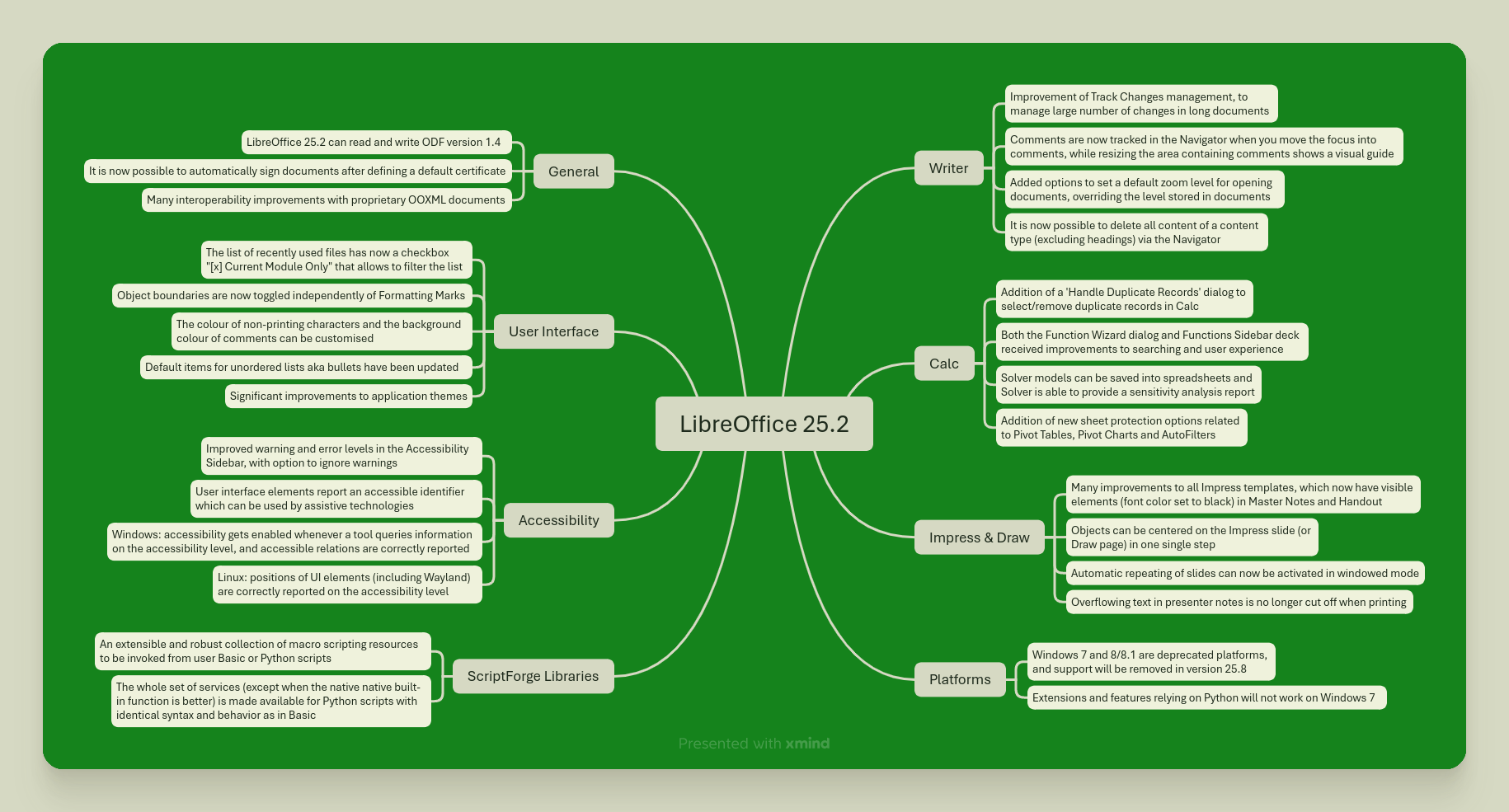
- LibreOffice 25.2 can read and write ODF version 1.4.
- Many interoperability improvements with proprietary OOXML documents.
- It is now possible to automatically sign documents after defining a default certificate.
- Windows 7 and 8/8.1 are deprecated platforms, and support will be removed in version 25.8.
- Extensions and features relying on Python will not work on Windows 7.
WRITER
- Improvements to Track Changes management, to manage large number of changes in long documents.
- Comments are now tracked in the Navigator when you move the focus into comments, while resizing the area containing comments now shows a visual guide.
- Added options to set a default zoom level for opening documents, overriding the level stored in documents.
- It is now possible to delete all content of a content type (excluding headings) via the Navigator.
CALC
- Addition of a “Handle Duplicate Records” dialog to select/remove duplicate records in Calc.
- Both the Function Wizard dialog and Functions Sidebar deck received improvements to searching and user experience.
- Solver models can be saved into spreadsheets and Solver is able to provide a sensitivity analysis report.
- Addition of new sheet protection options related to Pivot Tables, Pivot Charts and AutoFilters.
IMPRESS & DRAW
- Many improvements to all Impress templates, which now have visible elements (font colour set to black) in Master Notes and Handout.
- Objects can be centred on the Impress slide (or Draw page) in one single step.
- Automatic repeating of slides can now be activated in windowed mode.
- Overflowing text in presenter notes is no longer cut off when printing.
USER INTERFACE
- The list of recently used files has now a checkbox “[x] Current Module Only” that allows to filter the list.
- Object boundaries are now toggled independently of Formatting Marks.
- The colour of non-printing characters and the background colour of comments can be customised.
- Default items for unordered lists (also known as bullets) have been updated.
- Significant improvements to application themes.
ACCESSIBILITY
- Improved warning and error levels in the Accessibility Sidebar, with option to ignore warnings.
- User interface elements report an accessible identifier which can be used by assistive technologies.
- Windows: accessibility gets enabled whenever a tool queries information on the accessibility level, and accessible relations are correctly reported.
- Linux: positions of UI elements (including on Wayland) are correctly reported on the accessibility level.
SCRIPTFORGE LIBRARIES
- An extensible and robust collection of macro scripting resources to be invoked from user Basic or Python scripts.
- The whole set of services (except when the native native built-in function is better) is made available for Python scripts with identical syntax and behaviour as in Basic.
- The English documentation of ScriptForge libraries is now partially integrated in the LibreOffice help pages.
Contributors to LibreOffice 25.2
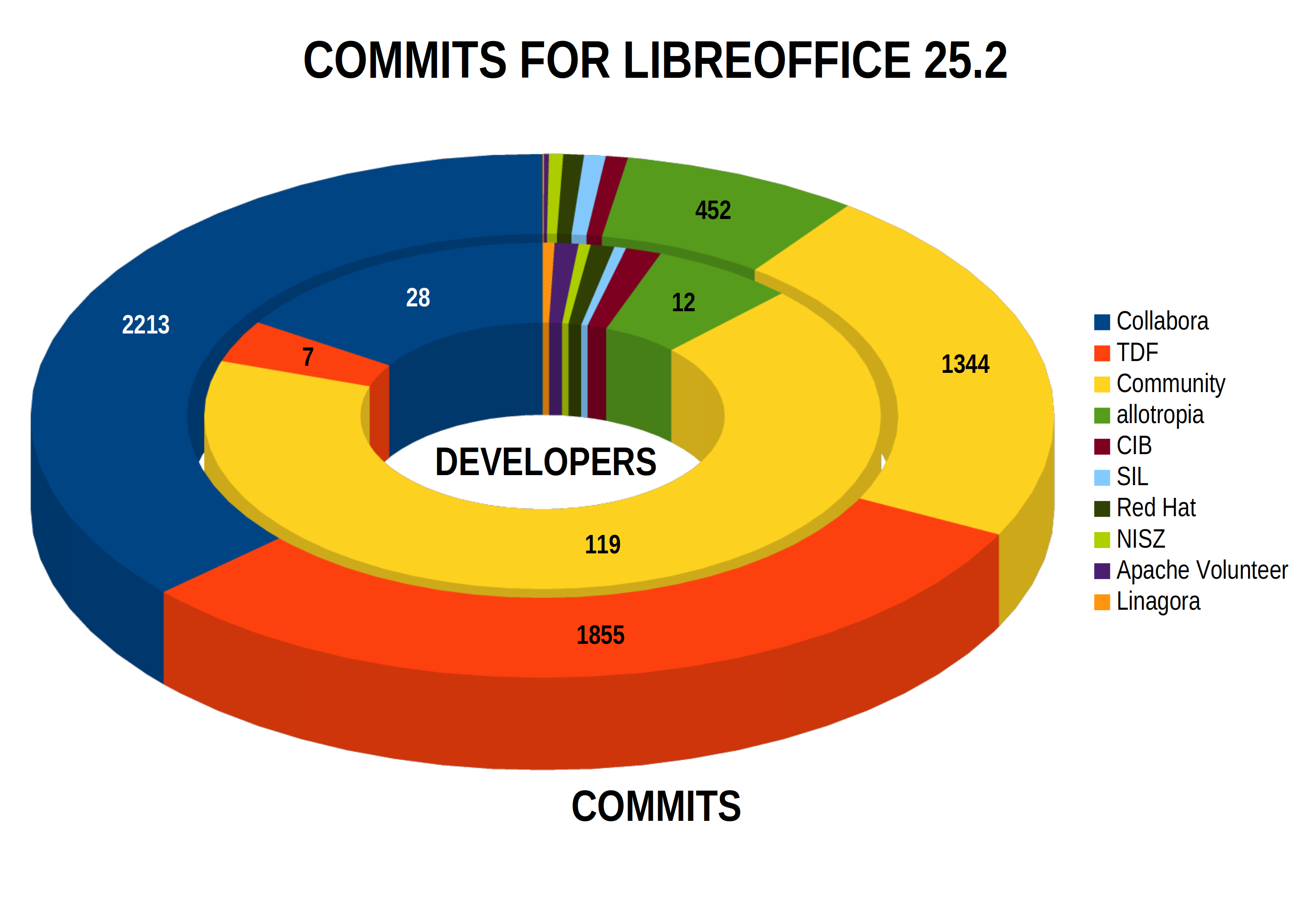 A total of 176 developers contributed to the new features in LibreOffice 25.2: 47% of the code commits came from 50 developers employed by ecosystem companies – Collabora and allotropia – and other organisations, 31% from seven developers at The Document Foundation, and the remaining 22% from 119 individual volunteer developers.
An additional 189 volunteers have committed 771,263 localized strings in 160 languages, representing hundreds of people working on translations. LibreOffice 25.2 is available in 120 languages, more than any other desktop software, making it available to over 5.5 billion people in their native language. In addition, over 2.4 billion people speak one of these 120 languages as a second language.
LibreOffice for Enterprises
For enterprise-class deployments, TDF strongly recommends the LibreOffice Enterprise family of applications from ecosystem partners – for desktop, mobile and cloud – with a wide range of dedicated value-added features and other benefits such as SLAs: www.libreoffice.org/download/libreoffice-in-business/.
Every line of code developed by ecosystem companies for enterprise customers is shared with the community on the master code repository and improves the LibreOffice Technology platform. Products based on LibreOffice Technology are available for all major desktop operating systems (Windows, macOS, Linux and ChromeOS), mobile platforms (Android and iOS) and the cloud.
Migrations to LibreOffice
The Document Foundation publishes a migration protocol to help companies move from proprietary office suites to LibreOffice, based on the deployment of an LTS (long-term support) enterprise-optimised version of LibreOffice, plus migration consulting and training provided by certified professionals who offer value-added solutions consistent with proprietary offerings. Reference: www.libreoffice.org/get-help/professional-support/.
In fact, LibreOffice’s mature code base, rich feature set, strong support for open standards, excellent compatibility and LTS options from certified partners make it the ideal solution for organisations looking to regain control of their data and break free from vendor lock-in.
Availability of LibreOffice 25.2
LibreOffice 25.2 is available at www.libreoffice.org/download/. Minimum requirements for proprietary operating systems are Microsoft Windows 7 SP1 and Apple MacOS 10.15. LibreOffice Technology-based products for Android and iOS are listed here: www.libreoffice.org/download/android-and-ios/.
For users who don’t need the latest features and prefer a version that has undergone more testing and bug fixing, The Document Foundation still maintains the LibreOffice 24.8 family, which includes several months of back-ported fixes. The current release is LibreOffice 24.8.4.
LibreOffice users, free software advocates and community members can support The Document Foundation with a donation at www.libreoffice.org/donate.
[1] Release Notes: wiki.documentfoundation.org/ReleaseNotes/25.2
LibreOffice at the Univention Summit 2025
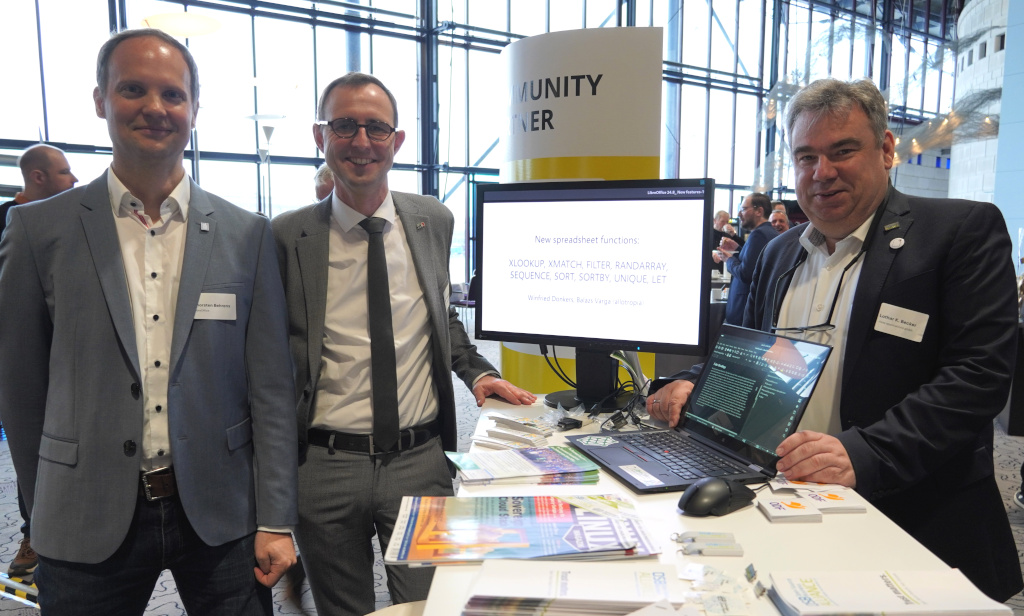
The northern German state of Schleswig-Holstein is moving 30,000 PCs from Microsoft Windows and Office to Linux and LibreOffice. At the recent Univention Summit 2025 which took place on January 23 and 24 in Bremen, the LibreOffice project was present and met with the people overseeing the migration.

500 people attended the event, a mixture of Free and Open Source Software (FOSS) providers and users from the public and private sectors. Many people who attended the LibreOffice stand were from foundations, state and federal organisations, as well as large companies that have plans to deploy FOSS.
Some of the topics at the stand were the Open Document Format 1.4, integration into third-party software, and training and support. Dirk Schrödter, Schleswig-Holstein’s Minister for Digitalisation, attended the stand and was informed about the upcoming LibreOffice 25.2 release. And the state’s CIO Sven Thomsen also joined us too.
We’re looking forward to following the migration to Linux and LibreOffice, and other federal states and organisations going the same path.

(Image credits: Staatsministerium.SH and Felix Kronlage-Dammers)