10/20: LibreOffice 10th anniversary in 2020, a year long celebration

LibreOffice was announced on September 28, 2010, with a positive feedback from tech and business media all over the world (above, two significant titles from eWeek and Linux Gizmos). To celebrate the event, The Document Foundation has organized a year long anniversary project, starting at FOSDEM in Brussels on February 1/2 and ending at POSS in Paris in early December 2020.

LibreOffice community members will attend as many FOSS events as possible, carrying stickers and swag with the anniversary logo. The author is Rania Amina from Indonesia, a member of the LibreOffice community who has already contributed with logos and 2D animations to the success of LibreOffice Indonesia Conference in 2018.

Rania Amina will attend FOSDEM in Brussels, and will also talk about the LibreOffice Theme Changer at the Open Document Editors DevRoom.

So far, in addition to FOSDEM and POSS, events have been confirmed in Nigeria (Open Source Africa), Kosovo (FLOSSK), Croatia (DORS/CLUC), Albania (OSCAL), France (Libre Graphics Meeting and OW2con), Taiwan (COSCUP and LibreOffice Asia Conference), India (Open Source India), Germany (Chemnitzer Linux-Tage, FrOSCon and the LibreOffice Conference), US (All Things Open) and Serbia (PSSOH), but several other are being currently discussed and will be announced as soon as possible.

Stay tuned !!! 2020 will be an exciting time for the LibreOffice community !!!

According to TechRepublic, LibreOffice is one of the best open source innovations of the last decade

According to TechRepublic’s Jack Wallen, LibreOffice is one of the best open source innovations of the last decade, with Docker, Kubernetes, GNOME 3, the cloud, Chrome OS, Internet of Things (IoT) and Firefox Quantum: “We head back to the desktop with LibreOffice. Although OpenOffice (which was originally StarOffice) was one of the first full-blown open source office suites, it wound up falling far enough behind as to become irrelevant. That’s when on January 25, 2011 LibreOffice came into being to offer up an open source office suite that could hang with the best of them and innovate quickly and reliably. Although, even if LibreOffice went away, there would still be plenty of options remaining (such as KOffice), but there wouldn’t be one that held so true to the ethos of open source, while still being a viable option for the world of business. Without LibreOffice, Linux users would be relegated to Google Docs and Office 365 for business collaboration.”

Second Bug Hunting Session for LibreOffice 6.4 – join in!

LibreOffice 6.4 is being developed by our worldwide community and certified developers, and is due to be released at the end of January 2020 – see the release notes describing the new features here.

In order to find, report and triage bugs, the LibreOffice QA team is organizing the second Bug Hunting Session for LibreOffice 6.4 on Monday December 23, 2019.

Tests will be performed on the first Release Candidate version, which will be available on the pre-releases server the same day of the event. Builds will be available for Linux (DEB and RPM) with GTK3 and KDE5 support, macOS and Windows. (Note that it will replace your current installation.)

Mentors will be available from 07:00 UTC to 19:00 UTC for questions or help in the IRC channel #libreoffice-qa and the Telegram QA Channel. Of course, hunting bugs will be possible also on other days, as the builds of this particular Release Candidate (LibreOffice 6.4.0 RC1) will be available until mid January, 2020, when LibreOffice 6.4 RC2 will be released. Check the Release Plan.

All details regarding the bug hunting session are available on the wiki. We look forward to – and appreciate – your help!

Help our community with social media in various languages and locations!

Love LibreOffice? Want to help spread the word? And do you speak another language than English? Then we’d appreciate your help! We have lots of community-created LibreOffice accounts on Facebook and Twitter, but some haven’t been updated for a while. The full list is below, with the date the account was last active – if you’re interested in helping to maintain one, join our marketing list and let us know!

(To join: send a blank email to marketing+subscribe@global.libreoffice.org and follow the instructions. Then you can post to the list.)

Or if you’re interested in creating a new account on another social media platform, such as Mastodon, that’s awesome too! This is a great way to help the LibreOffice community, and build up experience with managing a social media channel – who knows, it could land you a job somewhere one day…

Facebook

Twitter

Thanks in advance for any help 🙂

LibreOffice 6.3.4 available for download

Berlin, December 12, 2019 – The Document Foundation announces LibreOffice 6.3.4, the 4th minor release of the LibreOffice 6.3 family, targeted at technology enthusiasts and power users, who are invited to update their current version. LibreOffice 6.3.4 includes over 120 bug fixes and improvements to document compatibility.

LibreOffice 6.3.4’s change log pages are available on TDF’s wiki: https://wiki.documentfoundation.org/Releases/6.3.4/RC1 (changed in RC1) and https://wiki.documentfoundation.org/Releases/6.3.4/RC2 (changed in RC2).

LibreOffice’s individual users are helped by a global community of volunteers: https://www.libreoffice.org/get-help/community-support/. On the website and the wiki there are guides, manuals, tutorials and HowTos. Donations help us to make all of these resources available.

LibreOffice in business

For enterprise class deployments, TDF strongly recommend sourcing LibreOffice from one of the ecosystem partners to get long-term supported releases, dedicated assistance, custom new features and other benefits, including Service Level Agreements (SLAs). Also, the work done by ecosystem partners flows back into the LibreOffice project, benefiting everyone.

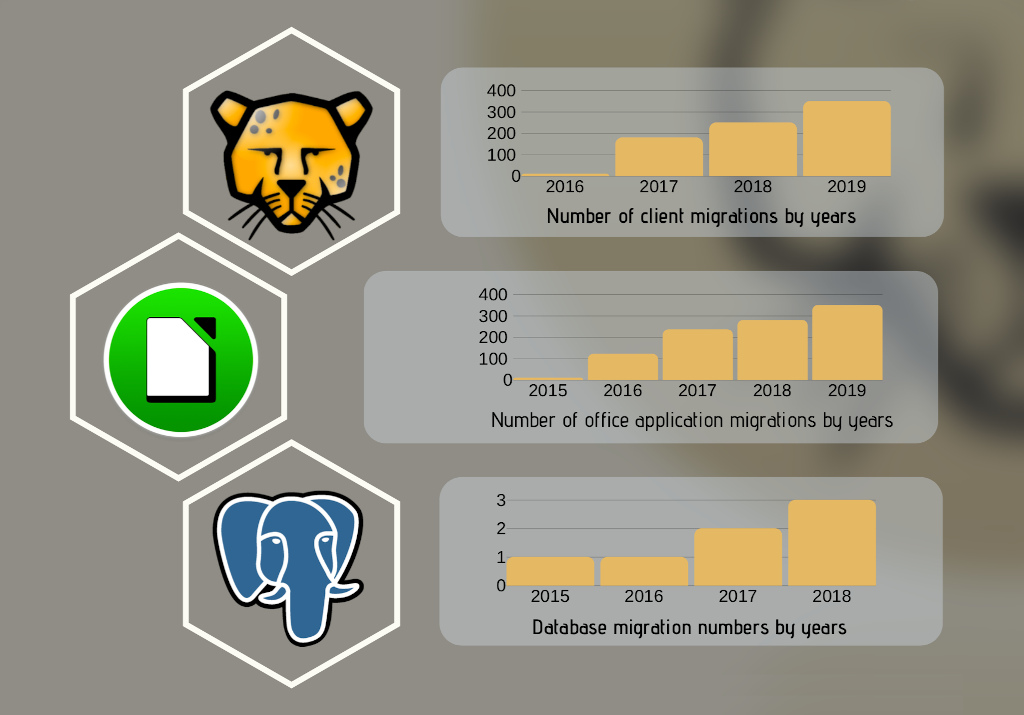
Also, support for migrations and trainings should be sourced from certified professionals who provide value-added services which extend the reach of the community to the corporate world and offer CIOs and IT managers a solution in line with proprietary offerings.

In fact, LibreOffice – thanks to its mature codebase, rich feature set, strong support for open standards, excellent compatibility and long-term support options from certified partners – represents the ideal solution for businesses that want to regain control of their data and free themselves from vendor lock-in.

Availability of LibreOffice 6.3.4

LibreOffice 6.3.4 is immediately available from the following link: https://www.libreoffice.org/download/. Minimum requirements are specified on the download page. TDF builds of the latest LibreOffice Online source code are available as Docker images: https://hub.docker.com/r/libreoffice/online/.

LibreOffice Online is fundamentally a server-based platform, and should be installed and configured by adding cloud storage and an SSL certificate. It might be considered an enabling technology for the cloud services offered by ISPs or the private cloud of enterprises and large organizations.

All versions of LibreOffice are built with document conversion libraries from the Document Liberation Project: https://www.documentliberation.org.

Support LibreOffice

LibreOffice users are invited to join the community at https://ask.libreoffice.org, where they can get and provide user-to-user support. People willing to contribute their time and professional skills to the project can visit the dedicated website at https://whatcanidoforlibreoffice.org.

LibreOffice users, free software advocates and community members can provide financial support to The Document Foundation with a donation via PayPal, credit card or other tools at https://www.libreoffice.org/donate.

Making LibreOffice a Friendly Platform for Indigenous People in Taiwan


Lin and Wang in the LibreOffice Conference 2019. The Chinese words in the photo in slide marks: “I have to speak Chinese, not local languages.”

Authors: Author: Kuan-Ting Lin and Tanax Yago (Xiao-Wu Wang)

Foreword: At the LibreOffice Conference 2019, two young people from Taiwan, Kuan-Ting Lin and Xiao-Wu Wang, gave a wonderful talk called “Making LibreOffice a lifesaver for dying languages in Asia”. (Video of the talk is at the end of this blog post.) It covered their work and plans for saving indigenous languages in Taiwan, and what an important role LibreOffice can play here.


Like many indigenous or native people around the world, the indigenous Taiwanese people have been excluded from contemporary technology for decades. During the rapid development of personal computers between the 1960s and 1980s, the indigenous people were suffering from the “national language” policy, which banned all indigenous languages and discourse promoting Chinese identity in school. That is the reason that the earliest Chinese input method for computers was invented before 1976, but there were no equivalents for indigenous languages until the late 2000s.

As smartphones boomed in this decade internationally, more and more indigenous people gained access to the internet mobile apps as, like other people do Taiwan. But the majority of the digital resources are still in Chinese: online news articles, educational materials, translation systems, digital government services, medical information, chat forums, and many more. Almost all of them are not available in the indigenous languages.

Maybe Taiwan has done a lot for indigenous rights, but as members of the indigenous community and students of anthropology here, we think there is still huge room for improvement. The input system is the first step. Typing has been difficult for indigenous people as sentences are treated as English – hence tons of red underlines indicating spelling or grammatical “mistakes” identified by various office software brands in the market. Therefore, making indigenous dictionaries for the apps to remove the underlines has become the top priority of our work.

Making it appealing

Furthermore, the system must be appealing for people to type in their own indigenous languages. It needs to be smart enough to correct grammar, if possible, and spelling. Being able to do so can empower the elderly to use new technology and to align their spelling with the official dictionary as long as they want to. New language learners will benefit from this system, since they don’t need to look up in dictionaries when typing as often.

After our research, we understand that Microsoft not only discourages people to type in indigenous languages in Microsoft Office – by failing to implement such support in the software suite – but also distance people from their mother tongue by restricting modifications to Office with its proprietary software license.

On the contrary, the LibreOffice community discovered this problem years ago and has been tackling it thanks to its open source development, and its appreciation of diverse values. For example, LibreOffice was translated to Guarani to address a similar issue in South America. In Taiwan, community members like Mark Hung have started to build databases for indigenous languages, too.

Working with the youth communities of indigenous people, we are able to extend the project to another level: local participation. We want this project to be an important point of revitalization of indigenous culture, and it can be applied in everyday life. We invite youngsters from all the indigenous communities, and connect them with the LibreOffice community. With such an idea, the LibreOffice community can also benefit from new perspectives and views of different people, and can get a huge group of new and enthusiastic users and promoters.

Good for everyone

The project is also good for the government. The central government of Taiwan is both struggling with its OpenDocument Format/LibreOffice policy and the “official documents in indigenous languages” policy. For public servants, everyday tasks seem to have made them reluctant to learn new things – both dying languages and new software. We hope that combining the two will make it easier for people to adapt new and meaningful policies.

We received so many words and a lot of help from our friends in the LibreOffice community around the world before, during and after the LibreOffice Conference 2019 in Almería, Spain. Our Taiwanese folks, including Franklin Weng and Eric Sun, introduced this wonderful opportunity for us to get to know this community. Mark Hung, Gustavo Pacheco, Eike Rathke and Cheng-Chia Tseng generously provided their precious knowledge and experiences. Shinji Enoki, Jeff Huang and many friendly LibreOffice community friends gave us their sincere encouragement and suggestions. We are so lucky to work on this important issue with these lovely people!

If you agree that this is worth doing, please join us! We’d love to see new participants from various backgrounds. For inquiries, participation, questions or suggestions, just send an email to a @ cssjh . com (Kuan-Ting). We appreciate your interest and support!

And as mentioned, here’s the video of the presentation from the conference:

Please confirm that you want to play a YouTube video. By accepting, you will be accessing content from YouTube, a service provided by an external third party.

YouTube privacy policy

If you accept this notice, your choice will be saved and the page will refresh.