LibreOffice in 2023 – TDF’s Annual Report

TDF Annual Report 2023 banner

In 2023, LibreOffice celebrated its thirteenth birthday. Two new major versions of the suite introduced a variety of new features, while minor releases helped to improve stability as well

(This is part of The Document Foundation’s Annual Report for 2023 – we’ll post the full version here soon.)

LibreOffice 7.5

On February 2, LibreOffice 7.5 was officially released after six months of work. Developers at Collabora, allotropia, CIB, Red Hat, NISZ, The Document Foundation (TDF) and other companies and organisations – along with volunteers – worked on many new features.

For instance, there were huge improvements to the dark mode thanks to Caolán McNamara (Red Hat), Rafael Lima, Michael Weghorn, Rizal Muttaqin and others. The single toolbar was updated by Maxim Monastirsky, while Michael Stahl (allotropia) added code so that images, embedded objects and text frames could be marked as decorative, which allows assistive technology to ignore them in exported PDFs. On top of the new features, there were many other general improvements to performance, compatibility and stability.

With the help of the Indonesian community, TDF produced a video to explain and demonstrate many of the new features in LibreOffice 7.5. This was linked to in the announcement, and embedded into various news websites that covered the release. The video is also available on PeerTube.

Please confirm that you want to play a YouTube video. By accepting, you will be accessing content from YouTube, a service provided by an external third party.

YouTube privacy policy

If you accept this notice, your choice will be saved and the page will refresh.

LibreOffice 7.6

Later in the year, on August 21, TDF released LibreOffice 7.6. Based on the LibreOffice Technology platform for personal productivity on desktop, mobile and cloud, it provided a large number of interoperability improvements with Microsoft’s proprietary file formats.

In terms of features, this release added support for document themes thanks to Tomaž Vajngerl at Collabora, while Jim Raykowski implemented highlighting for used Paragraph and Character styles along with highlighting for used Direct Formatting in text. Paris Oplopoios and Justin Luth (both Collabora) worked on a new page number wizard, and Samuel Mehrbrodt (allotropia) made sorting by colour possible in AutoFilter.

Many other features were added as well, and there were a large number of compatibility improvements. As with the previous release, TDF staff worked with the Indonesian LibreOffice community to make a video (PeerTube version) to demonstrate the new features:

Please confirm that you want to play a YouTube video. By accepting, you will be accessing content from YouTube, a service provided by an external third party.

YouTube privacy policy

If you accept this notice, your choice will be saved and the page will refresh.

Regular improvements

We also released 16 minor updates with bug and security fixes:

  • LibreOffice 7.4.4 – January 12
  • LibreOffice 7.4.5 – January 26
  • LibreOffice 7.5.1 – March 2
  • LibreOffice 7.4.6 – March 9
  • LibreOffice 7.5.2 – March 30
  • LibreOffice 7.5.3 – May 4
  • LibreOffice 7.4.7 – May 11
  • LibreOffice 7.5.4 – June 8
  • LibreOffice 7.5.5 – July 20
  • LibreOffice 7.5.6 – September 7
  • LibreOffice 7.6.2 and 7.5.7 – September 26
  • LibreOffice 7.5.8 – November 2
  • LibreOffice 7.6.3 – November 23
  • LibreOffice 7.6.4 and 7.5.9 – December 7

Like what we do? Support the LibreOffice project and The Document Foundation – get involved and help our volunteers, or consider making a donation. Thank you!

The Document Foundation in 2023 – Annual Report

TDF Annual Report 2023 banner

In 2023 we had elections for the foundation’s Board of Directors, along with regular Advisory Board calls, and support for other projects and activities

(This is part of The Document Foundation’s Annual Report for 2023 – we’ll post the full version here soon. And note that this section is only about TDF’s activities – we’ll post about all the changes and improvements to LibreOffice soon too!)

Election of new Board of Directors

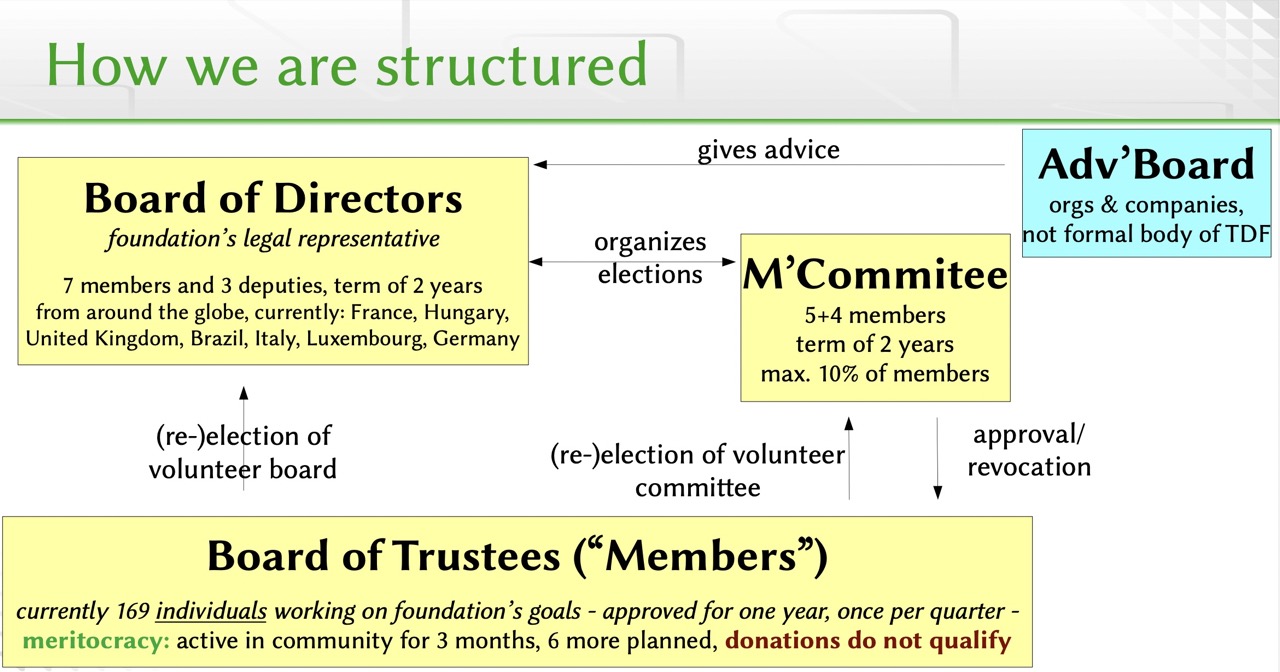
The “BoD” is the Foundation’s Board of Directors, the main administration of the Foundation’s projects and teams. Directors are directly elected by community members every two years, and serve for a two-year term. The Board of Directors consists of seven (7) members and three (3) deputies. The Board of Directors may launch any other teams or committees ad hoc if necessary.

TDF’s Membership Committee announced the election in October, opening the nomination phase for candidates. The final list of candidates was published on December 11, and this was immediately followed by three live “town-hall” Q+A meetings with the candidates, so that community members could ask questions and discuss the responses. We made video recordings of these meetings, and posted them on our video channel, for those who couldn’t take part live.

On December 29, the Membership Committee announced the preliminary results, along with a challenging phase for members to check their votes. On January 11, 2024, we announced the final results, with the following confirmed as full Board Members: Sophie Gautier, László Németh, Simon Phipps, Italo Vignoli, Bjoern Michaelsen, Eliane Domingos and Eike Rathke. Deputy members: Osvaldo Gervasi, Paolo Vecchi and Mike Saunders.

TDF Board of Directors

TDF would like to say thank you to all past and current members of the Board for their service to the community, and to all candidates for running.

Advisory Board members and meetings

The Document Foundation relies on its Advisory Board Members in order to receive advice and support. The Advisory Board’s primary function is to represent The Document Foundation’s supporters and to provide the Board of Directors with advice, guidance and proposals. Current members are Adfinis SyGroup, allotropia software GmbH, Collabora, GNOME, CAGE Technologies Inc, City of Munich (Landeshaupstadt München), Open Source Business Alliance (OSBA), Software in the Public Interest (SPI), KDE e.V., and the Free Software Foundation Europe (FSFE).

Throughout the year, TDF had regular calls with representatives of the Advisory Board. Staff and Board members at TDF provided updates on the foundation, LibreOffice software and community, and described plans and activities for the future. Advisory Board members were invited to provide valuable feedback on TDF’s work, and various ideas and proposals were discussed during the calls. TDF would like to express its thanks to all of the members for their help and support.

New team members

In January, we welcomed Juan José González, TDF’s new Web Technology Engineer to the team. “JJ” (as he’s informally known) dedicates his time to support, fix and improve the experience of TDF’s websites and services. He started with the extensions site, the place where users can get templates and extensions for LibreOffice. He began by replying to reported issues from users and improving the overall experience.

Juan José González

Then, in July, our team was expanded by Michael Weghorn who joined as a LibreOffice Developer, focusing initially on accessibility – ie improving the experience for users with limited vision or motor impairments. His initial focus was fixing problems encountered in the user interface when using LibreOffice with a screen reader.

Michael Weghorn

Highlights of activities

Throughout the year, TDF supported – and provided information about – various campaigns and events, via this blog and our social media channels. For instance, in March we celebrated International Women’s Day, looking forward to a world that’s diverse, equitable, and inclusive. One of our goals in TDF is to encourage more women to join our community (such as “LibreLadies”).

In April, we reported about TDF’s policy-related activities in the European Union. TDF has been involved in several discussions about policies which can affect or are affecting the adoption of free and open source software (FOSS), or the freedom of users’ choice for hardware, operating systems and software. A freedom of choice which should be protected by laws, especially when involving public administrations (with a strong focus on schools and universities, where future citizens grow up).

In May, we announced projects selected for LibreOffice in the Google Summer of Code 2023, while in June we collaborated with Thunderbird, an open source email client (which is very often used alongside LibreOffice) to see how we can make our applications work better together.

LibreOffice and Thunderbird logos

Then, in July, our Membership Committee announced a new membership management system called Proteus. In August we posted about Weblate (translation tool) improvements funded by TDF, and in November we supported freedom and the sustainable use of electronic products in the European Union.

Finally, throughout the year we celebrated our community of translators, who provide LibreOffice in over 110 different languages (with more hopefully becoming available in the future), more than any other software. This helps us to fulfil one of the most important objectives of The Document Foundation: “to support the preservation of mother tongues by encouraging all people to translate, document, support, and promote our office productivity tools in their native language”. Today, there are over four billion people in the world who can use LibreOffice in their native languages. We are very thankful to our hard-working community members who make all of this possible.

Like what we do? Support the LibreOffice project and The Document Foundation – get involved and help our volunteers, or consider making a donation. Thank you!

The new Board of Directors

The new Board of Directors of The Document Foundation has just started its two-year term on 18 February 2024.

The full members are, in alphabetical order: Eliane Domingos, Sophie Gautier, Björn Michaelsen, László Németh, Simon Phipps, Eike Rathke, Italo Vignoli.

The deputies are again in alphabetical order: Osvaldo Gervasi, Mike Saunders, Paolo Vecchi.

Mike Saunders was elected to the Board for the first time. All the other members have served either on the Steering Committee from 2010 to 2012 (Sophie Gautier and Italo Vignoli) or on the Board of Directors since 2014 as full or deputy members.

At its first meeting, the Board unanimously elected Eliane Domingos as Chair and Simon Phipps as Vice-Chair.

At the same time, they decided to review and reorganise responsibilities and areas of oversight to ensure a more agile decision-making process.

Six people who served during the previous term have left the Board, but will continue to contribute to the project as TDF Members: Thorsten Behrens, Gábor Kelemen, Gabriel Masei, Cor Nouws, Emiliano Vavassori, Ayhan Yalçınsoy.

We are deeply grateful to all of them for their dedication, their contribution to decision making and all the time they have volunteered to serve on the Board, as well as their ongoing contribution to FOSS and LibreOffice.

LibreOffice in Sri Lanka

ICTer International Conference is the successor to the seminal International Information Technology Conference (IITC) held in Sri Lanka since 1998. We have been invited by the conference organizers, thanks to the connection established by Daniska Navin, a long time project member, to attend the 2023 event on November 8 and November 9, to present LibreOffice during a keynote speech, and to manage a two day workshop about LibreOffice and the Migration Protocol, on November 7 and November 10.

I attended the conference and provided the keynote speech about LibreOffice Technology, and together with Lothar Becker – Certification Co-Chair – managed the two day workshop. The conference was a huge success, as we met many interested people, including some students who asked to organize a similar workshop in 2024 at their universities in other cities of Sri Lanka. We will definitely be back next year to attend ICTer 2024, and to visit the other universities for a workshop.

During the workshop we covered many topics:

  1. Workshop Day 1: LibreOffice project’s history, the technical evolution of the development platform, LibreOffice’s six modules, with an introduction to main features, an introduction to open source software and open standards (for software and for documents), and free open-source licenses and business models.
  2. Workshop Day 2: LibreOffice Migration Protocol, fixing bugs and regressions, interoperability with proprietary document formats, conversion of document templates and macros, compatibility of VBA macros, and integration with third-party applications.

At the end of the workshop, we handed the basic LibreOffice Certified recognition to the following people (in alphabetical order by first name): BWRU Siriwardhana, CS Jayakody, DN Gunawardana, Dilani Sagarika, DMDC Kumari, Gayani Sadagiri, HK Jayarathna, HP Henegama, JKDI Thilakarathne, JRM Muthumalki, KDPM Kannangara, Malsha Katugampala, Mrs LC Karunasagara, Ms AS Gunathilake, Nisantha Ranathunga, NS Gajasinghe, R Prasanna, Rajika Dilrukshi, Renuka Matiwalakumbura, RMJM Rathnayake, Ruwan Jayalath, Sachini de Silva, Selani Ekenayake, Vimukthika Sewwuandi and WMNK Weerasooriya.

A big thank to all our hosts at the School of Computing of the University of Colombo: the Director Dr DAS Atukorale and the Deputy Director Prof Kasun de Zoysa, and all the other academic and administrative staff members who have welcomed us and made the conference memorable. A special thanks to Sanduni Thrimavithana, who made our stay as memorable as the conference. And a final thanks to all the other people we have met during the four days. See you all in 2024.

Join the LibreOffice Team as a Paid Developer focusing on RTL/CTL/CJK languages, full-time, remote (m/f/d)

The Document Foundation's team

Love LibreOffice development? Want to turn your passion into a paid job? We are The Document Foundation (TDF), the non-profit entity behind LibreOffice. We’re passionate about free software, the open source culture and about bringing new companies and people with fresh ideas into our community.

To improve language support features in LibreOffice, the office productivity suite for over 200 million users around the globe, we’re searching for a developer (m/f/d) to start work (from home) as soon as possible. This is what you’ll do:

  • Work on the LibreOffice codebase (mostly C++)
  • Focus (initially) on right-to-left (RTL), complex text layout (CTL) and CJK (Chinese, Japanese, and Korean) languages in the LibreOffice code
  • Fix bugs, implement new features, and improve language support in LibreOffice

What we want from you:

  • Very good C++ development skills
  • Proven experience working on either RTL/CTL and/or CJK topics, or both
  • Good understanding of Unicode and internationalization (i18n)
  • Good understanding of text rendering and font issues
  • Proven contributions to FOSS projects (show us your repos!)
  • Good team-playing skills
  • Experience with LibreOffice development is a plus

Speaking and writing English is a mandatory requirement. Another language (for example: German, Spanish or Arabic) is a bonus.

A previously established relationship within the developer community, as well as with other teams such as QA is a plus, but it is not mandatory at the start and can be achieved during the work itself.

As always, TDF will give some preference to individuals who have previously shown a commitment to TDF, including but not limited to members of TDF. Not being a member does not exclude any applicants from consideration.

Join us!

All jobs at The Document Foundation are remote jobs, where you can work from your home office or a co-working space. The work time during the day is flexible, apart from a few fixed meetings. The role is offered as full-time (ideally 40 hours per week). Candidates that are resident in (or willing to relocate to) Germany will be employed directly by TDF. Otherwise, external payroll services will be used if available in the candidate’s country of residence.

Are you interested? Get in touch! We aim to schedule the first interview within two weeks of your application. You can also approach us any time for an informal chat, to learn about the role or in case of questions.

TDF welcomes applications from all suitably qualified persons regardless of their race, sex, gender, disability, religion/belief, sexual orientation or age. Don’t be afraid to be different, and stay true to yourself. We like you that way! 😊

We’re looking forward to receiving your application, including information about you (your resume), when you are available for the job, and of course your financial expectations. Pointing to public repositories with your code is very helpful. Please send us an e-mail to developers@documentfoundation.org no later than January 8, 2024. If you haven’t received feedback by February 9, 2024, your application could not be considered.

Also note: we only accept applications from the applicant, and not from any intermediary. We do not accept agency resumes. Please do not forward resumes to any recruiting alias or employee.