Publication of TDF Ledgers

TDF has begun publishing the accounting ledgers to the general public. As part of the foundation’s transparency and openness principles, TDF is committed to publishing the accounting ledgers on a regular basis from now on.

Accounting is done by a professional accountant, and the resulting ledgers are slightly anonymized and translated. The style of the ledgers is defined by our tax/accounting requirements and changes are possible only on a limited basis.

You can find TDF Ledgers at https://wiki.documentfoundation.org/TDF/Ledgers.

TDF is grateful to all donors and volunteers for the ongoing donations, support and contributions, which make TDF what it is today and contribute greatly to the ongoing success of the LibreOffice community!

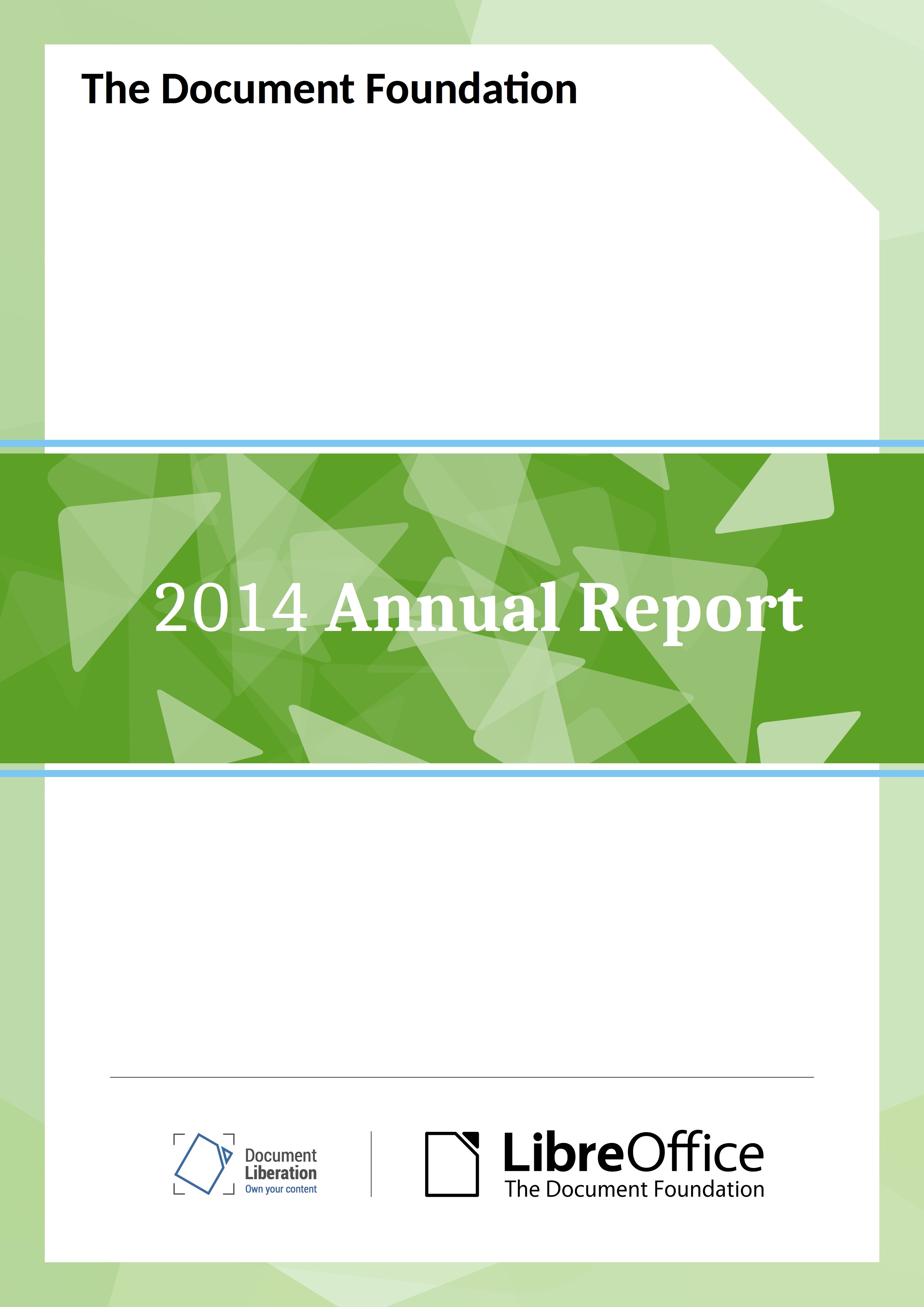
Read about The Document Foundation achievements in 2014: download the Annual Report!

TDF ReportThe Document Foundation (TDF) is proud to announce its 2014 Annual Report, which can be downloaded from the following link: http://tdf.io/report2014 (3.2 MB PDF). The version with HD images can be downloaded from http://tdf.io/report2014hq (15.9 MB PDF).

TDF Annual Report starts with a Review of 2014, with highlights about TDF and LibreOffice, and a summary of financials and budget.

Community, Projects & Events covers the LibreOffice Conference 2014 in Bern, Certification, Website and QA, Hackfests in Brussels, Gran Canaria, Paris, Boston and Tolouse, Native-Language Projects, Infrastructure, Documentation, Marketing and Design.

Software, Development & Code reports about the activities of the Engineering Steering Committee, LibreOffice Development, the Document Liberation Project and LibreOffice on Android.

The last section focuses on People, starting with Top Contributors, followed by TDF Staff, the Board of Directors and the Membership Committee, the Board of Trustees, or the body of TDF Members, and the Advisory Board.

To allow the widest distribution of the document, this is released with a CC BY 3.0 DE License, unless otherwise noted, to TDF Members and free software advocates worldwide.

[The German version of TDF Annual Report is available from http://tdf.io/bericht2014].

Behind the scenes at TDF: Localization and Native-Language Projects

Sophie Gautier has been a member of the OpenOffice.org project since its beginning, and then a founding member of The Document Foundation and LibreOffice. She is extremely active in the Francophone and international community, and is a staff member of The Document Foundation. She takes care of the French translation of LibreOffice (interface and help), is a member of LibreOffice certification committee and is a leading member of the quality assurance project.

2015 is more than ever a year packed with exciting projects and ideas around LibreOffice and The Document Foundation, so we want to continue our behind-the-scenes series, to share achievements with our community and our generous donours, to whom we’d like to express our sincerest gratitude and thanks for their incredible and wonderful support and their invaluable contributions!

The localization team has been very busy translating for the 4.4.x version, a lot of dialogues have been modified, so thousands of strings were touched, moved and need to be translated and validated again.

The L10N team had an important discussion on the workflow and the current workload due to changes on the sources, whether they are needed or purely cosmetic, which resulted in several decisions. The first is that the teams willing to work on master will have a new Pootle project reflecting the changes done there. It will be merged once a month and the template will be updated in Pootle accordingly. This allows us to check the strings much earlier and revert eventually unneeded changes. The teams wishing to work at the branch levels will still be able to do so.

To be able to reach out to developers more quickly and get a better communication between the teams, I attend and report the L10N activities and needs to the Engineering Steering Committee, by attending the weekly calls. For example, the request to have a mechanism that handles the localization of the templates will be provided for 4.5 and strings will be uploaded on Pootle.

The migration to the new Pootle version is going on. We are closely working with the Pootle team to get this done smoothly and to have the whole set of features the L10N team needs. The Deckard addendum will be the next step.

A cross work between the documentation and translation projects has been brought up by Milos Sramek from the Slovak community. They have developed a whole workflow to translate the user guides and to maintain them. After some tests in different languages, we have decided to use it for the whole project and document it on the wiki. This is handled via the OmegaT Project feature and we use the LibreOffice GitHub repository to manage revisions in the .ODT file, which turned out to be really time saving and reducing errors – even if the first work is important, it allows afterwards to only handle modifications needed by new LibreOffice versions. If you are willing to use this workflow for your own translation projects, even if it’s another LibreOffice writing, don’t hesitate to contact us either on the documentation or the L10N list.

Some new languages added to Pootle during the first quarter are: Guarani, Nahualt, Tigrinya, Pashto and a new contributor who will work on Tatar, which was stalled for the moment. Welcome to all of them, keep up the good work, guys!

It is a bit early, but let’s already talk about what L10N and NLPs wanted to discuss during the LibreOffice Conference. I am very happy to see that we will have a large group representing the teams this year! 🙂 If you are active in the L10N or NLPs groups and wish to attend, don’t hesitate to come back to me via e-mail and have a look also at the conference website. We will have workshops, discussions and presentations sharing our experiences, difficulties, tips & tricks, but the most importan,t we will be altogether in the same room 🙂 If you can’t attend, don’t feel sad, we will try to organize a hangout and an IRC chat as well.

TDF has also been a supporter of the Document Freedom Day, an event that will be followed by several groups all over the world. I’ll report about it next quarter. The Brazilian team has launched the 15th edition of its magazine. The Japanese team is, as always, organizing several events, trainings and mentoring during this quarter. Don’t forget to have a look at our calendar to follow the activities and perhaps meet a team exhibiting near your place.

The Document Foundation: the third anniversary

The Document Foundation has been incorporated on February 17, 2012. Today is the third anniversary, and this video is a testimonial of the activity of many members of the fantastic LibreOffice community in representation of thousands of volunteers and hundreds of developers. Thanks everyone for the wonderful journey.

Please confirm that you want to play a YouTube video. By accepting, you will be accessing content from YouTube, a service provided by an external third party.

YouTube privacy policy

If you accept this notice, your choice will be saved and the page will refresh.

TDF welcomes eight new LibreOffice certified professionals

Peer-to-peer review session at FOSDEM in Brussels

The Document Foundation welcomes the eight new LibreOffice certified professionals who have successfully passed the first peer-to-peer review during FOSDEM in Brussels: Adriano Afonso from Portugal; Osvaldo Gervasi, Gabriele Ponzo, Enio Gemmo, Sonia Montegiove and Alfredo Parisi from Italy; Douglas Vigliazzi and Valdir Barbosa from Brasil. The eight TDF members have been certified for Migrations and Trainings. Their certification will expire on January 31, 2017.

Reviewers for the first peer-to-peer session have been Marina Latini from Italy, who has attended the eight review sessions; Lothar Becker and Thomas Krumbein from Germany, who have attended four sessions on Saturday morning; Cor Nouws from the Netherlands, who has attended two hangout sessions on Monday afternoon; Eliane Domingos, Olivier Hallot and Gustavo Pacheco, who have attended two hangout sessions on Monday afternoon (it was late morning in Brasil).

tdf-infoprofessionals“Peer-to-peer review sessions are the final step of a rather lengthy certification process, where we discuss with candidates – once we have checked their pre-requisites – about their experience, and we ask to provide the relevant documents to attest their migration or training related activity”, explains Italo Vignoli, chairman of the Certification Committee, who has coordinated the sessions. “For different reasons, we rejected more applications than we have accepted. Some of them are on hold, others were missing the pre-requisites. This ‘funnel’ approach allow to bring in front of the review committee only those people who are likely to qualify for certification, and the peer-to-peer review is the final step to discuss face-to-face with the candidates”.

The eight new certified professionals join the 44 certified developers and the 13 certified migrators/trainers who have been appointed by the Board of Directors of The Document Foundation based on their code contributions, or on their experience and their contribution in setting up or improving the certification program.

Until the end of April 2015 the program is open only to TDF Members. From May 2015, certification will be open also to third parties, provided they meet the pre-requisites and follow a two day training course. LibreOffice Certification Program is extensively described at http://www.documentfoundation.org/certification.

Behind the scenes at TDF: Executive Director

With the beginning of 2015, a new year packed with exciting projects and ideas around LibreOffice and The Document Foundation, we continue our behind-the-scenes series, to share achievements in 2014 with our community and our generous donours, to whom we’d like to express our sincerest gratitude and thanks for their incredible and wonderful support and their invaluable contributions!

I’m Florian, and I live in the very southern part of Bavaria in Germany, 100 km southwest of Munich, near the border to Austria and Switzerland – a beautiful place to be. 😉

Today, I’d like to shed a light on my role as Executive Director, a fulltime position which I have held since last March. With TDF having grown over the past years in terms of contributions, projects, ideas, staff and donations, my role as Executive Director is, in a nutshell, to keep everything together and have “the show running”, working for the Board of Directors and with the Membership Committee,floeff2012_400x400 and all the other wonderful volunteers, contributors and staff members like Sophie, Italo, Christian, Robinson and Alex.

Having worked intensively on the statutes and the initial setup of TDF, the first part of my role is taking care of many administrative, legal and tax bits, removing that burden from the board to give them more time for strategy and other items. This work reaches from working closely with our accountant, tax advisor, payroll provider and legal counsel, to dealing with trademark requests, protection of domain names, checking and payment of invoices, and reviewing contracts and insurances, making proposals for the investment of our capital stock and other funds, and of course answering questions on details of the statutes and other parameters of the German “Stiftung”.

The second part of my role is handling the daily operations, which includes replying to and distribution of all sorts of inquiries and requests, be it formal letters, user inquiries and, together with other TDF spokespeople, a variety of press and media inquiries. The daily operations also involve monitoring the budget, organizing our internal file storage, preparing presentations for the annual board meetings, participating in and proposing agenda items for the biweekly phone conferences, handling our donation mechanisms, bank accounts and donation confirmations, monitoring deadlines and working on relations to our Advisory Board. When a new Board of Directors or Membership Committee is elected, or we have new staff members, I have the honour of introducing them to our internal workflow and our entity.

The most exciting part of my job surely is working with our staff in various projects, and the coordination of tasks, deadlines, priorities. As Executive Director, I am responsible for oversight of all budget items and projects TDF is carrying out. At the end of 2013 we have switched to Redmine for project management – started out of the infrastructure team’s needs, it has become an important tool for task and project handling in some non-development parts of LibreOffice. In addition to that, we are running weekly team calls with our staff members, have slots reserved for weekly one-on-one calls, and meet in IRC regularly to discuss current projects and challenges. Every once in a while we also have in-person meetings, mostly during LibreOffice Conferences and FOSDEM. Being responsible for that part of the foundation also involved handling tender processes, job openings and talking to candidates who apply for a job.

We do have a couple of recurring projects, like gradually improving our AskBot instance or writing our formal annual report, but there’s also individual items, like the certification program, the Android tender and the Bugzilla migration.

Should I find some spare time during the weekends, I also like hacking around on our infrastructure, especially our e-mail system and our Redmine instance, and try to join our admin phone calls and infra in-person meetings when possible. Having been a part of the German community for many years, I also try to regularly organize community meetings and phone conferences.

Last but not least, every once in a while I give a presentation, staff a booth at an event, and sometimes I even make it to a magazine or try to say some wise words in a podcast or a lecture. 😉