LibreOffice Community at FrOSCon 2019

LibreOffice development takes place mostly via the internet: volunteers, certified developers and other community members collaborate on programming, design, quality assurance, documentation and other tasks. But we also like to meet up in person, to share information, bring new people into the project, and have fun!

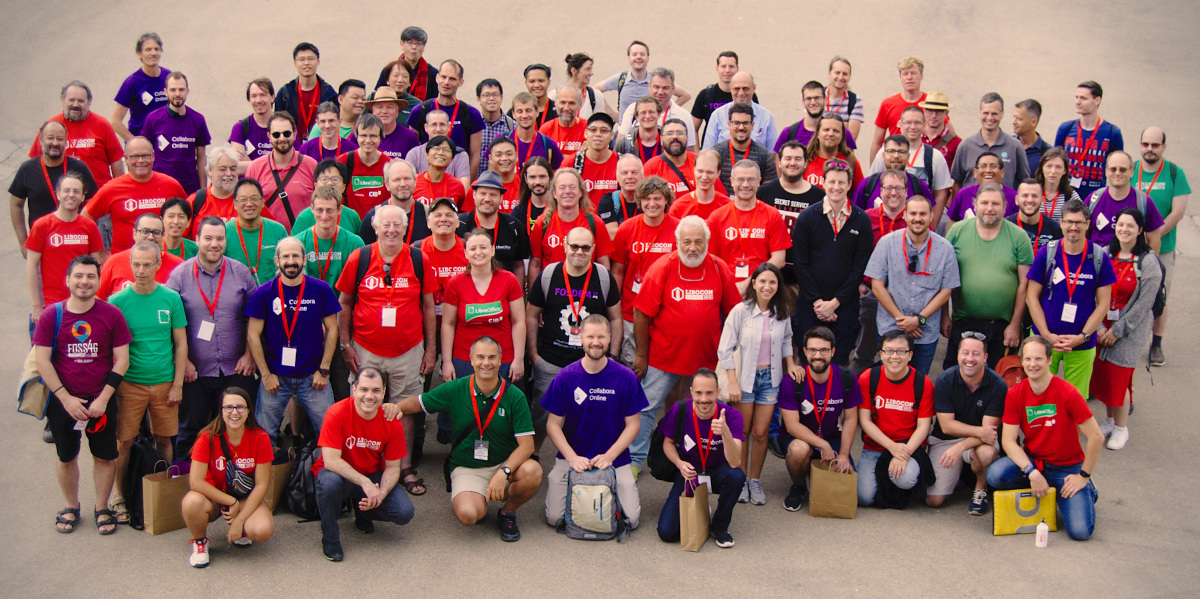
So on the weekend of 10 and 11 August, we attended FrOSCon 2019 in Sankt Augustin, a town just outside Bonn, Germany. FrOSCon is one of the largest free and open source software (FOSS) conferences in the country, with around 2,000 attendees. Most of the visitors know about FOSS already, but some had only learnt about it recently, and were eager to discover more.

Gerrit Großkopf, Uwe Altmann, Stefan Unverricht and Mike Saunders from the German-speaking LibreOffice community had a stand with flyers, stickers and a computer demonstrating LibreOffice 6.3 and LibreOffice Online. Indeed, many visitors to the stand had no idea that LibreOffice Online existed, and were eager to try it out on their own infrastructure.

Other common topics at the stand included LibreLogo, macros, mail merge and other features in the suite. We even had a couple of visitors who demonstrated minor bugs that they’d found in the software, which have been useful for creating bug reports.

In addition to helping with the stand, Stefan gave a lecture about “LibreOffice Online in EGroupware” (German) – the video is available at media.ccc.de. Stefan also translated the slides into English and linked them in the lecture program. The presentation slides are supplemented by web links, and some screenshots of the LibreOffice Online and EGroupware integration.

Overall, it was great to meet so many passionate and dedicated FOSS fans, and we hope we’ve encouraged them to take part in the LibreOffice community. If you’re reading this and would like to organise (or attend) an event near you, drop us a line on our marketing mailing list and we’ll get you started!

LibreOffice Asia Conference Report: Part 2

How does your software affect the autonomy of countries?

Author: Kuan-Ting Lin – click here for part 1

Foreword: the LibreOffice Asia Conference was successfully held in May 2019 in Tokyo. Kuan-Ting Lin, a university student and civic tech reporter also attended this conference and gives his observations here. In Part II, Kuan-Ting starts with the Open Document Format, and expounds on how to form an open government and better autonomy of Taiwan.

The “Taiwanese Language channel” (tâi-gí-tâi) of the Public Television Service (PTS) in Taiwan started its broadcasting service in July 2019. This channel became possible only because the National Languages Act was approved in parliament. This policy was rooted by many in the decision to improve expression, alleviation of limits on speeches, and the consolidation of autonomy following the new law.

After a long-time struggle, the state also sees a silver lining regarding another autonomy issue: document liberation.

What kind of autonomy do we give up for proprietary software?

The LibreOffice Asia Conference held in Tokyo in late May focused on the developments in document liberation in Asian countries. Italo Vignoli, one of the co-founders of The Document Foundation (TDF) that is behind the software, showed a map in a presentation: each country is depicted larger or smaller than its actual size according to its software license trade numbers.

The result was not a surprise: the USA seemed like a giant, while others were squeezed into a bunch of lines. Countries around the globe spend a lot on software licenses – and Taiwan is no exception. Taiwanese people pay tens of billions of New Taiwanese Dollars solely for Microsoft products every year.

Only with respect to trade affairs, Taiwan’s dependency on software products made by single country is damaging its bargaining power and is a threat to economic autonomy. In terms of the autonomy of speech, we are facing an even more serious crisis.

World map for software licenses import. The US becomes an one-pixel wide line between Canada and the Latin America. (Credit: Italo Vignoli)

For thousands of years, our writing and thoughts could only pass on with the help of paper. Then computers replaced paper with digital documents in just a few decades. The difference between paper and digital documents is that the latter are merely some electrical signals which cannot be touched or seen. When users try to open and edit these documents, we need “formats” based on people’s consensus to understand the meanings of different combinations of these electrical signals.

Take “.doc” and “.ppt” files saved by Microsoft Office as examples: these two “formats” are controlled by Microsoft, so it can decide all the rules. The ways to display different fonts, images and languages are Microsoft’s call. As Microsoft Office evolves, paying users may still experience failure to open documents generated by old versions of the software – or see different layouts of the same document in different versions of the software.

In other words, if we do not follow Microsoft’s rules, the appearance of a digital document could alter faster than a piece of paper fades. What you want to say, and how you want your speech to be displayed – the essential freedom of expression and autonomy – are quietly taken away by some companies.

Open format or fake copycat?

To end the domination of formats by Microsoft, some companies, government agencies and communities designed the Open Document Format, or ODF in short, and included a detailed framework of digital document files in it. ODF soon became an ISO standard in 2006. ISO standards are open for everyone to use and are easy to access online, so different developers can all follow them easily. With ODF on the table, we finally came to a consensus on a unified format of documents.

Microsoft joined the party by announcing its “Office Open XML” format and making it another ISO standard in 2008. Having “Office Open XML” in their hands, Microsoft seemed just as open as the ODF. But it didn’t take long for communities to find out that Microsoft wasn’t that open.

The software giant admitted that ordinary users of Microsoft Office save “Office Open XML” files that are not the “strict version” of the format by default. Describing the ISO standard submitted by itself as a “strict version”, and then leading customers to save non-ISO standard files not only make the concept of open standards ironic, but also give people reasons to doubt if the company is really willing to promote open standards.

Franklin Weng, an open standards activist in Taiwan and a board member of TDF also added that some features inside files saved in the so-called “strict version” format in Microsoft products are actually similar to those in “non-strict version” formats. “TDF was studying Office 2016 a couple of years ago. Whether a file is saved as strict OOXML (i.e. Office Open XML) or not, there is no significant difference in terms of file size and lines of XML code.” Therefore, it is debatable how strict the “strict” version claimed by Microsoft actually is.

Length of XML content. As you can see, the XML line numbers of OOXML 2016 Strict and Transitional are nearly the same. What is really saved in OOXML Strict format? (Credit: Italo Vignoli)

Since open formats belong to the public, they has to remain stable and to have a set of progress to review new or modified features, then implement it as a standard extension, thus not matching the style of commercial enterprises, which tend to launch new versions and features frequently in order to stimulate consumption.

Therefore, it is understandable that Microsoft is passive towards promoting open formats. However, for governments and civil society institutions, using a document format with an arbitrary decision-making process, high frequency of change, and non-observance to open standards is definitely not a reasonable policy for documents. It not only leads to more chaos when people exchange files, but also causes more trouble in terms of preserving important information for a long time. Imagine if 500 years in the future, our descendants want to open .docx files from today, yet its complicated document structure doesn’t match the specification Microsoft provides; in that time, there may be no Microsoft engineers able to solve the problems.

A good open format transforms contributions by the community and fuels progress

The monopolised “open format” is regrettable, but the multi-partied ODF format is right here to fix the problem. “ODF is open to many technical companies and communities, and it is more discreet in terms of enacting or revising the standard, which makes immediate and arbitrary changes impossible,” Franklin said.

At the LibreOffice Asia Conference, Mark Hung from Taiwan was invited to give a speech in the opening session keynote. The topic was “LibreOffice CJK (Chinese, Japanese and Korean) Bugs, Fixes and Stories.” Since the majority of the LibreOffice developers are from Europe and South America, the developers, who are usually more familiar with Latin characters, can barely understand the system of logographic scripts and thus are very likely to make some mistakes. Nevertheless, it is at this time that the community can utilise the power of elasticity: the more diverse the cultural backgrounds of participants are, the more easily the problems caused by lack of understanding can be solved.

Mark is exactly such a participant. In 2014, Mark was working for an organisation of around 400 people, and was responsible for transferring the document system to community-developed free software. At first, facing the mistakes in Chinese, Korean, and Japanese characters and Mark’s colleague’s unfamiliarity with new software, Mark gradually developed an operational Q&A to help them solve the problems.

Mark Hung. (Photo credit: Masataka Kondo)

Mark also found out a way to solve a bug that had been disturbing him for a long time. “I was working on a document, and then I thought why not try to look into what’s inside the document? … I decided to try to submit my patch to LibreOffice and to my surprise my patch got reviewed in one day and then it got merged.” Mark therefore became a LibreOffice developer and a community member.

In his five years of volunteering, Mark has dealt with dozens of CJK issues. He even noticed some slight issues, such as the difference between Taiwanese Chinese and Japanese regarding the placement of phonetic markers. Dae-Hyun Sung, another community member from Korea, also showed regional distinction. Dae-Hyun’s presentation mentioned different ways of writing for South and North Korea. These examples show community-driven attempts to include all the differences, instead of limiting the freedom of writing.

Franklin points out that these new features will be treated as extensions first. If they work well then they will be included in a revised ODF format. The whole process ensures that the community’s voice is constantly reflected, and that the versions of the format remain stable.

Shaping a future for governments, free software and open formats to support each other

In Taiwan, ODF is accepted as a national standard of digital documents called ODF-CNS15251. There still are many government agencies and schools that are buying Microsoft Office licenses, but with help from the civil society, the National Development Council has started the “Advancing ODF-CNS15251 to Be the Standard Document Format for the Government” programme, and has been encouraging other parts of the government to replace Microsoft solutions with LibreOffice. The goal of document liberation has transformed from a “mission impossible” to a future that can be expected.

In large companies’ international business strategies, Taiwan is merely a small market and has relatively little attention. But having the opportunity to participate in the development of ODF and LibreOffice, Asian members can finally meet their own needs of document production by themselves. The significance of the LibreOffice Asia conference is that the Asian community has become part of the collective development of LibreOffice.

In Taiwan, facing the native language policies and official documents in the indigenous language programme, Taiwanese people are able to take advantage of the flexibility of LibreOffice to include indigenous languages and other native languages in the software’s built-in dictionary. Native languages can no longer be sacrificed under business interests of companies. And technology can start to be the thing that positively revitalises native languages, instead of the being something that marginalises them.

The National Development Council of Taiwan has started to collaborate with local companies that designed the “NDC ODF Application Tools” based on LibreOffice. But Franklin has a further suggestion: “It’s already a huge leap forward that the National Development Council invested in software development, but I hope they will give some feedback to the community. As for the ODF standard, the government should be part of its making.” The communities alone won’t sustain a proper standard. Having all the benefits of document liberation, the government has obligation to help build a better future. Having a voice in the development of an international standard can also highlight the autonomy that belongs to Taiwanese people.

Thanks to Kuan-Ting Lin for his write-up and perspectives on ODF and LibreOffice in Asia! And on the topic of conferences, everyone is welcome to join our upcoming LibreOffice Conference 2019 in Almeria, Spain, from 10 – 13 September. See you there!

Community Member Monday: DaeHyun Sung

Today we’re talking to DaeHyen Sung from our Korean community, about opportunities and challenges for advocating LibreOffice and free software on the Korean peninsular…

To start with, tell us a bit about yourself!

So, my surname is Sung, first name is DaeHyun (Korean Hangul notation: 성대현, Korean Hanja notation: 成大鉉). I’m from the Korean peninsular’s south-east area, Gyeongsang Province (경상도/慶尙道) region, Korea. Now, I live in the south-east side of Seoul (서울).

I’m Korean. My mother tongue is Gyeongsang dialect of Korean. But I can speaks Both Standard Korean [표준말 or 표준한국어/標準韓國語] and Gyeongsang dialect of Korean [경상도사투리 or 경상방언/慶尙方言].

My Twitter ID is @studioego, and I’m also on Github: https://github.com/studioego

I contribute to improvements to Korean language support in free/libre open source software (FLOSS), mostly in my spare time. Also, I’m learning East Asian Languages (such as Mandarin Chinese, and Japanese).

This is because, three languages (Chinese, Japanese, Korean) use Chinese characters 漢字 (also called “ideographs”) and share a similar culture. I am curious as I study the commonalities and differences in the East Asian languages. I also like to visit some historic sites and take pictures in Korea.

What are you working on in LibreOffice at the moment?

My LibreOffice activities are about improving Korean features, bug reporting (Quality Assurance), translating into Korean, and some other things. Two years ago, I found a bug in LibreOffice’s Korean Hangul/Hanja dictionary. Some Korean Hangul/Hanja dictionary contents are broken on LibreOffice – so I fixed and added content. In addition, I updated the Hangul/Hanja conversion dictionary on LibreOffice.

In Korea, many people have rarely used LibreOffice – so I found many bugs and missing feaatures. So my overall goal is fix and improve Korean languages in LibreOffice.

Is there anything else you’d like to work on in the future?

Along with improving Korean support in LibreOffice, I’d like to do it with other FLOSS projects.

The Korean language (Hangul[한글]: 한국말/한국어 (these words are used in South Korea 🇰🇷), 조선말/조선어 (these words are used in North Korea 🇰🇵), 우리말 (this word is used neutrally in both Koreans and bt Korean expats, it literally means “our language”); Hanja[한자/漢字]: 韓國말/朝鮮말/韓國語/朝鮮語) is an East Asian language spoken by about 80 million people.

It is the official and national language of both Koreas: the Democratic People’s Republic of Korea (North Korea) and the Republic of Korea (South Korea), with different standardized official forms used in each territory. It is also one of the two official languages in the Yanbian Korean Autonomous Prefecture (연변 조선족 자치주/延邊朝鮮族自治州/延边朝鲜族自治州) and Changbai Korean Autonomous County (장백 조선족 자치현/長白朝鮮族自治縣/长白朝鲜族自治县) of the People’s Republic of China [中華人民共和國, Mainland China]. It is also used in Japan, Uzbekistan, Russia [it reads “Корё мар” in Russian], Kazakhstan, Kyrgyzstan, etc.

Also, the Korean language uses Chinese characters (漢字). It means “Sino-Korean vocabulary” or “한자어(漢字語/Hanja-eo)” in Korean. It is similar to Japanese Kanji [漢字かんじ]. So when you’re working on FLOSS, you have to consider both Chinese and Japanese as well as Korean and vice versa.

In future, If I have time, I want to do more research about the differences in Korean languages in South Korea 🇰🇷 and North Korea 🇰🇵.

How did you get involved with LibreOffice – and what was the experience like?

In 2017, I visited Taiwan’s FLOSS Conference, COSCUP (Conference for Open Source Coders, Users and Promoters) as the Korean FLOSS Contributor.

At that time, I had already contributed Linux character maps applications – both GNOME (gucharmap) and KDE (kcharselect). Then I attended COSCUP at National Taiwan University, in Taipei, Taiwan, and in 2017, I met TDF board members Italo Vignoli and Taiwan’s TDF members, Franklin Weng, Cheng-Chia Tseng and Jeff Huang. I also met a Japanese TDF member, Naruoka Ogasawara. When I watched Italo Vignoli’s presentation, it had a strong impression on me.

Then, Jeff Huang [Po-Yen Huang] invited me to the LibreOffice CJK Telegram group. So I joined the LibreOffice project in 2017. At that time, I installed and used LibreOffice for the first time. (When I was University student, I was used to OpenOffice. However, its compatibility was very low, so I had stop to using it.)

Last year, I met many of TDF members and Asian LibreOffice users in places such as Taiwan, Japan, Indonesian, Mainland China, etc. In February 2018, I met Japanese TDF member, Jun Nogata with KDE board member “Eike Hein”, KDE Korea members in Seoul. At that time, really I felt Jun Nogata’s passions for FLOSS.

Then, In August 2018, I heard and watched KDE Akademy 2018’s keynote. The keynote’s main topics were North Korea, FOSS in Both Koreas (North and South). In his keynote slide, he talked about Korean Expat challenges in Korea for using FOSS (for example, Korean input, fonts, banking, online transactions [maybe, Microsoft ActiveX technology is popular in Korea], and HWP [Hangul Word processor] files).

I think, In Korea, Microsoft’s product-friendly computing environment and proprietary software is popular (such as HWP), so many Koreans and expats in Korea think ALL FOSS is difficult to use. (Also, I personally feel that it is difficult to use FLOSS in Korea.)

In the presentation, I saw North Korea’s Linux distribution, Red Star OS (it’s based on KDE). Also, when I installed Red Star OS, I checked the office suite and found that it’s based on OpenOffice. In my opinion, Because of North Korea’s economic senctions, North Korean people mainly use FLOSS. I found the bugs in Red Star’s office suite – so I thought, I would have to work hard on the LibreOffice project.

Also, when I attended COSCUP, GNOME.Asia and openSUSE Asia summit 2018 in Taipei, Taiwan, I met other TDF members from Asia (such as LibreOffice Taiwan Team, Japan Team, Indonesia Team, etc). Then I met LibreOffice Indonesia team members at LibreOffice Asia Meetup in A+A Space, Taipei. I was impressed by the enthusiasm of Indonesian open source users and contributors to open source.

Also, In December, 2018, I attended Japanese meetups: OSC 2018 Fukuoka and the 8th Kyushu LibreOffice study meetup [第8回九州LibreOffice勉強会]. I met three contributors from Africa who are currently living in Japan. First time, I’m curious about African Open Source Contributors. Also I felt even more passion for FLOSS.

Finally, what do you see in the future for LibreOffice? What does it need most?

If LibreOffice does not have feature enhancements for Korean users, I think that using the ODF format and document liberation movements in Korea will be impossible. Also the future for LibreOffice is not good regarding the Korean language. In Korea, the HWP format is still widely used HWP – and the share of Microsoft doc formats is still low. HWP format is the de facto standard official document format for the public sector and schools in Korea.
OpenOffice and LibreOffice can only open HWP files only if they were created with Hangul ’97 – newer versions of HWP files cannot be opened with these applications.

Recently, the government of the Republic of Korea Government announced that they will “use ODF insteadd of the HWP format”. But it’s only a slogan – and they only use draft documents officially on web-based document management systems. When I read the article, ”Taiwanese government standardises on true ODF document format”, I really admired the Taiwanese FLOSS activists and contributors.

Thanks DaeHyun Sung! And to everyone reading this: you can also give our community a hand and help to spread the word about free software and open standards. See our “What Can I Do For LibreOffice” site to get started!

LibreOffice Asia Conference Report: Part 1

Free And Open Source Software (FOSS) Is Gradually Developing Its Commercial Ecosystems In Asia

Author: Kuan-Ting Lin
Translator: Franklin Weng

Foreword: the LibreOffice Asia Conference was successfully held in May 2019 in Tokyo. Kuan-Ting Lin, a university student and civic tech reporter also attended this conference and gives his observations here. In Part I, Kuan-Ting provides readers who are not familiar with FOSS, the Open Document Format (ODF) and LibreOffice a view about how FOSS communities work, and how FOSS grows its business opportunities and ecosystems.

On June 18, 2019, almost all of the government agencies in Taiwan’s cabinet received an official document from the National Development Council (NDC). “When exchanging digital documents between government agencies, the file format used shall be the Open Document Format (ODF) if the transferred files are editable… Do not use proprietary editors to directly save as ODF files… It is highly recommended to use the NDC ODF Application Tools or LibreOffice to generate standard ODF files.”

“This is the most exciting and cheering official document in recent years!” said Dr. Chao-Kuei Hung, a Science and Technology Studies (STS) researcher and inveterate FOSS promoter. In the document, users in Taiwan government agencies are asked to not use proprietary office suites like Microsoft Office to generate documents, and therefore not save and spread “.doc” or “.docx” format files, which people are quite familiar with.

Instead, they are asked to use free and open source software – which lets people to download, research, improve and redistribute it – like LibreOffice. They need to save and transfer documents in ODF format, which is an ISO standard (see the upcoming part II of the report for details). For most people, this seems to be a confusing policy; however, it will surely affect our lives in the future. For us, it is even as important as metric units like kilograms or meters.

In 50 Years, From Microsoft To Communities, There Are Huge Software Ecosystem Changes In The Taiwanese Government

The story begins more than 50 years ago. In the late 1960s, the Taiwanese central government introduced the first batch of computers for tax data registration. This purchase started the era of Taiwan’s digital government. With the increasing burden of people using computers, the government had been constantly buying and installing huge numbers of Microsoft product licenses, the majority of which were Microsoft Windows and Microsoft Office. Such unrestrained purchasing and use of Microsoft software had made the government a subject of criticism by the parliament and the supervisory court more than a decade ago.

Legislators held a press conference in 2002 to question the administrative system, and pointed out that the Ministry of Justice had “illegally allowed Microsoft’s bid rigging”. At the time, Minister Ding-nan Chen replied that he would “wait for other software to achieve a certain degree of universality and compatibility,” and then the Ministry of Justice “would not rule out considering adopting it”, which clearly suggested that options other than Microsoft were simply not sufficient for the government at that time.

The fact that the Taiwanese government’s editorial policy changed from the early conservative mentality to today’s announcement of abandoning Microsoft’s commercial solutions proves that a free and open source office suite, developed by the community, has already been able to establish its own “ecosystem”. Companies in different fields in this ecosystem provide various government information services, while meeting the government’s high requirements for stability and security. However, here is an interesting question: Aren’t FOSS community members against the concept of commercial companies and software? Why do they set up their own company in the ecosystem?

The Formation of a FOSS Ecosystem

Let’s get back to the end of May 2019. Many LibreOffice community members gathered together in Tokyo to attend the first LibreOffice Asia Conference, and discuss how LibreOffice – which was born and grown up in Europe – could develop in Asia, where the culture and policies are quite different.

Franklin Weng from Taiwan, the only Asian member in the Board of Directors of The Document Foundation (TDF) – the legal charity entity behind LibreOffice – was there too. Franklin has been deeply involved in the Taiwanese FOSS community, and is also one of the founding members of Software Liberty Association Taiwan (SLAT). In early years he simply contributed and promoted FOSS in government agencies and schools as a volunteer community member. Nevertheless, through these years he realized that it wasn’t enough. “Business and policies needs to push each other. Now LibreOffice and ODF are slowly moving toward this direction: Policy goes first, and then gradually forms the business model.”

Franklin started his own business a few years ago, which helps the public sector and other organizations to adopt FOSS solutions. Through the community’s connections and long-term accumulated trust, Franklin’s team has successfully co-worked with the National Development Council (NDC), the Yilan County Government, and many other central agencies in the Taiwanese government to provide training courses and consulting services.

The lecturers who work with Franklin are mostly freelancers and are also involved in the FOSS community as deeply as he is. Therefore, besides teaching skills for using LibreOffice, the lecturers would also share free software concepts and issues with users from government agencies.

The integrity of FOSS ecosystems also depends on the integration of other fields. Shigenobu Koufugata, a member of the Japanese community who lives in Chiba, Japan, purchases old computers, installs high-performance, low-cost free software, and then resells the renovated solutions to consumers.

Users of second-hand computers often lack certain computer knowledge. Therefore, if they can use the computers straight after buying them, they can avoid the high threshold of downloading and installing additional software. Shigenobu believes that this can naturally attract more users to try LibreOffice.

In addition to software training and hardware support, software development is of course indispensable to the ecosystem. Italo Vignoli, one of the co-founders of TDF, stated clearly: “Our main assets are developers.” LibreOffice has hundreds of developers since everyone can participate; however more than half of the development contributions are made by employees of companies such as Collabora, CIB and Red Hat. By developing the required features or customized versions of LibreOffice for customers, these companies can direct profits and feedback to the community at the same time.

The Open Source Software Integral Institute (OSSII) in Taiwan is one of the few companies that provides LibreOffice business services in the Chinese-language area. One of its products is the “NDC ODF Application Tools” – a customized LibreOffice designed for users in the Taiwanese government – provided by the NDC in Taiwan. The CPC Corporation, Taiwan, a large state-owned enterprise (around 16,000 employees) with 73 years of history, is one of their customers.

At the LibreOffice Asia Conference, Mr. Wen-ke Huang, an employee in CPC who is responsible for the infrastructure information systems and ODF adoption, shared his experiences and analyzed the reasons and methods for adopting ODF and NDC ODF Application Tools.

In contrast to Microsoft’s ecosystem, where companies are mainly selling licenses and external add-ons, FOSS allows anyone to contribute code and even publish their own customized versions. This enables community members to participate into the core aspects of software development. Besides, the growing demands for FOSS application training and second-hand hardware also encourages community members who are expert in different fields to join the ecosystem.

Commercial Company That Is Loyal To The Community

Unlike normal commercial software companies, FOSS-related companies would keep thinking about their responsibilities as members of the community while making a profit. Making money is one thing, but since the community is the original motivation of the company’s founding, the two must cooperate with each other.

The first LibreOffice Asia Conference follows this thought. “I asked the Japanese community about hosting the first LibreOffice Asia Conference, because I found that they have a very good and active community, and hence can go further to find appropriate business models,” said Franklin. “When I attended LibreOffice Kaigi or similar events in Japan and presented what we have done in Taiwan, they always showed their envy and said that it was very difficult to promote LibreOffice and ODF in Japan. However I think that they’re doing very well; they just need to start thinking and finding more business opportunities. So the topic of the first LibreOffice Asia Conference was business. I hoped that after the discussions in the business workshop and certification interview, they have more confidence to start moving to business.”

“Running an FOSS-related company gives me not only the ability to contribute without any worries in the community, but also to find business opportunities for other community members from our experience, and to use the operating principles to consolidate the FOSS ecosystem on the ground,” Franklin explained additionally.

Although commercial companies in the LibreOffice ecosystem can contribute to the community while having profits, the relationship between the company and community is not one-way assistance. Sometimes it can be tough if the relationship between the two is not good.

An obvious example is the former OpenOffice.org community and Oracle. A few years beforehand, Oracle acquired Sun and hence a large amount of OpenOffice.org’s development fell into Oracle’s hands. It was dangerous because Oracle has never been friendly to FOSS, so some core OpenOffice.org community members decided to fork LibreOffice and founded The Document Foundation. “That’s why they chose a foundation as the form of the organization. TDF emphasizes the independence of the organization, very much due to the previous troubles with Oracle,” said Franklin.

Italo described the differences between the OpenOffice.org and LibreOffice communities. “We reverted the paradigm,” said Italo. “This is OpenOffice, the company protects the project. So it’s like when it rains, if you are under the umbrella you don’t get wet. We reverted the umbrella (for LibreOffice), and this is the concept of the mixing bowl… We jump into a bowl and we have every one of us moving in the same direction.”

The independence of the community is not only reflected in the organizational form. Although the development work is mainly carried out by commercial companies, TDF still dominates and makes decisions about the direction of the community and software development.

In order to maintain this independence and avoid conflicts of interests, the statues of TDF stipulates that the composition of the Board of Directors and Membership Committees must not have more than one-third of its members belonging to a single company or organization. With such rigorous management, communities and companies can find the right balance for each other.

Ideals And Business Can Cooperate Through Certification

At the end of the LibreOffice Asia Conference, the TDF’s Certification Committee held a public interview with several candidates from Taiwan and Japan. As long as these candidates were approved by the committee, they would become “LibreOffice Certified Professional Trainers”, which implies the expert skills and abilities to teach LibreOffice; or “LibreOffice Certified Migration Professionals”, to assist organizations to adopt and migrate to LibreOffice.

For TDF, these certified migration professionals and professional trainers are important ways to promote the concept and develop business. “I invited the LibreOffice Certification Committee to attend this conference and talk about business. I hope to discuss with the community about what can be done, and what can be noticed when training,” said Franklin, who has been a certified migration professional and professional trainer since 2016.

Eric Sun, a TDF member and a candidate in the certification interview this time, won unanimous approvals from the committee and became a certified migration professional and professional trainer. Eric used to work in the Open Source Software Application Consulting Center (OSSACC), a project under SLAT, to promote FOSS and public domain educational resources in schools. He then co-worked with Franklin to promote ODF/LibreOffice and has been the ace lecturer in Franklin’s team. Becoming certified by TDF can no doubt bring him more credits and opportunities, both for business and for promoting FOSS.

LibreOffice will be ten years old next year. TDF was founded in the shadow of a large commercial company at that time, but those members who set up the foundation may not have expected that the seed of document liberation and LibreOffice can be spread across the sea, to the distant lands in Asia, and set roots in the ground there, with a philosophy of equal emphasis on ideals and profits.

Video presentations from the LibreOffice Asia Conference 2019

LibreOffice developers love to hack on code – but they also love to meet up, exchange ideas, share information, and enjoy good food! The LibreOffice Asia Conference 2019 took place on 25 and 26 May, and now the videos from the presentations are online. Check them out – there are 16 videos in total, and you can browse the playlist using the button in the top-right…

(Note: the videos are also hosted on a PeerTube instance.)

Please confirm that you want to play a YouTube video. By accepting, you will be accessing content from YouTube, a service provided by an external third party.

YouTube privacy policy

If you accept this notice, your choice will be saved and the page will refresh.

LibreOffice monthly recap: July 2019

Here’s our summary of updates, events and activities in the LibreOffice project in the last four weeks – click the links to learn more!

  • ODF (the Open Document Format) is the native file format of LibreOffice, and is a fully open and standardised format, ideal for long-term document storage. At the start of the month, we announced COSM – the Community of ODF Specification Maintainers, to hold funds and to retain editors to work at the ODF Technical Committee. The goal is to accelerate development of the standard, and build up experienced editors. Find out more here.

  • We put the next part of our Annual Report 2018 online! Our native language communities around the world help to improve LibreOffice and share knowledge – and their passion and dedication is wonderful. LibreOffice wouldn’t be what it is today without their great work!

  • Meanwhile, work continues on LibreOffice 6.3 (due to be released in early August), and our QA community organised a Bug Hunting Session. Give us a hand in future sessions to ensure that LibreOffice stays rock-solid!

  • We talked to Jun Nogata, who helps out with the Japanese Ask LibreOffice website, and is also involved in marketing and public relations for the Japanese community.

  • We already mentioned ODF earlier in this recap – well, also in July, we chatted to Regina Henschel about how the Open Document Format is developed, and how everyone can get involved.

  • Later in the month, we put another part of the Annual Report 2018 online: LibreOffice development. Check it out for a behind-the-scenes look at LibreOffice 6.2’s development process!

  • Members of the Canadian LibreOffice community set up LibreWaterloo, to improve their presence on the local scene.

Keep in touch – follow us on Twitter, Facebook and Mastodon. Like what we do? Support our community with a donation – or join us and help to make LibreOffice even better!