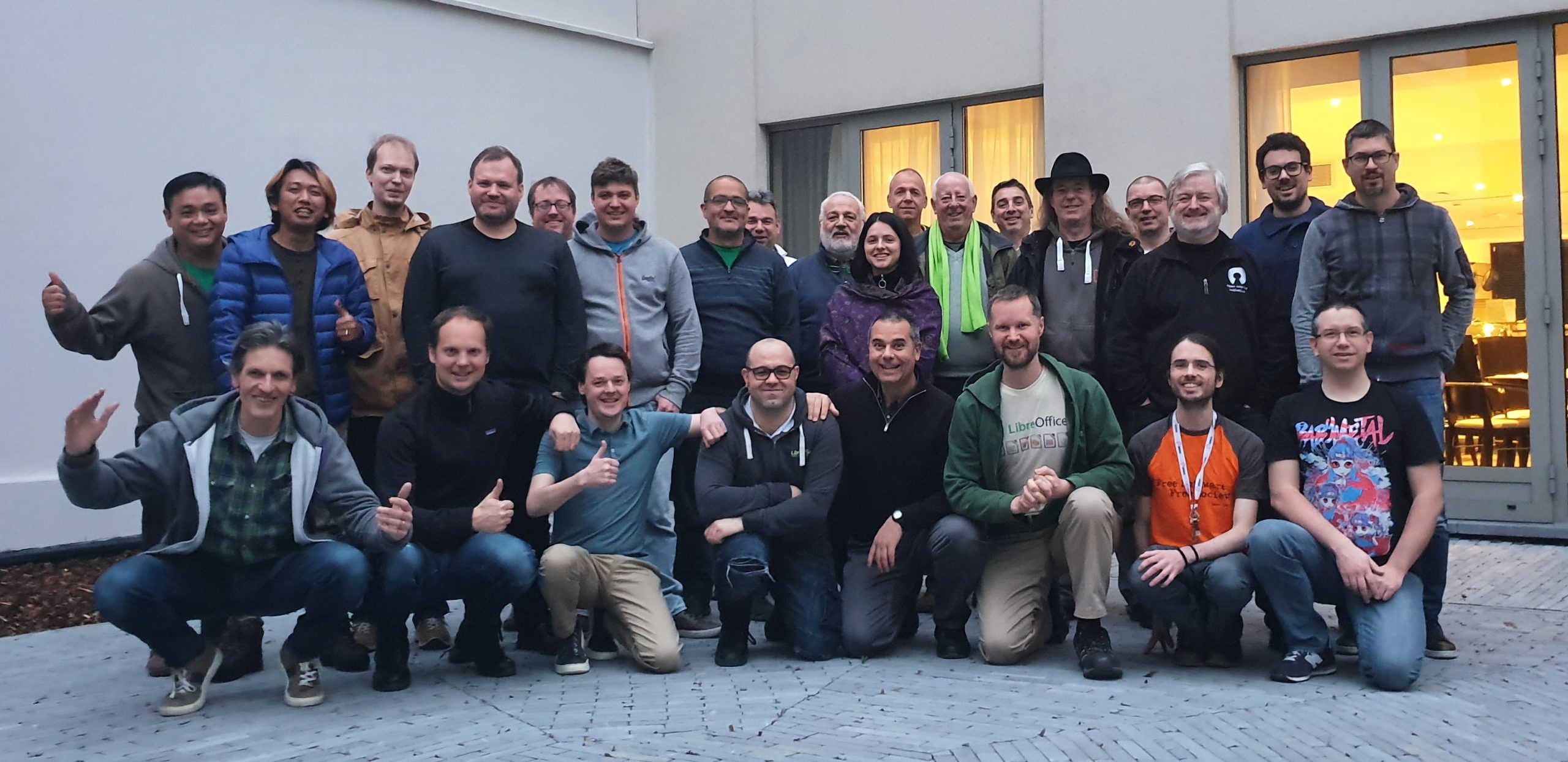



Consider a donation to support activities such as HackFests and other events organized by native language projects, to grow the community and educate about free open source software
Author: Italo Vignoli
Fundraising, December 1st
Consider a donation to support activities such as the LibreItalia Conference and other events organized by native language communities https://www.libreoffice.org/donate
The Municipality of Tirana moves to open source software and open standards by migrating to LibreOffice
Berlin, November 22, 2018 – The Document Foundation (TDF) announces that the Municipality of Tirana, the biggest in Albania, is moving to open source software and open standards by migrating to LibreOffice. The project is a further step in a large deployment of open source technologies in the city’s IT infrastructure, and follows the successful migration to Nextcloud.
The migration to LibreOffice is managed by the ICT Department, which has been following an open source approach when implementing many IT solutions, based on the strong belief that public IT infrastructure should use free and open source technologies (https://publiccode.eu). Thanks to LibreOffice, documents can now be exchanged and stored in the ISO standard Open Document Format, managed by OASIS, which represents the best solution to avoid proprietary lock-in.
Ermir Puka, the head of the ICT Department, believes that despite the resistance to change and the other big challenges facing the migration, using free and open source software and platforms like LibreOffice – supporting open standards – will guide the IT infrastructure of the municipality in the best interest of the citizens of Tirana.
The migration project has started with the HR Department, where most tasks are based on documents and spreadsheets. This has helped to identify many different issues during and after the migration, and has helped the process in other offices of the Municipality. The majority of the 1,000 desktops in the Municipality of Tirana have already been migrated to LibreOffice.
To further ease the migration, LibreOffice Writer and Calc manuals have been translated into Albanian, while the IT staff is working at an online learning course deployed on Moodle, the e-learning platform used by the Municipality. Activities are enthusiastically assisted by the local open source community, which gathers around Open Labs.
The Document Foundation announces LibreOffice 6.0.7 and LibreOffice 6.1.3: all users are invited to update for improved robustness and security
Berlin, November 5, 2018 – The Document Foundation announces the release of LibreOffice 6.0.7 and LibreOffice 6.1.3, which improve the quality and stability of previous releases, and integrate a security patch.
All LibreOffice users are therefore strongly recommended to update to the new versions:
- Power users, early adopters and technology enthusiasts should update from LibreOffice 6.1.2 to LibreOffice 6.1.3, which represents the bleeding edge in term of features for open source office suites;
- All other individual users and organizations of any size should update from any previous version of LibreOffice to LibreOffice 6.0.7, which is more mature and as such targeted at production environments and enterprise-class deployments.
Organizations should source LibreOffice 6.0.7 from one of the companies providing a Long Term Supported version of the suite, for additional value-added services which make the software better suited to enterprise deployments, thanks to professional support (the companies are all members of TDF’s Advisory Board, and are listed here: https://www.documentfoundation.org/governance/advisory-board/). When it is sourced from The Document Foundation, LibreOffice is supported by volunteers.
Also, value-added services for migrations and trainings, to support enterprise-class deployments in large organizations, should be sourced from certified professionals (a list is available here: https://www.libreoffice.org/get-help/professional-support/).
LibreOffice is deployed by large organizations in every continent. A list of some large or significant migrations announced in the media is available on the TDF wiki: https://wiki.documentfoundation.org/LibreOffice_Migrations.
LibreOffice 6.0.7 bug and regression fixes are described here: https://wiki.documentfoundation.org/Releases/6.0.7/RC1 (fixed in RC1), https://wiki.documentfoundation.org/Releases/6.0.7/RC2 (fixed in RC2) and https://wiki.documentfoundation.org/Releases/6.0.7/RC3 (fixed in RC3), while LibreOffice 6.1.3 bug and regression fixes are described here: https://wiki.documentfoundation.org/Releases/6.1.3/RC1 (fixed in RC1) and https://wiki.documentfoundation.org/Releases/6.1.3/RC2 (fixed in RC2).
Download LibreOffice
LibreOffice 6.0.7 and LibreOffice 6.1.3 are immediately available from the following link: https://www.libreoffice.org/download/. Builds of the LibreOffice Online source code can be downloaded as Docker images: https://hub.docker.com/r/libreoffice/online/.
LibreOffice Online is fundamentally a server service, and should be installed and configured by adding cloud storage and an SSL certificate. It might be considered an enabling technology for the cloud services offered by ISPs or the private cloud of enterprises and large organizations.
LibreOffice users, free software advocates and community members can support The Document Foundation with a donation at https://www.libreoffice.org/donate. Donations help TDF to maintain its infrastructure, share knowledge, and fund the presence of volunteers at events, where they can meet with other free software advocates.
LibreOffice 6.0.7 and LibreOffice 6.1.3 are built with document conversion libraries developed and maintained by the Document Liberation Project (DLP): https://www.documentliberation.org. Several of these libraries have been adopted by other software projects to provide an escape path from proprietary document lock-in.
Marketing Activities, January to September 2018
The new year at The Document Foundation starts with FOSDEM, where many LibreOffice contributors gather for the largest Free and Open Source Software (FOSS) meeting in Europe. In 2018 we had a booth in the main hall of building K, where most of the largest projects are based, and a devroom focused on OpenDocument Format (ODF) editing software.
The marketing team at TDF was in charge of the booth and the devroom, and also of logistics for the internal meetings and the hackfest organized at ICAB just after FOSDEM. I also helped to cook some real Italian pasta for the social dinner on Saturday, where the community gathered together with some friends.
Just before FOSDEM, we announced LibreOffice 6.0. We coordinated the announcement, drafting the documents for the press kit and organizing several pre briefings with journalists. As usual, thanks to the efforts of localization volunteers we were able to distribute the press release in some local languages.
We then followed up with announcements of minor releases, with a reduced emphasis in comparison with the major announcement.
After FOSDEM, we started working on TDF’s Annual Report, drafting most of the content and illustrations, and collecting images from community events for the final version. We have managed the final layout, using only free software (LibreOffice for drafting text and drawings, GIMP for tweaking images, and Scribus for creating the final layout, using the free fonts Carlito and Caladea).
After releasing the Annual Report, we started to concentrate on the next major announcement, preparing journalist mailing lists. We have a large number of contacts in media outlets around the world, which we have to update regularly.
Mailing lists are key to maintaining regular contacts with journalists. Of course, relationships must be nurtured over time, and the fact that we have always been proactive and responsive has increased our reputation. We have always replied to requests in due time, and pitched new article ideas as often as possible.
We also increased TDF and LibreOffice presence on social media, by increasing the number of tweets and posts. This will further grow in the next few months, as an increasing number of journalists are shifting to social media as the main source of information for news stories.
In early August we announced LibreOffice 6.1, with a test of the increased Twitter activity, based on a policy document that we drafted and shared with community members. We duplicated step-by-step most of the activities from the previous announcement, but we managed to organize a smaller number of pre-briefings.
In addition to these “major” marketing activities, we also managed several background tasks which are useful to keep TDF engine in good shape. The first is keeping track of donations, which provide the economic resources for the project. We are closely following donation trends, and have been implementing A/B testing for the donation page.
Starting from the month of November, this will include fundraising. If we want to bring the project to the next level, we need to raise money to increase the level of support for local communities, and for marketing and education activities behind the OpenDocument Format.
Last, but not least, we warmly invite community members to attend marketing calls. If the schedule is not the right one please let us know, and we will change it to suit your needs. If necessary, we can schedule two different calls to talk with people in different time zones (Asia and the Americas are hard to fit into the same time slot, but we have active community members in both continents).
LibOCon 2019
LibOCon 2019 will be in Almería, a sunny, lovely city on the south-east coast of Spain. On the shores of the Mediterranean sea, the city was founded in 955 by Abd-ar-Rahman III, who ordered the construction of the famous Alcazaba (the Citadel), one of the largest moorish castles in Europe. The modern city has grown over the hills that surround the Alcazaba, staying true to its visual and architectural tradition.
Almería is also the administrative capital of the homonymous province and part of the Autonomous Community of Andalusia. The region is famous for its prolific production of vegetables, having over 100,000 acres of greenhouses in the Poniente province. The city has about 195,000 inhabitants who are welcoming to visitors and always happy to enjoy the city’s excellent weather with a vibrant day and night life.
LibOCon 2019 dates will be communicated as soon as possible.