Berlin, August 8, 2019 – The Document Foundation announces LibreOffice 6.3, a feature-rich major release of the LibreOffice 6 family with better performance, a large number of new and improved features, and enhanced interoperability with proprietary document formats:
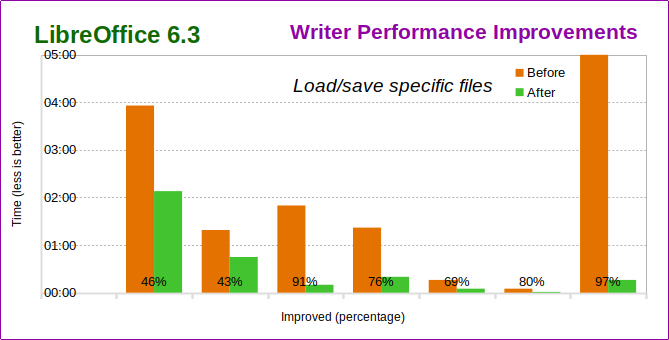
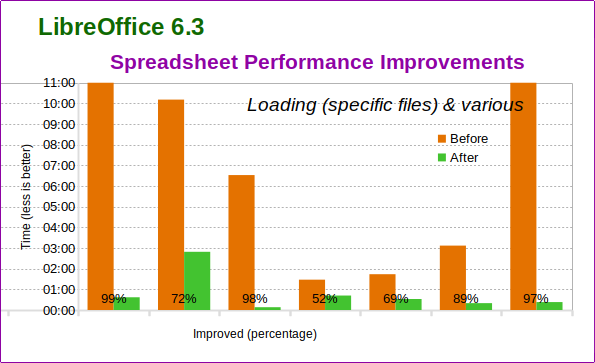
- Writer and Calc performance has been improved by an order of magnitude based on documents provided by end users: text files with different bookmarks, tables and embedded fonts, large ODS/XLSX spreadsheets, and Calc files with VLOOKUP load and render more quickly. Saving Calc spreadsheets as XLS files is also faster.
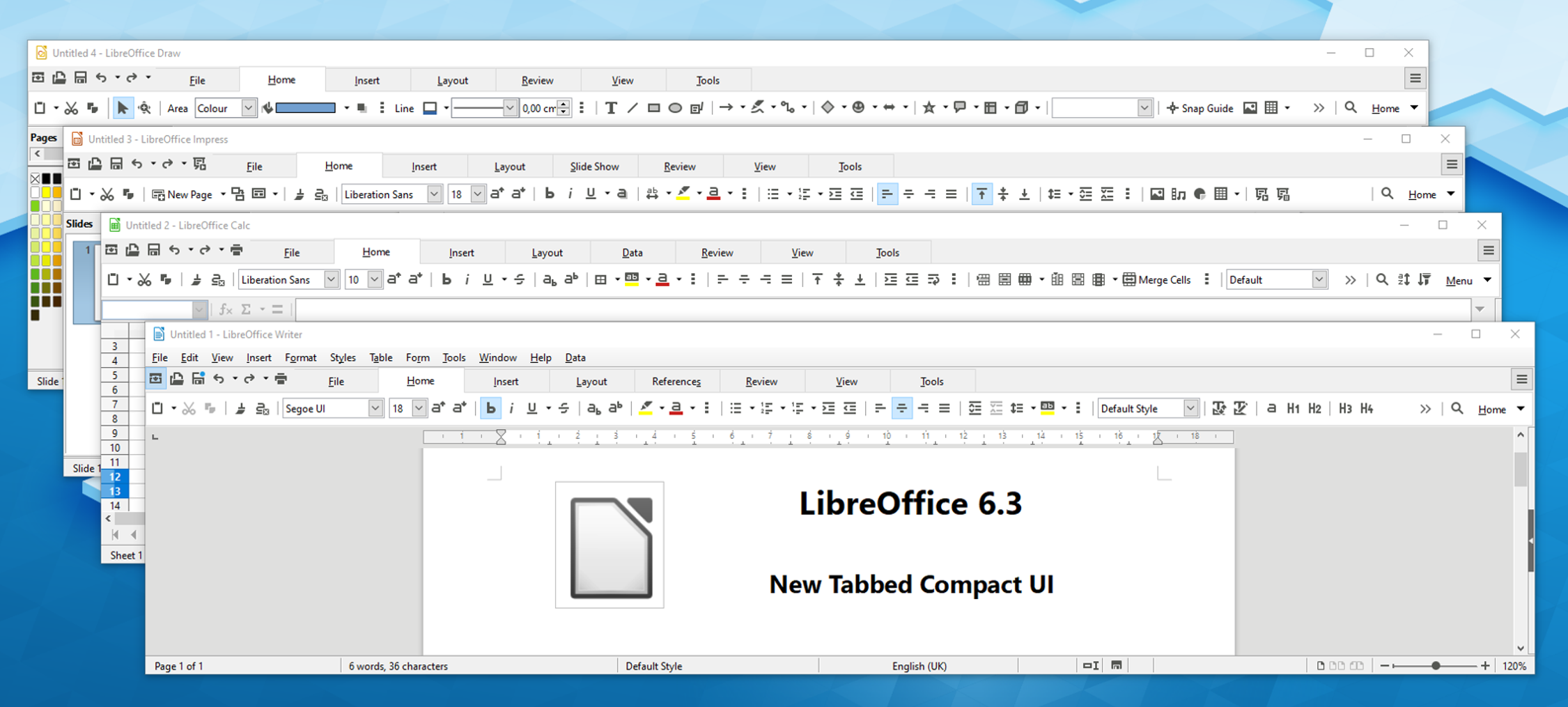
- The Tabbed Compact version of the NotebookBar user interface, introduced in LibreOffice 6.2, is now available for Writer, Calc, Impress and Draw. It leaves more space for user documents, spreadsheets and presentations on laptops with wide screens. In addition, the new Contextual Single UI is ready for Writer and Draw.
- In Calc, a new drop-down widget in the formula bar replaces the old Sum tool, giving the user quick access to the most frequently used functions. Also, a new FOURIER function has been added, to compute the discrete Fourier transform of an input array.
- Export as PDF has been improved with the support for the standard PDF/A-2 document format, which is required by several organizations for long term file storage. In addition, the design of editable PDF forms has been simplified with the addition of the Form menu to Writer, to further improve one of LibreOffice strongest features.
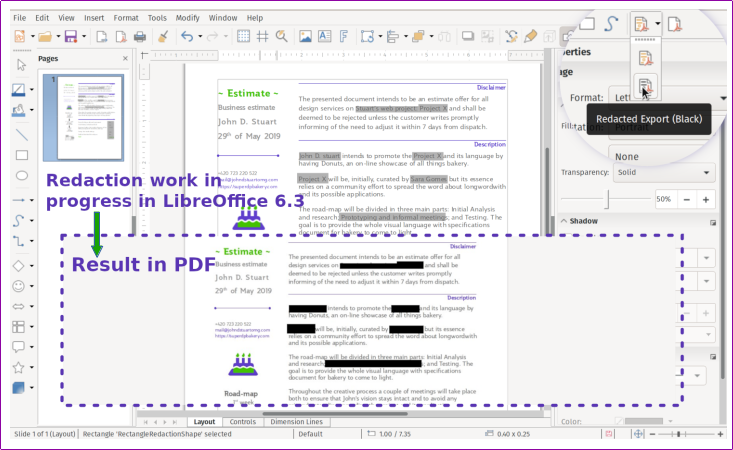
- Documents can now be redacted to remove or hide sensitive information such as personal data before exporting or sharing the file, to help companies or organisations to comply with regulations.
- On Windows, a proper console mode was added, with better output and error codes. This makes it easier to use LibreOffice to perform batch operations such as printing or converting many documents.
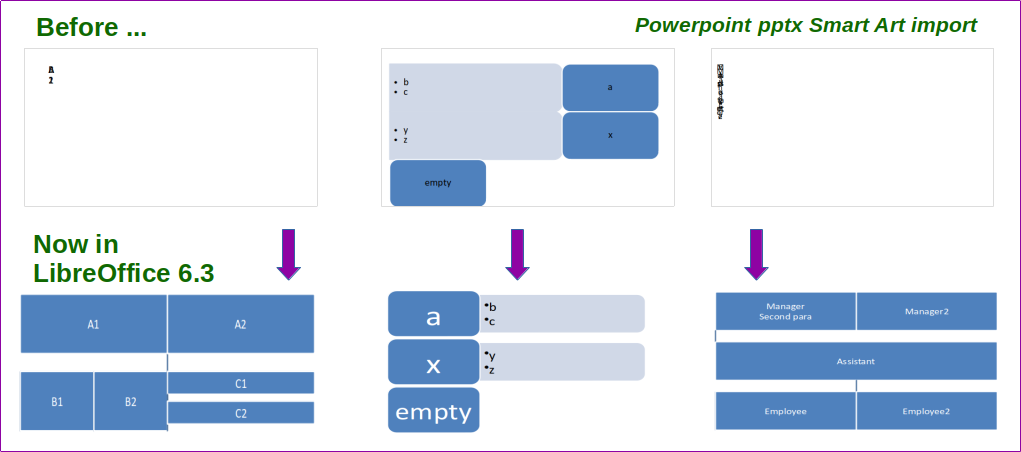
- Interoperability with Microsoft Office proprietary file formats has been improved in several areas with export support for DOTX document templates and XLTX spreadsheet templates, import of charts from DOCX drawingML group shapes, import/export of SmartArt from PPTX files, to preserve editing capabilities in PowerPoint, and better XLSX Pivot table interoperability.
LibreOffice 6.3’s new features have been developed by a large community of code contributors: 65% of commits are from developers employed by companies sitting in the Advisory Board like Collabora, Red Hat and CIB, plus other organizations, and 35% are from individual volunteers.
In addition, there is a global community of individual volunteers taking care of other fundamental activities such as quality assurance, software localization, user interface design and user experience, editing of help system and documentation, plus free software and open document standards advocacy.
A video summarizing the top new features of LibreOffice 6.3 is available on YouTube:
LibreOffice for individual users
LibreOffice 6.3 represents the bleeding edge in term of features for open source office suites, and as such is targeted at technology enthusiasts, early adopters and power users. The Document Foundation does not provide any technical support to users, although they can get help from other users on mailing lists and the Ask LibreOffice website.
For users whose main objective is personal productivity and therefore prefer a release that has undergone more testing and bug fixing over the new features, The Document Foundation maintains the LibreOffice 6.2 family, which includes some months of back-ported fixes. The current version is LibreOffice 6.2.5, and all users are invited to update.
LibreOffice in business
For enterprise class deployments, TDF strongly recommend sourcing LibreOffice from one of the ecosystem partners to get long-term supported releases, dedicated assistance, custom new features and bug fixes, and other benefits. Also, the work done by ecosystem partners flows back into the LibreOffice project, benefiting everyone.
Also, support for migrations and trainings should be sourced from certified professionals who provide value-added services which extend the reach of the community to the corporate world and offer CIOs and IT managers a solution in line with proprietary offerings.
In fact, LibreOffice – thanks to its mature codebase, rich feature set, strong support for open standards, excellent compatibility and long-term support options from certified partners – represents the ideal solution for businesses that want to regain control of their data and free themselves from vendor lock-in.
Availability of LibreOffice 6.3
LibreOffice 6.3 is immediately available from the following link: https://www.libreoffice.org/download/. Minimum requirements for proprietary operating systems are Microsoft Windows 7 SP1 and Apple macOS 10.9. Builds of the latest LibreOffice Online source code are available as Docker images: https://hub.docker.com/r/libreoffice/online/.
LibreOffice Online is fundamentally a server service, and should be installed and configured by adding cloud storage and an SSL certificate. It might be considered an enabling technology for the cloud services offered by ISPs or the private cloud of enterprises and large organizations.
LibreOffice users, free software advocates and community members can support The Document Foundation with a donation at https://www.libreoffice.org/donate.
LibreOffice 6.3 is built with document conversion libraries from the Document Liberation Project: https://www.documentliberation.org.
Press Kit
The press kit, with background documents – Hybrid PDF, opened from within LibreOffice can be edited as normal ODT files – and high-resolution images, is here: https://nextcloud.documentfoundation.org/s/g4zsogp5qxE9bdH