Development is now focused on interoperability with Microsoft’s proprietary file formats, and many new features are targeted at users migrating from MS Office
Berlin, August 18, 2022 – LibreOffice 7.4 Community, the new major release of the volunteer-supported free office suite for desktop productivity, is immediately available from https://www.libreoffice.org/download for Windows, macOS (Apple Silicon and Intel processors), and Linux.
Most Significant New Features
GENERAL
- Support for WebP images and EMZ/WMZ files
- Help pages for the ScriptForge scripting library
- Search field for the Extension Manager
- Performance and compatibility improvements
WRITER
- Better change tracking in the footnote area
- Edited lists show original numbers in change tracking
- New typographic settings for hyphenation
CALC
- Support for 16,384 columns in spreadsheets
- Extra functions in drop-down AutoSum widget
- New menu item to search for sheet names
IMPRESS
- New support for document themes
A video summarizing the top new features in LibreOffice 7.4 Community is available on YouTube: https://www.youtube.com/watch?v=PC8M4UzqpqE and PeerTube: https://peertube.opencloud.lu/w/myZUTCytN28kuxDa5VXNgh. A description of all new features is available in the Release Notes [1]
 Interoperability
Based on the distinctive features of the LibreOffice Technology platform for personal productivity on desktop, mobile and cloud, LibreOffice 7.4 provides a large number of improvements and new features targeted at users sharing documents with MS Office or migrating from MS Office. These users should check new releases of LibreOffice on a regular basis, as the progress is so fast, that each new version improves dramatically over the previous one.
LibreOffice offers the highest level of compatibility in the office suite market segment, with native support for the OpenDocument Format (ODF) – beating proprietary formats for security and robustness – to superior support for MS Office files, to filters for a large number of legacy document formats, to return ownership and control to users.
Microsoft files are still based on the proprietary format deprecated by ISO in 2008, and not on the ISO approved standard, so they hide a large amount of artificial complexity. This causes handling issues with LibreOffice, which defaults to a true open standard format (the OpenDocument Format).
Contributors to LibreOffice 7.4 Community
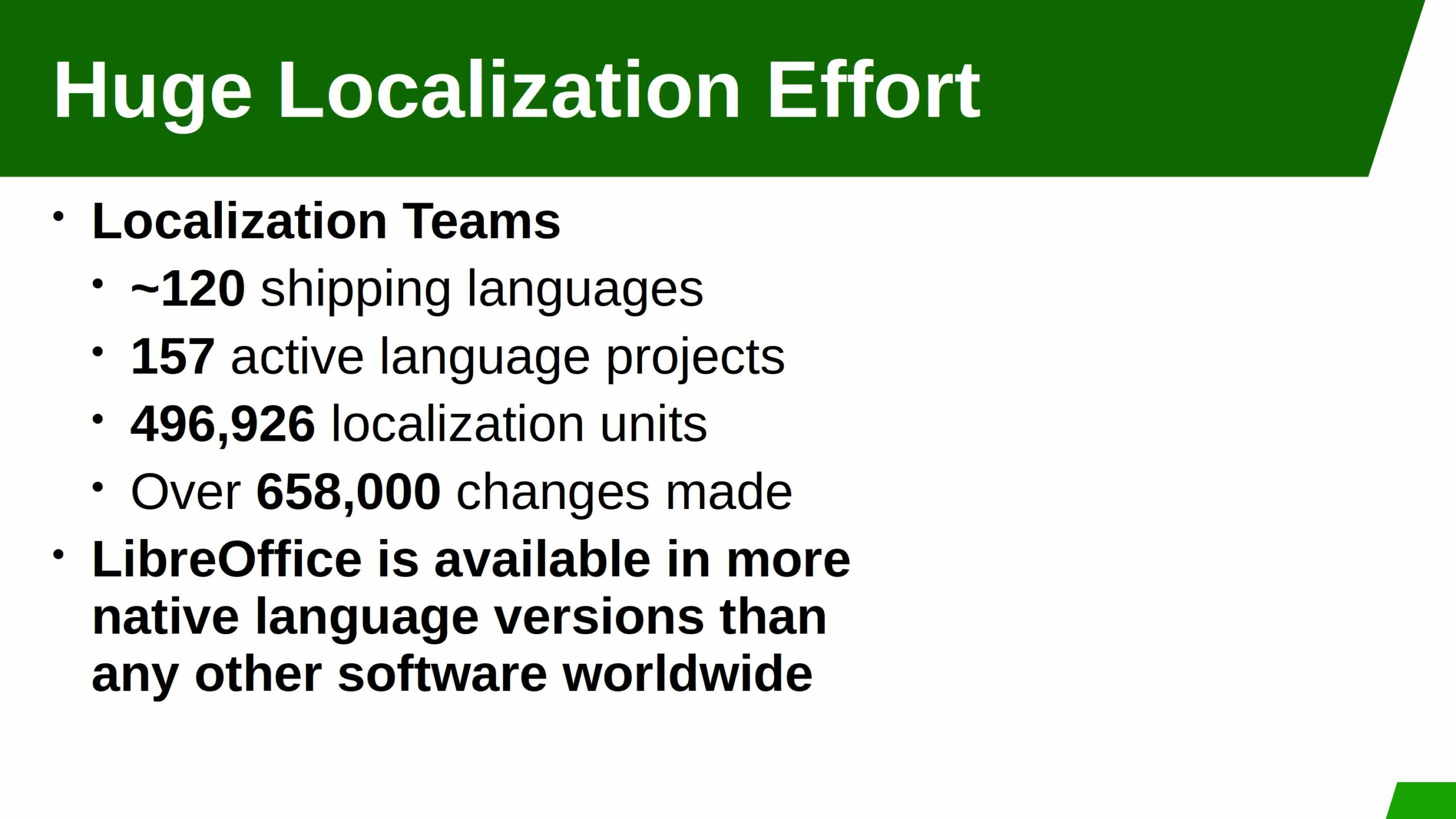 LibreOffice 7.4 Community’s new features have been developed by 147 contributors: 72% of code commits are from the 52 developers employed by three companies sitting in TDF’s Advisory Board – Collabora, Red Hat and allotropia – or other organizations (including The Document Foundation), and 28% are from 95 individual volunteers.
In addition, 528 volunteers have provided localizations in 158 languages. LibreOffice 7.4 Community is released in 120 different language versions, more than any other free or proprietary software, and as such can be used in the native language (L1) by over 5.4 billion people worldwide. In addition, over 2.3 billion people speak one of those 120 languages as their second language (L2).
LibreOffice for Enterprises
For enterprise-class deployments, TDF strongly recommends the LibreOffice Enterprise family of applications from ecosystem partners – for desktop, mobile and cloud – with a large number of dedicated value-added features and other benefits such as SLA (Service Level Agreements): https://www.libreoffice.org/download/libreoffice-in-business/.
Despite this recommendation, an increasing number of enterprises are using the version supported by volunteers, instead of the version optimized for their needs and supported by the different ecosystem companies.
Over time, this represents a problem for the sustainability of the LibreOffice project, because it slows down its evolution. In fact, every line of code developed by ecosystem companies for their enterprise customers is shared with the community on the master code repository, and improves the LibreOffice Technology platform.
Products based on LibreOffice Technology are available for major desktop operating systems (Windows, macOS, Linux and Chrome OS), for mobile platforms (Android and iOS), and for the cloud. Slowing down the development of the platform is hurting users, and the LibreOffice project may fall short of its expectations and possibilities.
Migrations to LibreOffice
The Document Foundation has developed a Migration Protocol to support enterprises moving from proprietary office suites to LibreOffice, which is based on the deployment of an LTS version from the LibreOffice Enterprise family, plus migration consultancy and training sourced from certified professionals who offer value-added solutions in line with proprietary offerings. Reference: https://www.libreoffice.org/get-help/professional-support/.
In fact, LibreOffice – thanks to its mature codebase, rich feature set, strong support for open standards, excellent compatibility and LTS options from certified partners – is the ideal solution for businesses that want to regain control of their data and free themselves from vendor lock-in.
Availability of LibreOffice 7.4 Community
LibreOffice 7.4 Community is available from: https://www.libreoffice.org/download/. Minimum requirements for proprietary operating systems are Microsoft Windows 7 SP1 and Apple macOS 10.12. LibreOffice Technology-based products for Android and iOS are listed here: https://www.libreoffice.org/download/android-and-ios/.
For users who don’t need the very latest features, and prefer a release that has undergone more testing and bug fixing, The Document Foundation maintains the LibreOffice 7.3 family, which includes some months of back-ported fixes. The current version is LibreOffice 7.3.5.
The Document Foundation does not provide technical support for users, although they can get it from volunteers on user mailing lists and the Ask LibreOffice website: https://ask.libreoffice.org
LibreOffice users, free software advocates and community members can support The Document Foundation with a donation at https://www.libreoffice.org/donate.
LibreOffice 7.4 is built with document conversion libraries from the Document Liberation Project: https://www.documentliberation.org
[1] Release Notes: https://wiki.documentfoundation.org/ReleaseNotes/7.4
Press Kit
Download link: https://nextcloud.documentfoundation.org/s/6i79yxpLYjsaGZB

 Berlin, June 9, 2022 – LibreOffice 7.3.4 Community, the fourth minor release of the LibreOffice 7.3 family, targeted at technology enthusiasts and power users, is available for download from