LibreOffice 10/20 Logo Community Contest

The year 2020 will be the 20th anniversary of the free office suite (OpenOffice.org was announced on July 19, 2000) and the 10th anniversary of LibreOffice (announced on September 28, 2010). We have the opportunity to celebrate both during the year, to reaffirm the fact that LibreOffice today is the leading free office suite available in the market.

For the anniversary project, we need a specific logo which celebrates the 10/20 anniversary without making a difference between the two dates, as the concept is that LibreOffice was born 20 years ago as OpenOffice.org, and evolved into LibreOffice 10 years ago.

The 10/20 logo should be easy to associate to the current LibreOffice logo (with tagline), and follow TDF design and style guides (Corporate Image) published on the wiki: https://wiki.documentfoundation.org/Marketing/Branding.

The 10/20 logo will be used for presentations, event signage, swag and gadgets (like stickers). It should be easy to recognize and read at small sizes.

The 10/20 logo must be developed with free and open source software, and released in vector-based (SVG) as well as bitmap-based (PNG, JPG) formats. The logo must be available in a squared or nearly squared format, plus other formats as appropriate.

One example of a possible implementation should also be provided with the proposal.

Intellectual property must be released under the Creative Commons Attribution-Share Alike 4.0 License (https://creativecommons.org/licenses/by-sa/4.0/), while a copyright transfer to TDF is not required.

Authors must declare in writing that they are the sole owners of all rights related to the artwork they have developed.
It should be clear that this is not a request for a mascot, and any kind of proposal which could be interpreted as a mascot will be rejected. Also, the 10/20 logo must be global and as such any reference to a regional styling approach (such as Anime or Manga) will also be rejected.

Logo proposals must be sent to: italo@libreoffice.org by November 30, 2019, at 11:59PM UTC. TDF will select the best proposal, which will be announced on December 16, 2019.

The author of the winning proposal will be announced at FOSDEM 2020, where the 10/20 logo will be displayed for the first time during a global FOSS event.

Interview with Ilmari Lauhakangas, Development Marketing

Ilmari Lauhakangas, based in Helsinki (Finland), is in charge of Development Marketing.

We have asked him a few questions, about his relationship with free software and his role in the community.

How did you become involved with free software and LibreOffice? Are you contributing to other FOSS projects?

I did localisation for FOSS projects in the early 2010s. Around 2012, I started contributing more to Retroshare, a secure communication platform, doing recruiting, translation coordination and web design.

In 2014 I began doing quality assurance for LibreOffice. People like Yousuf Philips, Joel Madero and Robinson Tryon were instrumental in making me understand the relevance of QA work. The attitude towards recruiting more contributors was spontaneous and immediate in the QA team.

I have focused on LibreOffice for the past few years.

You have been involved in the LibreOffice project for quite a long time, in QA and other areas. Can you summarize your activities?

I have: 1. somehow touched over twelve thousand reports in TDF Bugzilla, 2. improved and written technical documentation in TDF wiki, 3. improved help content, 4. done development for the web help, 5. edited content for the main website, 6. piloted the use of the translate extension for TDF wiki and guided people in its use, 7. helped new contributors get started in development, QA, documentation, design and infra, 8. recruited contributors through various channels such as VolunteerMatch.

You have explored several tools to attract new contributors. What do you think we should do as a project to keep the high level of contributions necessary for a large FOSS project such as LibreOffice?

We should make sure our technical documentation is high quality. When developers run into good documentation, they are very happy.

We should invest in improving the user experience of our web-based tools.

You are responsible for Development Marketing since September 1. How can you describe your responsibilities? Who should get in touch with you?

Basically everyone who wants to improve LibreOffice should get in touch. If you have no idea of how you could even be useful, I will help you find out, because everyone can be a part of the community and contribute! I hope to encourage strong cross-team collaboration. I want people to be credited for their work. I want us to have a safe and supporting environment for everyone to challenge themselves, try new things and learn new skills.

Technology focused high schools and universities, what should we do to grow the interest and the willingness to contribute among students?

This is more of a political question. If money and resources are lacking in education, teachers will not have time to offer structured introductions to free software projects. Likewise, if higher education is not free, students will have to work alongside their studies and will not have the energy contribute to FOSS.

On our part, we need to provide students with software they can rely on. In Finland, thirty thousand students in advanced secondary education use LibreOffice every year. If they find the software enjoyable, surely they are more inclined to contribute.

Happy 9th Anniversary, LibreOffice

Happy 9th Anniversary to LibreOffice, to the community of volunteer contributors  – represented by The Document Foundation – and to every person who made the dream possible with a donation or a simple download. If you have developed, patched, localized, tested, triaged, documented, communicated, promoted, explained, supported, certified, trained or migrated either the software or the organizations deploying it or the people using it, you should celebrate. Together, we have been able to transform a dream into a reality.

Thanks to Geralt for the image, released with a Pixabay License.

Co-Conference Logo Competition for 2020

The LibreOffice and openSUSE communities will have a joint conference next year in Nuremberg, Germany, and for this special co-conference, we are having a logo competition. The dates of the event are still being finalized, but there are some things we can do beforehand. 

A logo is essential for the conference and we want to visualize both communities during this co-conference as LibreOffice will celebrate its 10-year anniversary and openSUSE will celebrate its 15-year anniversary during the conference. 

You have seen both the openSUSE Conference logo and LibOCon logo change over the years. For this unique co-conference, we would like to have a unique logo reflecting both communities in one logo.

The competition is open now and ends on January 17, 2020. The organising team will send a “Mystery Box” as an appreciation for the best logo designed. This year, logo will be voted on by the organizers of the conference.

Deadline: 17 January 2020 UTC 13:00

Announcement of winner: 1 February 2020 at FOSDEM

The Rules of the Contest are as follows:

  • The logo should be licensed under CC-BY-SA 4.0 and allow everyone to use the logo without attribution (BY) if your work is used as the logo of LibOCon/oSC20. Note that the attribution is going to be shown on the conference website.
  • Design must be original and should not include any third party materials.
  • Both monochromes and color formats are essential for submission.
  • Submissions must be in SVG format.
  • Design should reflect the LibreOffice and openSUSE communities.
  • The logo should avoid the following things:
    • Brand names or trademarks of any kind.
    • Illustrations that may be considered inappropriate, offensive, hateful, tortuous, defamatory, slanderous or libellous.
    • Sexually explicit or provocative images.
    • Violence or weapons.
    • Alcohol, tobacco, or drug use imagery.
    • Discrimination based on race, gender, religion, nationality, disability, sexual orientation or age.
    • Bigotry, racism, hatred or harm against groups or individuals.
    • Religious, political, or nationalist imagery.
  • The logo should follow the LibreOffice Branding Guidelines and the openSUSE Project Trademark Guidelines.
  • The branding guidelines will be helpful to design your logo (optional).

Please submit your design to ddemaio@opensuse.org with the following entries:

  • Subject: Co-Conference Logo Design 2020  – [your name]
  • Your name and mail address to contact
  • A document about philosophy of the design (txt or pdf)
  • Vector file of the design with SVG format ONLY (created in eg LibreOffice Draw, Inkscape or another tool)
  • Bitmap of design in attachment — image size: 256*256 px at least, PNG format
  • File size less than 512 KB

The co-conference organizing team will decide on the logos, which is subject to the conditions that the logo meets all the requirements. The final decision will be made by the co-conference organizing team and it may not be the highest scored design.

We look forward to seeing your designs!

(Note: The LibOCon logo competition should not be confused with the LibreOffice 10th anniversary logo contest, which will be announced separately via our blog – stay tuned for more…)

The Document Foundation announces LibreOffice 6.3.2

Berlin, September 26, 2019 – The Document Foundation announces LibreOffice 6.3.2, the second minor release of the LibreOffice 6.3 family, with many bug and regression fixes. LibreOffice 6.3.2 “fresh” is targeted at technology enthusiasts and power users, who are suggested to update their current version.

LibreOffice’s individual users are helped by a global community of volunteers: https://www.libreoffice.org/get-help/community-support/. On the website and the wiki there are guides, manuals, tutorials and HowTos. Donations help us to make all of these resources available.

LibreOffice 6.3.2’s change log pages are available on TDF’s wiki: https://wiki.documentfoundation.org/Releases/6.3.2/RC1 (changed in RC1) and https://wiki.documentfoundation.org/Releases/6.3.2/RC2 (changed in RC2).

LibreOffice in business

For enterprise class deployments, TDF strongly recommend sourcing LibreOffice from one of the ecosystem partners to get long-term supported releases, dedicated assistance, custom new features and bug fixes, and other benefits. Also, the work done by ecosystem partners flows back into the LibreOffice project, benefiting everyone.

Also, support for migrations and trainings should be sourced from certified professionals who provide value-added services which extend the reach of the community to the corporate world and offer CIOs and IT managers a solution in line with proprietary offerings.

In fact, LibreOffice – thanks to its mature codebase, rich feature set, strong support for open standards, excellent compatibility and long-term support options from certified partners – represents the ideal solution for businesses that want to regain control of their data and free themselves from vendor lock-in.

Availability of LibreOffice 6.3.2

LibreOffice 6.3.2 is immediately available from the following link: https://www.libreoffice.org/download/. Minimum requirements are specified on the download page. TDF builds of the latest LibreOffice Online source code are available as Docker images: https://hub.docker.com/r/libreoffice/online/.

LibreOffice Online is fundamentally a server-based platform, and should be installed and configured by adding cloud storage and an SSL certificate. It might be considered an enabling technology for the cloud services offered by ISPs or the private cloud of enterprises and large organizations.

All versions of LibreOffice are built with document conversion libraries from the Document Liberation Project: https://www.documentliberation.org.

Support LibreOffice

LibreOffice users are invited to join the community at https://ask.libreoffice.org, where they can get and provide user-to-user support. People willing to contribute their time and professional skills to the project can visit the dedicated website at https://whatcanidoforlibreoffice.org.

LibreOffice users, free software advocates and community members can provide financial support to The Document Foundation with a donation via PayPal, credit card or other tools at https://www.libreoffice.org/donate.

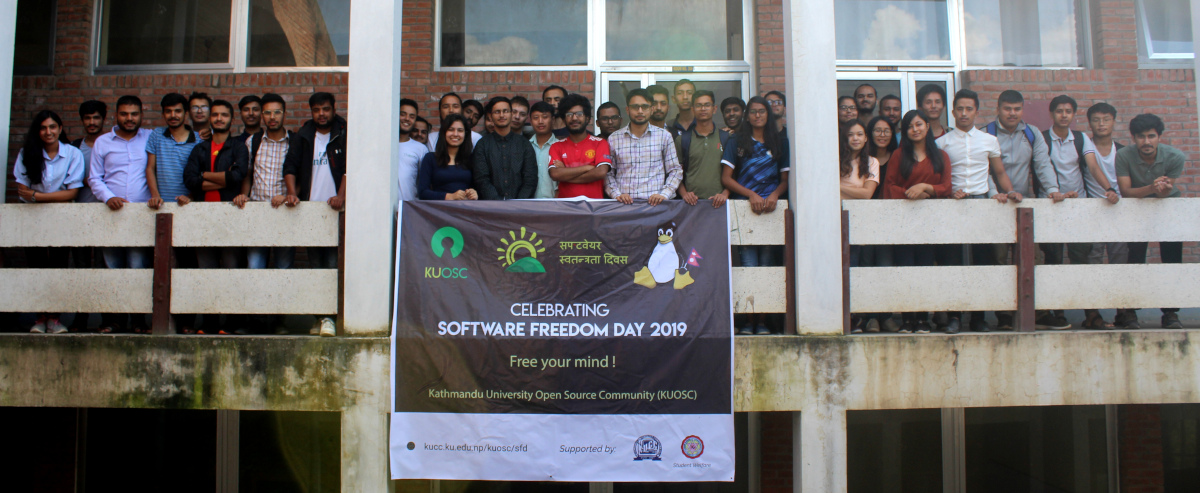
Nepal: LibreOffice localisation event on Software Freedom Day 2019

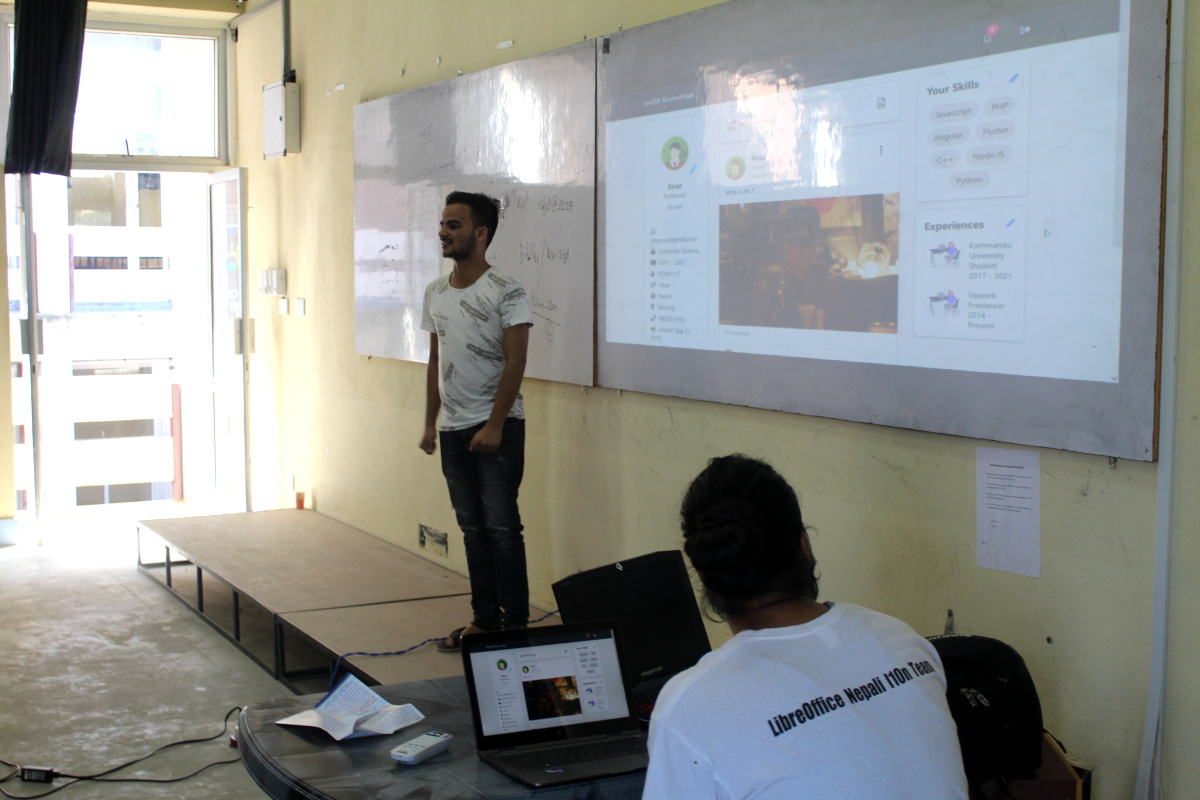
Thanks to our worldwide community, LibreOffice is available in over 100 languages. Volunteers help to translate the software, documentation and website – and on Software Freedom Day, the Nepalese LibreOffice community organised a localisation event. Sanjog Sidgel reports:

Title: LibreOffice L10N, organised by Kathmandu University Open Source Community on Software Freedom Day 2019
Organizer: Kathmandu University Open Source Community, Kathmandu University, Dhulikhel, Nepal
Date: September 21st, 2019
Focus: LibreOffice English to Nepali Localization
Hosted by: Sanjog Sigdel & Saroj Dhakal
Duration: 1 hour
Outcome: 14 new volunteers signed up; we presented the guidelines for doing the translations; and together we translated around 376 text strings into the Nepali language in an hour.

I would like to give a shout out to Mr. Anil Shrestha, Co-ordinator of Kathmandu University Open Source Community and his working committee, for making this Software Freedom Day 2019 a grand success.

The Document Foundation says a big thanks to Sanjog, Saroj and everyone else for taking part – your efforts are really appreciated! Because of your help, millions of people around the world can benefit from free, open and standardised productivity tools, in many languages. Cheers!