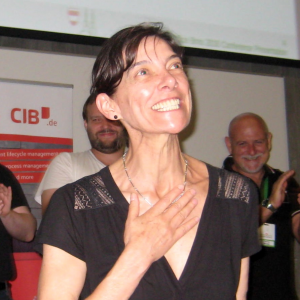
 Typical day of Sophie
A first thing of the day (together with coffee) is to read mails in my inbox, sort them by priorities and begin to answer. Then I do moderation on Ask instances and on Nabble gateway and answer mails to the different lists. I try to do administrative tasks for the Foundation in the morning, like meeting organization with a follow-up on Redmine. I work with localization team and local communities in the afternoon unless they need another time zone and unless I have a big task to manage like Advisory Board meetings or LibOCon. For that, I’m available for several social media (Telegram and Messenger, for example) and IRC to discuss with the community members at the place they contribute, help and coordinate where I’m needed.
2016 so far for LibreOffice and for TDF: your personal perspective
It’s a very nice team, each one is passionate about his work, with good communication and coordination among each others. The Foundation in itself is doing quite well from the feedback we have, thanks to the Board and Flo’s work (and it’s a lot of work to be done on a daily basis). What I really like and am proud of is the constant focus of transparency before our members.
On the community side, we need to increase the local communities in order to enhance the global participation to the different sub-projects. It’s not easy, but we learn each day how to do better the next one and I’m confident that by next year we will be much better at recruiting even more people. If we improve the participation on QA, documentation and marketing at a local level, help those small language communities find their way to the product, that will give more visibility to LibreOffice locally, make users more confident in the product, develop a local ecosystem. All these steps will make the overall community stronger and increase the participation at the international level.
For LibreOffice, I would like to underline the work done by the UX guys this year, it’s an incredible ant achievement they have provided to our product, really kudos to them. On my side of the project, I’m happy with the confidence built between the NLP/L10N community. This is a peaceful place to work and even if localization has still an important work load, PR translations are often late, we are one team. Also the number of languages on which LibreOffice is available is slowly growing and that makes me really happy. Interaction between the marketing team and the local communities bring a lot of value and is an important cement.
What do you see as the most important challenges for TDF in 2017 and beyond?
TDF must continue to be a strong community with a nourished reflection on the diversity of its members. TDF is not only LibreOffice, it is also the Document Liberation Project, and might host other projects too. Each TDF project should benefit the same energy, loyalty, transparency and accountability. For that, each TDF member is an important asset, both through the work he brings to the foundation and by the feedback on how the Board and the team are doing.
Where do you see TDF and LibreOffice in 2020? And in 2025?
A cloud version of LibreOffice is on the horizon of the LibreOffice ecosystem. Those who want to protect the investment they made in a migration should now protect it by helping this development. I’m also concerned by emerging countries and almost sure that a phone version will be needed in the future. Phone is the primary media used in the world, with more than 5 billions by 2019. Concerning the Foundation, my hope is to see it as innovative as it is today concerning its governance model, redefining the rules and building further an international team intrinsically involved in voluntary community as it is today, to port and serve it.
You have been with the project since day one: which is your opinion about what we have achieved, and what we could have achieved?
I’m very proud and happy about what we have achieved and what I personally’ve learned. That has been a very important step in my professional and personal life. Who could be more happy when changing is hobby on a living and I’m even more happy because we open the road to different models whether economic or political. It’s not only products we are developing, but also another way of life, including openness, transparency and consideration to all levels of governance.
Are you contributing to other open source projects? If yes, which is your role, and which are your expectations?
I’ve not so much time left to contribute to other projects, I’m still contributing as a volunteer to LibreOffice out of my day job. But I try to help the French part of DemocracyOS, an open source platform for collaborative decision-making, with my development and community knowledge. I’m also following Hacking Debout activities which are the digital part of Nuit Debout, my curiosity leads me to the Civic Tech Right now also, I’m reviewing the French translation of Mattermost to share my experience on localization with their community. I’m part of the Advisory Board of AppHub, a nonprofit marketplace that helps dissemination of open source software. I exchange also with DINSIC on several topics like relation with open source communities or accessibility. I participate in several events, hackathons, workshops, conferences where I can share my open source knowledge and experiences.
Last, but not least, which is your personal hardware/software configuration? Do you have any preferred tool?
I have two ASUS computers where I use Debian 8 and Ubuntu 16.04 with Gnome on both. Thunderbird (Mutt when I’m traveling), Chrome or Firefox, LibreOffice daily builds, Vim, Gedit, OmegaT and Guake are my (almost) daily (preferred) tools.