LibreOffice contributor interview: Tamás Bunth

LibreOffice developers, testers, translators and documentation authors are working hard on LibreOffice 5.3, which is due for release in early February. One contributor to the project, Tamás Bunth, has been helping to improve Base, the database front-end of the suite. We caught up with him to ask how he got involved with LibreOffice and what the community is like…

Where do you live, and are you active on IRC channels or social media?

I’m Hungarian, and I live in Budapest. My IRC nickname is Wastack (the name comes from the game Heroes of Might and Magic, one of my favourite games from childhood – Wastack is a barbarian hero). I’m on Facebook too: https://www.facebook.com/btomi96.

Do you work for a LibreOffice-related company or just contribute in your spare time?

I did some work for Libreoffice as a Google Summer of Code (GSoC) student last year. In the future I’ll contribute in my spare time.

How did you get involved with LibreOffice?

One of my roommates in my student hostel suggested that we should try GSoC. I was searching for an end user application written in Java or C++, since these are the languages I’m comfortable with. As I looked at the Easy Hacks I realised that I may be able to solve some of these, and the developer community was helpful as well.

What areas of the project do you normally work on? Anything else you want to tackle?

My GSoC project was to upgrade the internal Firebird database management system, which is used by LibreOffice Base, and solve related bugs, which makes Firebird an experimental feature. Therefore, I got to know the drivers in some detail, and I think I’ll stick to this area in the future.

What was your initial experience of contributing to LibreOffice like?

When I first looked at the C++ code in the repository, it was scary, since even a simple string is called OUString. After that I found some UNO interfaces, and I really don’t know what was going on there. Of course, after some time and guidance from my mentor things got much clearer.

Which is your preferred text editor – and why?

Vim is my favourite. Well, I don’t now many other editors, but Vim is highly customisable. I like the recording feature too.

What do you do when you’re not working on LibreOffice?

I am a 2nd year Bachelor of Science student of Budapest University of Technology and Economics. In my free time I go rowing. This year I got 4th place on the National Championship of Hungary in eights crew. I’ve achieved two first places there, but I’ve never been in an international race. It is one of my future goals.

Any other hobbies or projects you’re working on?

When I still have some free time, I like writing little computer games. I started with a simple snake game using Flash several years ago, which was followed by a Tetris with Java Swing and a multiplayer Tron game using TCP (still Java). Currently, I have an incomplete project of a browser game, where you have to move simultaneously with figures on a map. It is written in JavaScript, with Node.js on the server side.

Thanks Tamás! And thanks to everyone else who’s working on making LibreOffice 5.3 the best release yet. If you’re reading this and want to join a friendly and busy community promoting open standards and document liberation, get involved!
Marketing & PR at TDF in the second half of 2016

In terms of marketing and PR, a large free software project is quite similar to a large corporation. In fact, activities are following each other without interruption: major and minor product announcements, global events and local events, community fostering projects, and day to day activities (such as working with journalists).

In addition, there are the so called back office activities, which are instrumental for the success of the main ones but are less visible (and usually tedious). For instance, a major announcement has a burst of PR activities during the last week, which are based on a careful check of journalists’ email addresses, and on a thorough read of articles published during the last few months.

July is the month of a major announcement, which happens either at the end of July or during the first week of August. In 2016, we have announced LibreOffice 5.2, a feature rich major release, introducing – amongst a wealth of interesting novelties – document classification, a significant new feature for enterprise deployments.

August is usually the month before the LibreOffice Conference, and as such is spent finalizing the event schedule, and putting the finishing touches to the program.

September is the conference month. In 2016, the community has gathered in Brno, the second largest city in the Czech Republic and a technology hub, at the local IT university. The event was organized by OpenAlt and backed by Red Hat, which has a large software dev facility in the city. During the conference, we have announced LibreOffice 5.2.1 and LibreOffice 5.1.5.

October is usually the month when we start planning the next major announcement. In 2016 we have worked together with the Design Team at the new user interface concept, which will be affecting not only LibreOffice 5.3 but also the following major release, and possibly even the next one.

We have discussed extensively the concept, because we wanted to provide users a clear path forward without leaving behind those loyal to the traditional LibreOffice UI, which will not be abandoned.

LibreOffice will offer a flexible user interface, where each user will be able to configure the UI to fit his working habits. In fact, with millions of users, it would be impossible to please everyone by offering only one option in term of user interface.

In November, during the Month of LibreOffice, we have prepared the UI announcement, while working at media mailing lists and monitoring articles about LibreOffice 5.2 (which have reached the record amount of over 2,000 in less than six months).

We have also improved the results, in terms of clicks, of our Google sponsored AdWord account. This is a fine tuning activity, based on the mix of keywords and the bid value associated to each keyword.

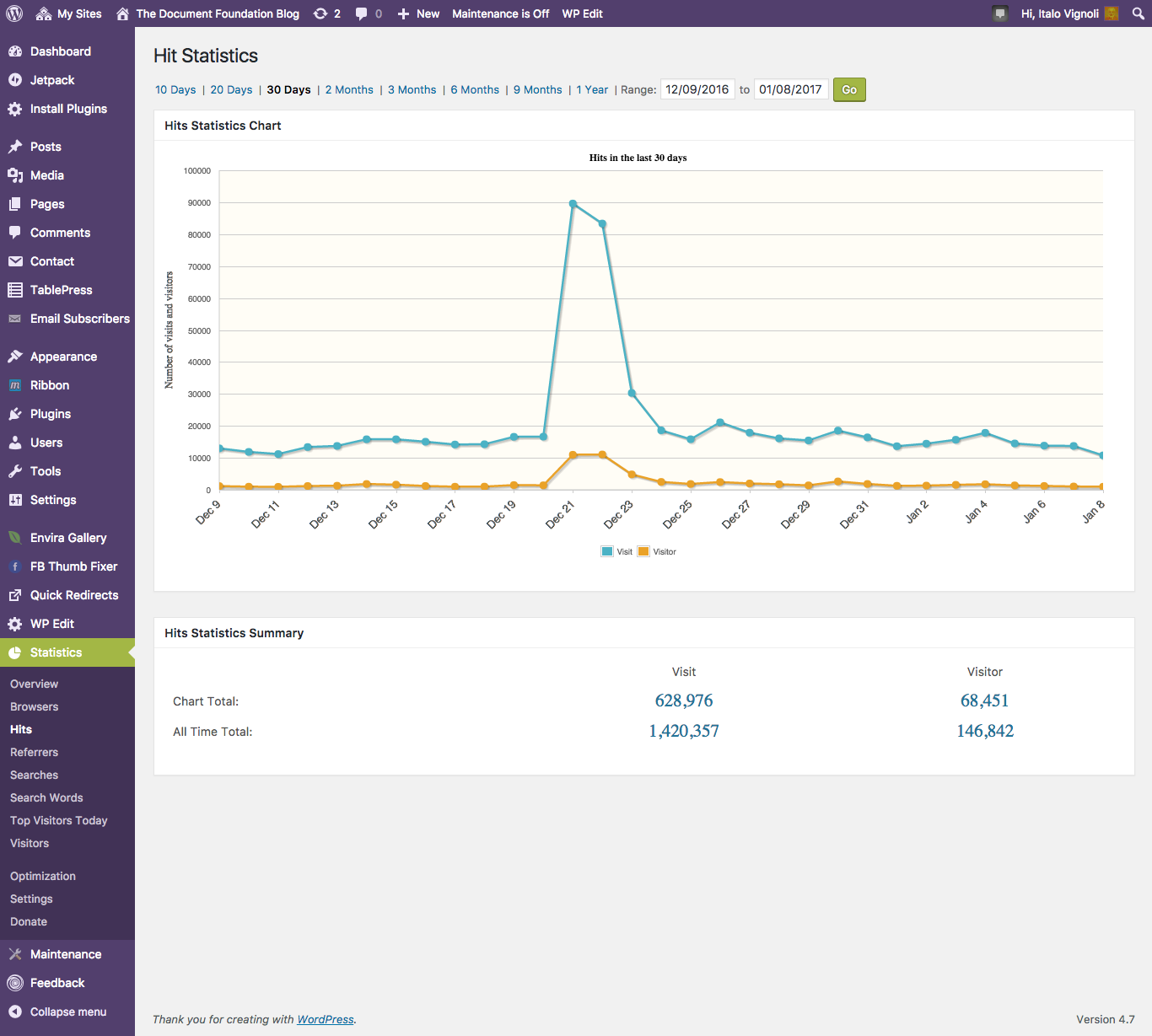
In December, we have announced the MUFFIN – My User Friendly & Flexible Interface – with a record number of over 20,000 visits (and over 80,000 page views) to TDF blog. It is an unexpected success, which confirms that we have chosen the right approach to an issue affecting a large number of LibreOffice users.

At the end of the semester, we are ready for a new exciting year (and another semester of ongoing marketing and PR activities, which will start in early January with the first draft of the documents for the announcement of LibreOffice 5.3).

Happy 2017

LibreOffice contributor interview: Hazel Russman


A new year begins, and we kick off with our first LibreOffice contributor interview of 2017. This time we’re talking to Hazel Russman who helps out with documentation and translations…

Where do you live, and are you active on social media?

I’m British and live in North London. I don’t do social media but I have a web page at www.hrussman.entadsl.com.

Do you work for a LibreOffice-related company or just contribute in your spare time?

I’m retired. I help out the documentation team mainly as a translator and proofreader.

How did you get involved with LibreOffice?

I wrote a novel some years ago and used OpenOffice.org to get it into shape for self-publishing. I wanted to give something back, and the OOo site suggested that time might be more valuable than money. When LibreOffice forked off, I moved over to their team.

What areas of the project do you normally work on? Anything else you want to tackle?

I’ve done quite a bit of translation from German into English, especially for Base, which has an excellent German handbook. Until I translated it, there was hardly anything on Base in English. English is my native language, but I grew up in a German-speaking home. My parents were refugees from Hitler. I’m also quite well known on the team as a proofreader.

What was your initial experience of contributing to LibreOffice like?

Interesting and very satisfying. But I’ve never been much interested in socialising online.

Which is your preferred text editor, and why?

For plain text, I like gVim. It has all the Vim keyboard commands but also graphical controls. The best of both worlds, you might say. I do a bit of coding in my spare time and for that I use Geany. Both Vim and Geany do syntax checking, which is a great help.

What do you do when you’re not working on LibreOffice?

Lots of things! I have a dog who takes up a lot of my time. I am active in my local church and play the cello as part of an instrumental group attached to the church’s gospel choir. I am also quite active on Linux Questions, which is the only social networking that I can be bothered with.

Thanks Hazel! We’ll be posting more interviews over the coming weeks and months, so if you want to join the LibreOffice community, pop over to tdf.io/joinus and choose how you want to get involved. We look forward to your input and contributions!

A huge thanks to our donors

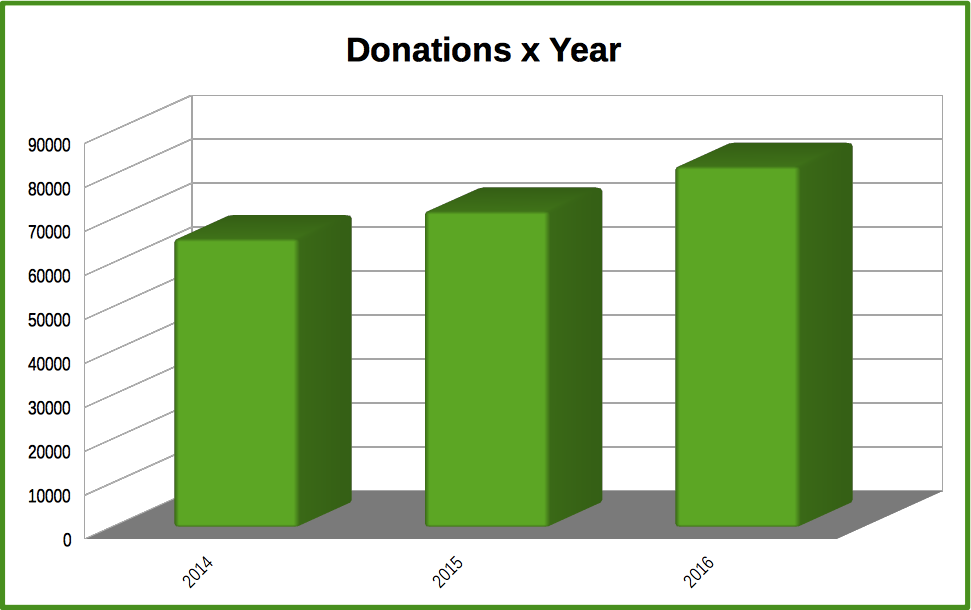
Donations to The Document Foundation have been steadily growing for the last three years, thanks to the generosity of many thousands of people around the world.

In 2016, donations have been 82,036 (a 14.2% increase over 2015).

In 2015, donations have been 71,839 (a 9.5% increase over 2014).

In 2014, donations have been 65,579.

Donations are key to our project, as they provide the economic resources to keep the organization and the infrastructure running, to fund activities such as participation of volunteers to FOSDEM and the LibreOffice Conference, and to help local activities organized locally by native language projects.

You can find examples of activities funded by donations money in the annual report: http://tdf.io/report2015.

Without donations, The Document Foundation could not be an independent community led project. Thanks again to all donors.

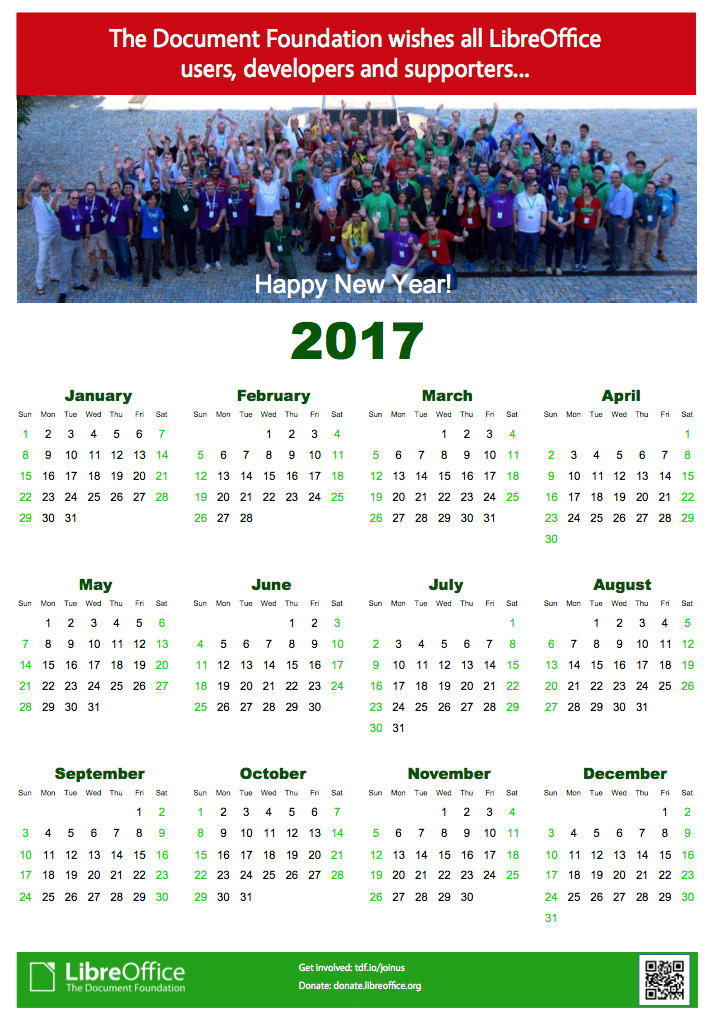
2017 TDF and LibreOffice calendar

2017 is just around the corner, so here’s a shiny calendar from The Document Foundation and the LibreOffice community. Print it out, hang it on your wall, and here’s to a great 12 months ahead!

Click for high-res PDF:

The Document Foundation opens LibreOffice Certification for Migrations and Trainings to all project volunteers, to members of not-for-profit bodies, and to individuals of proven competence

LibreOffice Certification represents a business opportunity for value added resellers, based on the proposition of consultancy and training services

Berlin, December 27, 2016 – Effective from January 1st, 2017, access to LibreOffice Certification will be extended to volunteers active at global and local levels, members of not-for-profit bodies sitting in the Advisory Board (namely, FSF, FSFE, Gnome Foundation and KDE), and for individuals whose competence and commitment are demonstrated by facts (successful migrations and trainings). In addition, Members of the Certification Committee can invite people to apply for certification, even if they do not belong to the approved categories, based on their direct relation, and to the competence and commitment of these individuals.

So far, LibreOffice Certification was limited to TDF Members who were active on a regular basis, in order to test the process with candidates already acquainted with the project.

In any case, every individual who applies will have to go through the same certification process, based on a first analysis of pre-requisites and documents, a second optional written questionnaire, and a third face-to-face discussion with the Certification Committee. The second optional written questionnaire is at the sole discretion of the Certification Committee.

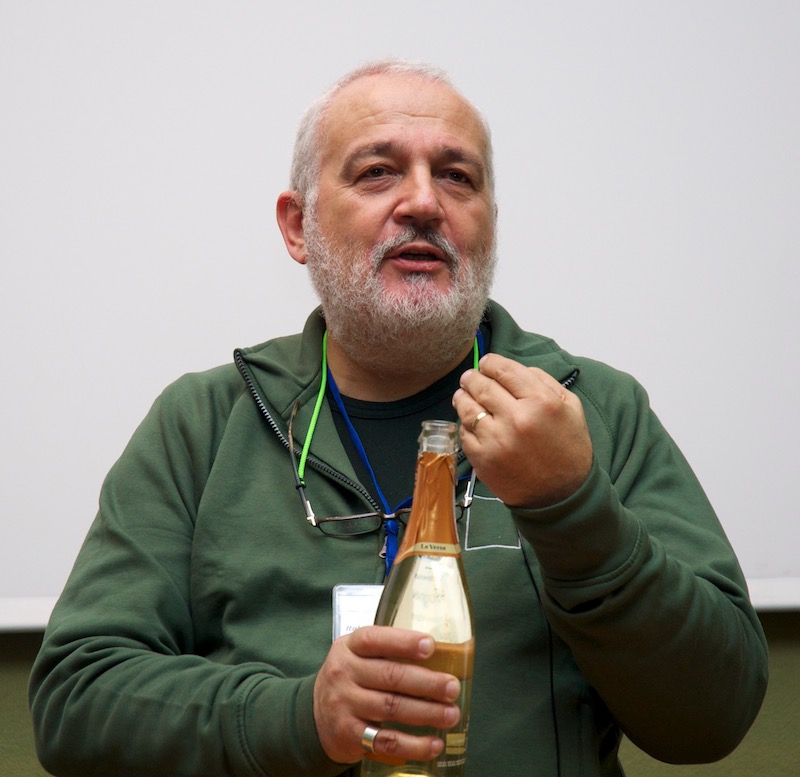
“LibreOffice Certification for Migrations and Trainings has been received in a different way in different geographies. In Italy, where it has been more successful, the availability of certified professionals has triggered a number of migrations in public administrations and enterprises”, says Italo Vignoli, Chairman of the Certification Committee.

Lothar Becker, Eliane Domingos de Sousa, Sophie Gautier, Olivier Hallot, Thomas Krumbein, Marina Latini, Gustavo Pacheco and Italo Vignoli have been renewed as members of the Certification Committee. In addition, Franklin Weng – a certified professional from Taiwan – has been added to the Certification Committee, with the objective of helping to increase the number of LibreOffice certified professionals in Asia.

The LibreOffice Certification website is available at the following link: http://www.documentfoundation.org/certification/program/.