Document Liberation Project: 2017 in review

While most of the posts on this blog are about LibreOffice, another project overseen by The Document Foundation is DLP – the Document Liberation Project. Whereas LibreOffice is an end-user application, DLP is a collection of free and open source software libraries that help to convert document formats. Developers can use these libraries in their programs, in order to import and export a large variety of files – including proprietary formats. Many well-known applications use DLP libraries, including Inkscape, Scribus, Calligra and of course LibreOffice.

So, what happened in DLP throughout 2017? Read on for our round-up of the year’s news…

New import filter: QuarkXPress

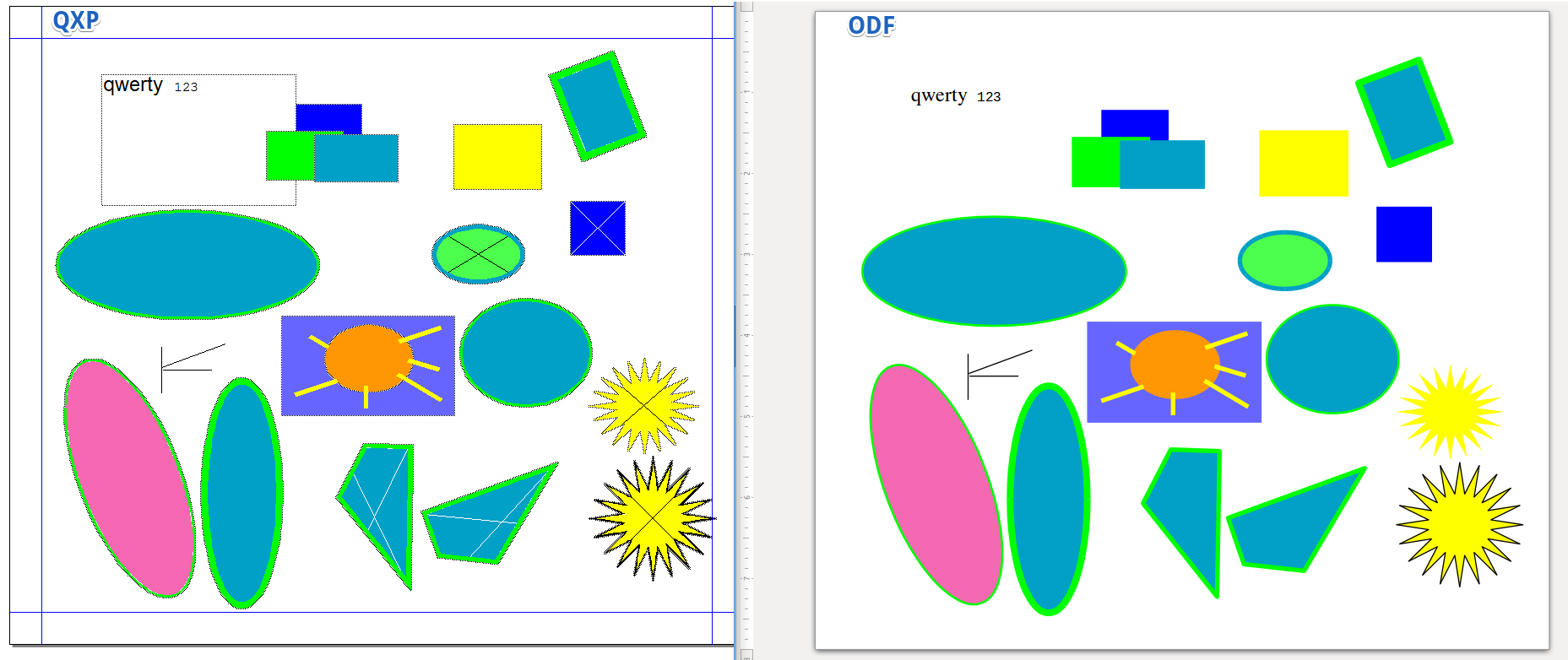
Aleksas Pantechovskis, as part of the Google Summer of Code, worked on a new import filter for QuarkXPress documents: libxqp. It currently supports QuarkXPress 3.1 – 4.1 documents, and this image shows it in action (original QuarkXPress file on the left, and how it’s converted into OpenDocument on the right):
Big improvements to Lotus 123 import

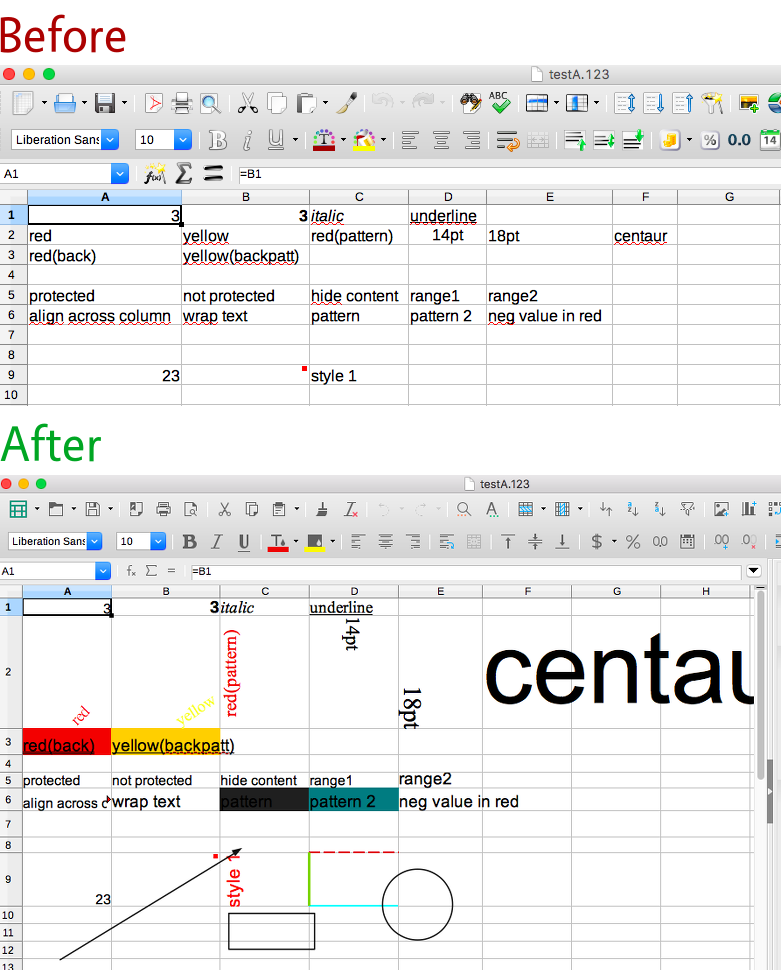
Laurent Alonso made some major improvements to the Lotus 123 filter, adding support for many formatting and layout options. Check out these pictures as an example – the top shows a Lotus 123 file in LibreOffice 5.3, missing almost all of its formatting. Underneath, however, you can see how it’s rendered in LibreOffice 5.4, with much more of the formatting present (click for bigger):
New library releases

Throughout the year, many libraries were updated as well. Here’s a summary:

  • 2 Aug – libepubgen 0.0.1 – This fixes escaping of HTML entities, and the code has been updated to C++11
  • 12 Sep – libwpd 0.10.2X – Also updated to C++11, and includes various fixes from OSS-Fuzz
  • 12 Sep – libwpg 0.3.2 – Improves performance of reading image data from WPG2 files
  • 14 Sep – libzmf 0.0.2 – Minor code cleanups and some fixes from OSS-Fuzz
  • 15 Sep – libcdr 0.1.4 – Fixes issues found by Coverity, and require C++11 for build
  • 16 Sep – libfreehand 0.1.2 – Parses more features, including text on paths, stroke patterns, arrows, and custom line and fill styles
  • 21 Oct – libvisio 0.1.6 – Various improvements to import of MS Visio files, plus Coverity and OSS-Fuzz fixes
  • 23 Oct – libetonyek 0.1.7 – Improves support for gradients, cell styles, non-RGB colours, and table border lines
  • 13 Dec – libepubgen 0.1.0 – EPUB3 support, plus support for embedded fonts, cover images and footnotes
  • 13 Dec – writerperfect 0.9.6 – Adds support for StarOffice Writer and Zoner Draw documents, and includes universal conversion tools

Find out more!

For details on the libraries mentioned above, see the projects page on the site. And check out the contribute page to see how you can help – because even if you’re not a developer, you can prepare sample documents for testing. Oh, and to learn more about DLP, watch this short video!

Please confirm that you want to play a YouTube video. By accepting, you will be accessing content from YouTube, a service provided by an external third party.

YouTube privacy policy

If you accept this notice, your choice will be saved and the page will refresh.
Update about Marketing Activities in 2nd Half of 2017

LibreOffice has turned seven on September 28, 2017. When we launched our first press release on September 28, 2010, our entire mailing list was quite small: 200 recipients gathered from different sources with journalists and media contacts from all over the world.

During these seven years, my main task has been media relations. One of the most important objectives has been the improvement of the mailing lists, both in terms of quantity and quality.

Today, after seven years, the size of the database has changed dramatically, as we have almost 19,000 email address in our mailing lists, which are targeted based on country, platform (desktop, iOS, Android, mobile, cloud) and focus (security and reviews). In 2017, we have started to target industry analysts, but this list is far from being complete.

Based on geography, we have 6 global lists (journalists, analysts, teams), 70 lists for Europe, 30 lists for the Americas, 5 lists for Pacific, 21 lists for Africa, 18 lists for Asia Middle East, 17 lists for Asia, and 24 lists for Asia Far East. In addition, around 5,000 records are updated and 2,500 are added each year.

Lists are global by country, plus each country – when possible – has a specific list of people who opened a previous press release. Thanks to this targeted database, we have a hit rate around 30%, twice as much as the global PR industry.

For major announcements, individual emails are sent to friendly journalists with a specific angle. I am connected to over 2,000 journalists via LinkedIn, and I have regular contacts with many of them.

Of course, taking care of mailing lists would not be enough without a monthly average of 50 personal contacts with editors, via email and/or phone, and over 100 answers to specific requests (pictures, statistics, review related questions and other info about TDF and LibreOffice).

Another project I have been working at is the production of basic slide decks on different subjects, which can be used by community members to create their own slide decks for presentations. At the moment I am working at updating the following slide decks: Project History & Background, LibreOffice & Competitive Presentation, Document Standards & Open Document Format, Advantages of ODF vs OOXML, Migration Protocol & Training Protocol, plus Useful Slides for Presentations. I also have less organized slides about Digital Citizenship, or the relationship between Technology and Individual Freedom of Choice.

Community members are warmly invited to send me an email to check if I have something which can help them to add some beef to their presentations. In fact, in some cases I test slide decks – adding new angles and concepts – in front of small audiences, before releasing them “officially” on the wiki.

Looking forward, I plan to bring analyst relations up to speed (as media), and improve community-focused activities, supporting the organization of local events and participate when it makes sense budget wise. I would also like to facilitate NLP (native language projects) involvement in the project, helping the integration of local communities within TDF and fostering their growth when they are small or even completely missing.