TDF’s Annual Report 2024 – LibreOffice Conference

LibreOffice Conference 2024 group photo

The LibreOffice Conference is the annual gathering of the community, our end-users, developers, and everyone interested in free office software. In 2024, it took place in Luxembourg

(This is part of The Document Foundation’s Annual Report for 2024 – we’ll post the full version here soon.)

This was our third in-person conference after the COVID pandemic, following on from the Milan conference in 2022 and Bucharest conference in 2023, but we also lived-streamed sessions so that participants could watch remotely (and ask questions in our chat channels too).

The conference took place from 10 – 12 October 2024 in Belval, Esch-sur-Alzette, which is around a 20 minute train ride from Luxembourg City. As public transport is free in the whole country, attendees staying in the city didn’t need to buy tickets to attend the event in Belval.

Conference Tracks and extra sessions

Opening sessions were given by Eliane Domingos (chairperson of the Board of Directors at TDF), Serge Linkels (Managing Director of the Digital Learning Hub and 42 Luxembourg), and Stéphanie Obertin (Luxembourg’s Minister for Digitalisation and Minister for Research and Higher Education).

Then there were presentations and talks were given across various “tracks”, or categories: LibreOffice Development; ODF and Interoperability; LibreOffice Design and Accessibility; and LibreOffice Marketing. There were highly technical talks focused on specific areas of LibreOffice and source code, along with more open discussions about community building and recent updates from The Document Foundation.

The conference also had some extra tracks to broaden its scope beyond just LibreOffice, and raise awareness about free and open source software (cybersecurity, EdTech and Open Source Program Office).

A workshop for new developers was held in parallel with the main tracks over the three days of the conference, and many different things around LibreOffice development were discussed, including: bug reporting and triaging; Git and Gerrit basics; building LibreOffice from its source code; and automation via scripting.

Sponsoring and merchandise

Partner sponsors were Collabora Productivity, Passbolt and SnT (University of Luxembourg), while venue sponsors were Digital Learning Hub and 42 Luxembourg. The Luxembourg Media & Digital Design Centre organised the EdTech track, and local supporters were Business Events Luxembourg, LU-CIX, LIST and Luxembourg House of Cybersecurity. Thanks to the sponsors, attendees could get merchandise at the event, including T-shirts with the conference logo.

Full programme and videos

Full details about the event are available on our main conference website. For a quick overview of all the talks, including links to PDF versions of the presentations, see the schedule. 63 videos – covering almost all of the talks are available as a playlist on our YouTube channel:

Please confirm that you want to play a YouTube video. By accepting, you will be accessing content from YouTube, a service provided by an external third party.

YouTube privacy policy

If you accept this notice, your choice will be saved and the page will refresh.

Conference in 2025

Planning is already underway for the LibreOffice Conference 2025, which will take place in Budapest from September 1 – 5, following a vote from TDF members. Stay tuned to this blog for more details soon…

Like what we do? Support the LibreOffice project and The Document Foundation – get involved and help our volunteers, or make a donation. Thank you!

LibreOffice in 2024 – TDF’s Annual Report

TDF Annual Report 2024 banner

In 2024, LibreOffice celebrated its fourteenth birthday. Two new major versions of the suite introduced a variety of new features, while minor releases helped to improve stability as well

(This is part of The Document Foundation’s Annual Report for 2024 – we’ll post the full version here soon.)

LibreOffice 24.2

On January 31, LibreOffice 24.2 was officially released after six months of work. Developers at The Document Foundation, Collabora, allotropia, CIB, Red Hat, NISZ and other companies and organisations – along with volunteers – worked on many new features.

For instance, there were many improvements to the tabbed “NotebookBar” user interface, while styles support was added for comments. A new search field was added to the Functions sidebar deck in Calc, while in terms of accessibility, several significant improvements to the handling of mouse positions and the presentation of dialogue boxes via the Accessibility APIs were made, allowing screen readers to present them correctly. And regarding security, the “Sace with Password” dialogue box now has a password strength meter, which uses zxcvbn-c to determine the password strength.

TDF’s marketing and localisation community produced and translated a video (below) which demonstrated many of the new features in LibreOffice 24.2. This was linked to in the announcement, and embedded into various web news websites that covered the release. The video is also available on PeerTube.

Please confirm that you want to play a YouTube video. By accepting, you will be accessing content from YouTube, a service provided by an external third party.

YouTube privacy policy

If you accept this notice, your choice will be saved and the page will refresh.


LibreOffice 24.8

Later in the year, on August 22, TDF released LibreOffice 24.8. Based on the LibreOffice Technology platform for personal productivity on desktop, mobile and cloud, it provided a large number of interoperability improvements with Microsoft’s proprietary file formats.

In terms of features, this release added many improvements to the Navigator in Writer, including ding cross-references by drag-and-drop items, deleting footnotes and endnotes, and indicating images with broken links. In Calc, the functions FILTER, LET, RANDARRAY, SEQUENCE, SORT, SORTBY, UNIQUE, XLOOKUP and XMATCH were added, along with chart types “Pie-of-Pie” and “Bar-of-Pie” which break down a slice of a pie as a pie or bar sub-chart respectively (this also enables import of such charts from OOXML files created with Microsoft Office/365).

Many other features were added as well, and there were a large number of compatibility improvements. As with the previous release, TDF staff worked with the marketing ad localisation communities to make a video (also on PeerTube) to demonstrate some of the new features.

Please confirm that you want to play a YouTube video. By accepting, you will be accessing content from YouTube, a service provided by an external third party.

YouTube privacy policy

If you accept this notice, your choice will be saved and the page will refresh.


Regular improvements

We also released 14 minor updates with bug and security fixes:

  • LibreOffice 7.6.5 – February 22
  • LibreOffice 24.2.1 – February 29
  • LibreOffice 7.6.6 and 24.2.2 – March 28
  • LibreOffice 24.2.3 – May 2
  • LibreOffice 7.6.7 – May 10
  • LibreOffice 24.2.4 – June 6
  • LibreOffice 24.2.5 – July 11
  • LibreOffice 24.2.6 – September 5
  • LibreOffice 24.8.1 – September 12
  • LibreOffice 24.8.2 – September 27
  • LibreOffice 24.2.7 – October 31
  • LibreOffice 24.8.3 – November 14
  • LibreOffice 24.8.4 – December 19

Like what we do? Support the LibreOffice project and The Document Foundation – get involved and help our volunteers, or make a donation. Thank you!

Annual Report 2024: The Document Foundation’s activities

TDF Annual Report 2024 banner

The Document Foundation is the non-profit entity that coordinates the LibreOffice project and community. In 2024 we had with elections for the foundation’s Membership Committee, along with regular Advisory Board calls, and support for other projects and activities

(This is part of The Document Foundation’s Annual Report for 2024 – we’ll post the full version here soon.)

Election of new Membership Committee (MC)

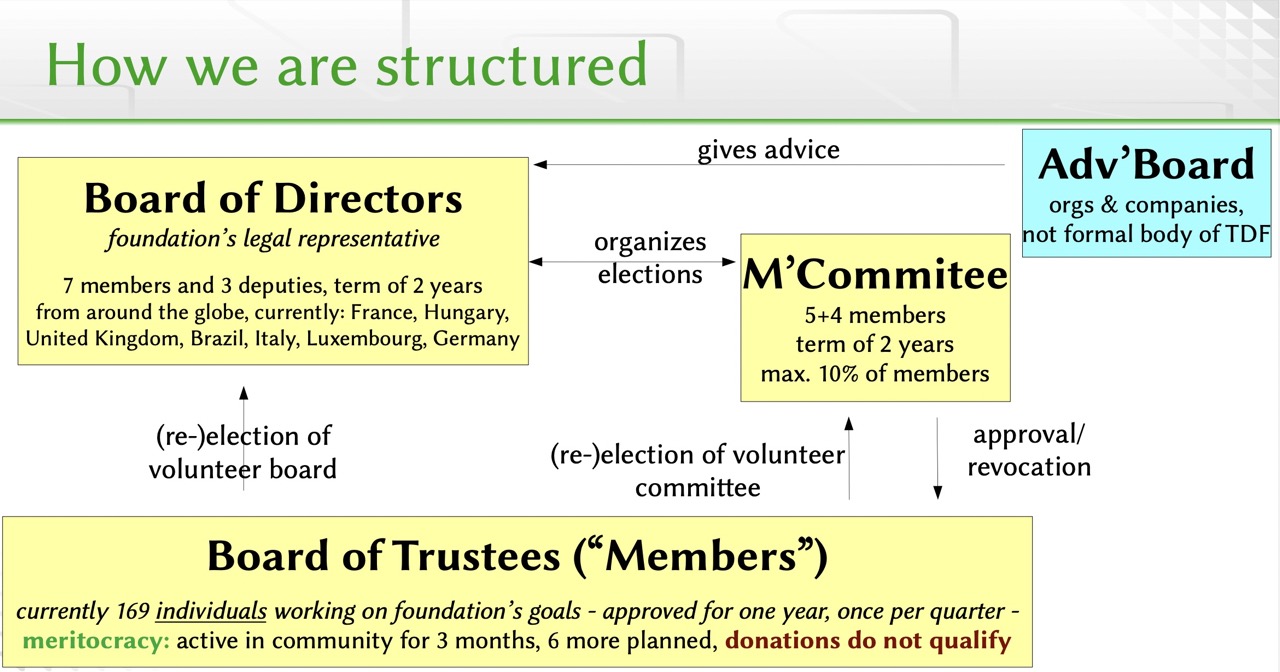
The mission of the Membership Committee is to administer membership applications and renewals following the criteria defined in the Foundation’s Statutes. Members of the MC are directly elected by community members every two years, and serve for a two-year term. The Board of Directors consists of five members and three deputies.

On July 15, Eliane Domingos – chairperson in the Board of Directors at TDF – announced the election for the next MC, and asked for nominations and self-nominations. On August 27, she then announced that the nomination phase had ended, and that voting would run from 3 – 9 September. Around this time there were also three live “town-hall” Q+A meetings with the candidates, so that community members could ask questions and discuss the responses. We made video recordings from the second and third meetings, and here they are (also available on PeerTube here and here):

Please confirm that you want to play a YouTube video. By accepting, you will be accessing content from YouTube, a service provided by an external third party.

YouTube privacy policy

If you accept this notice, your choice will be saved and the page will refresh.


Please confirm that you want to play a YouTube video. By accepting, you will be accessing content from YouTube, a service provided by an external third party.

YouTube privacy policy

If you accept this notice, your choice will be saved and the page will refresh.


On September 12, Eliane announced the preliminary results, along with a “challenge” phase for people to check their votes and contest the results. And on September 27, TDF announced the final results, with full MC members being Gustavo Buzzatti Pacheco, Stéphane Guillou, Balázs Varga, Pranam Kumarbhai Lashkari and Jona Azizaj; and deputy members being Shinji Enoki, Andreas Mantke and Marco Marinello.

TDF would like to say thank you to all past and new members of the MC for their service to the community, and to all candidates for running. Congratulations to the newly elected MC members and their deputies.

Advisory Board members and meetings

The Document Foundation relies on its Advisory Board Members in order to receive advice and support. The Advisory Board’s primary function is to represent The Document Foundation’s supporters and to provide the Board of Directors with advice, guidance and proposals. Current members are Adfinis, allotropia software GmbH, Collabora, GNOME, CAGE Technologies Inc, City of Munich (Landeshaupstadt München), Open Source Business Alliance (OSBA), Software in the Public Interest (SPI), KDE e.V., and the Free Software Foundation Europe (FSFE).

Throughout the year, TDF had regular calls with representatives of the Advisory Board. Staff and Board members at TDF provided updates on the foundation, LibreOffice software and community, and described plans and activities for the future. Advisory Board members were invited to provide valuable feedback on TDF’s work, and various ideas and proposals were discussed during the calls. TDF would like to express its thanks to all of the members for their help and support.

New team member

In summer 2024, we welcomed Jonathan Clark to the TDF team as a new developer. Jonathan is initially working on improving LibreOffice’s writing script support, especially for RTL (right-to-left), CTL (complex text layout) and CJK (Chinese-Japanese-Korean) languages. This will help to make LibreOffice more accessible and usable for hundreds of millions of people around the globe.

When asked why he decided to apply for the position at TDF, Jonathan said:

I want to help people use open source software to work and create in their own language. There are other reasons, too: I’m a long-time user, interested in linguistics, and my background seemed like a good fit for the role. But the most important thing to me that I can believe in the mission.

Photo of Jonathan Clark

Highlights of activities

Throughout the year, TDF supported – and provided information about – various milestones, campaigns and events, via this blog and our social media channels. For instance, in January we announced the ODF Toolkit 0.12.0 release. Big changes included a new ODF 1.3 mimetype “Text master template”, while the API for Text Selection was completely refactored. In addition, there were many fixes to improve reliability and security.

In early March, we announced that the new Board of Directors at TDF had started its term, while later in the month we celebrated Document Freedom Day, a yearly event which raises awareness of how open standards and open document formats provide us with the freedom to read and write as we wish.

Banner of Document Freedom Day with woman standing on a field enjoying the sunshine

Also in March, we wrote on our blog how the European Data Protection Supervisor (EDPS) had found that the European Commission had breached several provisions of Regulation (EU) 2018/1725, the EU data protection law for EU institutions, in its use of Microsoft 365, including those relating to the transfer of personal data outside the EU and the European Economic Area (EEA). The EDPS is imposing corrective measures on the Commission.

On a related topic, in September we supported a campaign to bring back Free Software funding, asking people to give their feedback to the European Commission, following a cut in important funds for FOSS.

Like what we do? Support the LibreOffice project and The Document Foundation – get involved and help our volunteers, or make a donation. Thank you!

Insights from the Prague InstallFest 2025 Conference

LibreOffice community at Prague InstallFest 2025

Petr Valach from the Czech LibreOffice community tells us about feedback from the LibreOffice booth at this event…

InstallFest is a well­‑established yet relatively small open­‑source conference held annually in the Czech Republic, traditionally at the Faculty of Electrical Engineering building at Karlovo náměstí in Prague. Personally, I prefer these more intimate spaces over the larger venues like the Faculty of Information Technology, where the LinuxDays conference takes place. I highly appreciate the somewhat old­‑fashioned and historical atmosphere that fills every corner of the faculty building. It reminds me of English universities and other institutions like museums, where the ambiance of past eras is still preserved. Some may find it irritating, but to me, such a place has far more character than modern buildings devoid of history.

Building E of the Faculty of Electrical Engineering (FEL), or perhaps the shared building of the Faculty of Electrical Engineering and the Faculty of Nuclear Sciences and Physical Engineering (FJFI) on Trojanova Street, which I used to visit as a student – and even more so the main building of FJFI on Břehová Street, or the joint workplace of FJFI and the Faculty of Mathematics and Physics (MFF) of Charles University on Karlova Street – all of these buildings naturally have their own history; and with even older buildings, history seems to radiate from them, evoking a sense of mystery and unattainability.

I’ve had this deep respect for historic landmarks since my school years, when I first encountered the epochal Jaroslav Foglar trilogy set in the mysterious world of Stínadla (The Mystery of the Puzzle, Stínadla in Revolt, The Secret of the Great Vont). These books have not lost their charm even after all these years (this year marks the 85th anniversary of The Mystery of the Puzzle), and that’s because you can actually touch the buildings described in them. That’s the true magic of Foglar’s stories – they’re part fiction, part grounded in reality, whether it’s the locations, characters, or structures, and that makes them more believable and realistic.

And even the InstallFest conference has something in common with them. After all, it takes place right in the area where Stínadla is set, and the building itself stands just a few hundred meters from the birthplace of Jaroslav Foglar. In the conference venue, you can even find a poster for a course titled Planning the Movement of 3D Objects in a Complex Environment, featuring the iconic hedgehog in a cage – hiding the epoch-making invention of fourteen-year-old Jan Tleskač: a flying bicycle! Coincidence? I don’t think so. 😊

And now, on to the actual course of the conference.

LibreOffice community at Prague InstallFest 2025

Changes

Last year, InstallFest was saved by a new team led by Jan Langmaier. Once again, they did an excellent job – everything ran smoothly, without confusion or chaos. They deserve recognition for organizing and executing the conference in such a limited space.

This year saw an increase in the number of booth exhibitors, which naturally raised the question of where to place them all. Unfortunately, the LibreOffice booth drew the short straw and ended up in a separate lecture room designated for booths. As a result, the number of visitors to our booth was significantly lower; throughout the entire conference, we only had a handful of individuals with whom we had actual discussions (not counting those just interested in stickers and the like). Therefore, user feedback this time around was quite limited.

Key Observations

The majority of questions and comments from attendees revolved around four main areas:

  • Compatibility of Microsoft formats with LibreOffice
  • Funding of the project
  • Use of LibreOffice/Collabora Online
  • Issues with Impress

Compatibility with OOXML

LibreOffice provides solid support for OOXML formats, as used by Microsoft Office/365. The use of the plural is appropriate – it should be noted that Microsoft does not use the standardized OOXML Strict format as the default in its suite. This leads to a number of issues, which are described in more detail in this article.

Funding LibreOffice

A common question at every conference is how LibreOffice is funded. Although LibreOffice is a community­‑driven project, where volunteers do most of the work in documentation, translations, local marketing and other tasks, the majority of code contributions come from ecosystem companies. These companies offer migration services, employee training, and 24/7 support for organizations using LibreOffice. They can also be commissioned to develop new features, which are then made available to everyone.

But volunteers (like us) are crucial for spreading awareness about LibreOffice, translating the software and manuals, and supporting users. In the Czech Republic, significant translation work has been done under the leadership of Zdeněk Crhonek. Without these efforts, the project wouldn’t function properly, as corporations require localized environments and documentation.

Growing Interest in LibreOffice Online

Awareness of the online version of LibreOffice (via Collabora) seems to be increasing. This product deserves more public attention, as it is one of LibreOffice’s strongest assets. It offers a fully autonomous solution that can run on user­‑owned cloud infrastructure as well as other platforms.

However, one drawback is that no one offers LibreOffice Online as a fully managed cloud service. Users often complain about the lack of a ready­‑to­‑use hosted solution, making deployment more challenging. The Document Foundation cannot provide hosting services, but the demand for such a service is significant.

LibreOffice community at Prague InstallFest 2025

General Feedback

As with every conference, we received feedback about LibreOffice’s user interface. One of the biggest pain points is the icon sets – finding a suitable set for dark mode is nearly impossible. The Elementary icon set is considered the best by many users (including myself), but it is no longer being developed and lacks dark mode support. The Karasa Jaga theme is interesting but also lacks a dark mode version.

Another frequent request is for automatic updates. Windows users now have this feature as of LibreOffice 24.8, but it is still missing for Linux, due to the fragmented nature of the Linux ecosystem.

Impress

The most frequent critical feedback was about Impress, LibreOffice’s presentation tool. Some reports and requests included:

  • Videos embedded in Impress do not work in PowerPoint (and vice versa)
  • Unlike PowerPoint, Impress does not display a progress bar when playing a video
  • There is no way to pause an animation during a presentation (a long­‑standing bug that remains unresolved)
  • The presenter screen does not support formatted notes

Users are welcome to join the project to help to improve these features, or again, fund developers so that all users can benefit.

Let’s Play a Game!

For the first time, we introduced a small game at InstallFest. QR codes with LibreOffice­‑related questions were placed around the venue, and visitors had to collect them to solve a puzzle. We prepared 200 answer sheets, but only about 30 were used.

Thanks to The Document Foundation (specifically Mike Saunders), we had plenty of giveaways, including T‑shirts, hoodies, and backpacks. Five lucky winners received prizes:

  • Milka (T­‑shirt)
  • Jaroslav K. (T­‑shirt)
  • Jan H. (T­‑shirt)
  • Šimon H. (backpack)
  • Vojtěch K. (hoodie)

LibreOffice community at Prague InstallFest 2025

Congratulations to the winners, and thanks to all participants!

A special shoutout to Ondra, a schoolboy who was the only one to complete a non­‑competitive task – writing a LibreOffice improvement suggestion on the back of his form. His request? Better copy/paste formatting options in Calc. Thanks, Ondra! Too bad you didn’t win this time – maybe at LinuxDays in autumn! 😊

LibreOffice Conference 2025 will take place in Budapest

Photo of Budapest

For this year’s LibreOffice Conference we had two location proposals: Luxembourg and Budapest. Members of The Document Foundation voted to choose the final location, and we can announce that Budapest is the winner.

Currently, the expected date for the conference is September 1 – 5, but this is still subject to change. We will confirm the final dates soon, then the fun begins: the call for papers, building up the schedule, planning social events and more…

Stay tuned to this blog for further details!

(Photo credit: JStolp on Pixabay)