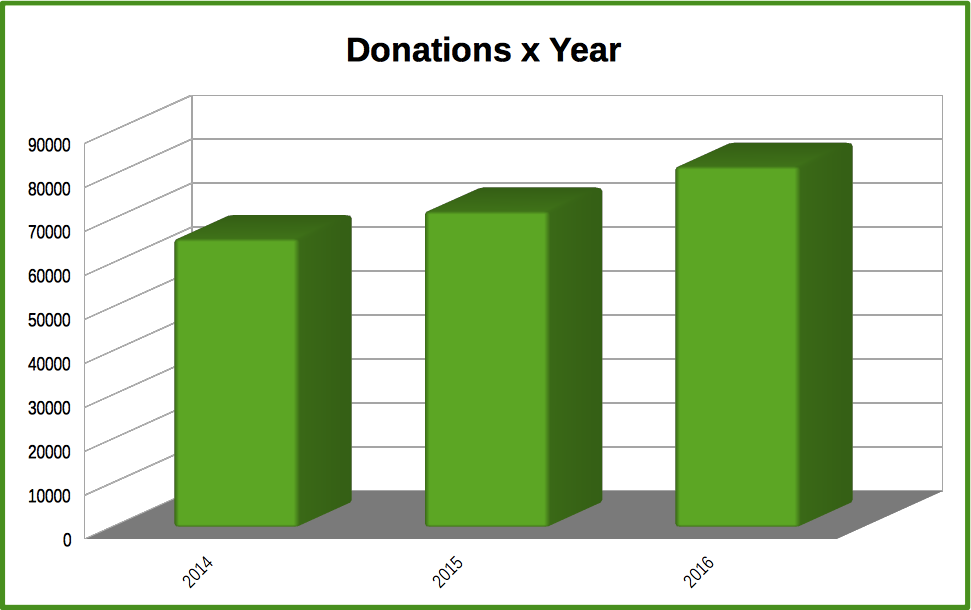
Donations to The Document Foundation have been steadily growing for the last three years, thanks to the generosity of many thousands of people around the world.
In 2016, donations have been 82,036 (a 14.2% increase over 2015).
In 2015, donations have been 71,839 (a 9.5% increase over 2014).
In 2014, donations have been 65,579.
Donations are key to our project, as they provide the economic resources to keep the organization and the infrastructure running, to fund activities such as participation of volunteers to FOSDEM and the LibreOffice Conference, and to help local activities organized locally by native language projects.
You can find examples of activities funded by donations money in the annual report: http://tdf.io/report2015.
Without donations, The Document Foundation could not be an independent community led project. Thanks again to all donors.
Donations to The Document Foundation help us to maintain a small team, working on various areas of the project including documentation, user interface design, quality assurance, release engineering and marketing. I help out with the latter, and as we come towards the end of 2016, I want to talk about some of the things I’ve been working on in the last six months. It’s been a really busy time, with a new release of LibreOffice, our conference and many other events and updates. And 2017 promises to be even better! But first, I’d like to provide a bit of background on my typical working day.
The first thing I do is catch up on discussions from the previous day. As you probably know, LibreOffice has many mailing lists covering all aspects of the project and community. I’ve signed up to “digest” subscriptions for some of them – so I get a summary at the end of each day. This is helpful for pinpointing topics of interest. Also useful are minutes from meetings, such as the design team or the Engineering Steering Committee (ESC).
Next, I check our IRC channels to see what’s going on, and what are the hot topics in the community at present. Then I’ll catch up with our social media channels: Twitter, Facebook, Google+ and others. Sometimes there are questions from LibreOffice users that need answering, but in any case, it’s good to see what end users are talking about.
Once I’ve caught up with everything, I turn to my own email inbox in Thunderbird and look at my pending tasks. Sometimes I’ll have a bunch of smaller jobs to take care of (like proofreading and email responses), before I start working on a bigger project for the rest of the day, such as videos, interviews, blog posts, website updates and other jobs. We in the LibreOffice project use Redmine to create and track tickets for tasks that we’re working on, so that we can see how things are progressing and share ideas.
What I’ve done in the last six months
In July we were putting the finishing touches to The Document Foundation’s 2015 Annual Report, of which I wrote many sections, and I helped to translate parts of it into German. Around the same time, we were gearing up for the release of LibreOffice 5.2, so I made a technical preview video for our community, showing some of the new features to help with testing and documentation.
Following that, I produced more polished New Features videos for the world to see on release day – and in total, they received over 100,000 views. Here’s the playlist:
Please confirm that you want to play a YouTube video. By accepting, you will be accessing content from YouTube, a service provided by an external third party.
If you accept this notice, your choice will be saved and the page will refresh.
Close to the release day, I worked with Italo Vignoli to contact journalists with information about the new version of LibreOffice, offering them to join us in press briefing calls where they can ask questions and speak to members of TDF’s Board of Directors. In addition, I worked on updates for the website, highlighting the new features with extra text and screenshots.
After LibreOffice 5.2 was released in August, we began preparations for our yearly conference, which was held in early September in Brno, Czech Republic. With some of the TDF’s marketing budget (which again, is thanks to generous donations!) I sourced some new video and audio equipment which I took to the conference. Along with various videos from the conference itself, like this wrap-up, I also made some contributor interviews which were also used in our Join the LibreOffice Community video. (And then, our community produced translations in many different languages, which I added to the videos.)
Bringing new people into the community is an important part of my role, so I worked on a redesigned Get Involved page on the LibreOffice website. (I also created a short URL for it: tdf.io/joinus.) This page makes it simpler for potential contributors to dive in to the project, in that they can simply click a topic of interest and get quick pointers on where to start.
Throughout October, I organised a series of LibreOffice Community Weeks on the blog, talking to different projects and exploring how they work. I interviewed contributors, looked at the tools that they use, and explained how to get involved, posting regular updates on social media to generate interest. In the end, we had new contributors in documentation, development and QA, so I plan to repeat these Community Weeks again next year.
November was another Month of LibreOffice, celebrating contributions across the project with badges and barnstars. This caught the attention of the Albanian LibreOffice community, which is running its own Month of LibreOffice throughout December – we’ll post a wrap-up on this blog when it finishes!
And then there were other tasks that I worked on over the last six months, including: updated training certificates, an acknowledgement document for new developers, contributor interviews for the blog, new items on our merchandise shop, and updates to the LibreOffice subreddit.
A first thing of the day (together with coffee) is to read mails in my inbox, sort them by priorities and begin to answer. Then I do moderation on Ask instances and on Nabble gateway and answer mails to the different lists. I try to do administrative tasks for the Foundation in the morning, like meeting organization with a follow-up on Redmine. I work with localization team and local communities in the afternoon unless they need another time zone and unless I have a big task to manage like Advisory Board meetings or LibOCon. For that, I’m available for several social media (Telegram and Messenger, for example) and IRC to discuss with the community members at the place they contribute, help and coordinate where I’m needed.
2016 so far for LibreOffice and for TDF: your personal perspective
It’s a very nice team, each one is passionate about his work, with good communication and coordination among each others. The Foundation in itself is doing quite well from the feedback we have, thanks to the Board and Flo’s work (and it’s a lot of work to be done on a daily basis). What I really like and am proud of is the constant focus of transparency before our members.
On the community side, we need to increase the local communities in order to enhance the global participation to the different sub-projects. It’s not easy, but we learn each day how to do better the next one and I’m confident that by next year we will be much better at recruiting even more people. If we improve the participation on QA, documentation and marketing at a local level, help those small language communities find their way to the product, that will give more visibility to LibreOffice locally, make users more confident in the product, develop a local ecosystem. All these steps will make the overall community stronger and increase the participation at the international level.
For LibreOffice, I would like to underline the work done by the UX guys this year, it’s an incredible ant achievement they have provided to our product, really kudos to them. On my side of the project, I’m happy with the confidence built between the NLP/L10N community. This is a peaceful place to work and even if localization has still an important work load, PR translations are often late, we are one team. Also the number of languages on which LibreOffice is available is slowly growing and that makes me really happy. Interaction between the marketing team and the local communities bring a lot of value and is an important cement.
What do you see as the most important challenges for TDF in 2017 and beyond?
TDF must continue to be a strong community with a nourished reflection on the diversity of its members. TDF is not only LibreOffice, it is also the Document Liberation Project, and might host other projects too. Each TDF project should benefit the same energy, loyalty, transparency and accountability. For that, each TDF member is an important asset, both through the work he brings to the foundation and by the feedback on how the Board and the team are doing.
Where do you see TDF and LibreOffice in 2020? And in 2025?
A cloud version of LibreOffice is on the horizon of the LibreOffice ecosystem. Those who want to protect the investment they made in a migration should now protect it by helping this development. I’m also concerned by emerging countries and almost sure that a phone version will be needed in the future. Phone is the primary media used in the world, with more than 5 billions by 2019. Concerning the Foundation, my hope is to see it as innovative as it is today concerning its governance model, redefining the rules and building further an international team intrinsically involved in voluntary community as it is today, to port and serve it.
You have been with the project since day one: which is your opinion about what we have achieved, and what we could have achieved?
I’m very proud and happy about what we have achieved and what I personally’ve learned. That has been a very important step in my professional and personal life. Who could be more happy when changing is hobby on a living and I’m even more happy because we open the road to different models whether economic or political. It’s not only products we are developing, but also another way of life, including openness, transparency and consideration to all levels of governance.
Are you contributing to other open source projects? If yes, which is your role, and which are your expectations?
I’ve not so much time left to contribute to other projects, I’m still contributing as a volunteer to LibreOffice out of my day job. But I try to help the French part of DemocracyOS, an open source platform for collaborative decision-making, with my development and community knowledge. I’m also following Hacking Debout activities which are the digital part of Nuit Debout, my curiosity leads me to the Civic Tech Right now also, I’m reviewing the French translation of Mattermost to share my experience on localization with their community. I’m part of the Advisory Board of AppHub, a nonprofit marketplace that helps dissemination of open source software. I exchange also with DINSIC on several topics like relation with open source communities or accessibility. I participate in several events, hackathons, workshops, conferences where I can share my open source knowledge and experiences.
Last, but not least, which is your personal hardware/software configuration? Do you have any preferred tool?
I have two ASUS computers where I use Debian 8 and Ubuntu 16.04 with Gnome on both. Thunderbird (Mutt when I’m traveling), Chrome or Firefox, LibreOffice daily builds, Vim, Gedit, OmegaT and Guake are my (almost) daily (preferred) tools.
A short interview to introduce Guilhem Moulin, the team member in charge of the development and the maintenance of The Document Foundation (TDF) infrastructure since October.
Q1. You have just started to take care of TDF infrastructure. Why did you apply for the role?
I finished my studies last spring and wanted to take a few months off to travel a bit and try to tie some loose ends on the many side projects I started earlier and never had time to finish. In particular, with the Debian 9 freeze approaching, I wanted to do some triaging on the BTS to help uploading some new upstream releases to the next Debian Stable. All in all, I was not really in a hurry to start with a new day job.
Of course, although I live rather cheaply, I had limited savings and I knew at some point I would have to find a job to pay the bills. I was looking for that day with apprehension, because I didn’t want to take a usual “9 to 5” job in an office, and was also afraid to have to make compromises and use proprietary software or closed formats to comply to an employer’s internal policy.
Although I never was a member, I knew TDF as a major actor of the Free Software ecosystem and as a strong supporter of open formats. So when one of my friends tipped me about the opening at TDF, I jumped on my keyboard to prepare an application. The mere fact of managing the infrastructure of one of the most popular Free Software projects out there was a unique enough opportunity to combine the practical and the enjoyable without renouncing my convictions. Furthermore, working from home with flexible working hours was particularly appealing to me.
Q2. Can you provide a short personal background, including both your education and work experiences?
I’ve been at school until very recently, actually I grew up in France and moved to Gothenburg (Sweden) in 2010 for my doctoral studies. I have graduated earlier this year with a PhD in theoretical Computer Science from Chalmers University of Technology [0].
In parallel to my studies, I did some volunteering work for various organizations. In particular, I’ve been a volunteer system administrator at Fripost [1], a Sweden-based association (ideell
förening) providing an email infrastructure for its members.
Q3. Which is your perception of the project, as seen from outside and then as a team member (even for a short time)?
As a mere user, I was aware that LibreOffice was one of the biggest Free Software project out there, and although I wasn’t familiar with TDF internals, I was very pleased it was managed by a non-profit organization.
My first contact with the community was in Brno earlier this year (at the LibreOffice Conference), and I was impressed by its cohesion. I also immediately felt very welcome! Moreover, I’m used to go to conferences where the audience is a lot less diverse, and I was pleased to see a better gender / ethnic / background balance at LibreOCon. Even if I know there is still a long, long way to go…
As a very fresh team member, I’m still trying to get up to speed on the infrastructure. But I’d say staff & team members reflect the atmosphere of the general community and so far have been very helpful and very welcoming.
Q4. Which are the objectives of your role within TDF, in the short and long term?
Aside from regular internal infrastructure maintenance, which is probably irrelevant for most members and contributors, my short term goal is to implement Single Sign On (starting with the most popular services, namely Gerrit, the wiki, and Bugzilla) so people don’t have to remember one set of credentials per service. I’m also eager to try out Jabber/XMPP [2] as a modern (and free!) alternative to our weekly phone calls.
A long term goal would be to lower the threshold to get oneself accustomed to the infrastructure. Getting fresh blood in the infra team is crucial for sustainability, especially in a non-profit where most of the contributors are volunteers.
Q5. How would you describe yourself?
I guess I’m an idealist, and rather binary: I’m absolutely passionate about the things I care about — and find it really hard to make compromises about these (so I guess it’s good I ended up in infra and not in marketing :-D) — and I tend to neglect the rest. As such, I live a relatively simple life and value principles over comfort or convenience.
Q6. Are you contributing to other open source projects? If yes, which is your role, and which are your expectations?
I’ve been a Debian GNU/Linux [3] user for over a decade, but only became a maintainer around 2 years ago, after a couple of months contributing to various packages. Debian is aiming at being the “the universal operating system”, and of course I expect its releases to become better and better.
Beside package maintenance and some minor contributions to my packages’ upstream I enjoy email-related protocols, and one of my long-term project is to write an email client to replace the venerable mutt [4] I’ve been using for around 10 years.
I also feel close to the GnuPG [5] and Tor [6] communities, although for the latter, I mostly contribute by only running relays these days.
Q7. Last, but not least, which is your personal hardware/software configuration? Do you have any preferred tool?
I still use the old Thinkpad X60s I bought second hand in 2010 (although I believe I changed every single part by now: screen, motherboard, case,…) the BIOS of which I replaced by a free one (libreboot [7]). By today’s standard a Core™2 Duo isn’t that fast anymore, but it doesn’t bother me much as I tend to use my laptop merely as a terminal: for builds or heavy computation I remotely access a workstation. I also recently bought an USB armory from Inverse Path [8] which I would like to use as an air gap for my GnuPG secret keyring.
Of course, I run Debian GNU/Linux [3] on all my machines (sid on my laptop & workstations, and the latest stable on servers) I don’t use a desktop environment like GNOME or KDE, but a minimalist tiling window manager (dwm [9]) instead. My editor of choice is Vim, and the current email client is mutt [4]. For web browsing I pretty much exclusively use the Tor Browser. In fact, I’d say Tor is my favorite tool.
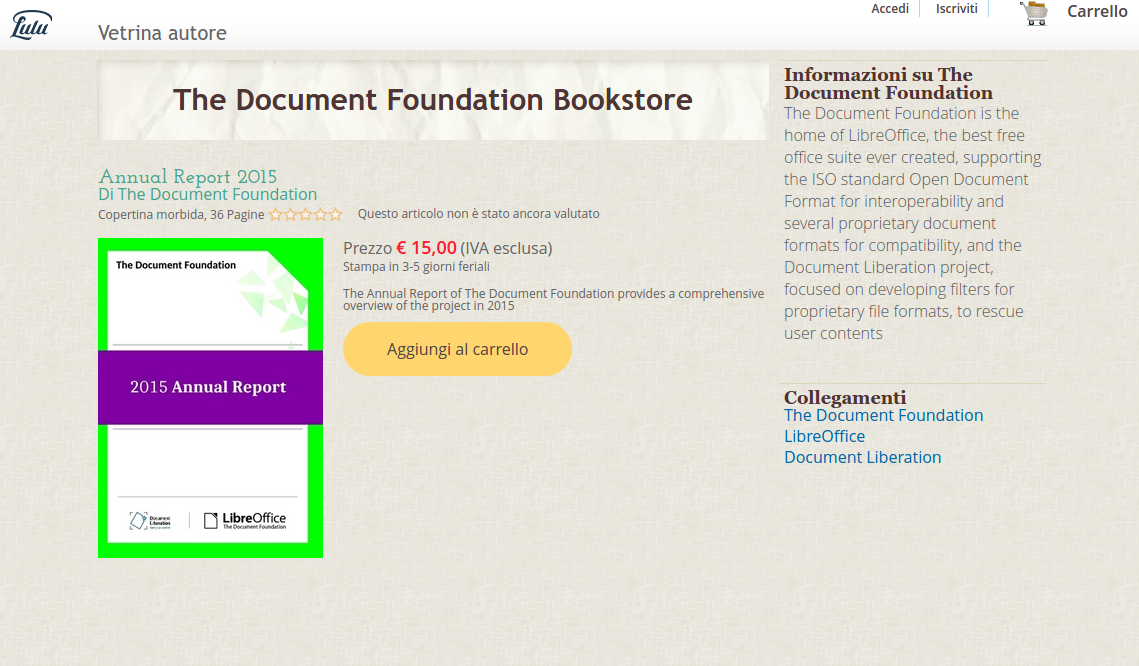
The Document Foundation (TDF) is proud to announce its 2015 Annual Report, which can be downloaded from the following link: http://tdf.io/report2015 (3.6 MB PDF). The version with HD images can be downloaded from http://tdf.io/report2015hq (22.1 MB PDF).
TDF Annual Report starts with a Review of 2015, with highlights about TDF and LibreOffice, and a summary of financials and budget.
Community, Projects & Events covers the LibreOffice Conference 2015 in Aahrus, Certification, Website and QA, Hackfests in Brussels, Gran Canaria, Cambridge, Hamburg, Terni and Madrid, Native-Language Projects, Infrastructure, Documentation, Marketing and Design.
Software, Development & Code reports about the activities of the Engineering Steering Committee, LibreOffice Development, Google Summer of Code, and the Document Liberation Project.
The last section focuses on People, starting with Top Contributors, followed by TDF Staff, the Board of Directors and the Membership Committee, the Board of Trustees, or the body of TDF Members, and the Advisory Board.
To allow the widest distribution of the document, this is released with a CC BY 3.0 DE License, unless otherwise noted, to TDF Members and free software advocates worldwide.

 Donations to The Document Foundation have been steadily growing for the last three years, thanks to the generosity of many thousands of people around the world.

 The Document Foundation (TDF) is proud to announce its 2015 Annual Report, which can be downloaded from the following link: