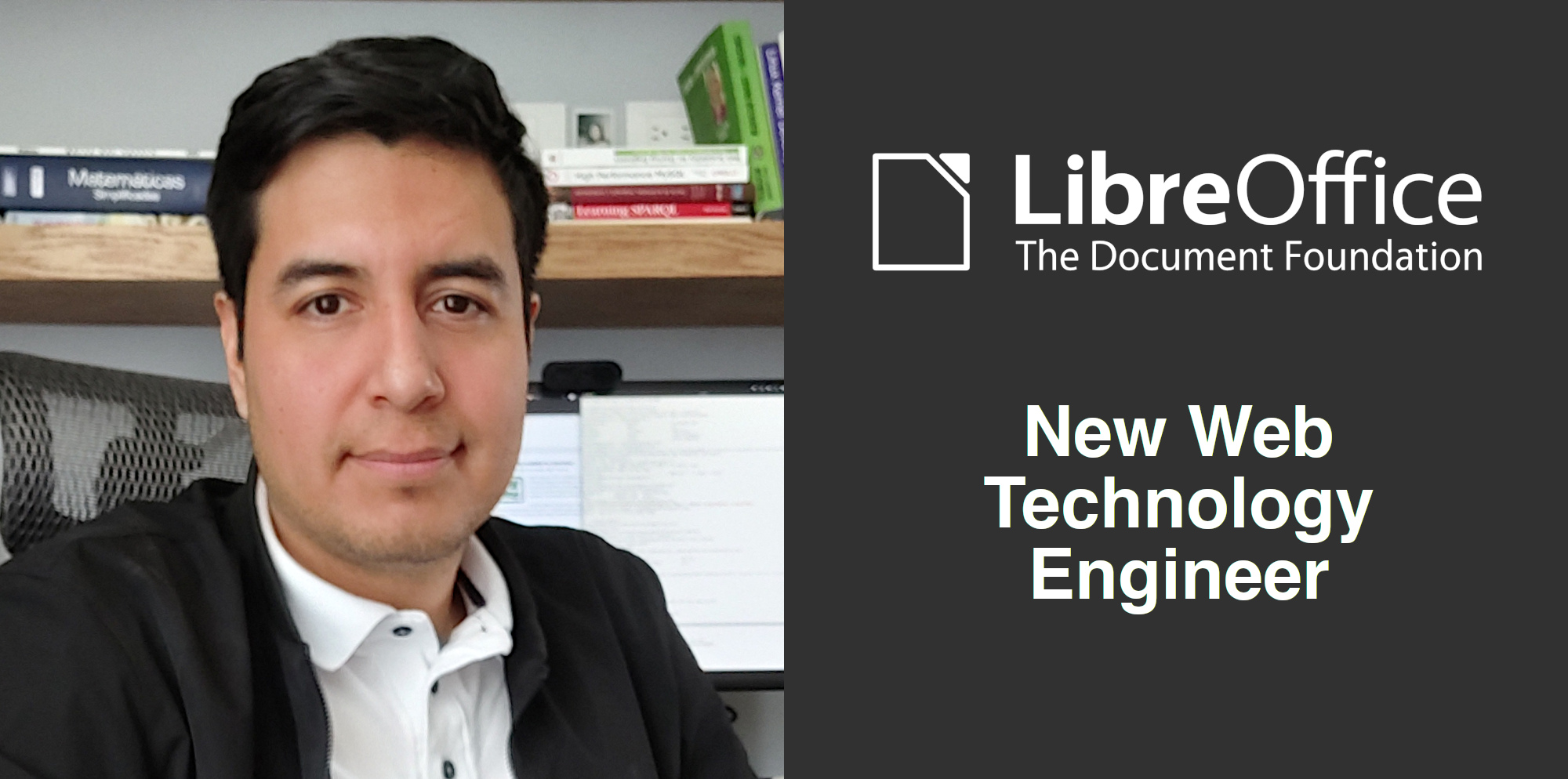
Welcome Juan José González, TDF’s new Web Technology Engineer!

Photo of Juan José

Here at The Document Foundation, the non-profit entity behind the LibreOffice community, we have many websites and services: this blog, the LibreOffice website, our wiki, the extensions website, Weblate and many more.

To improve them and keep them up-to-date, TDF now has a new Web Technology Engineer! So let’s get to know him…

Tell us a bit about yourself!

My name is Juan José and I am from México. I moved from my beautiful hometown to Guadalajara nearly thirteen years ago looking for a good job as a developer and I fell in love with the city. In Guadalajara I met my wife, my friends and many free software enthusiasts.

Since the first day, I realized that there were local communities around free software so I like to keep in contact with them, and contribute with technical talks about various topics.

I studied a masters degree in Computer Science, where I got interested in the semantic web and the automated reasoning discipline behind it. I’ve been working as a web developer for more than a decade now.

I am so happy that I found this position at The Document Foundation – I am determined to contribute as much as I can to improve our existing web sites and web apps that support the foundation’s efforts.

Were you using LibreOffice before you joined TDF?

I used LibreOffice to write the final project of my bachelor degree, I can say that LibreOffice was the first application for what I consider myself a power user (that was 10 years ago – but I have lost most of my talents sadly). I also remember writing an essay about the importance of open document formats, and my references included many people from the LibreOffice community.

This role marks my first time actively contributing to LibreOffice – so I hope I can help the project significantly.

ODF logo

What’s your new role at TDF?

I joined the Foundation as the new Web Technology Engineer, where I will dedicate my time to support, fix and improve the experience of our websites.

I believe it’s a great role since the web has become the default entry point to all people that want to interact with LibreOffice, from being an end-user, to collaborate on the software’s development. I have adopted the mission to facilitate this interaction.

What are you working on?

I am starting on the extensions site – it’s the place where you can get templates and extensions for LibreOffice. I am replying to reported issues by improving the web experience. I also want to keep an eye on the experience of the end user, taking care of both ends: extension developers and the users.

We’re really happy to have Juan José on board! LibreOffice users and community members can give him feedback and help via the website mailing list. Looking forward to seeing all the great things to come 😊

TDF position on EU’s proposed Cyber Resilience Act

THE DOCUMENT FOUNDATION
Summary of Issues of the Cyber Resilience Act (in the current status)

Introduction

The Cyber Resilience Act (CRA) sets out a number of cybersecurity and vulnerability management requirements for manufacturers (Annex I) and will require products to be accompanied by information and instructions for users (Annex II). Software vendors will also be required to conduct a risk assessment and produce technical documentation (Annex V) to demonstrate compliance.
Currently, the text implies that if a developer or supplier derives commercial benefit from OSS, it would be subject to the Cyber Resilience Act. It even implies, in relation to the distribution of software, that open source producers or developers could be held liable if their open source projects are used commercially.

If the Cyber Resilience Act becomes EU law without clarification, the impact on several European-based open source projects, such as products based on LibreOffice technology, could have devastating (unintended) consequences.

The Commission recognises that not all products in our society are equally dependent. The Cyber Resilience Act therefore distinguishes between products and critical products, reflecting the level of cybersecurity risk associated with these products. On the other hand, the CRA ignores the security risks associated with files created by the software covered by the act itself, which can have even more devastating consequences (according to security expert Kaspersky Labs, in 2018, 70% of all malware worldwide was carried by documents created by the most widely used office suite).

Software developers must declare compliance with the requirements of the Cyber Resilience Act and therefore take responsibility for compliance in one of three ways. They can either:

  1. perform a self-assessment, or
  2. apply for a product examination by an auditor and then set up checks and balances for their development processes, or
  3. apply for an assessment of their quality system by an auditor.

These options come with a growing administrative/compliance burden.

The Cyber Resilience Act attempts to exempt open source software from its provisions. But there’s some problematic language about how the CRA draws the line between commercial and non-commercial use of OSS, which could affect all products based on LibreOffice technology and many other products based on open source software.

This is the text of the Open Source Software exception:

In order not to hamper innovation or research, free and open-source software developed or supplied outside the course of a commercial activity should not be covered by this Regulation. This is in particular the case for software, including its source code and modified versions, that is openly shared and freely accessible, usable, modifiable and redistributable.

While the Cyber Resilience Act does not define commercial activity, the EU Blue Guide to the implementation of EU product legislation does:

Commercial activity is understood as providing goods in a business related context. Non-profit organisations may be considered as carrying out commercial activities if they operate in such a context. This can only be appreciated on a case by case basis taking into account the regularity of the supplies, the characteristics of the product, the intentions of the supplier, etc. In principle, occasional supplies by charities or hobbyists should not be considered as taking place in a business related context.

For the purposes of the Cyber Resilience Act, there is a real risk that software based on LibreOffice technology will be considered to be made in the course of a commercial activity, and thus subject to the legislation, based on the following:

  1. Products based on LibreOffice technology are developed by the majority of full-time employees of ecosystem companies or by individuals who make a living from consulting services related to their project work.
  2. Products based on LibreOffice Technology are goods in a business-related context because they are intended to provide software that can be used immediately by businesses or employees in their daily work.
  3. The Document Foundation has never missed a LibreOffice release in 12 years.
  4. Products based on LibreOffice technology are high quality software that matches the quality of commercial products.

So the features of a product based on LibreOffice technology are equivalent to those of commercial products.

Charging for support also makes open source a commercial activity. The Document Foundation does not charge for support, but it certifies professionals who are supposed to charge companies for consulting and support, and encourages companies to adopt professionally supported software.

Having said all this, it is important to remind the reader that The Document Foundation provides software free of charge, on a non-profit basis, and under OSI-approved open source licences that permit further use, study, modification and redistribution, whereas ecosystem companies provide commercial software with service level agreements.

Impact Assessment

CE Markings for Software Products

Basically, the core of the proposed legislation is to extend the CE marking regime to all software products distributed in Europe. Our understanding is that this process will be applied to open source software that is made available under open source licences and distributed free of charge.

We are deeply concerned that the Cyber Resilience Act could fundamentally alter the social contract that underpins the entire open source ecosystem: open source software that is provided free of charge, that can be modified and redistributed free of charge, but without warranty or liability to the authors, contributors, or open source distributors.

Legally changing this arrangement through legislation is likely to have unintended consequences for Europe’s innovation economy.

Without a clearer exemption for open source, in order to comply with the legislation, The Document Foundation will need to develop, document and implement policies and procedures for each project to ensure that they comply with the requirements of the Cyber Resilience Act, including:

  • All development and post-release security requirements specified in Annex I, including the provision of notification and update mechanisms.
  • All the requirements for user documentation set out in Annex II.
  • All of the product technical documentation set forth in Annex V, including … complete information on the design and development of the product… including, where applicable, drawings and schemes and/or a description of the system architecture explaining how software components build on or feed into each other and integrate into the overall processing
  • For each release, prepare the documentation required by Annex V, including … an assessment of the cybersecurity risks against which the product with digital elements is designed, developed, produced, delivered and maintained…
  • Determine for each product whether it meets the definition of product with digital elements, critical product with digital elements or highly critical product with digital elements
  • For each product which is a product with digital elements, establish, complete and document a CE mark self assessment process
  • For each critical product with digital elements or highly critical product with digital elements engage with an external CE auditing body and complete the additional processes required to get the CE mark approval
  • For each individual release, document that the CE marking process has been followed (as described above), that an EU Declaration of Conformity has been written and signed by an officer of the Foundation, that the CE mark has been affixed, and that the technical documentation and EU Declaration of Conformity will be made available for at least 10 years after the release.

Note that we estimate that The Document Foundation’s projects release at least a dozen versions in any given year. It is not clear to us what the cost in time, resources and money would be to implement these external review processes. We assume that they would be substantial.

Article 4 (3)

Member States shall not prevent the making available of unfinished software which does not comply with this Regulation provided that the software is only made available for a limited period required for testing purposes and that a visible sign clearly indicates that it does not comply with this Regulation and will not be available on the market for purposes other than testing.

Projects based on LibreOffice technology make integration, nightly, weekly and milestone builds available under their open source licences indefinitely. The intent is to provide community testing and traceability. These binaries are marked as such, but the terms under which they are provided do not require that they be used for testing purposes only.

It is not clear how this requirement could be implemented by any open source project using modern CI/CD infrastructure and operating under the principle of transparency.

Even if the binaries are marked as for testing only, the open source licences under which they are provided permit uses other than testing. In addition, it is common practice to provide interim builds for extended periods of time to allow testers access to previous builds for problem identification and resolution.

Discontinuing this practice would be very disruptive. And any solution based on making intermediate builds available under non-open source licences would be impossible for projects based on the LibreOffice technology, as TDF does not own the copyright and obtaining the consent of all contributors would be impractical.

In summary, compliance with the proposed requirements of the Cyber Resilience Act would be a significant blow to open source development best practices.

Article 5 (1) and Section 1 of Annex I

(1) Products with digital elements shall be designed, developed and produced in such a way that they ensure an appropriate level of cybersecurity based on the risks

This would probably ask for the development and enforcement of written policies that require each project to assess its level of cybersecurity risk and to implement processes to ensure that the level of risk and justification for the development processes adopted are determined.

(k) ensure that vulnerabilities can be addressed through security updates, including, where applicable, through automatic updates and the notification of available updates to users

With few exceptions, products based on LibreOffice technology do not require registration and do not provide a mechanism for notifying all users that an update is either available or required. Implementing these requirements would require a whole new infrastructure to be mandated across all projects.

Article 5 (2)

In general, The Document Foundation can deal with many of the requirements, as it has a security team and TDF is also a CVE numbering authority. However, there are two notable elements in the requirements.

(1) identify and document vulnerabilities and components contained in the product, including by drawing up a software bill of materials in a commonly used and machine-readable format covering at the very least the top-level dependencies of the product

This would impose a legal requirement to produce SBOMs for all projects based on the LibreOffice technology, which would be a very significant effort, and would also require active monitoring of all dependencies for known vulnerabilities.

(3) apply effective and regular tests and reviews of the security of the product with digital elements

These would require a significant change to our community’s development processes to mandate a whole class of testing that is not currently mandated for our projects. This is a very significant effort, both to implement and to maintain.

Section 2 of Annex I “Vulnerability Handling Requirements”

(1) Products with digital elements shall be designed, developed and produced in such a way that they ensure an appropriate level of cybersecurity based on the risks
(2) Products with digital elements shall be delivered without any known exploitable vulnerabilities
(3) On the basis of the risk assessment referred to in Article 10 (2) and where applicable, products with digital elements shall:
(a) be delivered with a secure by default configuration, including the possibility to reset the product to its original state
(b) ensure protection from unauthorised access by appropriate control mechanisms, including but not limited to authentication, identity or access management systems
(c) protect the confidentiality of stored, transmitted or otherwise processed data, personal or other, such as by encrypting relevant data at rest or in transit by state of the art mechanisms
(d) protect the integrity of stored, transmitted or otherwise processed data, personal or other, commands, programs and configuration against manipulation or modification not authorised by the user, as well as report on corruptions
(e) process only data, personal or other, that are adequate, relevant and limited to what is necessary in relation to the intended use of the product (minimisation of data)
(f) protect the availability of essential functions, including the resilience against and mitigation of denial of service attacks
(g) minimise their own negative impact on the availability of services provided by other devices or networks
(h) be designed, developed and produced to limit attack surfaces, including external interfaces
(i) be designed, developed and produced to reduce the impact of an incident using appropriate exploitation mitigation mechanisms and techniques
(j) provide security related information by recording and/or monitoring relevant internal activity, including the access to or modification of data, services or functions
These would require a significant change to our community’s release processes to require certifications that there are no known vulnerabilities and to meet the many requirements listed.
(k) ensure that vulnerabilities can be addressed through security updates, including, where applicable, through automatic updates and the notification of available updates to users

Several products based on LibreOffice technology do not require any kind of user registration and do not provide a mechanism for notifying all users that an update is either available or required. Implementing these requirements would require a whole new infrastructure to be mandated.

Recommendation and Conclusion

We propose that all open source development and distribution activities should be excluded from the scope of the Cyber Resilience Act, without exception. This is the simplest solution to the problems previously described in the document.

In order to encourage open source developers and distributors to continue their activities, we believe it is important that the Regulation provides comfort and certainty to these organisations that their activities are exempt from the obligations of the Regulation. Although it is the aim of Recital 10 to clearly establish this exemption, we believe that including the FOSS exemption in the body of the Regulation itself would establish the exemption with greater clarity and certainty.

As an alternative, we suggest clarifying the interpretation of “commercial activity” in a way that is more appropriate to the context of open source software. This would recognise that not all efforts to generate recurring revenue (such as paid “technical support services”) should be characterised as “commercial activity”.

Even without the commercial activity qualifier, the wording of Recital 10 would still require companies that primarily monetise open source software, for example by charging for products incorporating such software, to comply with the Regulation, but would no longer cover organisations that make FOSS available to the developer community.

Join the LibreOffice Team as a Developer focusing on RTL/CTL languages, full-time, remote (m/f/d)

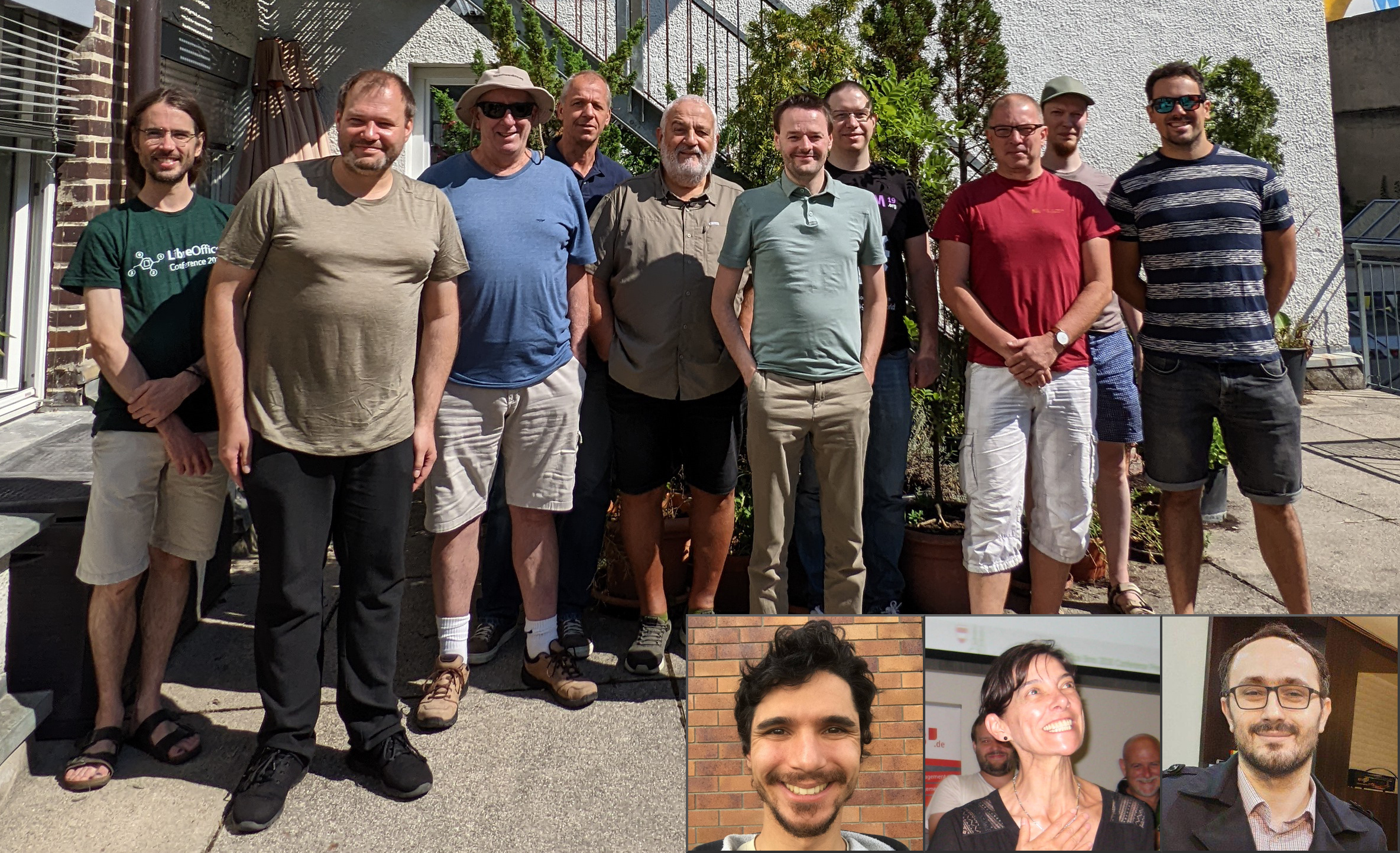
TDF team group photo

Note: this is one of two Developer positions currently available – the other focuses on accessibility

The Document Foundation (TDF) is the non-profit entity behind the world’s leading free and open-source office suite, LibreOffice. We are truly passionate about free software, the open source culture and about bringing new companies and people with fresh ideas into our community, especially in the second decade of our project. Look at what we did last year!

To improve features in LibreOffice, the office productivity suite for over 200 million users around the globe, we’re searching for a developer (m/f/d) to start work (from home) as soon as possible. The role includes:

  • Working on the LibreOffice codebase and build system
  • Focusing on right-to-left (RTL) and complex text layout (CTL) languages

The role requires the following:

  • Very good C++ development skills
  • Proven experience working on RTL/CTL topics
  • Proven contributions to FOSS projects (show us your repos!)
  • Good team-playing skills
  • Experience with LibreOffice development is a plus

Speaking and writing English is a mandatory requirement. Another language like German, Spanish or Arabic is a bonus.

A previously established relationship within the developer community, as well as with other teams such as QA is a plus, but it is not mandatory at the start and can be achieved during the work itself.

As always, TDF will give some preference to individuals who have previously shown a commitment to TDF, including but not limited to members of TDF. Not being a member does not exclude any applicants from consideration.

Join us!

All jobs at The Document Foundation are remote jobs, where you can work from your home office or a co-working space. The work time during the day is flexible, apart from very few fixed meetings. The role is offered as full-time. Candidates that are resident in or willing to relocate to Germany will be employed directly by TDF. Otherwise, external payroll services will be used if available in the candidate’s country of residence.

Are you interested? Get in touch! We aim to schedule the first interview within two weeks of your application. You can also approach us any time for an informal chat, to learn about the role or in case of questions.

TDF welcomes applications from all suitably qualified persons regardless of their race, gender, disability, religion/belief, sexual orientation or age. Don’t be afraid to be different, and stay true to yourself. We like you that way!

We are looking forward to receiving your application, including information about you, when you are available for the job, and of course your financial expectations. Pointing to public repositories with your code is very helpful. Please send us an e-mail to developers@documentfoundation.org no later than February 10, 2023. If you haven’t received feedback by March 24, your application could not be considered.

Please note that there’s a holiday break from December 22 to January 9, so we might not reply to your email during that time – but we’ll follow-up as soon as possible. So if you want to apply, do so now!

Also note: we only accept applications from the applicant, and not from any intermediary.

Join the LibreOffice Team as a Developer focusing on accessibility, full-time, remote (m/f/d)

TDF team group photo

Note: this is one of two Developer positions currently available – the other focuses on RTL/CTL topics

The Document Foundation (TDF) is the non-profit entity behind the world’s leading free and open-source software office suite, LibreOffice. We are truly passionate about free software, the open source culture and about bringing new companies and people with fresh ideas into our community, especially in the second decade of our project. Look at what we did last year!

To improve features in LibreOffice, the office productivity suite for over 200 million users around the globe, we’re searching for a developer (m/f/d) to start work (from home) as soon as possible. The role includes:

  • Working on the LibreOffice codebase and build system
  • Focusing on accessibility in LibreOffice

The role requires the following:

  • Very good C++ development skills
  • Proven experience working on accessibility topics
  • Proven contributions to FOSS projects (show us your repos!)
  • Good team-playing skills
  • Experience with LibreOffice development is a plus

Speaking and writing English is a mandatory requirement. Another language like German, Spanish or Chinese is a bonus.

A previously established relationship within the developer community, as well as with other teams such as QA is a plus, but it is not mandatory at the start and can be achieved during the work itself.

As always, TDF will give some preference to individuals who have previously shown a commitment to TDF, including but not limited to members of TDF. Not being a member does not exclude any applicants from consideration.

Join us!

All jobs at The Document Foundation are remote jobs, where you can work from your home office or a co-working space. The work time during the day is flexible, apart from very few fixed meetings. The role is offered as full-time. Candidates that are resident in or willing to relocate to Germany will be employed directly by TDF. Otherwise, external payroll services will be used if available in the candidate’s country of residence.

Are you interested? Get in touch! We aim to schedule the first interview within two weeks of your application. You can also approach us any time for an informal chat, to learn about the role or in case of questions.

TDF welcomes applications from all suitably qualified persons regardless of their race, gender, disability, religion/belief, sexual orientation or age. Don’t be afraid to be different, and stay true to yourself. We like you that way!

We are looking forward to receiving your application, including information about you, when you are available for the job, and of course your financial expectations. Pointing to public repositories with your code is very helpful. Please send us an e-mail to developers@documentfoundation.org no later than February 10, 2023. If you haven’t received feedback by March 24, your application could not be considered.

Please note that there’s a holiday break from December 22 to January 9, so we might not reply to your email during that time – but we’ll follow-up as soon as possible. So if you want to apply, do so now!

Also note: we only accept applications from the applicant, and not from any intermediary.

Sign the open letter about the universal right to install any software on any device

Earlier in 2022, together with more than 100 European organisations and companies, The Document Foundation has signed the #OpenLetter about the universal right to install any software on any device. Join us and sign the letter today.

To: Legislators in the European Union

In copy: Citizens of the European Union

The universal right to freely choose operating systems, software and services

Software design is crucial for the ecodesign and sustainability of products and hardware. Free Software systems and services enable reuse, repurposing and interoperability of devices. The universal right to freely choose operating systems, software and services is crucial for a more sustainable digital society.

The ongoing digitization of infrastructures and services comes along with a continuously growing number of electronic devices that are connected to the Internet – be it in private, public or business environments. Many of these devices need more energy and natural resources to be produced than the energy they consume during their entire lifespan. And way too many of these devices are being wasted and not reparable simply because the software stops working or is not being updated anymore.

Once the pre-installed software stops users from continuing to use their hardware, restrictive ownership models prevent users from helping themselves to enjoy longer use of their devices. Restrictions span from physically locking down hardware, to technical obscurity by using proprietary software, to legal restrictions via software licenses and end user license agreements. This way, manufacturers often prohibit repairability, access and reuse of their devices. Even after purchase, customers often do not really own their devices. They are not able to do what they want with their very own devices. If you cannot install the software you want on your own device – you don’t own it.

We, the signees of this open letter,

  • recognize that free access to the hardware and software determines how long or how often a device can be used or reused.
  • declare the increased longevity and reusability of our devices to be inevitable for a more sustainable digital society.

That is why we ask legislators around Europe to make use of the historic chance and enable a more sustainable use of electronic products and devices with a universal right to install and run any software on any device. To this end, we demand that:

Users have the right to freely choose operating systems and software running on their devices

Our tablets, phones and other connected devices are general purpose computers. Replacing software and operating systems on these devices enables us to extend the initial lifespan of a device and to make full use of our hardware. For the ability to reuse and repurpose our resources in a creative and sustainable way we need the universal right to install and develop any operating system and software we want on any of our devices. Any legal, technical or other obstacles to reuse these devices for any purpose must not be allowed.

Users have the right to freely choose between service providers to connect their devices with

Users must have the free choice of providers offering software related services, meaning they can use the device from one manufacturer with the service provided by another. Many connected clients today go to waste simply because their online services go offline. Free choice of services allows these clients to be reused by connecting to another service.

Operating systems and embedded software determine possible interactions between generic sensors, modules and systems with their connected online services. For users to exercise free choice of services, they must be able to use the device from one manufacturer with any online service, which could be supplied by any other third party or by themselves. Connected services as well as the software on connected devices and applications must offer interoperability and full functionality of a device’s initial purpose with the use of Open Standards.

Devices are interoperable and compatible with open standards

Software designs and architectures determine accessibility and compatibility of hardware via standards, drivers, tools, and interfaces. Proprietary software and protocols hinder competition among manufacturers, undermine repairability of devices and create an artificial incompatibility of different devices within the same infrastructure. Interoperability of single devices however is crucial for the creation of sufficient, sustainable and long-lasting IT infrastructures. To enable interoperability, manufacturers must ensure that any data necessary to run a device’s primary function is compatible with and possible to import/export in open standards.

Source code of drivers, tools, and interfaces are published under a free license

Smaller components of a device often require specific drivers, tools, and interfaces to operate. Users need full access and free reusability of the source code of those drivers, tools, and interfaces to analyse and integrate a device within a set of interconnected devices from different manufacturers. Source code reusability is also key to exercise the full right to repair for any third-parties from professional repair shops to repair cafés to end users.

A free license is any license that gives everyone the four freedoms to use, study, share and improve the software, including Free Software and Open Source Software licenses. The obligation to publish drivers, tools, and interfaces under such a free license after market entry is key for full access to our devices and exercising the universal right to repair.

To sign the open letter, you can click on the following link: Open Letter about the universal right to install any software on any device


New Liaison role for the Native Language Communities

Sophie Gautier writes…

Hi all,

We are launching a new role in the Native Language Communities. This role aims to improve the communication between the global projects, The Document Foundation and the local communities.

This communication should be directed in two ways: keep local communities informed on what is happening internationally, and keep the international community informed of what is achieved by the local communities.

My hope is also that TDF will be able to bring more help, if it is informed of the achievements, difficulties, wishes and needs locally.

The role is called Liaison and should be carried by one volunteer chosen by the local community, or self represented if there is no local community yet.

To know more about Liaison, please read this page. This is a first process that I’d like to enhance with the help of the Liaison members.

To discuss about the role and (in the future) with other Liaison members, join our discussion forum.

Don’t be shy, introduce yourself and tell us all 😄