LibreOffice in the Google Summer of Code 2021

New features in LibreOffice are made by volunteers, certified developers, and – during the summer – participants in the Google Summer of Code programme. This is focused on introducing students to open source software development, and last year LibreOffice received a bunch of new features thanks to the work of several students.

Well, we’re happy to announce that LibreOffice is part of this year’s Summer of Code (GSoC). If you’re a student, want to improve your programming skills and receive a financial stipend to implement new features in LibreOffice, take a look. Get in contact with us, show us that you’ve learnt the basics by working on an Easy Hack, and then propose your project(s). We look forward to meeting you!

Click here to get started

And to learn more about GSoC, check out this interview with Gautam Prajapati, who was part of the programme a few years ago:

Please confirm that you want to play a YouTube video. By accepting, you will be accessing content from YouTube, a service provided by an external third party.

YouTube privacy policy

If you accept this notice, your choice will be saved and the page will refresh.

Update on tender for a built-in UNO object inspection tool in LibreOffice

In July last year, we launched a tender to implement a dedicated, built-in UNO object inspection tool in LibreOffice. UNO refers to Unified Network Objects, the component model used by the software.

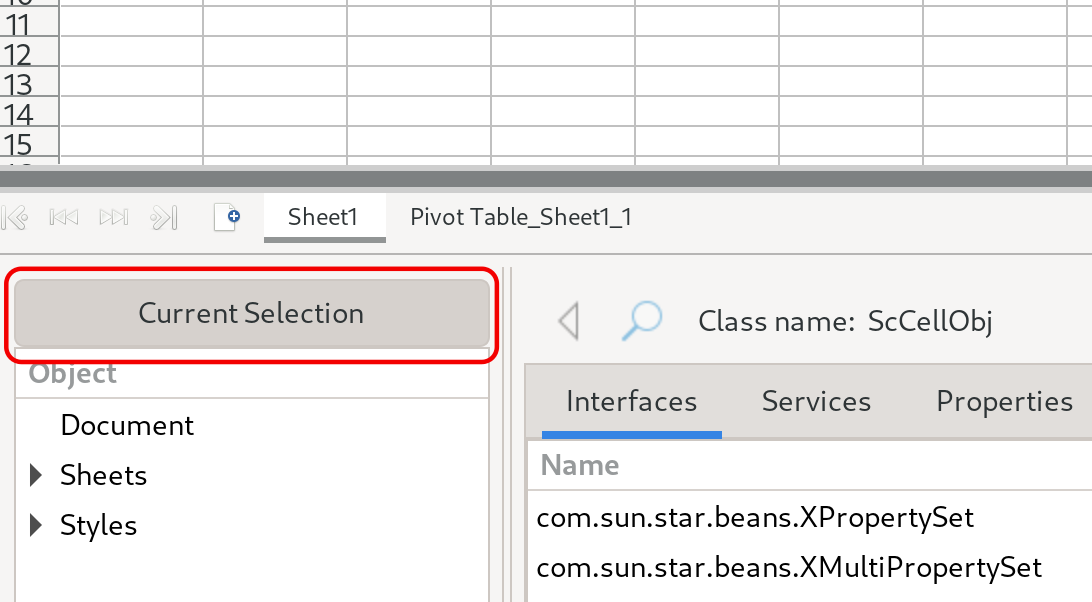
Tomaž Vajngerl was assigned to work on the tender, and has blogged about his progress. He discusses the point-and-click functionality to inspect selected objects in the document, and his next steps.

If you’re interested in the technology “under the hood” in LibreOffice, check it out!

Join the LibreOffice Team as a Developer Community Architect (m/f/d), 20-40h per week, remote (#202101-01)

The Document Foundation (TDF) is the non-profit entity behind the world’s leading open source office suite, LibreOffice. We are truly passionate about free software, the open source culture and about bringing new companies and people with fresh ideas into our community, especially as we are about to enter the second decade of our project.
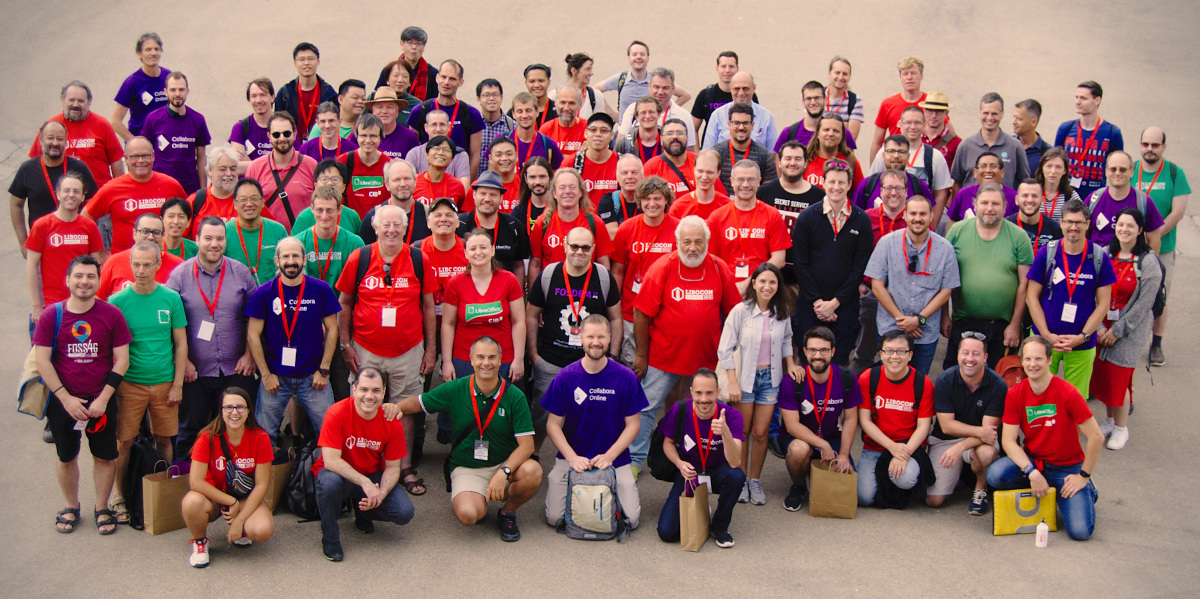
To grow the LibreOffice community and to enlarge the associated ecosystem, together working on office productivity for over 200 million users around the globe 🌎, we’re searching for a Developer Community Architect (m/f/d) to start work as soon as possible.

As our future Developer Community Architect, you work with a great team of currently eleven to:

  • Attract new contributors by promoting the LibreOffice project

  • Identify and onboard them, by building relationships between new coders and the community

  • Introduce them to our communication channels where they meet fellow co-hackers

  • Affirm and encourage everyone’s contribution and show community members ways to grow

  • Bring skilled contributors in contact with existing experts in the various fields for even deeper learning

To succeed in this new role, you ideally already have some of the following skills:

  • Previous experience in remote work

  • Self-driven and an excellent team player, who is interested in working as part of our team

  • Patience and kindness to work with potential contributors of various skill levels

  • Been a long-time contributor to one or more FLOSS communities, with coding experience in at least one FLOSS code base – ideally LibreOffice, of course! 🙂

  • Demonstrable C++ coding experience of at least five years, or a comparable language like C#, plus active knowledge of at least one more language used in LibreOffice, like Python or Java

  • Excellent communication abilities, that help you transport your enthusiasm for LibreOffice and our community

  • A quick learner with good self-starting capabilities (demonstrable quick learning is a good compensation for immediate lack of LibreOffice knowledge!)

  • Experience in web development and/or mobile technologies is a plus

  • When possible again, willingness to regularly travel to Hackfests and conferences in Europe and globally. In the meantime, you are excited to create virtual events on a regular basis, with the excellent infrastructure offered by TDF.

  • Fluent written English for e-mail and chat, with good speaking and comprehension is a mandatory requirement. Fluency in another widely-used language like e.g. Spanish or Mandarin would be considered an advantage.

Here’s how a typical day in your new role might look like:

You start your day by looking in Gerrit for unreviewed patches. There, you help to onboard new contributors, by positively reviewing their code contributions, which also involves syncing the coding style of their patches with LibreOffice’s. Your goal is to work with them and help them grow their skills where needed, like C++ programming, design and coding, and encourage them to bring up their own ideas how to implement a new feature or fix a bug in the codebase – in short, you are their guide to make their ideas become a reality. Especially for new contributors, you will introduce them not only to our community culture, but also to our variety of tools, which you regularly review and make proposals to improve or unify them.

One way to attract new contributors is to lower the entry barriers. You design and define easy tasks (“Easy Hacks”) for coders, that help them to learn about the code, our toolchain, the LibreOffice build system and leads them step by step into growing mature in the repository, so that they can ideally work on more advanced tasks.

Apart from the individual mentoring, an important part of your role is about knowledge sharing with the general public by writing and updating our technical documentation, like the developer guide, our wiki articles and also code comments. You master that thanks to your ability to write comprehensive texts for technical people.

The role you will fill gives you a lot of freedom and flexibility to shape our mentoring program. That requires you to work goals-oriented and with a laser-sharp focus to grow excellent LibreOffice core contributors. As our successful Developer Community Architect, you will come up with creative ways of finding and attracting volunteers who will stay in the community!

All jobs at The Document Foundation are remote jobs 🌟, where you can work from your home office or a coworking space. The work time during the day is flexible, apart from very few fixed meetings. The role is offered both as part- or fulltime, with the option to grow the hours later, just as you grow into your role.

Are you interested? Get in touch! We aim to schedule the first interview within two weeks of your application. You can also approach us anytime for an informal chat to learn about the role or in case of questions – and you can directly join our virtual FOSDEM DevRoom on February 7 to see what’s going on in the community!

TDF welcomes applications from all suitably qualified persons regardless of their race, gender, disability, religion/belief, sexual orientation or age. Don’t be afraid to be different, and stay true to yourself. We like you that way!

We are looking forward to receiving your application, including information about you, when you are available for the job, and of course your salary expectations. Please send us an e-mail to mentor.application@documentfoundation.org by February 18, 2021. A final decision for the role will be made by March 18, 2021.

Note: We do not accept agency resumes. Please do not forward resumes to any recruiting alias or employee.


Community Member Monday: Sarper Akdemir

Today we’re talking to Sarper Akdemir, who is a passionate supporter of free software and is helping to add new features to LibreOffice…

Tell us a bit about yourself!

I live in Istanbul, where I am pursuing a bachelor’s degree in Electronics and Communication Engineering at Istanbul Technical University. I like to hack code, cook, play bass, and rice some desktops in my free time. My primary computer is a Thinkpad X220 – such a cutie – and I use Emacs to hack on it.

On April 28 2018, Istanbul Technical University Software Freedom Club (ITUGnu) organized an event called “Free Software Summit”, which introduced me to free software. After that event, I decided to join and be an active member of the club, in the hope of learning more about free software and the hacker culture.

People in ITUGnu informed me about a summer camp called “Mustafa Akgül Free Software Camp”, which is a non-profit organization where people all around Turkey volunteer to teach attendees about free software, with courses ranging from GNU/Linux system administration to IT law.

I took a workshop there that Muhammet Kara gave called “LibreOffice Development Workshop” which got me started hacking on LibreOffice.

After the workshop, I decided to keep contributing to LibreOffice and apply to the Google Summer of Code. And I was lucky enough to get selected as a Google Summer of Code student in the past summer.

Why did you decide to become a member of The Document Foundation?

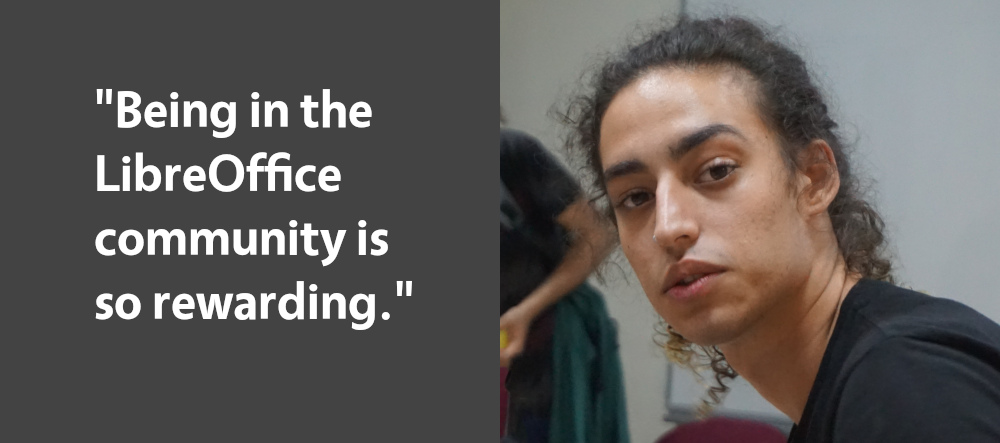
Throughout the Google Summer of Code period, hacking on LibreOffice daily was a lot of fun and at times challenging. While doing so, I got to interact and learn from the community of developers, especially my mentor Thorsten Behrens (CIB). Since being in the LibreOffice community is so rewarding, I wanted it to be official with a TDF membership – and having a say in what the future holds for LibreOffice is, of course, a plus.

What are you working on in the LibreOffice project right now?

I finished my Google Summer of Code project that introduced physics-based animation effects to LibreOffice Impress. And right now, I’m looking forward to fixing some bugs, starting from the ones related to animation effects.

Anything else you plan to do in the future? What does LibreOffice really need?

Since LibreOffice is one of the core utility pieces that the end user looks for in a computer, I think it is also an important piece for end users to achieve freedom. Therefore, I think LibreOffice can always use more robustness, so I will be fixing as many bugs as I can in the future.

Other than that, in the near future I’m trying to organize an event under ITUGnu to help some fellow students to contributing to LibreOffice and other free software projects.

Huge thanks to Sarper for his work on the new Impress animations, and Thorsten, his mentor, for supporting him. We hope to be in the next Google Summer of Code, but in the meantime, everyone with some C++ knowledge is welcome to explore the LibreOffice source code and try some EasyHacks. We’ll be there if you need help!

Bug Hunting Session for LibreOffice 7.1 Alpha

LibreOffice 7.1 is being developed by our worldwide community, and is due to be released in early February 2021see the release notes describing the new features here.

In order to find, report and triage bugs, the LibreOffice QA team is organizing the first Bug Hunting Session for LibreOffice 7.1 on Monday October 26, 2020. Tests will be performed on the first Alpha version. Builds will be available for Linux (DEB and RPM), macOS and Windows, and can be installed and run in parallel along with the production version.

Mentors will be available from 07:00 UTC to 19:00 UTC for questions or help in the IRC channel #libreoffice-qa and the Telegram QA Channel. Of course, hunting bugs will be possible also on other days, as the builds of this particular Alpha release (LibreOffice 7.1.0 Alpha1) will be available until mid November. Check the Release Plan.

All details of the first bug hunting session are available on the wiki.

Tender to finish transition of LibreOffice to ODF 1.3 (ODF 1.3 delta) (#202010-01)

The Document Foundation (TDF) is the charitable entity behind the world’s leading free/libre open source (FLOSS) office suite LibreOffice.

We are looking for an individual or company to finish transition of LibreOffice to ODF 1.3 (ODF 1.3 delta).

This tender builds on the previous ODF 1.3 tender and aims to implement additional features.

The work has to be developed on LibreOffice master, so that it will be released in the next major version.


The following required features (section A) need to be implemented:

  • chart:data-label-series. Missing feature. It is needed for import from Excel.
    • Relevant bugs in TDF’s Bugzilla: #94235, #133176
    • OASIS reference: OFFICE-2117
  • chart:regression-moving-type. Implementation of types “center” and “average-abscissa” is missing. It is needed for interoperability with Gnumeric.
    • For this feature, there is existing code that can be extended.
    • Relevant bug in TDF’s Bugzilla: #133423
    • OASIS reference: OFFICE-3959
  • <text:index-entry-link-start> and <text:index-entry-link-end> in user-index. The link marks exist, but the function itself is not implemented.
    • For this feature, there is existing code that can be extended.
    • Relevant bug in TDF’s Bugzilla: #121842
    • OASIS reference: OFFICE-3941

The following are desirable features (section B):

  • draw:fill for background of pages. Attribute draw:background-size specifies whether a background fill covers the entire page or only the content area of the page. It belongs to element <style:drawing-page-properties>. ODF 1.3 has extended its use to all kind of pages. Some related bug reports have been set to “fixed”, but the problem is not completely solved, details in the bug report.
    • The respective attribute seems to get written by LibreOffice already. All Writer documents are now the entire page.
    • Relevant bug in TDF’s Bugzilla: #134734
    • OASIS reference: OFFICE-3937
  • draw:z-index more precise with increase from back to front. Problem needs to be solved too for cases when converting from docx to odt.
    • Relevant bug in TDF’s Bugzilla: #133487
    • OASIS reference: OFFICE-2122

The following features are nice to have (section C):

  • Wrong icon of master document template in Windows Explorer
    • Relevant bug in TDF’s Bugzilla: #133285
    • OASIS reference: OFFICE-2580
  • pivot table based on named range with local scope
    • The previous implementation didn’t work out. This is a rather complex task.
    • Relevant bug in TDF’s Bugzilla: #37268
    • OASIS reference: OFFICE-3665

The following features are purely optional (section D):

  • Adapt function wizard to the fact, that the second parameter of DCOUNT and DCOUNTA may be empty (i.e. optional)
    • This can be qualified as an “EasyHack”.
    • OASIS reference: OFFICE-3906
  • chart:coordinate-region. There is no help about this topic. There exists no option to not use this kind of position and size reference.
    • That feature was handled differently until OpenOffice.org 3.0, where the coordinates included the description, now they are without, i.e. the reference changed.
    • OASIS reference: OFFICE-3928
  • fo:min-height as attribute of draw:text-box. LibreOffice does not use that attribute and ignores it on file open. Missing feature.
    • That element seems to be written by Word, but likely not yet by LibreOffice.
    • OASIS reference: OFFICE-3735

The following feature is purely optional, and not trivial from a UX point of view (section E):

  • svg:stroke-linecap at object style vs draw:style in element. Implementation of draw:style is incomplete. Especially there is no UI to define a line style with round dashes.
    • Relevant bugs in TDF’s Bugzilla: #133499 (Implementation has error), #127509, #127348, #127266, #123349, #53276, #127207
    • OASIS reference: OFFICE-3742

Required skills

  • Extensive knowledge of C++
  • Experience working on the LibreOffice source code
  • Knowledge of the OpenDocument Format standard, particularly in version 1.3.

Other skills

  • English (conversationally fluent in order to coordinate and plan with members of TDF)

We use free, libre and open source (FLOSS) software for development wherever possible, and the resulting work must be licensed under the Mozilla Public License v2.0.

TDF welcomes applications from all suitably qualified persons regardless of their race, sex, disability, religion/belief, sexual orientation or age.

Bidders will get a preference for including a partner or independent developer who has not been involved in a successful tender before.

As always, TDF will give some preference to individuals who have previously shown a commitment to TDF, including but not limited to certified developers and/or members of TDF. Not being a member, or never having contributed before, does not exclude any applicants from consideration.

The task offered is a project-based one-off, with no plans to a mid- or long-term contractual relationship. It is offered on a freelance, project basis. Individuals and companies applying can be located anywhere in the world.

When budgeting, we anticipated that this project (sections A-E) to take in the region of 32 days of work.

TDF is looking forward to receiving your applications for one or more of the aforementioned tasks, your financial expectations and the earliest date of your availability, via e-mail to a committee at tender20201001@documentfoundation.org no later than November 10, 2020.

Applicants who have not received feedback by December 8, 2020 should consider that their application, after careful review, was not accepted.