LibreOffice merchandising is available from Spreadshirt.Net

The Document Foundation has opened a store for LibreOffice merchandising at Spreadshirt.Net.

LibreOffice Merchandising Shop

We have a few items at the moment, mostly mugs and t-shirts, but we are open to suggestions and new designs. If you want to contribute, or if you already have a design to suggest, send an email to italo@documentfoundation.org.

The shop is managed by Spreadshirt, which is also responsible for the production of the items, the collection of the payment and the delivery of the items. The Document Foundation will get a small percentage of each item cost, to support the project.

The geography of LibreOffice

The LibreOffice community has a wide geographical reach, which is shown on this map, where all countries where there is at least a TDF Member are shown in green.

membersmap


The LibreOffice community will gather in Aarhus for the LibreOffice Conference, where most of the countries will be represented. In addition, there will be volunteers from other countries, according to this map, where all countries where there is at least a conference participant are shown in green.


conferencemap

Program of Events at LibreOffice Conference in Aarhus

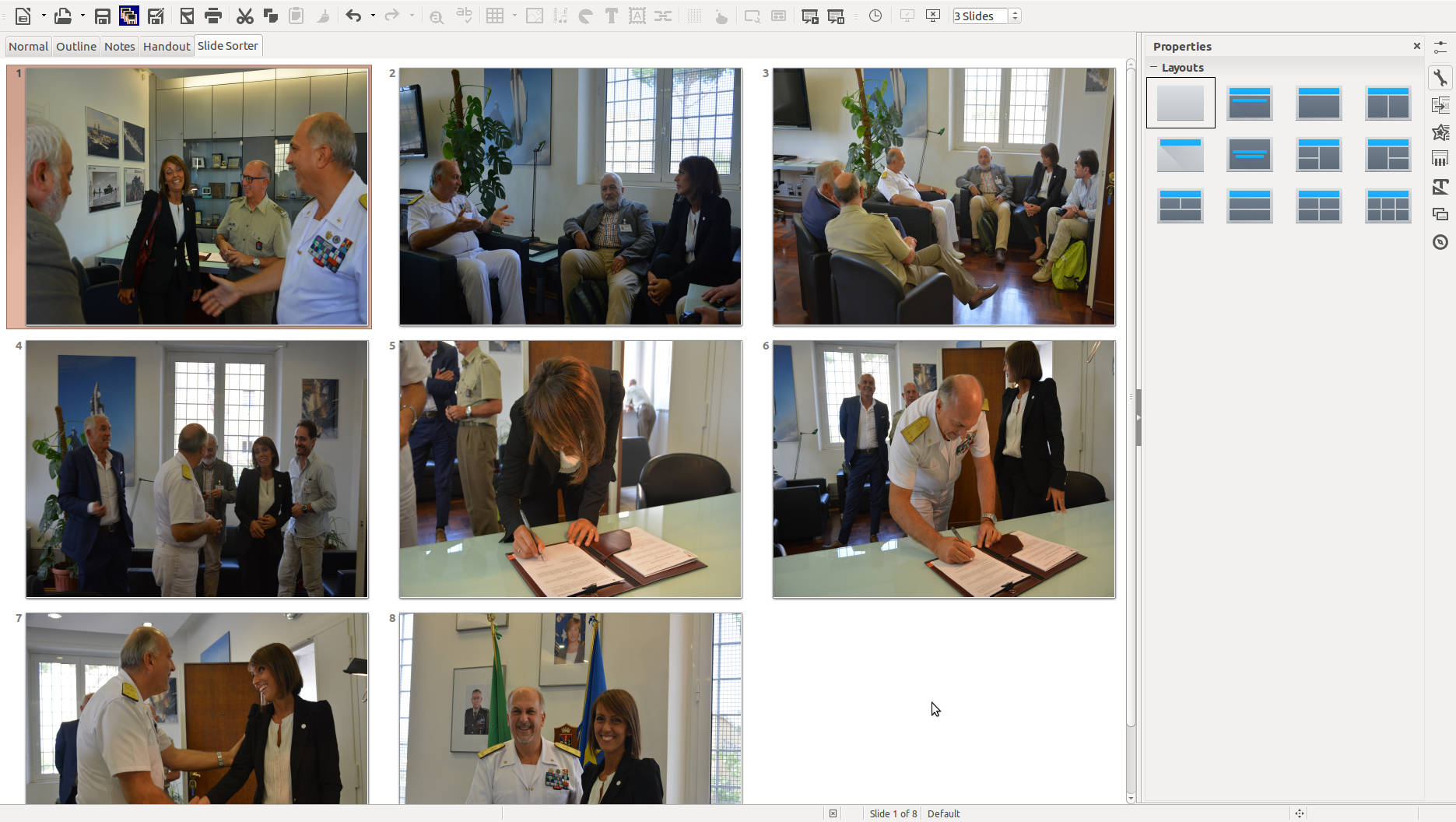
OLYMPUS DIGITAL CAMERAThe organizing committee has published the calendar of events at the upcoming LibreOffice Conference in Aarhus: http://conference.libreoffice.org/2015/events/.

On Tuesday, September 22nd, there will be a Community Dinner at Restaurant Flammen: http://conference.libreoffice.org/2015/events/community-dinner/.

On Wednesday, September 23rd, there will be a Conference Dinner at Restaurant Bone’s: http://conference.libreoffice.org/2015/events/wednesday-dinner/.

On Thursday, September 24, there will be a HackFest & Party at the Aarhus University: http://conference.libreoffice.org/2015/events/hack-fest-and-party/.

To better organize the three events, all interested conference participants are kindly requested to register using the form that can be found in each event page. Only people registered will have access to the events in Aarhus.

The Document Foundation announces LibreOffice in Guarani, to offer the free office suite in yet another native language

Berlin, August 19, 2015 – Following the announcement of LibreOffice 5.0, The Document Foundation (TDF) announces the availability of LibreOffice in Guarani, the language spoken by 80% of the population in Paraguay, and the official second language of the country.

Map-Most_Widely_Spoken_Native_Languages_in_Latin_America
Guarani is spoken in the area in yellow

Guarani is spoken in parts of northeastern Argentina (Corrientes, Formosa,Misiones, eastern parts of the Province of Chaco, and at isolated points of Entre Rios), is the second official language of the Argentine province of Corrientes since 2004, is the co-official language of Bolivia, and is spoken in several cities of the eastern state of Mato Grosso do Sul in Brazil. Guarani is also one of the official languages of Mercosur (source: Wikipedia).

LibreOffice in Guarani has been be presented on August 13 at OEI (Organización de Estados Iberoamericanos) facilities in Asunción, Paraguay, to a selected audience. TDF and LibreOffice have also been presented in the Centro Nacional de Computación of UNA (Universidad Nacional de Asunción) in San Lorenzo Campus.

The localization to Guarani was carried by a single volunteer: Giovanni Caligaris. LibreOffice in Guarani is immediately available for download from http://www.libreoffice.org/download/.

“Back in 2011, I started discussing with the CIO of a Paraguayan corporation at the LibreOffice Conference in Paris, and we envisioned how to get the office suite in Guarani”, said Olivier Hallot, a founding member of TDF, and a LibreOffice advocate. “Unfortunately, the project stalled, until Giovanni Caligaris picked up the task, and managed to localize LibreOffice in Guarani in a rather short timeframe”.

“With the availability of LibreOffice in Guarani, Paraguay positions itself at the same level of more developed countries, and represents an incentive for countries in Latin America, Africa and Asia to conduct a localization project for their native languages”, said Giovanni Caligaris. “The next task is to increase the LibreOffice awareness in Paraguay, with the help of the LibreOffice community”.

With the addition of Guarani, LibreOffice gets closer to the vision of the founding members of the project, to bring the free office suite in their native language to 100% of the world population, to reduce the digital divide based on the familiarity with one of the languages spoken in the richest countries. Today, close to 90% of the world population can use LibreOffice in their native language.

Behind the scenes at TDF: Infrastructure

With the beginning of 2015, a new year packed with exciting projects and ideas around LibreOffice and The Document Foundation, we today finish our behind-the-scenes series, to share achievements in 2014 with our community and our generous donours, to whom we’d like to express our sincerest gratitude and thanks for their incredible and wonderful support and their invaluable contributions!

I’m Alexander Werner and I am responsible for the infrastructure of The Document Foundation on a contracted basis since March 2014. I have been with the project since its foundation in 2012, and been a longtime supporter of free and open source software. As a volunteer I helped setting up and maintaining our first server and optimizing it to handle the load of the first days.
The infrastructure is one of the most important things The Document Foundation provides for the community. As long as every part is working as expected, it is basically invisible. It is my job to make sure that this is always the case, mostly by orchestrating the different services on our growing number of virtual machines.

When the LibreOffice fork began, we started with only one server where all services were located – mailing lists, both private and public, website, mirror management, wiki and many more. As time went by, this server survived its first slashdot, but soon it became clear that more power was needed. So our infrastructure started growing organically as more and more servers were added. Our admins specialized on different parts of the infrastructure, while the whole configuration was centrally documented in a single ODT file.

It soon became clear that this was not a viable solution – our quest for infra 2.0, as we internally call it, began. The admin team worked under fast escalating load while looking for ways to optimize resource usage, inclusion of new volunteers, configuration documentation and management. Also high availablility of services became increasingly important. In our sparse free time we started creating concepts, tested HA with DRBD, Pacemaker and Heartbeat, evaluated different solutions for centralized documentation and started using tools for centralized configuration management.

It soon became clear that we needed more flexibility for working HA with the solution described above, so as interim solution we started virtualizing services first in paravirtualized guests with LXC and then switched to fully virtualized guests with KVM. For infrastructure documentation I suggested to use the documentation generator Sphinx. The source files for the documentation – human readable RST text files – are located in a git repository, and the online documentation is automatically updated on every push. For configuration management and deployment, I eventually stumbled upon SaltStack.

My daily work consists of working on various small recurring tasks such as helping people with mailing list troubles, adding and removing mirrors in MirrorBrain, installing updates and doing necessary reboots as well as handling unexpected incidents such as the Heartbleed bug.

In spring I started working on our Salt states, made them more reliable and made sure that all user accounts are now managed by Salt. I have setup a new virtualization host with VMs for Gerrit, Jenkins, Bugzilla and Plone. Apart from that I worked on improving the documentation of our services, looking for undocumented and unused services.

I also worked on our AskBot setup. While having set up the initial AskLibO instance, it was decided to contract Evgeny Fadeev, the primary developer of AskBot, to develop additional features needed by our community, which will then be made available upstream again. Despite that, I also did some changes such as enabling the newly-developed multilanguage support, fixed template bugs and administered the list of moderators.

Except for my ongoing work to improve the Salt states and adding more not yet managed servers to our Salt infrastructure, I also continued to concatenate various documentation sources into our centralized repository.

I also worked on a download counter that will be useful to track all our downloads by language, location, version and operating system.

But the most interesting, time consuming and fascinating part of my work was the planning, testing and setup of our new cluster/cloud infrastructure. As it was decided to virtualize all of our services, I looked for a solution that is easy to manage and maintain but provides powerful tools for easily creating highly available services.

After quite some time of evaluating I decided to go for oVirt – a KVM-based virtualization solution that provides a nice out-of-the-box experience, the simplicity of its setup was worlds apart from other solutions. It is also possible to provide fully high available services with only two nodes by having the management engine run as VM on the platform.

During the time of evaluation I also had contact to hardware suppliers and hosters, and after a good offer from manitu we decided to host our new platform on two large, dedicated servers, each with 256 GB RAM and 64 CPU cores. Until the end of the year, over 20 virtual machines were migrated and a third node was ordered that will be used primarily for crash testing and to increase the stability of the platform even more.

If you are interested in learning more about our infrastructure or helping out, consider subscribing to the website mailing list, where infra calls are announced or write a mail to alex@documentfoundation.org

Behind the scenes at TDF: Executive Director

With the beginning of 2015, a new year packed with exciting projects and ideas around LibreOffice and The Document Foundation, we continue our behind-the-scenes series, to share achievements in 2014 with our community and our generous donours, to whom we’d like to express our sincerest gratitude and thanks for their incredible and wonderful support and their invaluable contributions!

I’m Florian, and I live in the very southern part of Bavaria in Germany, 100 km southwest of Munich, near the border to Austria and Switzerland – a beautiful place to be. 😉

Today, I’d like to shed a light on my role as Executive Director, a fulltime position which I have held since last March. With TDF having grown over the past years in terms of contributions, projects, ideas, staff and donations, my role as Executive Director is, in a nutshell, to keep everything together and have “the show running”, working for the Board of Directors and with the Membership Committee,floeff2012_400x400 and all the other wonderful volunteers, contributors and staff members like Sophie, Italo, Christian, Robinson and Alex.

Having worked intensively on the statutes and the initial setup of TDF, the first part of my role is taking care of many administrative, legal and tax bits, removing that burden from the board to give them more time for strategy and other items. This work reaches from working closely with our accountant, tax advisor, payroll provider and legal counsel, to dealing with trademark requests, protection of domain names, checking and payment of invoices, and reviewing contracts and insurances, making proposals for the investment of our capital stock and other funds, and of course answering questions on details of the statutes and other parameters of the German “Stiftung”.

The second part of my role is handling the daily operations, which includes replying to and distribution of all sorts of inquiries and requests, be it formal letters, user inquiries and, together with other TDF spokespeople, a variety of press and media inquiries. The daily operations also involve monitoring the budget, organizing our internal file storage, preparing presentations for the annual board meetings, participating in and proposing agenda items for the biweekly phone conferences, handling our donation mechanisms, bank accounts and donation confirmations, monitoring deadlines and working on relations to our Advisory Board. When a new Board of Directors or Membership Committee is elected, or we have new staff members, I have the honour of introducing them to our internal workflow and our entity.

The most exciting part of my job surely is working with our staff in various projects, and the coordination of tasks, deadlines, priorities. As Executive Director, I am responsible for oversight of all budget items and projects TDF is carrying out. At the end of 2013 we have switched to Redmine for project management – started out of the infrastructure team’s needs, it has become an important tool for task and project handling in some non-development parts of LibreOffice. In addition to that, we are running weekly team calls with our staff members, have slots reserved for weekly one-on-one calls, and meet in IRC regularly to discuss current projects and challenges. Every once in a while we also have in-person meetings, mostly during LibreOffice Conferences and FOSDEM. Being responsible for that part of the foundation also involved handling tender processes, job openings and talking to candidates who apply for a job.

We do have a couple of recurring projects, like gradually improving our AskBot instance or writing our formal annual report, but there’s also individual items, like the certification program, the Android tender and the Bugzilla migration.

Should I find some spare time during the weekends, I also like hacking around on our infrastructure, especially our e-mail system and our Redmine instance, and try to join our admin phone calls and infra in-person meetings when possible. Having been a part of the German community for many years, I also try to regularly organize community meetings and phone conferences.

Last but not least, every once in a while I give a presentation, staff a booth at an event, and sometimes I even make it to a magazine or try to say some wise words in a podcast or a lecture. 😉