The Document Foundation Releases LibreOffice 26.2.3

LibreOffice 26.2 banner

Berlin, 30 April 2026 – The Document Foundation today announces the release of LibreOffice 26.2.3, the third maintenance update to the LibreOffice 26.2 branch, which was released in early February. This update delivers targeted bug and compatibility fixes, along with stability improvements contributed by our global community.

LibreOffice 26.2.3 is available for immediate download at for Windows, macOS and Linux.

LibreOffice 26.2 introduced a broad set of improvements to daily productivity workflows, including Markdown import and export, connector shapes in Calc, multi-user Base, faster EPUB export, and mandatory Skia rendering on macOS and Windows for better graphics performance. LibreOffice 26.2.3 consolidates these advances with a focused set of fixes (detailed in the RC1 and RC2 changelogs), addressing issues identified by users and testers since the initial release.

Videos describing the new features of the LibreOffice 26.2 family are available on PeerTube and YouTube:

Please confirm that you want to play a YouTube video. By accepting, you will be accessing content from YouTube, a service provided by an external third party.

YouTube privacy policy

If you accept this notice, your choice will be saved and the page will refresh.

LibreOffice users, free software advocates and community members can support The Document Foundation and the LibreOffice project with a donation.

The LibreOffice community is also working on LibreOffice 26.8, our next major release, due in August. To assist with this, The Document Foundation is taking on new developers, such as Neil Roberts and Vissarion Fisikopoulos, with more to come. All LibreOffice users are welcome to join the project and help to make the software even better.

Insights from the InstallFest 2026 Conference in Prague

InstallFest banner

Petr Valach from the Czech LibreOffice community writes:

On the last weekend of March 2026, the regular InstallFest 2026 conference took place. Here is a summary of the news and insights we gained at the event.

New venue

What every visitor noticed immediately upon entering was the change in the location of the conference spaces. Instead of Building E in the courtyard of the Faculty of Electrical Engineering complex, visitors headed up the stairs directly inside Building A from the reception. The conference thus gained larger premises (three floors were allocated), which visitors likely appreciated, as there was no crowding anywhere.

As I mentioned in my report from the previous year, I personally prefer historic spaces over modern architecture like that of LinuxDays. Its design is also very interesting, with a certain intended rawness and practicality, but historic buildings hide their own charm and the mystery of bygone times.

However, the placement of most booths was problematic. They were (as last year) located in a single room. If visitors didn’t know about them, they wouldn’t go there on their own – they had to deliberately search and find them (although there were signs everywhere and the magnetic navigation system deserves praise). Booths should rather be placed in hallways where they are visible. On the other hand, it must be acknowledged that due to echo, such placement would increase noise levels in the corridors, which could be disturbing. In any case, there were very few visitors at the LibreOffice booth – much fewer than at LinuxDays. Therefore, the list of observations will be brief.

At the The Document Foundation / LibreOffice booth

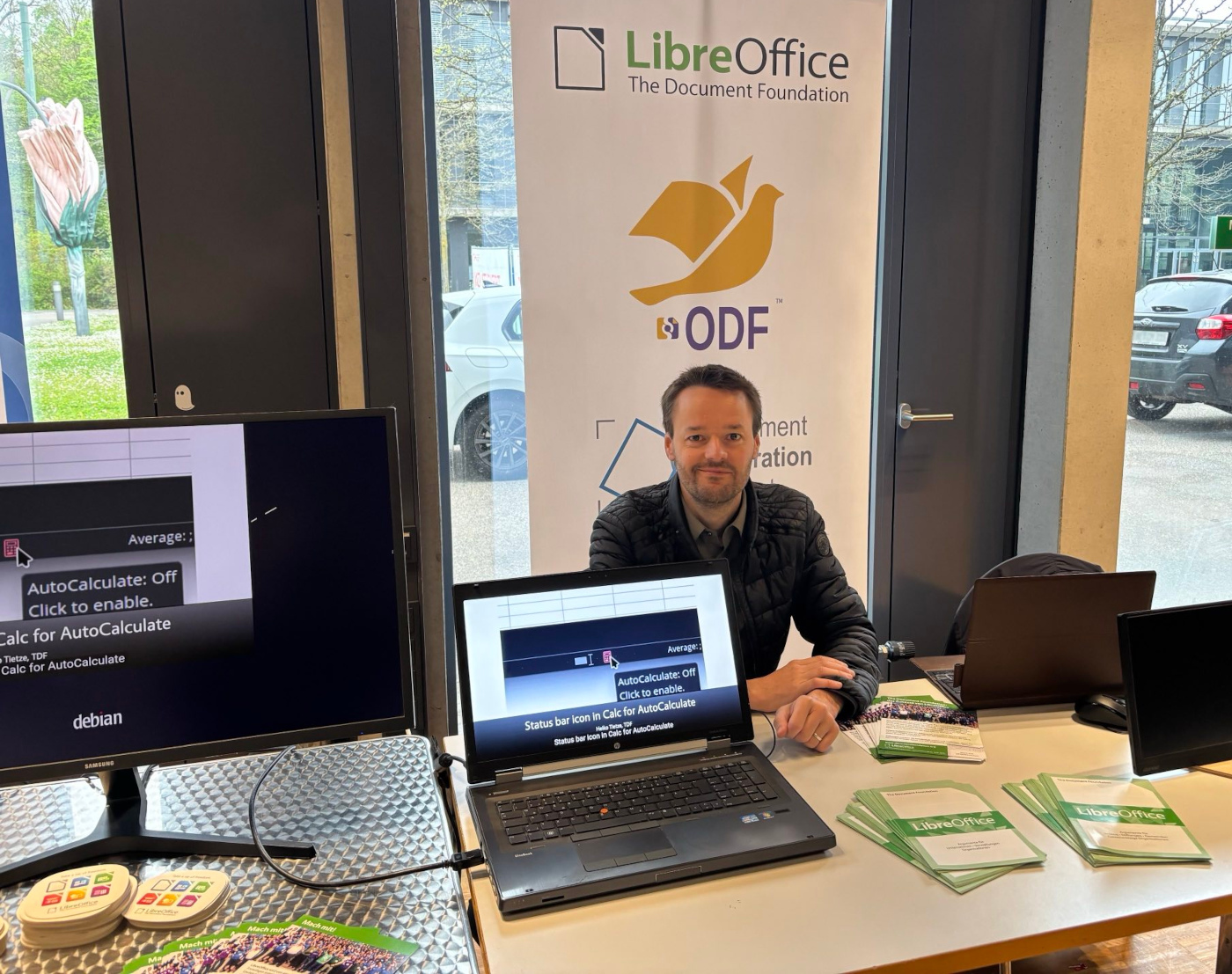
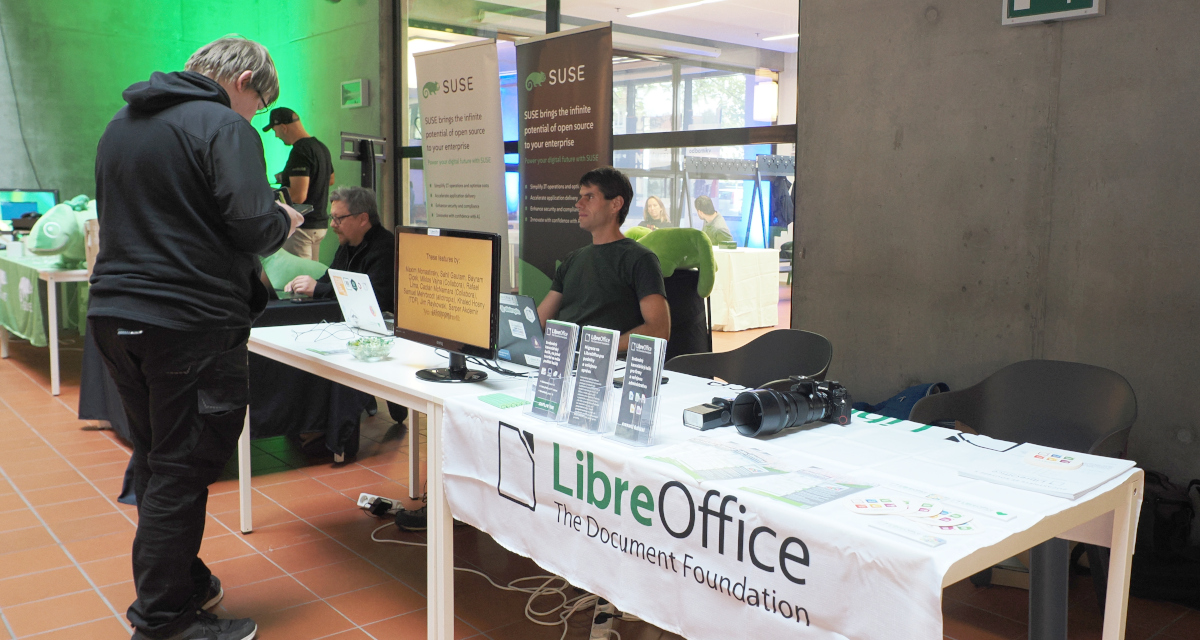
LibreOffice booth

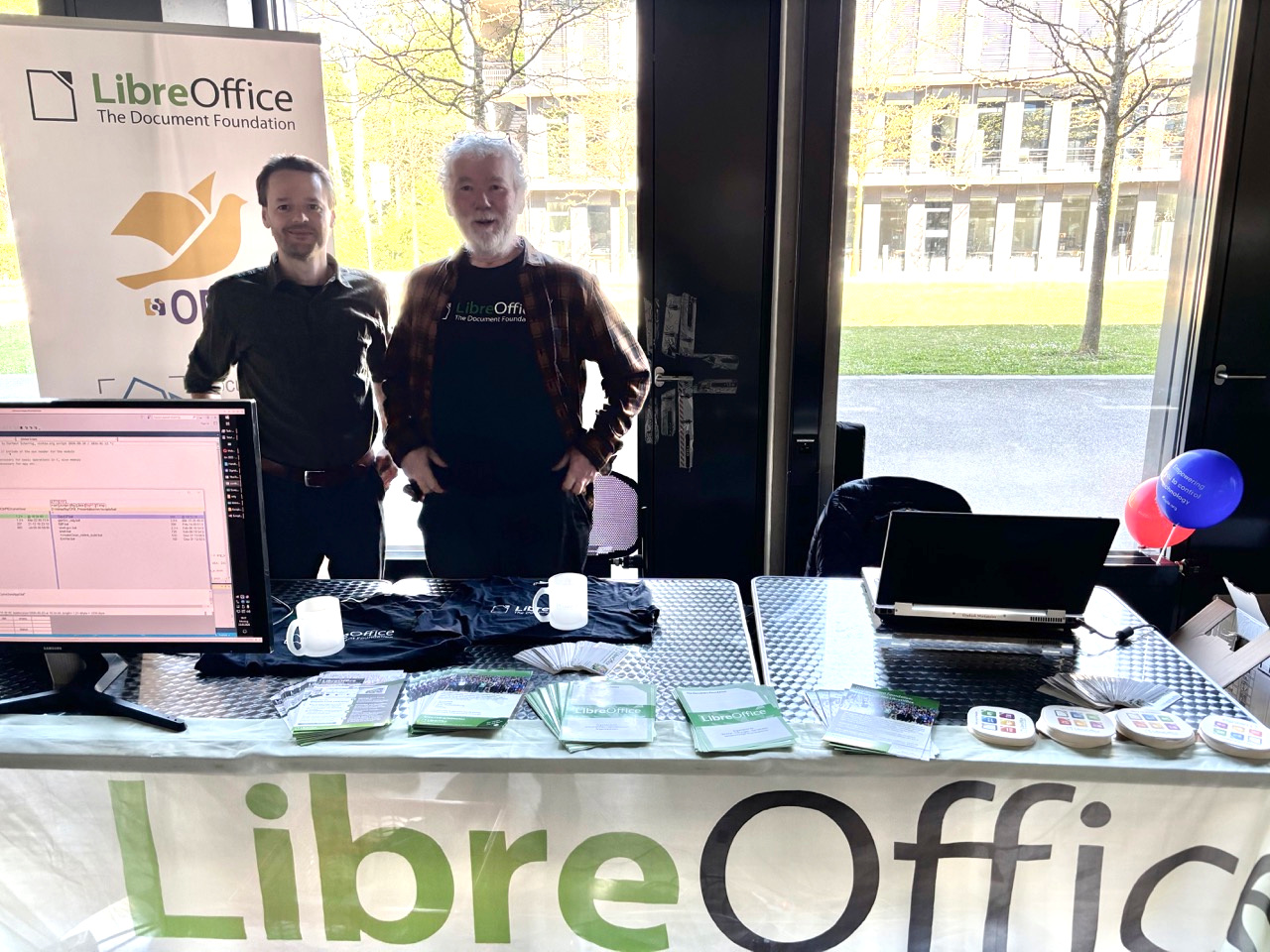
At the booth, in addition to providing information and advice, we offered traditional promotional items such as stickers, beer coasters, and flyers. New this time were badges that visitors could pin to their lapels, and interest in them was surprisingly high.
A small contest in the form of a fill-in puzzle was again prepared for visitors. Clues were distributed across two floors where the conference took place.

Contest sheet

This year, only one member of The Document Foundation attended InstallFest. A significant reinforcement, however, was thirteen-year-old Matěj, who helped mainly with carrying things and staffing the booth. He also attended a lecture focused on FreeCAD and its related workshop (plus one more). Matthew is a high-functioning autistic with interests in physics, astronomy, photography, and IT, and he will newly contribute to LibreOffice translations. We’ll see how he does.

Workshop

Topics and insights

Just a few days before the conference, the German government issued a directive mandating the use of the ODF format in public administrations. ODF is one of the required formats (alongside XML, PDF, etc.). The OOXML format is entirely absent, meaning it is not supported at the federal level in Germany. This has clear consequences and signals a move away not only from OOXML but also from Microsoft Office, as its compatibility with ODF is not good.

This information (along with recent implementations, for example in Denmark, Austria, Schleswig-Holstein, etc.) generated significant interest among visitors. These implementations demonstrate that governments (regional or national) take LibreOffice seriously. They send a signal that LibreOffice is a high-quality suite capable of meeting governmental needs.

For this to be the case, LibreOffice must meet certain criteria. Perhaps the most important is functionality – it must be able to do what governments require. Equally important, however, is security. As we know, using Microsoft 365 (the cloud version of Microsoft Office) is problematic because it conflicts with GDPR regulations. Users do not have control over their data when using this application. This issue does not arise when using the desktop or online version of LibreOffice; here, users have full control over their data. For institutions that process sensitive personal data, this is a crucial requirement that cannot be taken lightly.

It was interesting to observe how important privacy and security are to booth visitors (mostly young students). But not only to them. One student from the Faculty of Social Sciences at Charles University mentioned that using Google Workspace is prohibited at their school due to data protection concerns; however, it is curious that Microsoft 365 is still allowed (even though the same policy issues apply).

The students we spoke with are generally satisfied with LibreOffice and use it for standard office tasks. In addition to Writer and Calc, Impress is also used – students are satisfied with it, although it is often considered the weakest module of LibreOffice. They agreed that it would be very useful to directly label objects on slides automatically, which would improve clarity when editing animations; users would immediately see the order of actions applied to specific objects (as in PowerPoint).

One student also asked about morphing between slides (as in PowerPoint); Impress does not support this feature, and subjectively it is not essential – more of an unnecessary “visual effect.”

This time, far fewer people participated in the contest than at LinuxDays – only seven completed entries were submitted, which is even fewer than last year at InstallFest. Nevertheless, three successful participants were drawn and won T-shirts and a printed color translation of the Writer manual. As always, participants could add questions or comments – only one participant did so, with two questions:

T-shirt winners

  • The first concerned dark mode support. This is not new in LibreOffice; it can be selected under Tools | Options in the LibreOffice | Appearance section. Since LibreOffice 25.8, users can not only switch between light and dark themes but also install themes that completely change the interface colors.
  • The second question was about support for cloud services in LibreOffice. LibreOffice allows connections to various cloud services such as OneDrive, Google Drive, WebDAV, and others. This option is available under File | Open Remote.

Screenshot of LibreOffice's Appearance preferences

The InstallFest 2026 conference is now behind us. We’ll have to wait until October for the next IT conference – LinuxDays 2026. Will we meet there?

Help us to improve LibreOffice’s Swahili translation!

Image of globe

In the LibreOffice project, our goal isn’t to just make a powerful office suite – but to also make it usable for as many people as possible. And a big part of that is translating the user interface, help content and websites. LibreOffice (the app itself) is available in over 120 languages, thanks to our worldwide translation and localisation communities. But we want to do more!

Some translations need more work, for example – such as Swahili (also known as Kiswahili). This language has an estimated 150 – 200 million native and second-language speakers, primarily in Tanzania and Kenya. Swahili is one of three official languages of the East African Community countries, and one of the working languages of the African Union.

LibreOffice’s Swahili (Tanzanian variant) translation is currently 33% complete, so we’d love to get some more help here. If you speak the language, you can help to improve it:

Thank you in advance for any help you can give! And of course, we’re always happy to see translations of LibreOffice in other languages too. So if the software is missing your language, please let us know and let’s improve it 😊

LibreOffice Asia Conf 2025 – Panel: Lessons from Open Source Business, Part II

Panel discussion from LibreOffice Asia Conference 2025

Jiajun Xu writes, following on from part 1:

The annual community event LibreOffice Asia Conference was held on December 13–14, 2025 in Tokyo, Japan. One of the sessions was a panel discussion titled “Lessons from Open Source Business,” moderated by Franklin Weng, featuring three company leaders from different countries sharing how they run their businesses through open source tools. This article covers Part II: the moderator’s questions and discussion.

(Note: photo credits: Tetsuji Koyama, CC BY 4.0)

Question 1: Open Source as Business Core vs. Business Using Open Source Technology

Panel discussion from LibreOffice Asia Conference 2025

Franklin first provided some context for this question. In 2022, he wrote a handbook on “Public Money, Public Code” for the Friedrich Naumann Foundation for Freedom. At the press conference marking its release, someone asked him about open source business, and he proposed two models:

  • “Open source as the business core”: You start with open source software, then think about building a business around it.
  • “Business using open source technology”: You start with a business model, then consider which tools to use.

He emphasized that neither approach is inherently better or worse — the distinction simply serves as a useful way to frame the discussion. Franklin then asked the panelists what they thought about the two models and which they preferred.

Ahmad Haris said the question was difficult to answer directly, but if forced to choose, he would align with the “business using open source technology” path — and that it has become his way of life. Haris explained that although he never attended university, the community taught him how to use Linux and how to accomplish all sorts of things with open source tools. Without the community’s support, he wouldn’t be where he is today.

However, over the years of participating in the community, he has seen many talented people unable to sustain their involvement due to financial difficulties, which he finds deeply regrettable. This motivated him to think: if he could succeed in business, he could channel resource back into the open source community. To this day, he continues to hold this view: he uses open source technology, avoids reinventing the wheel, and whenever he has the means, gives back to the community or open source projects through sponsorship.

Kevin Lin pointed out that the key difference between the two models becomes particularly evident when working with governments. In their work, they can’t simply be users of open source software — they need the capability to build tools and integrate open source software into their company’s solutions. In practice, OSSII operates with both models running in parallel.

Lothar Becker admitted it’s hard to draw a clear line between the two, especially since the boundary between “contributing code” and “contributing services” isn’t always clear-cut. His personal experience spans both models, but over time he has increasingly leaned toward “business using open source technology,” as he values direct client engagement more. What is particularly interesting is that, as he’s gotten older, his consulting work has actually circled back closer to the open source core: he increasingly advises clients on how to participate in open source communities, such as getting involved in projects like Nextcloud. This isn’t traditional training or technical support, but rather strategic advice on “how to stay connected with the open source world.”

Question 2: Developing Products vs Focusing on Projects

Panel discussion from LibreOffice Asia Conference 2025

Franklin observed that for small open source companies, there is often a trade-off between “building products” and “taking on projects.” If you invest resources in developing your own product, revenue may be constrained, requiring companies to take on projects to sustain operations. But if you devote too much energy to projects, it reduces the time available for product development. This is especially pronounced when a company is just starting out, so he asked the panelists to share their approaches.

Kevin Lin said that OSSII does both product development and government projects, but they follow one crucial principle: projects should not come at the expense of product development. Therefore, they try to select projects that align with their product roadmap. Whenever they develop a feature for a project, they first ask themselves: “Can this feature also be incorporated into our product, making it more useful for a wider range of clients?” This way, project work and product development don’t pull against each other—they reinforce each other.

Lothar Becker noted that even though .riess is a service company that doesn’t focus on development, they still think about “productizing services.” They have developed a series of standardized training programs around LibreOffice, and in recent years have increasingly been productizing integrated solutions for file sharing plus online office use cases.

Lothar described the process: first, a client comes with a specific need, and they craft a tailored solution. They then step back and ask, “Which parts of this solution could also serve other clients’ needs?” Products grow organically from individual projects this way.

Franklin followed up: clients always demand more customization — how do you deal with that? Lothar acknowledged this is reality, but said it’s not always the case. His advice: if the product can cover 80% of a client’s needs and the remaining 20% requires customization, that is generally considered an acceptable balance. Pricing should factor in a certain degree of individual adjustments from the start, and as the product matures, the proportion of customization naturally decreases. The key, however, is that the sales team must be able to convince the client that the existing product already meets their needs.

Ahmad Haris said he takes different approaches depending on which of his two companies he’s working with. At STIA, where he is an employee and the company is project-oriented, he simply follows the company’s approach. At Nenggala, which he leads, the approach is different; most of the time they are product-oriented, prioritizing product development and getting at least to the proof-of-concept stage. He admitted that his judgment relies more on intuition than formal business training. For instance, when developing a secure communication app, he had a gut feeling that some organization would need it during the next general election — and they did. However, when funds run low, Nenggala still has to fall back on taking projects to stay afloat, even graphic design work. His philosophy: “As long as it’s not murder or arson, I’ll take it.”

Question 3: The Biggest Challenges in Working with Governments

Panel discussion from LibreOffice Asia Conference 2025

All three panelists have extensive experience working with governments, helping public sector organizations migrate to open source software or open document formats. Franklin asked them: what is the biggest challenge in this process?

Lothar Becker quoted a remark he made at the LibreOffice Asia Conference 2024: “Don’t blame your customer.” He believes the biggest challenge is people’s resistance to change. This resistance exists in both the public and private sectors, but the public sector situation is particularly tricky: government employees face less pressure from job insecurity, making the resistance especially deep-rooted. Lothar emphasized that this needs to be factored into business planning; the cost of “overcoming resistance” should even be included in the budget. In practice, this means extensive communication, training, and people-focused work; the technical aspect is actually secondary.

Ahmad Haris shared an experience from 2008 to 2010, before LibreOffice even existed. At the time, Aceh had just been devastated by the Indian Ocean tsunami, and Haris went there as an NGO member to assist with reconstruction. One of the tasks was to migrate the entire province of Aceh from Microsoft Office to OpenOffice.org. OOo’s word processing capabilities weren’t mature enough at the time, but technical issues were secondary — the real challenge was people. Although Haris is also a Muslim, as a Javanese person, he had a very different language and culture from the local Acehnese, and friction arose frequently when working face-to-face. His solution was to work with the local community: first train local community members, then have them act as a bridge to end users.

Haris pointed out that the most significant outcome of those two years was actually localization. Aceh is an autonomous province that implements Sharia law, and many official documents require Arabic script. At the time, under the Microsoft Windows environment, Arabic support was quite rudimentary. Through OpenOffice.org and Linux, they successfully enabled Arabic text input, and the mayor was delighted: “This is the Islamic way!” This was also something Haris had observed over years of promoting free software in rural areas across Indonesia — one of the features of free software most valued by rural communities.

Kevin Lin offered a more focused perspective. He believes the biggest challenge is finding the real decision-maker and earning enough trust for them to candidly tell you what their concerns and constraints are. Once you achieve that, the technical issues are all solvable. The truly hard part is finding that key person who is genuinely committed to driving the migration forward.

Question 4: The Most Valuable Lessons from Running an Open Source Business

Panel discussion from LibreOffice Asia Conference 2025

For the final question, Franklin asked the three panelists: after years of running their business, what is the most valuable lesson you’ve learned?

Kevin Lin said that open source has shown him many creative possibilities, though he admitted this feeling is difficult to articulate. Having reached this stage of running a business, he realized that the core is no longer open source itself; it’s about people. In the end, what business owners spend most of their time dealing with isn’t the business model, but people-related challenges.

Lothar Becker laughed and said he had actually written down the same answer before Kevin spoke: “It’s all about people, not about technology.” Finding people who share your passion and are willing to work in ways you believe in is particularly challenging.

He then added another insight: stay true to your values. If you believe open source is the right thing to do, then do it. Over the past 25 years, there was no shortage of skepticism: “Forget it, you’ll never succeed.” Of course, you must constantly think about what you can offer and adapt to changing circumstances, but if this is where your passion lies, stick with it. He said this is essentially why all three of them sitting here are still on this path today.

Ahmad Haris said his answer depends on the context. His experience is: when the government says it wants to migrate to open source, those promises are not always reliable. He hopes that one day governments will truly invest resources — such as donating funds or sponsoring developers to contribute to projects like LibreOffice — but until that day comes, he remains skeptical of government commitments.

In the private sector, however, Haris actually “challenges” his clients: when they insist on customizing everything, he pushes back: “No, you don’t actually need that,” prompting them to re-examine whether their existing solutions are truly inadequate. This somewhat provocative approach often leads to positive outcomes.

Conclusion

At the end of the panel, Franklin summarized the discussion with three key takeaways.

First, companies in the open source space, like those in any other industry, face persistent challenges in achieving profitability and scaling. Precisely because they tend to be small teams, they must collaborate closely with partners — “fight as a group” — in order to provide long-term, stable services.

Second, whether open source is the core of your business or a tool you adopt, you need a sound business model as a foundation. Without that foundation, sustainable becomes difficult.

Third, pushing government migration to open source is undeniably difficult, but the key point is: when the day comes that the government decides to act, we need to be ready. Taiwan’s experience illustrates this perfectly: when the government commits, and there are already partners nearby who can provide immediate assistance, the outcome is vastly different.

Using LibreOffice for writing screenplays

Photo of screenplay document

LibreOffice Writer is the suite’s word processor, and can be used for virtually any task involving… well, processing words, of course. But how about screenwriting (aka writing screenplays)?

We saw a discussion on Ask LibreOffice where user Peter J. talked about his experiences in this field. Initially he described LibreOffice’s limitations in screenwriting, but then robleyd pointed out to the new Markdown support added in LibreOffice 26.2. Peter explored this new feature and concluded:

“So, basically, if I was to write a screenplay now, I would use LibreOffice Writer”

What changed in the software, to change Peter’s mind? He explained:

The problem with LibreOffice Writer was exporting. Its HTML output is HTML 4… with font tags. Very bad. It can be cleaned up relatively easily, but it takes some tinkering skill, therefore it is no good route.

BUT the sizzling new export to Markdown functionality changes everything! Now you can easily share what you have cooked up. You have a professional PDF export… PLUS an export to Markdown.

He went on to explain how LibreOffice Writer is now a good tool for writing movie scripts, because:

It has pagination. You can set up A4 and other formats easily and precisely.

It has styles. You can create as many paragraph styles as you want. Nevertheless, you only need a few, like 5…

You can precisely set up these styles. You can easily apply these styles, using short keys, too. You can easily modify these styles, before, during, after.

AND… you can export it to Markdown. From Markdown you can get to Final Draft easily.

See the full discussion here

LibreOffice Asia Conf 2025 – Panel: Lessons from Open Source Business, Part I

LibreOffice Asia Conference logo

Jiajun Xu writes:

The annual community event LibreOffice Asia Conference was held on December 13-14 2025 in Tokyo, Japan. One of the sessions was a panel discussion titled “Lessons from Open Source Business,” moderated by Franklin Weng, featuring three company leaders from different countries sharing how they run their businesses with open source tools. This article covers the first part of the panel: the business introductions.

(Note: photo credits: Tetsuji Koyama, CC BY 4.0)

Business Introductions

Germany: Lothar Becker and .riess applications

Lothar Becker

The first to present was Lothar Becker from Germany, Managing Director and owner of “.riess applications.” The company primarily operates in Europe, providing consulting services based on open source solutions.

Lothar described himself as not being development-oriented, but rather focused on client relationships and consulting — a personal trait that has shaped the company’s direction. As a consulting firm, a defining feature of .riess’s business model is that it does not charge for technical support or long-term support licensing fees. Instead, they productize their expertise as consulting services. This means .riess operates on a people- and time-based revenue model, which does not lend itself to the kind of exponential revenue scaling that SaaS companies achieve through near-zero marginal costs.

Regarding market positioning, Lothar noted that .riess has extensive experience in desktop-oriented open source solutions. “This was the direction we set 20 years ago. At the time, every company in Europe was focused on the server side and the operating system side, while very few were working on the desktop. By not following the crowd, we carved our own path. It wasn’t easy, but it turned out to be the right decision,” Lothar said.

.riess has served many notable clients, including internationally renowned companies such as JP Morgan Chase and the Deutsche Bundesbank. They have also been involved in large-scale government migration projects, including those in Schleswig-Holstein and the Free State of Thuringia (Freistaat Thüringen). In the Schleswig-Holstein case, 25,000 client endpoints were migrated from Microsoft Office to LibreOffice. The project established a resilient support structure: the government’s existing IT service provider, Dataport, handled first- and second-level support, while .riess provided third-level support focusing on strategic consulting, macro migration, and interoperability issues.

Development and bug fixing were handled by another open source partner, Allotropia. This collaborative model demonstrates how small open source service companies can participate in large government migration projects by partnering with others, each contributing their specific expertise. Beyond major clients, .riess has also helped many smaller clients adopt online collaborative office suites and other open source solutions.

Taiwan: Kevin Lin and OSSII

Kevin Lin

The next speaker was Kevin Lin from OSSII (Open Source Software Integral Institute) in Taiwan. Founded in 2003, OSSII’s core business includes LibreOffice-related product development and system integration, Nextcloud customization and deployment, and open source solution consulting services. Kevin noted that his core role is to serve as a bridge between the government, enterprises, and the open source community, while helping clients stay grounded and avoid unrealistic expectations: open source is powerful, but making effective use of it still requires proper planning and professional support.

OSSII is focused on localized office productivity solutions built on open source software. On the desktop side, “OxOffice” is a LibreOffice-based office suite customized with various features tailored to the needs of Taiwanese enterprises and government agencies.

For online collaboration, “OxOffice Online” is an online editor derived from Collabora Online. Together with “ODFWeb”, an online collaboration platform customized from Nextcloud that provides full-text search, data sharing, and file permission management, these components form a complete open source document collaboration ecosystem. Kevin also demonstrated real-world customer deployments, proving that the solution works reliably in large-scale environments.

It’s worth noting that OSSII has maintained a close partnership with the Taiwanese government for over a decade. After the government established policies to promote the Open Document Format (ODF) standard, the open source community helped with advocacy while OSSII provided technical solutions centered on LibreOffice, contributing as much source code as possible back to the community. Kevin showed the Ministry of Digital Affairs’ “ODF Application Tools” page, with its source code publicly shared on GitHub — a prime example of collaboration between government, enterprise, and the open source community.

Finally, Kevin reiterated his company’s role as a bridge: OSSII connects communities and open source projects on one side with enterprises, government, and end users on the other, facilitating exchange and interaction through operations, development, integration, and training. OSSII’s vision is to open up Taiwan’s traditionally closed software ecosystem, reduce dependence on major vendors, and support digital sovereignty while maintaining a healthy business environment.

Indonesia: Ahmad Haris and STIA & Nenggala

Ahmad Haris

The third speaker was Ahmad Haris from Indonesia, who serves as Vice President at STIA and founder of Nenggala. Rather than talking about a vision and mission statements, he preferred to let his case studies speak for themselves.

Haris joked that government officials sometimes refer to him as a “technology magician” because they always come to him with all sorts of challenges—often with deadlines of just three to four weeks. The largest government project he handled at STIA was building a biometric-based criminal record database for the Indonesian Attorney General’s Office, capable of connecting to cameras and surveillance systems, enabling real-time facial recognition matching against criminal records. This system is expected to be deployed to every city in Indonesia within the next few years.

What stands out is that Haris has never successfully “sold” LibreOffice as a standalone offering. Instead, his approach is to embed LibreOffice within backend systems to handle document generation – so users don’t even know they’re using LibreOffice. He even plans to try getting clients to use Linux on the desktop next: not by pushing it, but by building it first, showing that it works well, and then saying, “It’s up to you whether you want to use it.”

Nenggala has only three full-time employees including Haris himself, yet they have built an impressive array of tools: a secure communication system based on the Matrix protocol, used by the election commission during the last presidential election and serving over 300,000 users; task management based on Planka; and SymbiotOS, a hardened mobile device solution based on GrapheneOS with high privacy and security standards — even capable of running Debian on a phone via KVM.

However, not every project is profitable. During the COVID-19 pandemic, they built a remote learning solution using BigBlueButton and Moodle, but rural elementary schools simply couldn’t afford to pay. Haris just couldn’t bring himself to charge them, and in some cases even donated servers.

Haris also shared an important practice: when his team uses open source projects, they don’t simply fork and rebrand—they actively contribute back upstream. For example, when they adopted the support management system Zammad, they discovered that an Indonesian language translation was missing. His teammate Rania Amina completed the full localization and pushed it upstream. Rania has since become the Indonesian language maintainer for the project.

Moderator’s Summary

After the three business introductions, Franklin provided a comparative summary of the three speakers’ business styles:

  • Kevin’s OSSII started in the OpenOffice.org era and has remained focused on LibreOffice and Nextcloud. They have their own products, development capabilities, and do customization—a well-rounded, all-in-one type.
  • Lothar’s .riess applications traces its origins back even further, having been the first commercial service partner for StarOffice and later OpenOffice.org. Today, they have chosen to focus purely on services: no products, no licensing fees, no development — a highly focused consulting model.
  • Haris leverages open source technologies across different business models. His two companies differ in approach: STIA is project-oriented, while Nenggala is more product-oriented. Both do development and customization, but with different emphases.

Despite their different paths, Franklin pointed out several clear commonalities. First, all three started by participating in open source communities and gradually developed their skills in development, community leadership, or business operations along the way. Second, scaling remains a challenge for these companies; none of them has more than ten employees. Being small companies, they always need to collaborate with other partners, operating in a “fight as a group” mode. Finally, all three have extensive experience working with government clients, helping public sector organizations migrate to and adopt open source solutions.