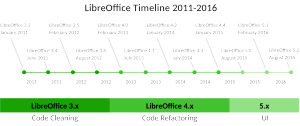
 LibreOffice has a time-based release schedule (https://wiki.documentfoundation.org/ReleasePlan), with a major announcement every six months: early February, and early August. A time-based release schedule is predictable, and as such makes it easier to plan large deployments and subsequent updates.
On the other hand, a major announcement every six months translates to a “project that never sleeps”. In fact, you start thinking about the next major release a few weeks after the previous one is over.
In advance of every release, we listen to end users about requested features and changes requested to support the individual workflow. We do not only listen but iteratively present proposals in order to create a user experience that is in alignment with our long-term vision of being the best free office suite, easy for beginners and powerful for experts.
 Let’s take the just-released LibreOffice 5.2 as an example of the many activities which have been carried out during five full months – from early March to early August – by several members of the team, and a very large number of community members in every geography.
LibreOffice is available in a large number of native languages (actually, it is the office suite available in the largest number of native languages), thanks to the localization activity carried out by volunteers in many geographies. This activity is extremely important, but is one of the less known, as many of the people involved are more interested in getting the work done than in raising their visibility inside the project.
In early March, the development team consolidates the release plan (https://wiki.documentfoundation.org/ReleasePlan/5.2), and the marketing team sets the release date according to industry events or major software announcements. Of course, the release date might need last minute changes, as in 2015, when the launch of LibreOffice 5.0 was shifted because of the announcement of Windows 10.
From that point on, developers work on finalizing new features, which are usually described in the release notes on the wiki (https://wiki.documentfoundation.org/ReleaseNotes/5.2). Based on that page, and on other sources of information within the project, the marketing team starts to brainstorm about the messaging.
LibreOffice 5.2 has been a rather nice example of successful messaging, as many significant articles on popular media underlined the enterprise focus based on a few specific features like document classification and new Calc financial forecasting functions.
 At the same time, the Quality Assurance team – with volunteers active in many geographies on many different language version of the office suite – start testing nightly builds to discover bugs and regressions over previous LibreOffice releases. As soon as Alphas and Betas are available, Quality Assurance volunteers organize global bug hunting sessions (https://wiki.documentfoundation.org/BugHunting_Session_5.2.0_Alpha).
Bug hunting sessions are one or two day “virtual” events, where Quality Assurance volunteers provide their expert support to less skilled users, to help them file reports about bugs and regressions. Although they may look boring on paper, they are usually rather engaging, as most people involved get the distinctive feeling of contributing in a significant way to the success of the new LibreOffice major release.
Bug hunting sessions are usually announced in advance on this blog. Stay tuned for the next one, to test the first Beta of LibreOffice 5.3.
Alphas and Betas are extremely important for the marketing team, too. In fact, they are used to test new features, and to understand their relevance for the upcoming announcement. In some cases, as for the classification feature, the team gathers additional information, to add a background document to the press kit.
When the first Release Candidate is announced, around six weeks before the launch date, most of the back office activities have been completed. At that time, the different teams start to concentrate on the final details, to be ready for the new major release.
Localizers have already completed their activity, and committed all translated strings into the Pootle translation system. Quality Assurance experts are focusing their attention on bugs and regressions which might impact on the release, with the help of developers who are refining new features while getting rid of the last “wrinkles” in the source code.
The marketing team defines the announcement strategy, and the media relations activities for the week prior to the announcement. According to the media angle, they develop a couple of different mailing lists: a smaller one for press briefings where recipients are sent individual messages, and a large one for press releases. In addition, country-specific mailing lists are used for press releases in native languages.
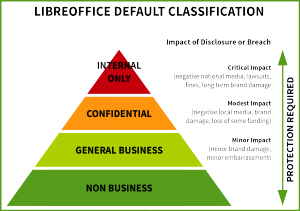 At the same time, the launch documents go from draft to final: a press release, a technical backgrounder for the classification feature, the image visually explaining classification levels, an infographics for the top feature list, and a slide deck which is going to be used for press briefings.
The last steps are coordinated by team members: release management prepares the builds and loads them on the mirrors, in time for the launch, while marketing hosts the phone press briefings with journalists (with the participation of board members, who provide statements about the new release).
On the launch date, release management switches the links on the download page, while marketing publishes the blog post and sends out the email to TDF members and announce mailing lists (https://blog.documentfoundation.org/blog/2016/08/03/libreoffice-5-2-fresh-released-for-windows-mac-os-and-gnulinux/). In addition, it handles the distribution of press releases in English, and in many other native language translations provided by community volunteers, by using the free open source PHPList.
Each LibreOffice major release is a real team effort, which is possible thanks to the contribution of many people around the world.
Last, but not least, we should not forget companies sitting in the Advisory Board (http://www.documentfoundation.org/governance/advisory-board/), which are supporting the global development effort by employing a large number of full time hackers. In addition, a couple of these companies provide a Long Term Supported version of LibreOffice (at the moment, based on the LibreOffice 5.1 family).

 The board declares the following Members of The Document Foundation elected into the Membership Committee:
 Brno, September 7, 2016 – The Document Foundation (TDF) has celebrated the opening session of LibOCon with the announcement of LibreOffice 5.2.1, the first minor release of the LibreOffice 5.2 family.
 Xisco Fauli, a Spanish LibreOffice developer working in Madrid as a Quality Assurance (QA) specialist, will be a consultant for The Document Foundation effective from September 1st, as QA Engineer.