Linguistic challenges, women’s participation in FOSS, interoperability, professional training, migration, scripting and much more were hot topics in the conference held at the Facultad Politecnica of the Universidad Nacional de Asunción, Paraguay.
By Daniel A. Rodriguez.
The event started internally on Thursday 18 with a translation sprint of the LibreOffice Guarani team, with the assistance of Olivier Hallot (Brazil), LibreOffice volunteer translator for Brazilian Portuguese.
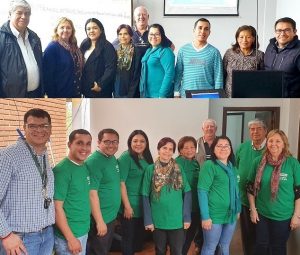
The Conference opened to public on Friday 19 in a ceremony that gathered the Minister of the Secretariat of Linguistic Policies (SPL), Ladislaa Alcaraz de Silvero, Prof. Limpia Ferreira Ortiz, FP-UNA Vice-Dean, members of the Guaraní Culture Atheneum, Prof. Mag. Alcides Torres Gutt, Coordinator of the Translation Team together with Italo Vignoli and Gustavo Pacheco representing The Document Foundation and the LibreOffice Community.
“The LibreOffice Latin American Conference is an event not only of technology, it is also a space for the study of new forms of productive organization. It will deal with technical topics such as development and quality control, but also with successful cases of migration and, with special attention, the translation into Guaraní, native of the American continent and official in Paraguay,” said the Vice-dean in her inaugural speech.
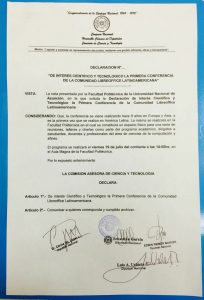
The conference initiative was declared of “Scientific and Technological Interest” by the Honorable Chamber of Deputies of Paraguay.
This regional conferences were carried out for 8 years in Europe and other continents, and for this time Paraguay was chosen as the venue, because it has a vibrant Free Software community, a special interest for the Guaraní language, and was completely organized by volunteers. Talks and workshops were held by speakers, members of the LibreOffice community, from Italy, Spain, Mexico, Costa Rica, Bolivia, Chile, Brazil, Argentina and Paraguay, from Thursday 18 to Saturday 20 of July at the Polytechnic Faculty of the National University of Asuncion in San Lorenzo campus.
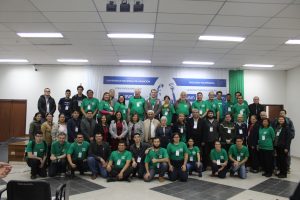
The first presentations covered the Hispanic community, the reality of the companies linked to the FLOSS in Paraguay and the difficulties faced by women workforce in the technological field. An official photo of the participants followed.
Starting the afternoon Henry Castro (Bolivia) talked on the development and technical challenges of LibreOffice Online. He was followed by José Gattica (Chile) talk on “Migration to LibreOffice in a vulnerable school”. Simultaneously, Mauricio Baeza (Mexico) gave the workshop on macros in the computer lab.
Xiomara Céspedes talked about the migration to LibreOffice and open document formats at the University of Costa Rica. She was followed by Renato Barsotti (Argentina) experience of the Faculty of Economics of the National University of Misiones (UnaM).
The next day morning, Olivier Hallot (Brazil) shared with the attendees the details about the importance of documenting the software. Simultaneously, Klaibson Ribeiro (Brazil) conducted the Calc workshop.
Italo Vignoli (Italy) talked about the characteristics of the LibreOffice community on a global scale, presenting graphs and figures to support the features and trends of the people involved in LibreOffice. He was followed after lunch by Xisco Fauli (Spain) on LibreOffice Development and Quality Control. At the same time, the certification team reviewed and approved the application of Rute Solipa (Portugal) for Professional Instructor and Xiomara Céspedes (Costa Rica) as Certified Migration Consultant in a video call session with Lothar Becker (Germany), Italo Vignoli and Gustavo Pacheco.
Italo Vignoli returned to give two presentations, the first one explaining the certification policy of The Document Foundation and the second one addressing the importance of adopting and using open documents formats such as the ODF standard.
The conference ended with the testimony of the participating students and the general public about the personal gains from the themes and knowledge presented at the conference and, in particular, the individual commitment to create a genuinely Paraguayan LibreOffice community and focus on LibreOffice translated into Guarani.