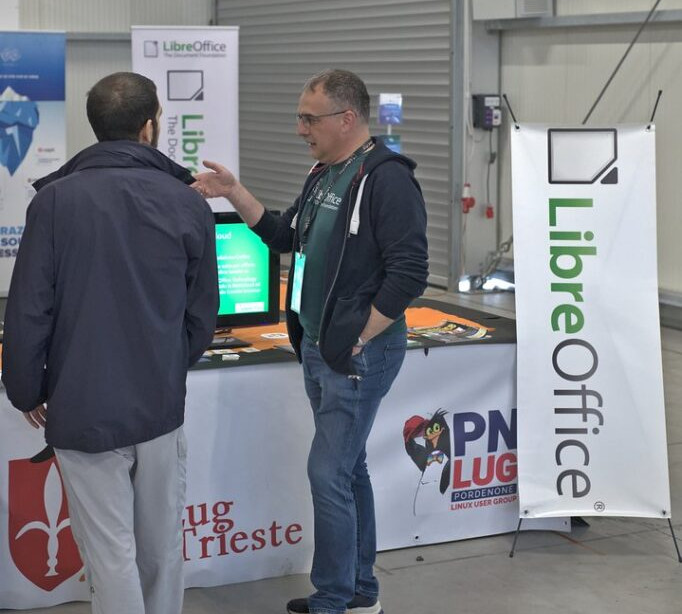
LibreOffice Asia Conference 2024 pre-party!
The LibreOffice Asia Conference 2024 starts tomorrow in Taipei! First was the pre-party, and then the event begins…


The LibreOffice Asia Conference 2024 starts tomorrow in Taipei! First was the pre-party, and then the event begins…


Here’s our summary of updates, events and activities in the LibreOffice project in the last four weeks – click the links to learn more…


(This is part of The Document Foundation’s Annual Report for 2023 – we’ll post the full version here soon.)
During the year, Tigran Zargaryan worked on a translation of LibreOffice into Armenian, and in January 2024 he announced the results of his work:
“With great pleasure, I’m informing that the Armenian localisation of LibreOffice is complete, and this is an especially significant event for Armenian community members worldwide, who are using various office suites in their daily work and – due to lack of Armenian user interface translations – are facing language difficulties.”
He added:
“I hope that the presence of the Armenian language interface translation will be of great support especially in schools, educational institutions and state organisations. In general, many state-based entities are financed by tax payers, and the presence of such a suite will ease their life, as they will legally be able to use office products without copyright infringement, and for them a totally new world of Free/Open Source Software (FOSS) philosophy will be introduced.”
There were two events in Bangladesh: the Open Tech Talk at UITS in Dhaka, and Software Freedom Day 2023 Bangladesh event in MBSTU, Tangail. Meanwhile, community members assisted users in their native language Telegram groups.
Bulgarian speakers continued to maintain their translation of LibreOffice’s user interface at 100%, and the Help content at 95%.
Throughout 2023, the Czech community maintained its translation of LibreOffice’s user interface, keeping it at 100% complete, and the Help content at around 95%. They presented LibreOffice at a booth at the LinuxDays event in Prague in October, and published user guides in the Czech language in the LibreOffice Bookshelf (including their migration to HTML format). These included the Draw Guide 7.4, Base Guide 7.3, Calc Guide 7.4 and Impress Guide 7.5.
In addition, community members added support for Czech decimals to the Numbertext library, supported end users on the Czech “Ask LibreOffice” site, and maintained social media accounts on X (Twitter), Facebook and Instagram.

Throughout 2023, the Dutch-speaking community helped to support LibreOffice users by answering questions on the “Ask LibreOffice” website and mailing lists.
They set up a stand at the NLLGG in November – a conference of the Dutch Linux community. There, LibreOffice users could obtain information and ask questions about the software, whether or not in conjunction with a Linux-based operating system.
Community members also worked on maintaining the Dutch LibreOffice website, and translated and published handbooks: the Writer Guide for LibreOffice 7.5 (translated and published in February); the Math Guide for LibreOffice 7.5 (translated and published in June) the Draw Guide for LibreOffice 7.5 (translated and published in August); and he Impress Guide for LibreOffice 7.6 (translated and published in November).
Translators, using TDF’s Weblate instance, managed to keep up with changes in LibreOffice’s user interface, maintaining the 100% translated status. They added:
“Translating the Help content is a lot of work for a small group of volunteers. Although the Help keeps growing, we were able to maintain it at 100% translated.”
By the end of the year, the Esperanto translators had achieved the following levels of completion: user interface 99%, LibreOffice Online 100%, Impress Remote 100%, LibreOffice Help 37%, and the website 100%.
The Finnish-speaking community worked primarily on translating LibreOffice’s user interface, and to a lesser extent, the Help content.
In 2023, French contributors maintained translations on Weblate at almost 100% for all versions of LibreOffice, and progressed with translations of Calc functions on TDF’s wiki. They took part in two events, Capitole du Libre (Toulouse) and Open Source Experience (Paris), and held several online meetings with other community members. Finally, they made contributions to code, QA, marketing, documentation and Ask LibreOffice.
In Weblate, the translation of LibreOffice’s user interface reached 99% completeness, and the Help content 96%. There was user support by answering questions via Ask LibreOffice and mailing lists, while community members worked on translating release notes for new major LibreOffice releases, publishing videos, and working on translations of handbooks.
The Indonesian community organised a two-day “LibreOffice Conference Asia 2023” event in Surakarta, and posted a summary on this blog.
Regarding community activities, members worked on engaging and encouraging new contributors to work on videos showcasing the new features in LibreOffice.

Thanks to the efforts of the Italian community, the translation of LibreOffice’s user interface and online Help content reached 100%. Together with other communities, they started a pilot project to translate the Getting Started Guide via Weblate. In addition, they organised several activities and events during Linux Day 2023.
In terms of events, the Japanese community organised its local annual conference, LibreOffice Kaigi 2023 Online. There were three online study parties in which users shared knowledge and interacted with one another, along with 49 online hackfests, where participants worked together to make progress on tasks and transfer skills. There were also 10 “LibreOffice day” events – in-person events in Awaji, Osaka City. They were held jointly with Open Awaji, a group themed around open data and a movement towards open cities.
Japanese community members attended five open source conferences and had booths (in Tokyo, Nagoya, Hiroshima, Fukuoka and again in Tokyo). There was the Kansai Open Forum 2023, an event for open source and IT communities in the Kansai region that has been held annually since 2002. Additionally, Japanese community members participated in the LibreOffice Conference Asia 2023 and COSCUP (a comprehensive open source event in Taiwan).
Apart from events, community members worked on “how-to” videos and uploaded them to YouTube, and worked on translations of LibreOffice’s user interface into Japanese (93% complete) and the Help content (49% complete). They translated complete handbooks (the Writer Guide 7.5 and Calc Guide 7.5) and one community member, Meguro-san, translated using TexTra, a machine translation service provided by NICT, a Japanese government research institute.
There was also work on Ask LibreOffice, with 85 questions or comments added, and on the blog (19 articles posted). In terms of social media activity, the Japanese X (Twitter) account had 2,941 followers, 63 posts, 58,000 impressions and an engagement rate of 5.9%. The Facebook page had 22 posts and 625 followers.
In 2023, work continued on the Kazakh translation of LibreOffice’s user interface.
Work continued on translation of LibreOffice’s user interface, and the community promoted LibreOffice at the Ubuntu Korea 2023 event.
Locale data was added for Morisyen, the creole language used in the Republic of Mauritius (Islands of Mauritius, Rodrigues, Agalega and Archipelago of Chagos including Diego Garcia). The document language in LibreOffice can therefore be defined as such. There was input by Jean-Yves Dick and Ragini Kistnasamy from Ledikasyon pu Travayer (LPT) association, and Eike Rathke from the LibreOffice community.
Then there was work on an extension: the implementation of a unified spell-checker for use when writing in Morisyen. The extension includes 26,000 words and an AFF file, both works-in-progress.
Suraj Bhattarai, LibreOffice’s liaison in the Nepali community, mentored around 60 students from different universities and he connected a few more open-source communities in Nepal. They were able to localize around 10,000 strings in two weeks.
Suraj, along with the Kathmandu University Open Source club, organised a localisation camp during Software Freedom Day, and more than 53 students joined. They also organised an online course on called “localisation 101”, in which 11 students joined for two months, every Sunday from 21:00 – 22:00 Nepal time. Suraj shared with participants the concepts of localisation, internationalisation and the importance of style guides, terminologies, glossary, tools used, computer-aided translation and Weblate.

Community members reported various issues with RTL/CTL (right-to-left and complex text layout languages) on TDF’s Bugzilla instance, and worked with TDF’s RTL/CTL developer to test and verify fixes. They considered many fixed issues with justified Persian text, and received very good feedback.
Fixing rendering issues remain the most important goal. In terms of localization, most of the work on translating LibreOffice’s user interface was from three contributors. Another worked on an AI assistant extension that works with ChatGPT. Finally, there were various posts on local websites and the Persian Telegram group, along with supports to end users.
The highlight of 2023 was the Latin America LibreOffice Conference, held in the Ciudad de México, Mexico. Community members also participated in the esLibre 2023 conference (an annual free software and hardware event), with two talks and three workshops.
Work continued on the translation of LibreOffice’s user interface (99%) and Help content (87%), while 20 articles were published on the Spanish blog. Then the Spanish version of Getting Started Guide 7.3 was published in Open Document and PDF formats, while two previous guides were published as HTML.
Community members provided user support in the Telegram channel (bridged with Mastodon), which has over 1,400 subscribers, while support for users writing Python macros continued on Mastodon. There was also a new iteration of the university program “Servicio Social para la Documentación de LibreOffice en español”. Participants published three magazines and collaborated on LibreOffice’s user interface translations.

Work continued on translation of LibreOffice’s user interface, which was maintained at 99% complete.
Throughout the year, the Ukrainian team translated over 1,600 strings in LibreOffice’s “UI-Master” project, reaching overall 99% completeness. They also reached 51% completeness in the “Help-Master” project.
We at The Document Foundation would like to say a huge thank you to everyone who in the native language communities. Your work makes LibreOffice accessible to hundreds of millions of people around the world, and your passion is wonderful. Thank you!

(This is part of The Document Foundation’s Annual Report for 2023 – we’ll post the full version here soon.)
Based on LibreOffice’s Human Interface Guidelines (HIG), during 2023 there were various improvements to LibreOffice’s user interface.
Support for dark and high contrast operating system themes on Windows, macOS and Linux were greatly improved. More than 40 bugs were fixed by contributors including Caolán McNamara (Red Hat), Rafael Lima, Michael Weghorn (TDF) and Rizal Muttaqin.
In addition, Maxim Monastirsky implemented an improved version of the single toolbar user interface, supporting context-aware controls and their customization. It can be activated via View > User Interface > Single Toolbar. Finally, Heiko Tietze (TDF) updated the Start Center so that it can filter recent documents by type.
Andreas Heinisch worked on the recent documents picklist under File > Recent Documents; it now shows the five most recent module-specific items first. The list can be configured using the “ShowCurrentModuleOnly” expert option to show only files that can be handled by the current LibreOffice module.
Andreas also made it possible for documents in the Start Center to be pinned, to show them at the beginning of the recently opened document list. To pin a document, users can hover the corresponding document and click on the pin icon in the top-left corner. The selected document is then shown in a separate line at the beginning of the list, along with already pinned documents.

Heiko Tietze (TDF) did further work on the colour schemes: sets of “Automatic” application colours can now be chosen independently from the Application Color scheme in Tools > Options > LibreOffice > Application Colors.
Lastly, Michael Weghorn (TDF) improved keyboard navigation for the Special Characters dialog box.
Berlin, 11 July 2024 – LibreOffice 24.2.5 Community, the fifth minor release of the free, volunteer-supported office productivity suite for office environments and individuals, the best choice for privacy-conscious users and digital sovereignty, is available at www.libreoffice.org/download for Windows, macOS and Linux.
The release includes more than 70 bug and regression fixes over LibreOffice 24.2.4 [1] to improve the stability and robustness of the software, as well as interoperability with legacy and proprietary document formats. LibreOffice 24.2.5 Community is the most advanced version of the office suite and is aimed at power users but can be used safely in other environments.
LibreOffice is the only office suite with a feature set comparable to the market leader. It also offers a range of interface options to suit all users, from traditional to modern Microsoft Office-style, and makes the most of different screen form factors by optimising the space available on the desktop to put the maximum number of features just a click or two away.
LibreOffice for Enterprises
For enterprise-class deployments, TDF strongly recommends the LibreOffice Enterprise family of applications from ecosystem partners – for desktop, mobile and cloud – with a range of dedicated value-added features, long term support and other benefits such as SLAs: www.libreoffice.org/download/libreoffice-in-business/
Every line of code developed by ecosystem companies for enterprise customers is shared with the community on the master code repository and contributes to the improvement of the LibreOffice Technology platform. All products based on that platform share the same approach, optimised for the privacy-conscious user.
Availability of LibreOffice 24.2.5 Community
LibreOffice 24.2.5 Community is available at www.libreoffice.org/download/. Minimum requirements for proprietary operating systems are Microsoft Windows 7 SP1 and Apple macOS 10.15. Products based on LibreOffice Technology for Android and iOS are listed here: www.libreoffice.org/download/android-and-ios/
For users who don’t need the latest features and prefer a version that has undergone more testing and bug fixing, The Document Foundation maintains a version with some months of back-ported fixes. The current release has reached the end of life, so users should update to LibreOffice 24.2.5 when the new major release LibreOffice 24.8 becomes available in August.
The Document Foundation does not provide technical support for users, although they can get it from volunteers on user mailing lists and the Ask LibreOffice website: ask.libreoffice.org
LibreOffice users, free software advocates and community members can support the Document Foundation by making a donation at www.libreoffice.org/donate
[1] Fixes in RC1: wiki.documentfoundation.org/Releases/24.2.5/RC1. Fixes in RC2: wiki.documentfoundation.org/Releases/24.2.5/RC2.

(This is part of The Document Foundation’s Annual Report for 2023 – we’ll post the full version here soon.)
The Document Foundation website provides general information about the foundation (overview, statutes, code of conduct, financials and reports) and its governance (board of directors, membership committee, members, advisory board, and engineering steering committee), and about LibreOffice certification, including a list of certified developers, and professionals for migrations and trainings.
In 2022, we launched a new version of documentfoundation.org, using the Hugo website building framework. In 2023 we worked on updates to this site, refining the design and keeping content about the foundation’s various bodies up-to-date.
During 2023, the foundation’s website was visited 107,558 times, with 143,731 page views, a slight reduction in both statistics from 2022. Continent-wise, the largest chunk of visits were from Europe (49%), followed by North America (30-%) and Asia (15%). And for operating systems: the most visits were from PCs using the Windows (61%) operating system, followed by GNU/Linux (13%, a 3% gain from 2022) and macOS (8%), while for browsers: Chrome had 41%, followed by Firefox (16%) and Microsoft Edge (14%).
This image shows weekly visits to documentfoundation.org, throughout 2023:

The LibreOffice website provides information about the office suite and the document format, the various download options, how to get help, how to contribute to the project, events where users can get to know the LibreOffice community, and how to make a donation to support the project and the community.
In 2023, we continued to make improvements and tweaks to the website, updating the timeline that shows events, activities and new releases of LibreOffice. We also worked on updates to the “Discover” and “New features” sections of the site, to reflect new versions of the software.
During 2023, the English-language LibreOffice website was visited 19,176,691 times (a 0.8% gain over 2022), with 46,011,840 page views (a -1.1% drop). Most visits were from Europe (52%), followed by Asia (18%), North America (15%) and South America (10%), from PCs using the Windows operating system (82%), followed by macOS (5%) and Linux (2.5%). Regarding web browsers, Chrome was the most popular (43%), followed by Microsoft Edge (28%) and Firefox (13%).
This image shows weekly visits to www.libreoffice.org, throughout 2023:

TDF’s blogs are essential for communicating activities inside and around the project, including new releases of LibreOffice, community events and support for other free and open source initiatives. In 2023, we used them to post regular interviews with community members and provide updates from team members about documentation, marketing, QA, design and more.
Blogs were also maintained by various native language communities including Japanese, French, Spanish, German and others. Thanks to the hard work of community members, we had press releases, tips and other articles translated into many languages, and picked up by local media organisations.
These native language blogs complement the information provided by the main blog in English, and by the two blogs managed by members of the design and the quality assurance projects, which provide updates about activities for the upcoming major releases.
In 2023, the English-language blog had 151,352 visits and 196,287 page views. The press releases for LibreOffice 7.5 and 7.6 were the most popular posts, followed by posts for minor bugfix releases.