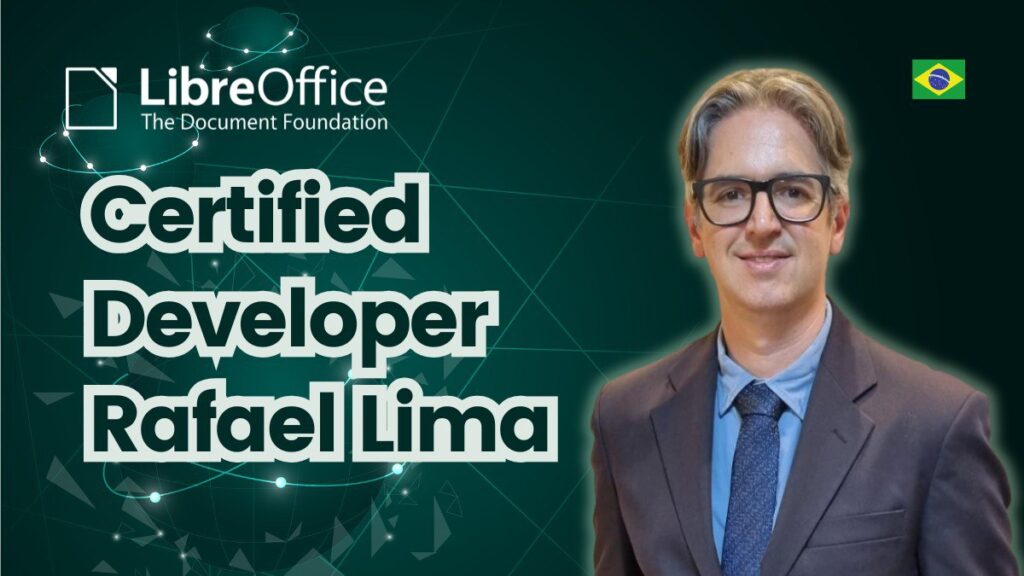
Interview with Newly Certified LibreOffice Developer Rafael Lima

The LibreOffice Engineering Steering Committee (ESC) has appointed Prof. Rafael Henrique Palma Lima, from Federal Technological University of Paraná (UTFPr) as the newest certified LibreOffice developer.

Prof. Lima has been contributing new code to LibreOffice since 2020, and the committee has attested to the quality and value of his contributions to LibreOffice for this certification. We interviewed Prof. Lima, who tells us about the process and what areas of the code he works on.
(more…)

Host the LibreOffice Conference 2025 in your location!

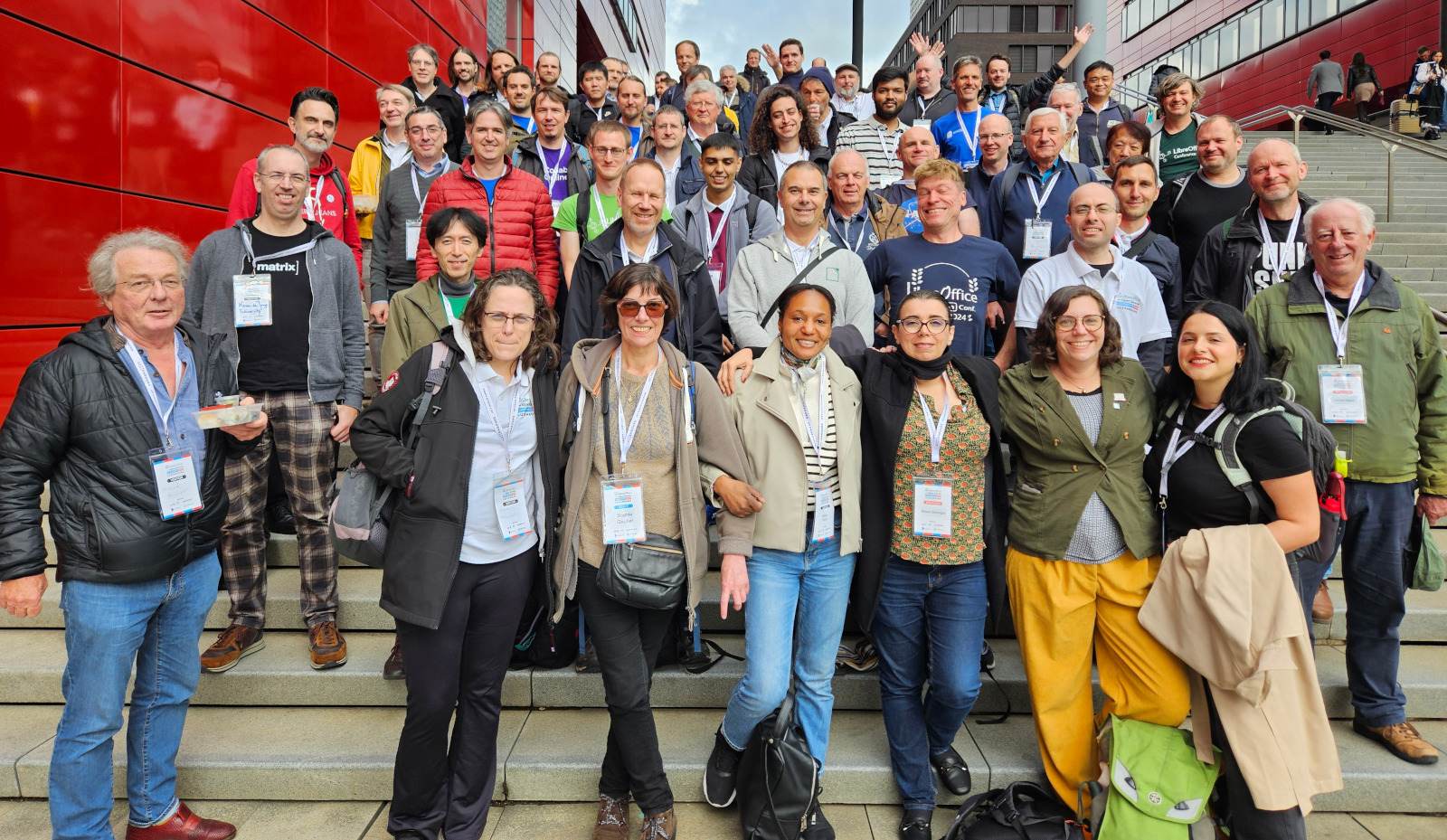
LibreOffice Conference 2024 group photo
LibreOffice Conference 2024 (Luxembourg) group photo

Once a year, the LibreOffice community gathers for a global community event: the LibreOffice Conference. After a series of successful events – Paris, Berlin, Milan, Bern, Aarhus, Brno, Rome, Tirana, Almeria, two events online, Milan again, and Bucharest – it was held in Luxembourg in 2024. And we had a great time!

The conference usually takes place between September and November, with a preference for September.

Now we’re looking for locations for 2025! Organising the conference is a great way to gain experience running events and managing communities, so if you’re interested, please let us know.

The deadline for sending in proposals is February 28. After receiving the applications, we will evaluate if all pre-conditions have been met and the overall content of the proposal, and give all applicants a chance to answer questions and clarify details if needed.

What applicants need to know

Several team members are needed and getting closer to the event, it tends to become a time-consuming job, and each member of the team should be able to devote as much time as necessary. Also, dealing with finances and sponsors is a specific responsibility of local conference organizers. Although TDF will provide a list of sponsors and ease the process, the team must be able to manage the budget according to the amount of sponsorships, and commit expenses based on the resulting amount of money.

In the past, we have received applications from several third parties, including casinos or professional event managers. Keep in mind that the LibreOffice Conference is a community event, by the community for the community. While we appreciate the interest of people with professional background, proposals not supported and driven by community members (not only TDF members) will not be considered as valid.
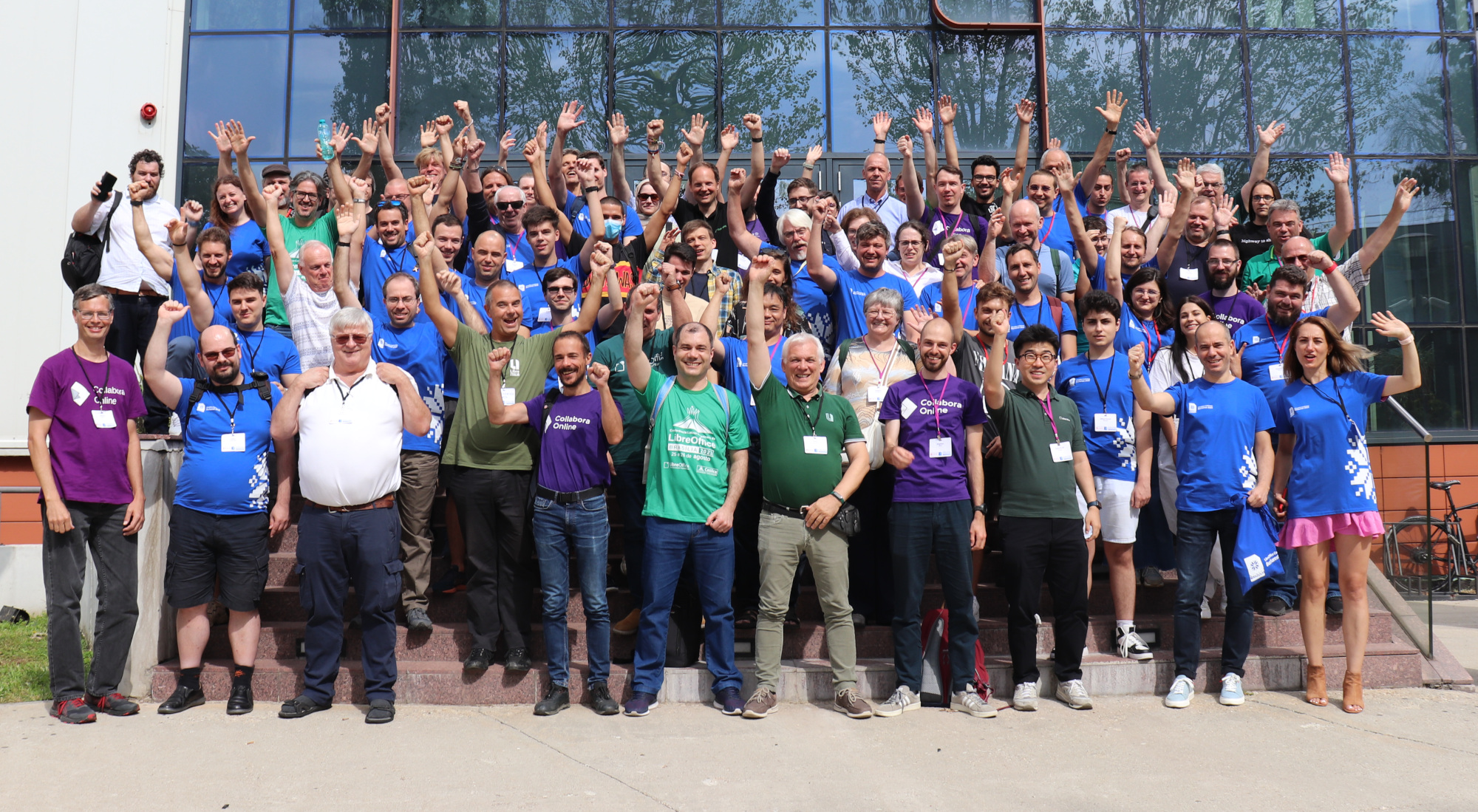
LibreOffice Conference 2023 group photo
LibreOffice Conference 2023 (Bucharest) group photo

What must be covered by the proposal

IMPORTANT: Proposals missing the following information might be considered incomplete. While we try to give every applicant a chance to add or clarify missing information, there is no guarantee that the proposal will be accepted, since we have a rather short time frame. In order to enhance the chances for your proposal to be accepted, please answer as many of the following questions as possible.

The team

Only proposals with a fair amount of team members who are able to dedicate time and are part of the LibreOffice community will be considered as valid. Based on our experience, at least five team members are required, and those team members need to interact and communicate with the community. Please name all the team members, their role in the community, and their availability in term of time (especially during the month prior to the conference).

At least one team member should be working exclusively on sponsor relations, and on managing invitations for VISAs (as required for many countries). Both of these tasks require a fair amount of time, and are crucial to the organization. Based on our experience, at least a few dozen VISA requests, if not more, need to be dealt with, and you need between € 10.000 and € 20.000 in sponsorship fees. Please let us know if you have at least one team member willing to work on these topics.

The organizing entity

The Document Foundation itself will not be legally or financially responsible for organizing the event. Although it will support the organization of the conference by any possible means, it is necessary to have a local entity, an enterprise or preferably a non-profit, to take care of financial and legal requirements such as insurances and signing contractual obligations.

Another important reason for a local entity is the fact that VISA invitation letters can usually be issued only by a local entity from within the country. Please give details on the organization, its type and its leadership.

The main venue

The venue should be easily accessible from other countries, so ideally, an airport and a central train station are nearby. It should also have a good connection to the local public transportation. Please give details on the venue, its location, and its connection to public transportation.

Ideally, there is just one venue for all conference sessions. In case you distribute the conference among two venues, they should be reachable by public transportation or foot in no more than 10 minutes. Please let us know in case you plan for more than one venue (with the exception of parties and receptions).

The main venue should be partially wheelchair-accessible, with at least the opening/closing sessions and main track room fulfilling this requirement. Please let us know how accessible is the venue.
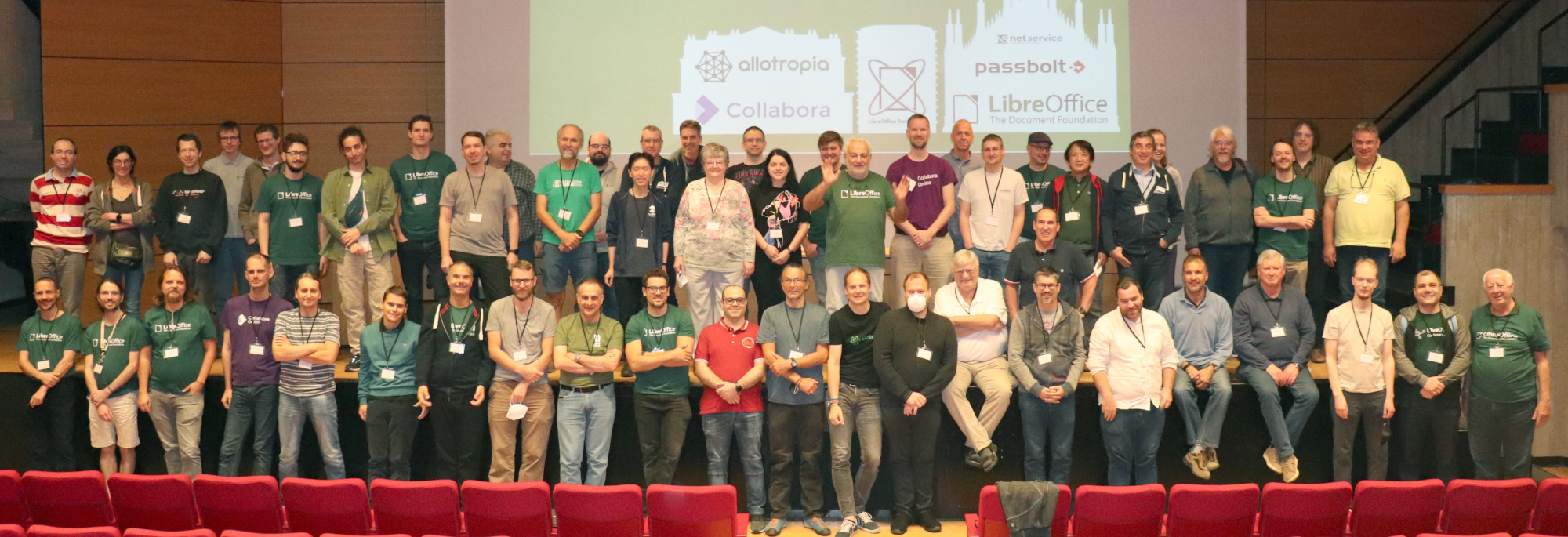
LibreOffice Conference 2022 group photo
LibreOffice Conference 2022 (Milan) group photo

The conference itself is on 3 days, but their is an extra day before the conference dedicated to community meetings, which should be taken into account into the proposal.

Also let us know if there are defibrillators available at the venue and if your team has basic life support/first aid knowledge.

Providing canvas, projectors and rooms for two to five parallel tracks, for a total of approximately 200 participants, is also required. Please let us know if your venue fulfils these requirements.

Alongside the presentations, there is often the need to have private meetings. For sure, there are a TDF Board of Directors meeting, a Membership Committee meeting and a TDF Team meeting, so at least two additional rooms are required one day before and one day after the conference. These meeting rooms can also be in a different location from the main conference venue. Please let us know if you can provide these meeting rooms.

And along with the conference rooms, there should also be an open space for community gatherings. Please let us know if you can provide such a space.

A publicly accessible, free wireless Internet connection is required. If the venue itself does not provide WiFi, an alternative is represented by broadband 3G/4G wireless routers.

We should also know in advance if there are firewall restrictions in place that limit or forbid the access to services like SSH, Gerrit, Git and others (including e-mail), and whether we can provide a TDF VPN to overcome such limitations. Please let us know which kind of wireless Internet connectivity will be provided to conference attendees.

Having video archives or video live streams is not a must-have, but a nice-to-have. Please let us know if you plan video archives or live streams of the presentations.

Also, if at least one of the social events will be in a wheelchair-accessible location, this will be highly appreciated and will be absolutely wonderful.
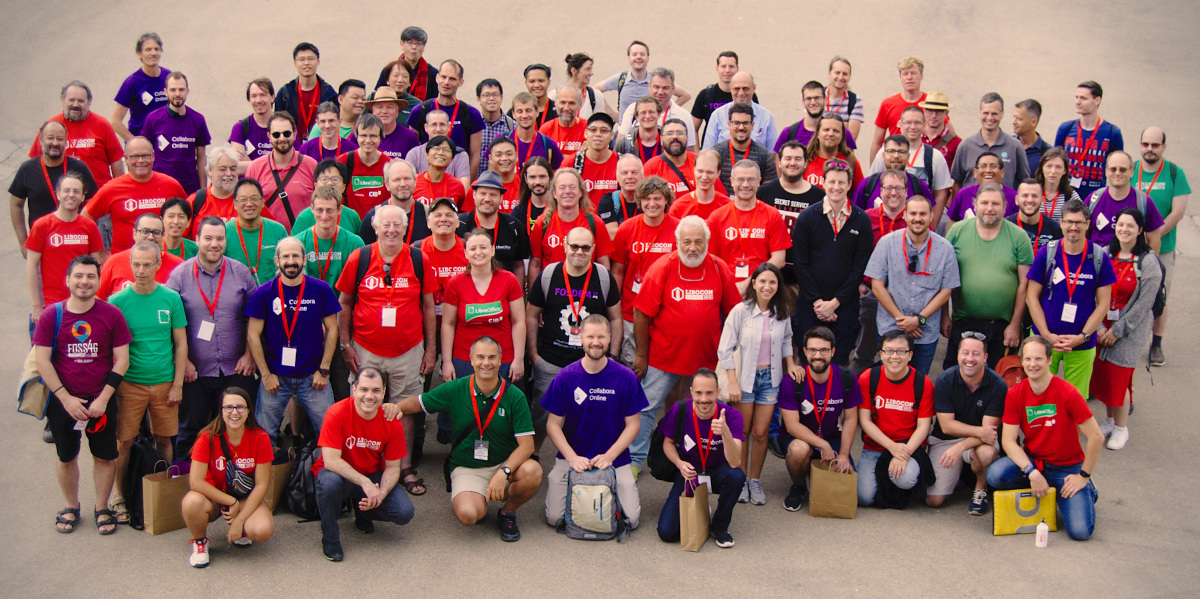
LibreOffice Conference 2019 group photo
LibreOffice Conference 2019 (Almeria) group photo

Accommodation

Since we expect around 200 visitors, the availability of three/four stars hotel rooms or equivalent accommodations (B&B, or similar) is required. Please elaborate on the hotel offerings near the venue.

Offering couch surfing, motels, youth hostels or other means of free to cheap accommodation is a nice-to-have. Please let us know if such accommodations are available at your venue.

One more thing…

Please describe in your own words why you want to host the next LibreOffice Conference, what motivates you, and what you expect from organizing the event.

Other information

Please write anything else that can support your application, like

  • Adoption of free open source software and open document standards in your country/region
  • FOSS support by national/local government bodies, or other organizations, enterprises, user groups
  • Cultural and/or IT related events close to the conference (parallel events are not a problem, if they do not distract participants from the LibreOffice Conference)
  • Potential conference sponsors, and the sponsorship size if it is already confirmed
  • Parties and receptions that are already planned, also in partnership with other local organizations
  • Anything else…

Providing child care would be a nice addition to the application, as there are participants with children who might be encouraged to participate if the service is available.

You may find useful information on the dedicated pad for conference management.

How to apply

Please send your proposal as plain text e-mail, or HTML e-mail, or Open Document File to info@documentfoundation.org. Please write only in English. We will send a confirmation of your application no later than one week after we have received your proposal. If you have not heard back from us by then, please let us know.

Again, the deadline is February, 28 2025 24:00 UTC

Thank you for your interest in hosting our conference! 😊

Interview: Jonathan Clark, team member, developer focusing on RTL / CTL / CJK

Hello Jonathan, you have been hired by The Document Foundation in the role of developer focusing on the issues of languages written from right to left, or RTL (Right to Left).

Not only RTL topics – also CTL (Complex Text Layout), and CJK (Chinese-Japanese-Korean). I wanted to point this out, first for the interest of those communities, and second because I feel strongly about the scope The Document Foundation has chosen for this role.

In order to have great language support, I think you need to have two different kinds of people working together: those who can speak to the incredible depth of specific languages and the unique needs of the people who use them; and generalists who can, in the limit, think about all languages, and thus avoid oversights that will prove costly in the long term. I see this role as much closer to the latter than to the former.

Let’s start with a short biography: your origins, your studies, your professional experiences.

My origin is the Canadian wilderness. My parents introduced me to PC games when I was young, and I was instantly and insatiably curious about how they worked. I learned C++, and that eventually led to an undergraduate degree in Computing Science from the University of Alberta.

Most of my professional experience has been working on commercial C++ software quality tools, both as an individual contributor and by providing technical leadership.

For the past few years, I’ve been doing a deep dive on modern game engine technologies as a passion project. Among many other topics, this included real-time text layout and hardware-accelerated text rasterization.

When and how did you approach open source software?

As a user, I can’t remember a time when I didn’t use open source software in one way or another. I’ve never felt comfortable trusting closed-source software for anything important, and that discomfort has only grown over time as business practices change.

As a developer, I’m a bit of a hypocrite – other than a few small projects, I haven’t contributed much. However, speaking both normatively and from experience, I firmly believe that the only way to deliver quality software is with the transparency and accountability of open source.

Why did you decide to respond to The Document Foundation’s job search?

I think it’s important. I want to help people use open source software to work and create in their own language.

There are other reasons, too: I’m a long-time user, interested in linguistics, and my background seemed like a good fit for the role. But the most important thing to me is that I can believe in the mission.

What is your experience as a developer, and why do you think you can contribute significantly to LibreOffice?

As an individual contributor, I’ve been using C++ for a long time and I’m comfortable with large code bases. I’d never looked at the LibreOffice source code before, but it’s similar to projects I’ve worked on in the past.

Finally, what is your feedback after the first few months in the LibreOffice project?

The main feedback I want to offer is praise for the new contributor outreach effort. Most open source projects seem to treat this as an afterthought, but a lot of work has been put into attracting, guiding, and retaining new LibreOffice contributors. It’s wonderful to see.

It’s also been great to see the passion from the community about improving language support.

Video recap: LibreOffice Conference 2024

Here’s a quick recap of the recent LibreOffice Conference 2024! 😊 (This video is also available on PeerTube.)

We now have the raw video from the rooms too, so will start editing and uploading talks…

Please confirm that you want to play a YouTube video. By accepting, you will be accessing content from YouTube, a service provided by an external third party.

YouTube privacy policy

If you accept this notice, your choice will be saved and the page will refresh.

FOSDEM 2025: LibreOffice Technology DevRoom Call for Papers

FOSDEM 2025 will be only in person, taking place on Saturday, February 1, and Sunday, February 2. LibreOffice Technology DevRoom is scheduled for the morning of Saturday, February 1, from 10AM to 2PM.

IMPORTANT DATES TO REMEMBER

Submission open: 30th October 2024
Submission deadline: 1st December 2024 at 11:59PM CET
Acceptance notifications: 6th December 2024
Final confirmation deadline: 12th December 2024
Final schedule announcement: 15th December 2024
Devroom: 1st February 2025 from 10AM to 2PM

Please note that the submission deadline is managed by the FOSDEM team and not by the devroom managers, which means that after that deadline nothing will be accepted.

We might update this call for papers with further details, as soon as we receive them from FOSDEM organizers. Please check TDF blog and social media channels on a regular basis.

CALL FOR PAPERS

We are inviting proposals for talks about “LibreOffice Technology, a development platform for desktop, mobile and cloud office suites“.

Main topics are LibreOffice development, localization, QA, UX, documentation, extensions, migrations and general advocacy, plus the native document format ODF. Please keep in mind that product pitches are not allowed at FOSDEM.

In order to fit as many presenters as possible in the schedule, the length of talks will be limited to a maximum of 20 minutes, including questions, according to the number of submissions.

TALK SUBMISSIONS

FOSDEM Pretalx system will be open for applications starting from October the 30th, 2024.

To submit a talk, please visit the FOSDEM 2025 Pretalx website: https://pretalx.fosdem.org/fosdem-2025/cfp. Please select “LibreOffice” as the *track* and ensure you include all the requested information when submitting a proposal: the title of the talk, a short abstract (one / two paragraphs), some information about yourself (name, bio and photo, but please do remember that your profile might be already stored in Pretalx).

If you already have a Pretalx account from last year, even if your talk was not accepted, please reuse it. Create an account if, and only if, you don’t have one from a previous year. The system is the same used for LibreOffice Conference, so you should not have issues with Pretalx, but in case you have please contact italo at libreoffice.org for help.

All presentations will be recorded and streamed. Sending your proposal implies giving permission to be recorded.

For accepted talks, speakers will receive an email to confirm that the proposal has been accepted. They may expect additional emails with more instructions, for instance to confirm their travel schedule.

CONTACTS

Italo Vignoli: italo at documentfoundation.org
Michael Meeks: michael.meeks at collabora.com

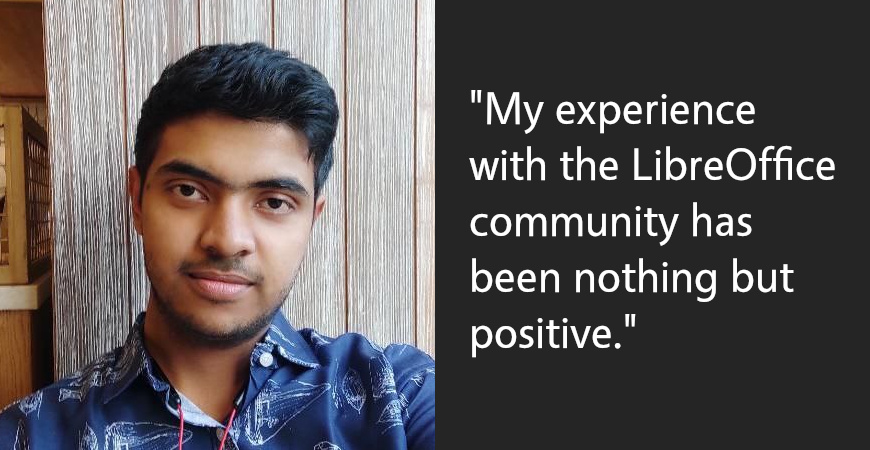
Community Member Monday: Ritobroto Mukherjee

Ritobroto Mukherjee

Tell us a bit about yourself!

I live in Delhi, India, where I’m working my way towards a bachelor’s degree in IT with a focus on network security at Netaji Subhas University of Technology.

My journey into programming began with QBASIC in school, sparking a love for coding. Since then, I’ve explored everything from game development to operating system internals, embedded systems to mobile apps – anything that catches my interest. My hobbies include learning random science-y things, binge-watching sitcoms, and working late nights only to fall asleep in the middle of the next day 😛

Before the Google Summer of Code (GSoC), my open-source experience was mostly limited to personal projects. Now, I’m much more comfortable filing bug reports, submitting patches, and engaging in code reviews. I also feel more confident in discussing problems and solutions with people I consider far more knowledgeable than me.

What are you working on in the LibreOffice project right now?

I recently completed upgrading the .NET Bindings for UNO as part of GSoC 2024.

Currently, I’m on a short hiatus for exams and personal projects, but I’ve been chipping away at the next item on my future work checklist: adding support for in-process bridging, thus enabling LibreOffice extensions to be created with the new .NET Bindings.

Why did you choose to join the project, and how was the experience?

Since switching to Linux a while back, I’ve almost become dependent on the LibreOffice suite to get me through university, having used it for everything from assignments to presentations. The chance to give back to this amazing project, to gain the experience of participating in GSoC, and to tackle a complex .NET and C++ project all at once was too good to pass up.

My experience with the LibreOffice community has been nothing but positive, especially with my mentors, Mr. Hossein Nourikhah and Mr. Thorsten Behrens. Their guidance, paired with the freedom they gave me to make my own decisions on the bindings, was integral to the project’s success.

Anything else you plan to do in the future? What does LibreOffice really need?

I’m planning on continuing the .NET Bindings project. While the core of the bindings was completed in time for GSoC, there’s still more features, documentation, and examples to work on.

Additionally, I believe LibreOffice needs more documentation, especially for legacy code. Much of my GSoC time was spent understanding the existing bindings before I could start work on the new ones. Using what all I’ve figured out, I want to try and help the Docs team document the bindings better. I might also consider working on introducing more languages bindings in the future.

Big thanks to Ritobroto for all his contributions! Everyone is welcome to join our community, build new skills, and help to make LibreOffice even better for the whole world 😊