Welcome Dan Williams, new LibreOffice Developer focusing on UI/UX
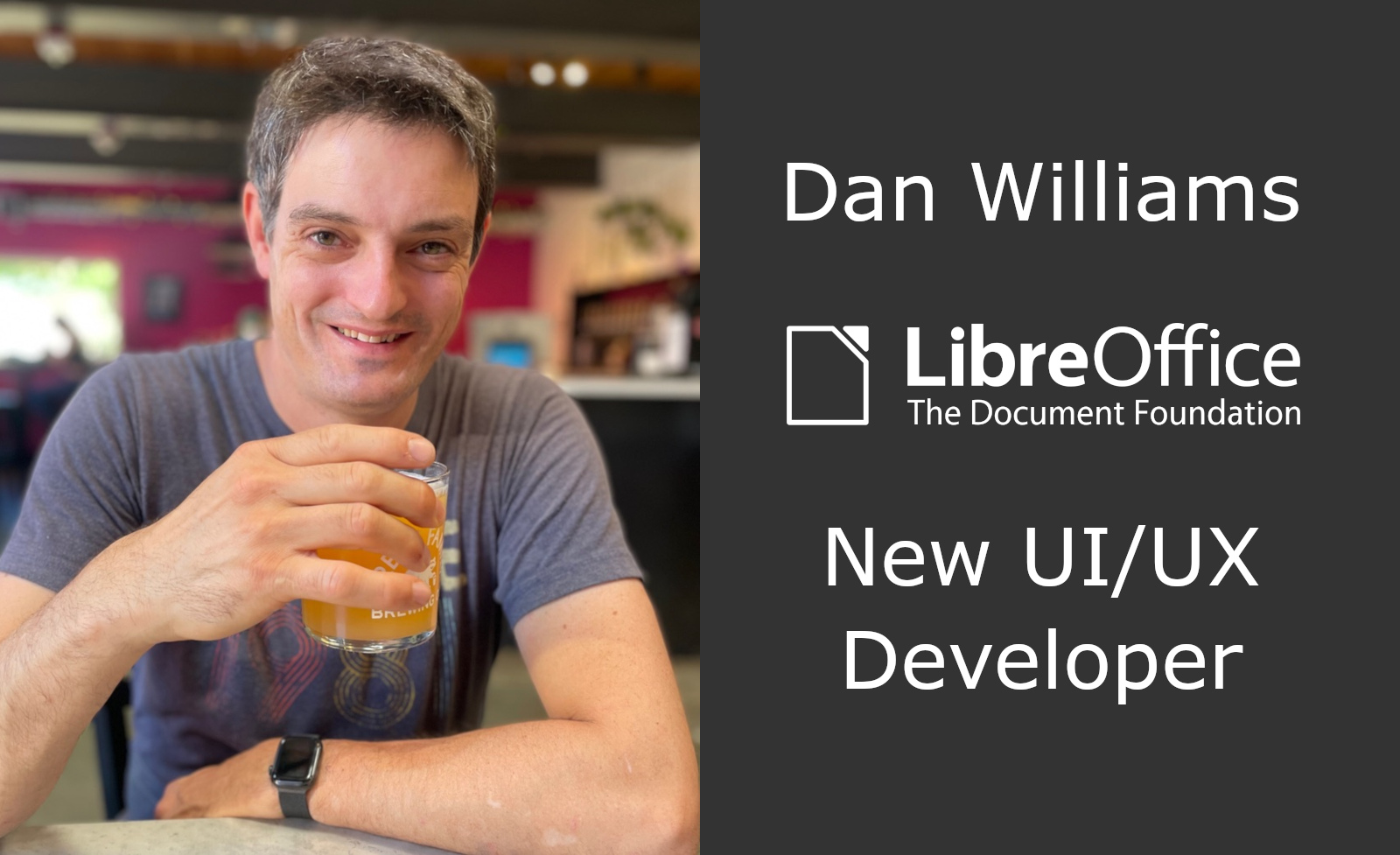
Photo of Dan Williams

The Document Foundation is the small non-profit entity behind LibreOffice. It oversees the project and community, and is now expanding with new developer roles. So let’s say hello to Dan Williams, who joins the team to work on design and user interface (UI) improvements, with an initial focus on macOS:

Tell us a bit about yourself!

I’m from the USA, have lived on both US coasts at various times, and now live back in the “midwest” where I grew up.

I was previously a software engineer, team lead, and manager at Red Hat for more than 20 years. In that time I’ve worked on a large variety of projects, from local networking to cloud networking to desktop software. I spent two years helping build the One Laptop Per Child software stack which was an eye-opening experience from a UI and design perspective. I believe passionately in free and open-source software; all the code I’ve written so far in my career is open-source.

Oddly enough, I’m not new to the LibreOffice community; I was an OpenOffice contributor and co-founded the NeoOffice port to Mac OS X (now called macOS). That led to being hired by Red Hat to package and improve OpenOffice for Fedora and Red Hat Enterprise Linux, where I helped start the 64-bit port and realize the Native Widget Framework that’s still used in LibreOffice today. I eventually handed my Red Hat OpenOffice duties over to Caolán McNamara (now at Collabora) and moved on to networking. I still recognize quite a few of our community members who I worked with before!

Outside of office software I’m the maintainer of the ModemManager WWAN software stack and I seem to have developed a hobby of collecting LTE and 5G base stations. I enjoy playing with hardware (especially if it runs Linux), baking and cooking, building large structures out of wood, and occasionally brewing beer in my basement.

What’s your new role at TDF, and what will you be working on?

A significant part of my new role will echo my early OpenOffice contributions: Mac! I’ll convert the last bits of Carbon API into modern Cocoa ones. This old code involves some pretty core functionality like popup menus and key modifier detection so it’s going to be tricky but we need to do it. Nobody knows how much longer Apple’s going to support HIToolbox but I’d like to be prepared. I’m also going to improve general Mac usability and experience; I’ve been using LibreOffice on macOS since the beginning so I’m familiar with its rough edges.
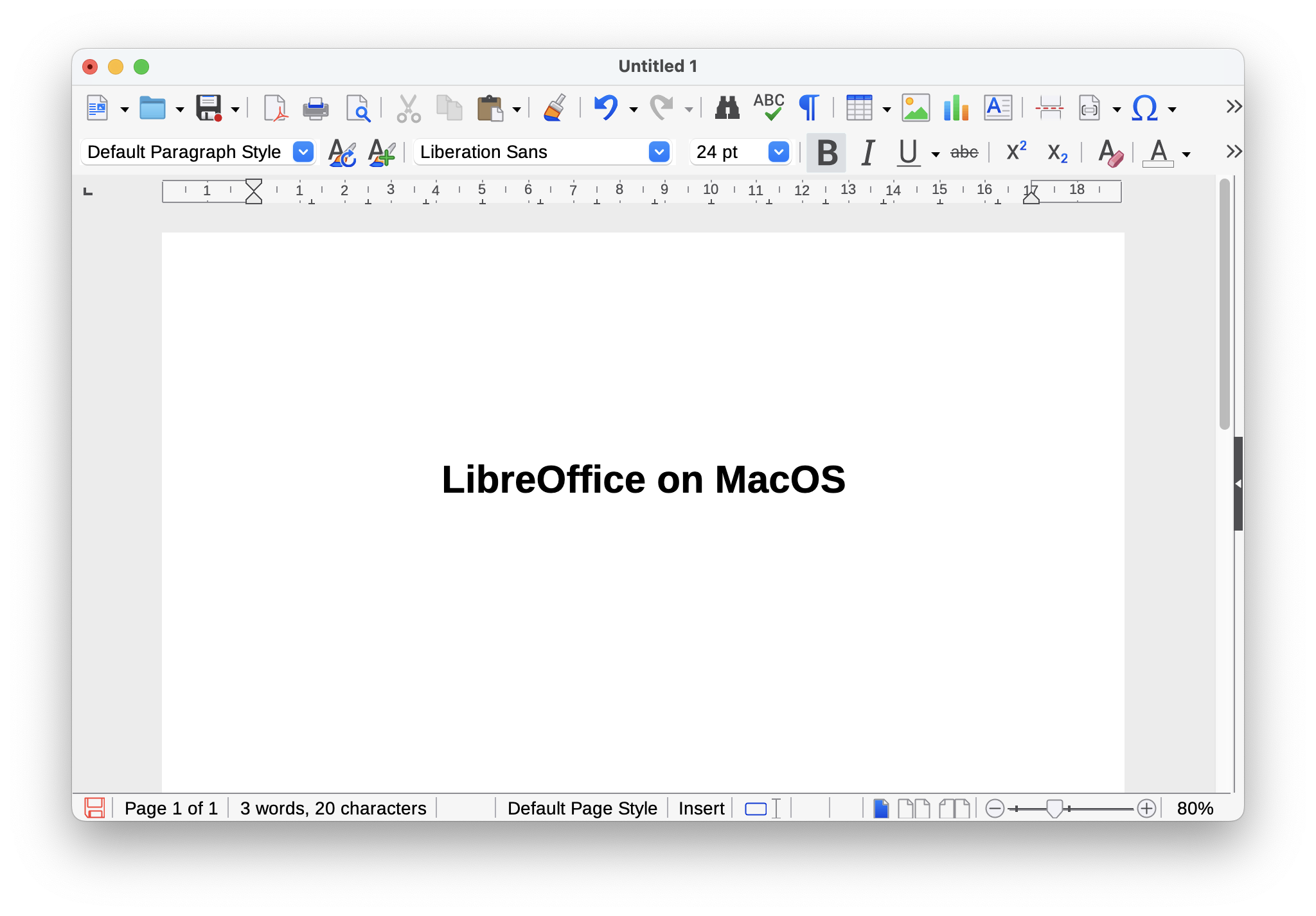
LibreOffice screenshot, running on macOPS

But the Mac isn’t the only platform so I’ll be driving user interface improvements and fixing annoying bugs everywhere else too, regardless of platform or visual backend. I also look forward to working with the LibreOffice Design community to try out new ideas and see what sticks.

I enjoy the challenge of working throughout the entire codebase, from the depths of VCL/SAL up to the UI logic and layout in the applications at the top. I’m also a big believer in automated testing and continuous integration (CI) and I hope to improve our reliability and reduce regressions. It’s often a pain to write tests for a small bug fix or any other change, but I think they’re necessary for a healthy project.

How can all users of LibreOffice help out?

What are the most annoying interface and interaction bugs, for the Mac or otherwise? Make sure they’re in Bugzilla! I need help prioritizing issues – so here’s your chance to get your favorite bug looked at.

If you’re interested in LibreOffice’s user interface and visual identity, join the Design team.

Do you have Cocoa experience on the Mac and a bit of extra time? Help me out with bugs! I’d be happy to get you started.
The Document Foundation announces the approval of the Open Document Format (ODF) v1.4 standard by OASIS Open

ODF 1.4 Approved as Oasis Open StandardThis new version of the native LibreOffice document format standard marks the 20th anniversary of the only open document format for office applications

Berlin, December 3, 2025 – The Document Foundation announces that OASIS Open (www.oasis-open.org), the global open-source and standards organisation, has approved the Open Document Format (ODF) for office applications v1.4 as an OASIS standard, which is the organisation’s highest level of ratification.

The release of ODF v1.4 coincides with the 20th anniversary of ODF’s adoption as an OASIS Standard. Since 2005, ODF has served users as a vendor-neutral, royalty-free format for office documents, ensuring that files remain readable, editable and interoperable across platforms.

Several governments and international organisations, including NATO, the European Commission and countries across multiple continents, have mandated ODF for their operations worldwide.

ODF v1.4 maintains full backward compatibility and improves developer documentation, adds better support for assistive technologies for accessibility, improves professional document formatting and visual design capabilities, and expands features for data analysis and technical documentation. These updates reinforce the Open Document Format’s position as a comprehensive solution for office productivity and document creation.

“ODF provides a vendor-neutral foundation for office productivity and collaboration. With v1.4, the standard continues to evolve, supporting cloud collaboration, richer multimedia, and standardised security,” said Svante Schubert, Open Document Format’s TC Co-Chair. “Looking ahead, ODF is moving beyond document exchange towards standardised, semantic, change-based collaboration, enabling the meaningful sharing of interoperable changes across platforms.”

ODF v1.4 safeguards digital sovereignty by removing a single vendor’s control over documents and returning it to the community, to allows individuals and enterprises to independently decide how and with whom to share content, preventing it from being analysed for commercial purposes or potentially shared without the legitimate owner’s knowledge.
Like all other versions of the standard format, ODF 1.4 is based on an XML schema that complies with simplicity and readability guidelines, making files much more robust and secure than those commonly found on the market.

Overall, this is another significant step towards transparency, openness and digital sovereignty, thanks to the collaborative efforts of open-source software developers, advocates and users.
The finalized four-part specification of ODF v1.4 can be found in the OASIS library by clicking here: docs.oasis-open.org/office/OpenDocument/v1.4/os/.

The announcement mentions OASIS sponsors who have not contributed to the development of ODF 1.4, whereas The Document Foundation, which funded the development of the standard alongside companies such as Microsoft and has always advocated for it, is not mentioned at all. Unfortunately, business is business, even when it comes to open standards.

ODF 1.4 New Features

General

  • The writing direction specification has been expanded and clarified.
  • Complex backgrounds, such as colour gradients or hatching, can now be applied to a wider range of objects.
  • Objects can be marked as “decorative” to support accessibility technologies.
  • Shapes can now contain not only simple text and lists, but also tables.
  • The method for specifying the handles of shapes has been improved.
  • A new, more flexible method has been added for specifying the format of number labels in multi-level lists.

Text Documents

  • It is now possible to position objects relative to the page margins.
  • A binding area (also known as a gutter) can be set in the page format.
  • The overlay behaviour of objects can now be specified more flexibly.

Spreadsheets

  • A new function, EASTERSUNDAY, can be used to calculate the date of Easter and its associated dates.
  • Text colour and cell background colour can be used as filter criteria.

Charts

  • Scales can be labelled more flexibly.
  • For logarithmic scales, the underlying base can be specified.

Formula Typesetting

  • All versions of the MathML formula language are now permitted.

Code of Ethics and Fiduciary Duties for TDF’s Board of Directors

TDF logo and words Code of Ethics

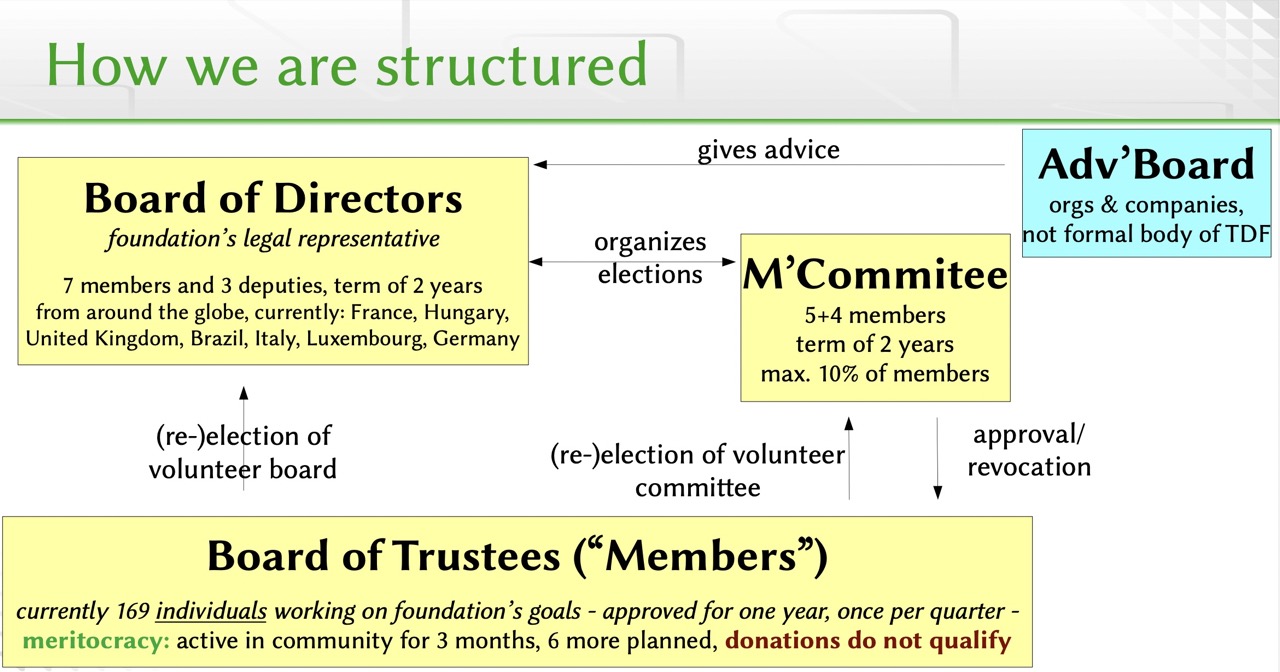
The Document Foundation (TDF) is the non-profit entity behind the LibreOffice project. It collects donations from users, and employs a small team to support and coordinate the worldwide community that makes the software. In TDF there are various bodies including the Board of Directors, Membership Committee, and the Board of Trustees:

Diagram of structure of TDF bodies

These foundation bodies are guided by a set of policies, and now the Board of Directors has voted on a Code of Ethics and Fiduciary Duties. The code ensures that members of the Board of Directors “strive to speak and act with the mission and effectiveness and the best interest, and only the interest, of the foundation in mind.” See here for the results of the vote.

Click here for the full Code of Ethics and Fiduciary Duties

The Role of ODF in Digital Identity and Authentication

Reliable data flows, verifiable signatures and predictable structures are essential for digital identity systems, which touch every aspect of modern digital life. They authorise transactions, confirm requests and guarantee security policies.

In this context, the Open Document Format (ODF) offers a transparent, computer-readable foundation for verifying the authenticity of documents and ensuring their long-term integrity.

Each ODF file is a structured ZIP container with a consistent internal layout. It contains a set of XML files that are always located in the same position. These files include meta.xml for metadata, manifest.xml for the list of files and relationships, content.xml for document data and styles.xml for presentation rules. The files are either ODT (text), ODS (spreadsheets), ODP (presentations) or ODG (drawings).

Because everything is in XML format and in the same location, identity systems can analyse the content without searching for it as they would with OOXML files, which vary greatly depending on the application used to create them. Identity systems can therefore focus on specific parts of a file rather than scanning raw binary blocks, which are present in OOXML files.

This is important for signing, integrity validation, metadata extraction and policy enforcement. When documents move from one identity platform to another, APIs can map ODF elements in a stable manner, reducing ambiguity and improving verification speed.

Document Signing

ODF supports the XML Signature and XML Encryption standards via the META-INF/documentsignatures.xml file. This file can contain multiple independent signatures, each relating to specific parts of the document. The signature refers to an explicit path within the ZIP container, making automatic verification easier and avoiding confusion caused by false errors resulting from layout changes.

Each document can contain user signatures, organisational seals, timestamps, and workflow attestations. Each signature can also contain its own certificate chain, revocation information, and policies.

ODF is compatible with standard X.509 certificates, enabling the use of national eIDAS identification systems and corporate PKI systems. Verification pipelines can apply the same trust rules used for signed emails or encrypted communications.

Interoperability and Identity Federation

Digital identity works best when it is portable. ODF’s openness supports this by avoiding vendor-specific binary constructs. Any identity framework can be integrated with ODF because its schema is public and stable, its structure is predictable, and there are no proprietary validators.

In federated identity ecosystems, such as cross-border government services or multi-cloud enterprise configurations, ODF reduces friction and ensures that documents remain compatible, even when authentication systems differ.

Long-Term Signature Validation and Archival Use

In some cases, identity systems must verify a document signed many years earlier, which requires long-term validation. ODF supports long-term authentication because its XML structure is future-proof: it can store timestamps, revocation data and certificate chains, and it avoids vendor-specific cryptographic formats.

In legal, regulatory and archival contexts, this aspect is more important than speed. Formats that rely on proprietary rendering engines risk becoming unreadable over time, whereas ODF remains readable, even many years later.

ODF in Zero Trust Workflows

In Zero Trust architectures, every resource must be verified at every stage. The structure of ODF fits perfectly into this model. Automated systems can verify the following: certificate validity, signature integrity, metadata trust levels, and the consistency of internal component hashes

As ODF exposes everything via XML, identity engines can apply consistent rules without performing custom analysis, thereby reducing attack surfaces and simplifying compliance.

The Evolution of ODF into the Future

Technical opportunities include using more powerful predefined hash algorithms, adopting JSON-based metadata levels, providing native support for verifiable credentials, and creating standardised profiles for government identity systems.

Given the growth of digital identity frameworks, ODF is the optimal format for documents requiring both authentication and additional security features.

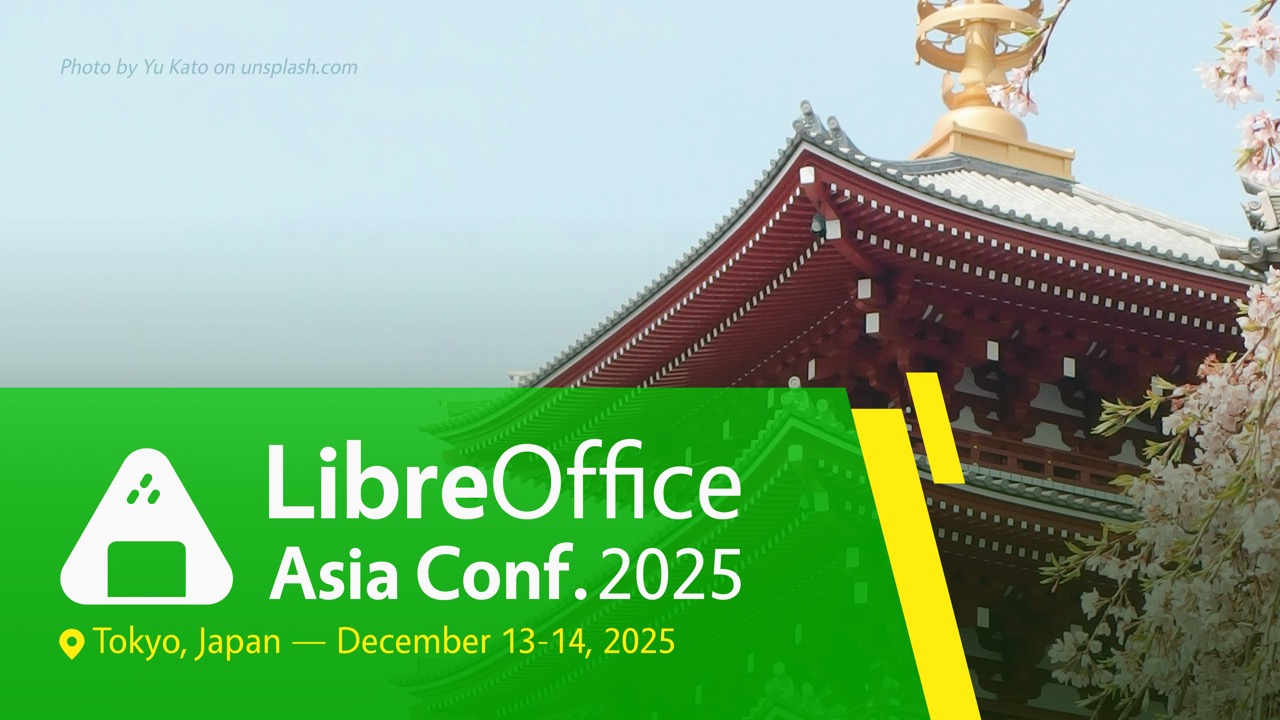
LibreOffice Asia Conference 2025 Japan is coming!

Conference logo and picture of Japan

Tokyo, Japan – The LibreOffice Asia Conference 2025 is scheduled to take place on December 13-14, 2025, at the Internet Initiative Japan Inc. headquarters in Iidabashi Grand Bloom, Tokyo. The event will bring together the Asian Open Source community to discuss developments in LibreOffice, the OpenDocument Format (ODF), and related technologies.

The conference features a diverse lineup of international speakers covering various technical and community-oriented topics. Below is an overview of the sessions organized by the speakers’ regions.

🇮🇩 Indonesia: Massive Contribution and Regeneration

The Indonesian delegation brings a strong spirit of sharing. Diah Asyanti will recount the inspiring journey of open document adoption by educators in Indonesia, a significant step for the education sector. Community sustainability is also a key focus for Ahmad Haris, who will thoroughly explore the challenges and strategies for regenerating young talent in FOSS projects.

Equally engaging, Rania Amina invites participants to dive into the fun side of contributing to LibreOffice, debunking the myth that contribution is difficult or boring. For technical enthusiasts, Sartika Lestari is ready to share practical tips on LibreOffice automation using Python ScriptForge.

🇯🇵 Japan: Host with Technical and Community Focus

As the host, the Japanese community presents topics highly relevant for both new users and developers. Kenta Ito & Yuichi Kojima will lead a beginner-friendly session designed to help users transition smoothly to LibreOffice Writer.

On the innovation front, Koji Annoura will introduce “Dana Language,” an intriguing new approach to intent-driven automation. Meanwhile, Saburo Yoshida will open perspectives on how contributing to LibreOffice is inclusive and not limited to programming skills alone.

🇩🇪 Germany: Standards and Business

Perspectives from Europe, specifically Germany, will enrich participants’ understanding of standards and business. Svante Schubert will emphasize why the OASIS OpenDocument Format (ODF) standard is crucial for long-term interoperability. Complementing this, Lothar K. Becker will dissect how Open Source has become a strategic competitive factor for the private sector.

🇹🇼 Taiwan: Customization and Debugging

Experts from Taiwan are set to share deep technical techniques. Jia, Jun Xu will demonstrate how customizing key components can significantly boost productivity. For those who love problem-solving, Buo-ren Lin & Po-Yen Huang will introduce the unique “Vibe-debugging” method to tackle bugs in LibreOffice.

🌏 Other International Participation

The conference is further colored by speakers from around the globe. From India, Manish Bera will share effective strategies for growing the LibreOffice community. Tomaž Vajngerl from Slovenia will showcase cutting-edge features in Collabora Online.

Important updates regarding the community and ODF status in South Korea will be delivered by DaeHyun Sung. Finally, Eyal Rozenberg will raise vital issues regarding non-Western script support, uniting the interests of RTL and CJK language communities.

The LibreOffice Asia Conference 2025 aims to foster collaboration among Asian communities and promote the advancement of free and open-source office software.

Registration and Participation Details

Participation in the conference is free of charge, but advance registration is required via the Connpass platform.

  • Registration Link
  • Fee: Free
  • Venue: Internet Initiative Japan Inc. Head Office, Iidabashi Grand Bloom, Tokyo

Important Notice for International Participants

The Connpass registration system is primarily designed for residents of Japan. Participants residing outside Japan (particularly those in the EEA) who have concerns regarding personal data protection are advised to contact the organizers at ja-contact@libreoffice.org prior to completing their registration.

Announcing the LibreOffice US community!

LibreOffice US community banner

LibreOffice is made by hundreds of people around the world. In many countries, we have active communities that organise events, do local marketing, and help users in their local language.

But while we have many users and contributors in the United States of America, so far we haven’t built up an active local community. Of course, part of this is due to the size of the country – the US is huge, so getting people together isn’t easy.

Nonetheless, we want to try! There are many things we’d like to do in the US with LibreOffice, such as:

  • Creating merchandise designs for events and giveaways
  • Working on local marketing materials and advocacy projects
  • Organising meetups to bring contributors and users together

To get things going, we’ve created some communication groups and a social media channel. Our Discord server has a few channels which are also bridged to Matrix, so join one of those and let’s start discussing ideas. We also have the LibreOfficeUS Mastodon account where we’ll be posting updates.

We look forward to seeing you there 😊