Using LibreOffice Base to Teach Relational Database Management

Dominique Welt, Ph.D. Candidate and instructor at McGill University, writes:

This summer, my paper on using LibreOffice Base to teach relational database management was featured at the Twenty-eighth Americas Conference on Information Systems (AMCIS). AMCIS is the Americas’ major conference for management information systems scholars. The paper draws from my experience using LibreOffice Base to teach relational database management at McGill University in 2021.

You can consult the paper and watch the video presentation using this link to the conference proceedings, which also features a video presentation.

LibreOffice 7.4.1 Community available for download

Berlin, September 15, 2022 – LibreOffice 7.4.1 Community, the first maintenance release of LibreOffice 7.4, the volunteer-supported office suite for personal productivity on the desktop, is immediately available from https://www.libreoffice.org/download for Windows (Intel and Arm processors), macOS (Apple M1 and Intel processors), and Linux.

LibreOffice offers the highest level of compatibility in the office suite market segment, with native support for the OpenDocument Format (ODF) – beating proprietary formats for security and robustness – to superior support for MS Office files, to filters for a large number of legacy document formats, to return ownership and control to users.

Most Significant New Features of LibreOffice 7.4

GENERAL
• Support for WebP images and EMZ/WMZ files
• Help pages for the ScriptForge scripting library
• Search field for the Extension Manager
• Performance and compatibility improvements

WRITER
• Better change tracking in the footnote area
• Edited lists show original numbers in change tracking
• New typographic settings for hyphenation

CALC
• Support for 16,384 columns in spreadsheets
• Extra functions in drop-down AutoSum widget
• New menu item to search for sheet names

IMPRESS
• New support for document themes

A video summarizing the top new features of the LibreOffice 7.4 Community major release is available on YouTube: https://www.youtube.com/watch?v=PC8M4UzqpqE and PeerTube: https://peertube.opencloud.lu/w/myZUTCytN28kuxDa5VXNgh. A description of all new features is available in the Release Notes: https://wiki.documentfoundation.org/ReleaseNotes/7.4.

LibreOffice Technology Platform

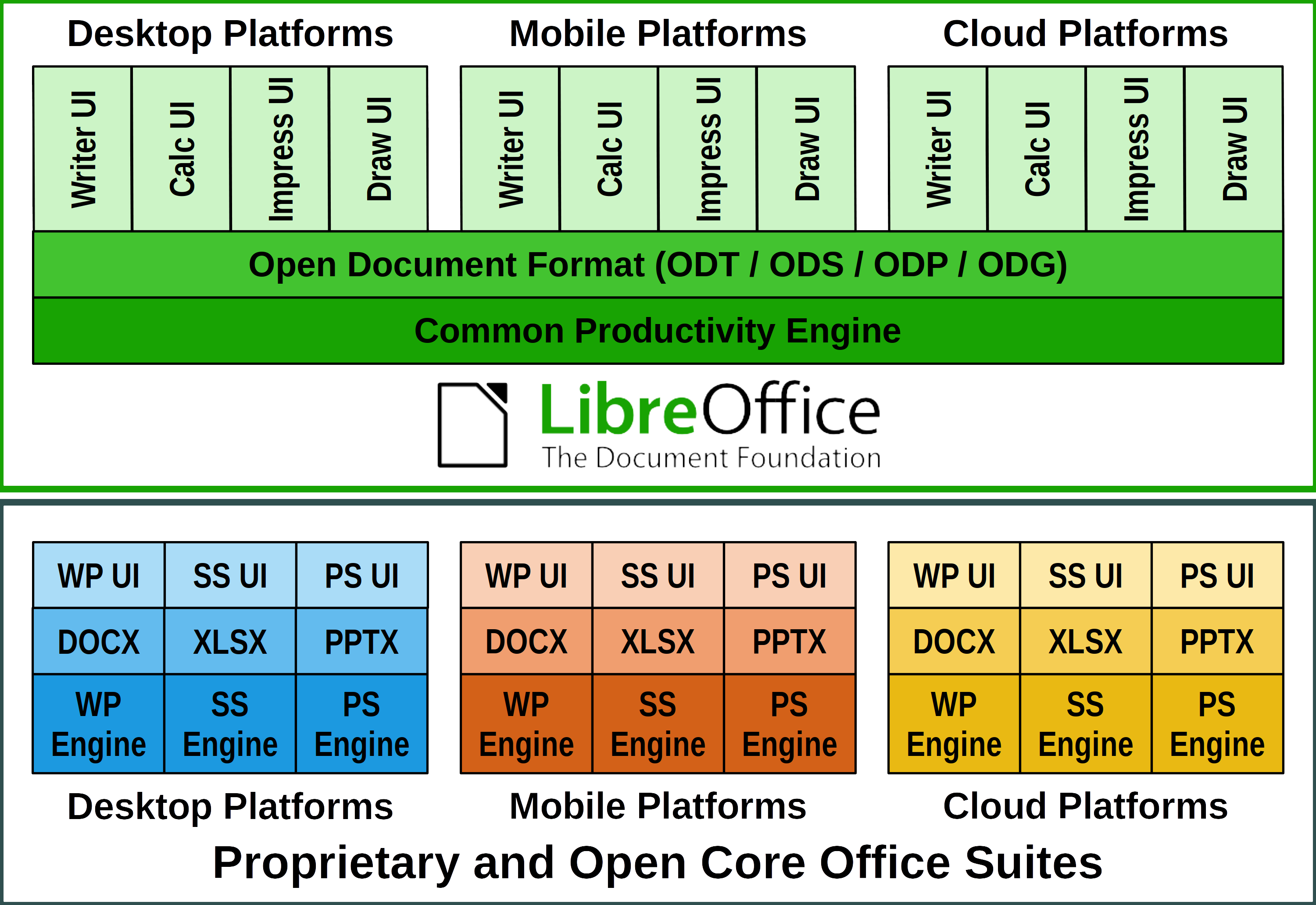
Products based on the LibreOffice Technology platform – the transactional engine shared by all LibreOffice based products, which provides a rock solid solution with a high level of coherence and interoperability – are available for major desktop operating systems (Windows, macOS, Linux and Chrome OS), for mobile platforms (Android and iOS), and for the cloud.

For enterprise-class deployments, TDF strongly recommends the LibreOffice Enterprise family of applications from ecosystem partners – for desktop, mobile and cloud – with a large number of dedicated value-added features and other benefits such as SLA (Service Level Agreements): https://www.libreoffice.org/download/libreoffice-in-business/. All code developed by ecosystem companies for enterprise customers is shared with the community and improves the LibreOffice Technology platform.

LibreOffice – thanks to its mature codebase, rich feature set, strong support for open standards, excellent compatibility and LTS options from certified partners – is the ideal solution for businesses that want to regain control of their data and free themselves from vendor lock-in.

Availability of LibreOffice 7.4.1 Community

LibreOffice 7.4 Community is available from: https://www.libreoffice.org/download/. Minimum requirements for proprietary operating systems are Microsoft Windows 7 SP1 and Apple macOS 10.12. LibreOffice Technology-based products for Android and iOS are listed here: https://www.libreoffice.org/download/android-and-ios/.

For users who don’t need the latest features and prefer a release that has undergone more testing and bug fixing, The Document Foundation maintains the LibreOffice 7.3 family, which includes some months of back-ported fixes and is currently at version 7.3.6.

The Document Foundation does not provide technical support for users, although they can get it from volunteers on user mailing lists and the Ask LibreOffice website: https://ask.libreoffice.org

LibreOffice users, free software advocates and community members can support The Document Foundation with a donation at https://www.libreoffice.org/donate.

Index of Training Videos about LibreOffice

In order to make it easier for users to find training videos about LibreOffice, we have created a comprehensive index updated to the end of April 2022 using the open source Zotero bibliography and reference management software.

The index is published on this blog in the Media Hub section (clicking on the Media Hub menu, you will open a drop down menu with Press Releases and Index of Videos).

At the moment, indexed videos are only in English (although there are also videos in other languages, which have still to be indexed), and have been grouped by topic: LibreOffice, LibreOffice Writer, LibreOffice Calc, LibreOffice Impress, LibreOffice Draw, LibreOffice Base, LibreOffice Math, LibreOffice Interviews and LibreOffice Talks.

The next task is to create an index of documents relevant for The Document Foundation and LibreOffice, covering topics such as open source software, open standards, change management, sustainability, interoperability, digital citizenship, migrations, openness, digital sovereignty and document formats, to mention only the most important. The objective is to provide educational materials to all LibreOffice stakeholders, as a background for training and presentations, or as a simple but comprehensive source of information.

Projects selected for LibreOffice in the Google Summer of Code 2022

The LibreOffice Google Summer of Code projects have been selected for 2022.

  • Hannah Meeks – VBA Macros – Tests and missing APIs : We support VBA (Visual Basic for Applications) Macros in LibreOffice, but the implemented API isn’t complete and the API functions aren’t largely tested. The consequence of this is that the VBA macros in OOXML documents don’t run as intended in LibreOffice, which causes compatibility problems. The goal of this project is to add tests for the functions already implemented and then look for what functions are missing for a method or module and add them.
  • Paris Oplopoios – Extend Z compressed graphic format support: Some graphic formats are compressed with ZIP (deflate) to make them smaller, while the formats themselves don’t support compression. In LibreOffice we already support SVGZ format, but not other formats. The goal of this idea is to look at how SVGZ is implemented and extend that to other formats (EMF, WMF). The extended goal is to implement support for compressing in addition to extracting.

Good luck to the contributors – we appreciate their work on these important features and improvements! And thanks to our mentors for assisting them: Tomaž Vajngerl and Miklos Vajna (Collabora); Thorsten Behrens (allotropia).

From September 5 – September 12, contributors will submit their code, project summaries, and final evaluations of their mentors. Find out more about the timeline here, and check out more details about the projects on this page.

Annual Report: TDF’s infrastructure in 2021

In 2021, the infrastructure team migrated our “Ask LibreOffice” site to Discourse, deployed a Decidim instance, and assisted with video streaming during the LibreOffice Conference.

(This is part of The Document Foundation’s Annual Report for 2021 – we’ll post the full version here soon.)

LibreOffice’s infrastructure team is responsible for maintaining the hardware, virtual machines and services that enable the wider community to develop, market, test, localize and improve the software. The public infrastructure is powered by around 50 kernel-based virtual machines (KVMs) spread across four hypervisors, plugged to an internal 10Gbps switch, hosted at Manitu in St. Wendel (Germany), and managed with libvirt and its KVM/QEMU driver. The virtual disk images are typically stored in GlusterFS volumes – distributed across the hypervisors – except for some transient disks (such as cache) where the IOPS requirement is higher and the redundancy less important.

As 2021 marked another “pandemic year” with only online events, the infrastructure team helped to make these a pleasant experience from home. Notably, they deployed a Pretalx instance to manage conference submissions and the schedule, and put in place a streaming backend based on Jitsi/Jibri/RTMP during the annual conference, thereby providing several participation options to chose from.

Ask LibreOffice

After several months of tests and feedback from the community, the infra team also concluded the migration of LibreOffice’s Q&A platform (“Ask LibreOffice”) to Discourse. Over 65,000 questions and 130,000 replies from 50,000 users — spanning over 17 languages — were imported, with a focus on preserving post attribution and overall layout. The metric collection engines (Matomo as well as the public Grimoire Dashboard) were updated to reflect that change.

Also on the community participation front, the infrastructure team deployed a Decidim instance to structure debate and encourage democratic participation from community members. The instance is currently still under test.

On the Continuous Integration (CI) front, the team deployed new buildbots for Windows and Linux baselines, as well as a buildbot for the WebAssembly (WASM) effort. They also migrated and refactored the bibisect setup to better suit the needs of the quality assurance community.

Backends

As for the backends: Debian GNU/Linux 11 (codename “Bullseye”) was released in the middle of 2021, and the team upgraded most of TDF’s virtual machines accordingly during the second half of the year. However, for the lower layers of the virtualization stack, the upgrade is planned for 2022. Furthermore, lots of work was done in planning the restructuring of database engines, most notably around Point-in-Time Recovery; this work was driven by contributor Brett Cornwall. Finally, the team assisted the Membership Committee with the architecture of the back-end side of their new tooling.

Like what we do? Support the LibreOffice project and The Document Foundation – get involved and help our volunteers, or consider making a donation. Thank you!

Build up your skills, and learn exciting new things!

LibreOffice is made by a worldwide community of volunteers, certified developers and many other people. Every summer, we participate in the Google Summer of Code programme: this is focused on introducing contributors to open source software development, and last year LibreOffice received a bunch of new features and improvements thanks to the work of several contributors.

We’re super happy to announce that LibreOffice, once again, is part of this year’s Summer of Code (GSoC). If you’re a contributor, want to improve your programming skills and receive a financial stipend to implement new features in LibreOffice, get involved! You can get in contact with us, show us that you’ve learnt the basics by working on an Easy Hack from the category “difficultyInteresting”, and then propose your project(s). We’re looking forward to hearing from you and seeing your work!

Click here to get started