
The Document Foundation announces LibreOffice 6.2.1, the first minor release of the LibreOffice 6.2 family

Berlin, March 6, 2019 – The Document Foundation announces LibreOffice 6.2.1, the first minor release of the LibreOffice 6.2 family that was announced in early February, targeted at tech savvy individuals: early adopters, technology enthusiasts and power users.

LibreOffice users are invited to join the community at https://www.libreoffice.org/get-help/community-support/, where they can get and provide user-to-user support. While The Document Foundation cannot provide commercial level support, there are guides, manuals, tutorials and HowTos on the website and the wiki. Your donations help us to make these available.

Enterprise deployments

LibreOffice 6.2.1 represents the bleeding edge in term of features for open source office suites, and as such is not optimized for enterprise class deployments, where features are less important than robustness. Users wanting a more mature version can download LibreOffice 6.1.5, which includes some months of back-ported fixes.

Value-added services for enterprise class deployments – related to software support, migrations and training – should be sourced from certified professionals (https://www.libreoffice.org/get-help/professional-support/). In addition, some of TDF Advisory Board members provide LibreOffice LTS (Long Term Supported) versions targeted to enterprise deployments (https://www.documentfoundation.org/governance/advisory-board/).

Sourcing enterprise class software and/or services from the ecosystem of certified professionals are the best support options for organizations deploying LibreOffice on a large number of desktops. In fact, these activities are contributed back to the project under the form of improvements to the software and the community, and trigger a virtuous circle which is beneficial to all parties, including users.

Availability of LibreOffice 6.2.1

LibreOffice 6.2.1 is immediately available from the following link: https://www.libreoffice.org/download/. Minimum requirements for proprietary operating systems are Microsoft Windows 7 SP1 and Apple macOS 10.9. Builds of the latest LibreOffice Online source code are available as Docker images: https://hub.docker.com/r/libreoffice/online/.

LibreOffice Online is fundamentally a server service, and should be installed and configured by adding cloud storage and an SSL certificate. It might be considered an enabling technology for the cloud services offered by ISPs or the private cloud of enterprises and large organizations.

LibreOffice users, free software advocates and community members can support The Document Foundation with a donation at https://www.libreoffice.org/donate.

LibreOffice 6.2.1 is built with document conversion libraries from the Document Liberation Project: https://www.documentliberation.org.

First LibreOffice Asia Conference

The First LibreOffice Asia Conference Will Be Held On May 25-26, 2019 In Nihonbashi, Tokyo, Japan

This is the first ever LibreOffice conference covering Asia, a rapidly-growing area for free and open source software. The call for papers will be launched soon.

Berlin, February 18, 2019 – After the huge success of the LibreOffice Conference Indonesia in 2018, members of the Asian communities have decided to raise the bar in 2019 with the first ever LibreOffice Asia Conference in Nihonbashi – the very center of Tokyo, Japan – on May 25-26.

One of the main organizers, Naruhiko Ogasawara, a member of the Japanese LibreOffice community and The Document Foundation, can’t hide his excitement: “When we launched the LibreOffice Mini Conference Japan in 2013 as a local event, we knew little about communities in other parts of Asia. In recent years we have attended the LibreOffice Conference and other Asian events like OpenSUSE Asia, COSCUP etc. We have realized that many of our colleagues are active and that our community should learn a lot from them. We are proud to be able to hold the first Asia Conference with our colleagues to further strengthen that partnership.”

“It’s a real leap of faith,” says Franklin Weng, an Asian member in the Board of Directors of The Document Foundation. “Asia is a rapidly-growing area in adoptions of ODF and LibreOffice, but our ecosystem for LibreOffice and FOSS has not been good enough yet. In this conference we’re not only trying to make the FOSS ecosystem in Asia more healthy, but also to encourage Asian community members to show their potential.”

Several core members from The Document Foundation will attend this conference, including Italo Vignoli, leader of the marketing and public relations community (and co-chairman of LibreOffice Certification Committee), along with Lothar Becker, who is also co-chairman of the Certification Committee. In addition, there will be community members from Indonesia, South Korea, Taiwan, Japan and probably China attending.

The main focus areas of this conference include:

  • Business workshop – which will be hosted by Lothar Becker and Italo Vignoli. Lothar and Italo will discuss business services: what are the fundamentals of LibreOffice business services, the current status of LibreOffice business in Europe, Asia and other geographies, and how we can support each other, etc.
  • CJK Hackfest – which will be led by Mark Hung, a LibreOffice Certified Developer in Taiwan, to discuss and hack CJK issues in LibreOffice.
  • Certification Interview – the second LibreOffice Certification Interview in Asia will be held during the LibreOffice Asia Conference, hosted by Italo Vignoli and Lothar Becker. So far total four or five candidates will be interviewed for LibreOffice Certified Migration Professionals and LibreOffice Certified Trainers.
  • Asia Local Certification for LibreOffice – which will be hosted by Franklin Weng and Eric Sun, two TDF members from Taiwan, to introduce the concept of having LibreOffice skills and trainer certifications in Asia.

The call for proposals will be launched soon in February. Besides the topics above, other LibreOffice and ODF-related topics are also welcome.

The Document Foundation announces LibreOffice 6.2 with NotebookBar, the office suite which offers the most flexible user experience

LibreOffice 6.1.5 also released, for enterprise class deployments and mainstream users looking for robust productivity

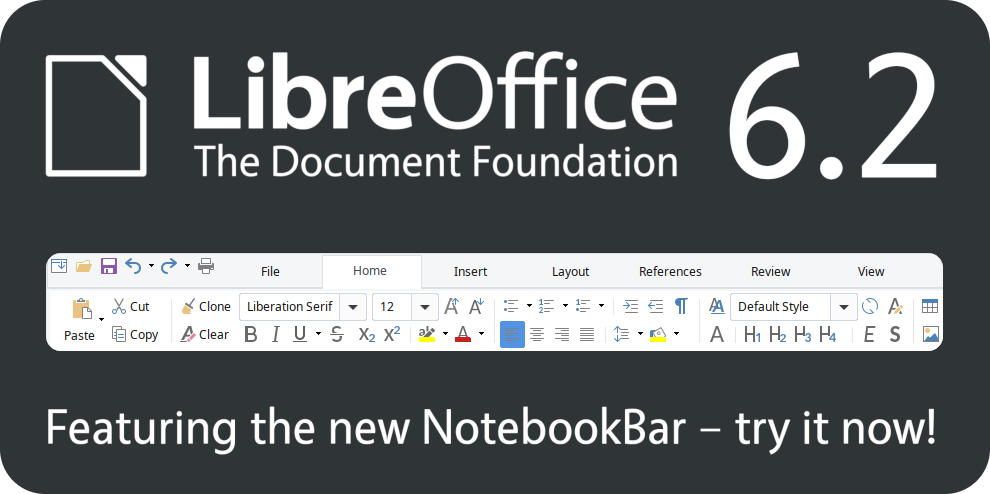
Berlin, February 7, 2019 – The Document Foundation announces LibreOffice 6.2 with NotebookBar, a significant major release of the free office suite which features a radical new approach to the user interface – based on the MUFFIN concept [1] – and provides user experience options capable of satisfying all users’ preferences, while leveraging all screen sizes in the best way.

The NotebookBar is available in Tabbed, Grouped and Contextual flavors, each one with a different approach to the menu layout, and complements the traditional Toolbars and Sidebar. The Tabbed variant aims to provide a familiar interface for users coming from proprietary office suites and is supposed to be used primarily without the sidebar, while the Grouped one allows to access “first-level” functions with one click and “second-level” functions with a maximum of two clicks.

The design community has also made substantial changes and improvements to icon themes, in particular Elementary and Karasa Jaga.

LibreOffice 6.2 new and improved features:

  • The help system offers faster filtering of index keywords, highlighting search terms as they are typed and displaying results based on the selected module.
  • Context menus have been tidied up, to be more consistent across the different components in the suite.
  • Change tracking performances have been dramatically improved, especially in large documents.
  • In Writer, it is now possible to copy spreadsheet data into tables instead of just inserting them as objects.
  • In Calc, it is now possible to do multivariate regression analysis using the regression tool. In addition, many more statistical measures are now available in the analysis output, and the new REGEX function has been added, to match text against a regular expression and optionally replace it.
  • In Impress & Draw, the motion path of animations can now be modified by dragging its control points. In addition, a couple of text-related drawing styles have been added, as well as a Format Table submenu in Draw.
  • LibreOffice Online, the cloud-based version of the suite, includes many improvements too. On mobile devices, the user interface has been simplified, with better responsiveness and updates to the on-screen keyboard.

Interoperability with proprietary file formats has also been improved, as with every major and minor version of LibreOffice, for better compatibility with Office documents, including old versions which have been deprecated by Microsoft. The focus has been on charts and animations, and on document security features, with agile encryption and HMAC verification.

LibreOffice 6.2’s new features have been developed by a large community of code contributors: 74% of commits are from developers employed by companies sitting in the Advisory Board like Collabora, Red Hat and CIB and by other contributors such as the City of Munich and SIL, and 26% are from individual volunteers.

In addition, there is a global community of individual volunteers taking care of other fundamental activities such as quality assurance, software localization, user interface design and user experience, editing of help system and documentation, plus free software and open document standards advocacy at a local level.

A video summarizing the top new features of LibreOffice 6.2 is available on YouTube: https://www.youtube.com/watch?v=6HUnR5IoAQk.

LibreOffice 6.1.5 for enterprise class deployments

The Document Foundation has also released LibreOffice 6.1.5, a more mature version which includes some months of back-ported fixes and is better suited for enterprise class deployments, where features are less important than robustness as the main objective is individual productivity.

Enterprises willing to deploy LibreOffice on a professional basis should source value-added services – related to software support, migrations and training – from certified people (https://www.libreoffice.org/get-help/professional-support/) and a LibreOffice LTS (Long Term Supported) versions provided by one of the companies sitting on TDF Advisory Board (https://www.documentfoundation.org/governance/advisory-board/).

Sourcing enterprise class software and/or services from the ecosystem of certified professionals are the best support options for organizations deploying LibreOffice on a large number of desktops. In fact, these activities are contributed back to the project under the form of improvements to the software and the community, and trigger a virtuous circle which is beneficial to all parties, including users.

Availability of LibreOffice 6.2 and LibreOffice 6.1.5

LibreOffice 6.2 and LibreOffice 6.1.5 are immediately available from the following web page: https://www.libreoffice.org/download/. Builds of the latest LibreOffice Online source code are also available, released as Docker images: https://hub.docker.com/r/libreoffice/online/.

LibreOffice Online is fundamentally a server service, and should be installed and configured by adding cloud storage and an SSL certificate. It might be considered an enabling technology for the cloud services offered by ISPs or the private cloud of enterprises and large organizations.

LibreOffice users, free software advocates and community members can support The Document Foundation with a donation at https://www.libreoffice.org/donate.

LibreOffice 6.2 is built with document conversion libraries from the Document Liberation Project: https://www.documentliberation.org.

Press Kit

The press kit is here: https://tdf.io/lo62presskit.

[1] https://blog.documentfoundation.org/blog/2016/12/21/the-document-foundation-announces-the-muffin-a-new-tasty-user-interface-concept-for-libreoffice/

LibreOffice 6.1.4 announced

Berlin, December 18, 2018 – The Document Foundation announces LibreOffice 6.1.4, the 4th minor release of the LibreOffice 6.1 family, targeted at tech savvy individuals: early adopters, technology enthusiasts and power users.

LibreOffice 6.1.4 provides over 120 bug and regression fixes over the previous version, contributed by a thriving community of developers, which are described in the change log pages: https://wiki.documentfoundation.org/Releases/6.1.4/RC1 (changed in RC1) and https://wiki.documentfoundation.org/Releases/6.1.4/RC2 (changed in RC2).

LibreOffice users are invited to join the community at https://ask.libreoffice.org, where they can get and provide user-to-user support. While TDF can not provide commercial level support, there are guides, manuals, tutorials and HowTo on the website and the wiki. Your donation help us make these available.

Enterprise deployments

LibreOffice 6.1.4 represents the bleeding edge in term of features for open source office suites, and as such is not optimized for enterprise class deployments, where features are less important than robustness. Users wanting a more mature version can download LibreOffice 6.0.7, which includes some months of back-ported fixes.

Value-added services for enterprise class deployments – related to software support, migrations and training – should be sourced from certified professionals (https://www.libreoffice.org/get-help/professional-support/). In addition, some of TDF Advisory Board members provide LibreOffice LTS (Long Term Supported) versions targeted to enterprise deployments (https://www.documentfoundation.org/governance/advisory-board/).

Sourcing enterprise class software and/or services from the ecosystem of certified professionals are the best support options for organizations deploying LibreOffice on a large number of desktops. In fact, these activities are contributed back to the project under the form of improvements to the software and the community, and trigger a virtuous circle which is beneficial to all parties, including users.

Availability of LibreOffice 6.1.4

LibreOffice 6.1.4 is immediately available from the following link: https://www.libreoffice.org/download/. Minimum requirements for proprietary operating systems are Microsoft Windows 7 SP1 and Apple macOS 10.9. Builds of the latest LibreOffice Online source code are available as Docker images: https://hub.docker.com/r/libreoffice/online/.

LibreOffice Online is fundamentally a server service, and should be installed and configured by adding cloud storage and an SSL certificate. It might be considered an enabling technology for the cloud services offered by ISPs or the private cloud of enterprises and large organizations.

LibreOffice users, free software advocates and community members can support The Document Foundation with a donation at https://www.libreoffice.org/donate.

LibreOffice 6.1.4 is built with document conversion libraries from the Document Liberation Project: https://www.documentliberation.org.

The Municipality of Tirana moves to open source software and open standards by migrating to LibreOffice

Berlin, November 22, 2018 – The Document Foundation (TDF) announces that the Municipality of Tirana, the biggest in Albania, is moving to open source software and open standards by migrating to LibreOffice. The project is a further step in a large deployment of open source technologies in the city’s IT infrastructure, and follows the successful migration to Nextcloud.

The migration to LibreOffice is managed by the ICT Department, which has been following an open source approach when implementing many IT solutions, based on the strong belief that public IT infrastructure should use free and open source technologies (https://publiccode.eu). Thanks to LibreOffice, documents can now be exchanged and stored in the ISO standard Open Document Format, managed by OASIS, which represents the best solution to avoid proprietary lock-in.

Ermir Puka, the head of the ICT Department, believes that despite the resistance to change and the other big challenges facing the migration, using free and open source software and platforms like LibreOffice – supporting open standards – will guide the IT infrastructure of the municipality in the best interest of the citizens of Tirana.

The migration project has started with the HR Department, where most tasks are based on documents and spreadsheets. This has helped to identify many different issues during and after the migration, and has helped the process in other offices of the Municipality. The majority of the 1,000 desktops in the Municipality of Tirana have already been migrated to LibreOffice.

To further ease the migration, LibreOffice Writer and Calc manuals have been translated into Albanian, while the IT staff is working at an online learning course deployed on Moodle, the e-learning platform used by the Municipality. Activities are enthusiastically assisted by the local open source community, which gathers around Open Labs.

The Document Foundation announces LibreOffice 6.0.7 and LibreOffice 6.1.3: all users are invited to update for improved robustness and security

Berlin, November 5, 2018 – The Document Foundation announces the release of LibreOffice 6.0.7 and LibreOffice 6.1.3, which improve the quality and stability of previous releases, and integrate a security patch.

All LibreOffice users are therefore strongly recommended to update to the new versions:

  • Power users, early adopters and technology enthusiasts should update from LibreOffice 6.1.2 to LibreOffice 6.1.3, which represents the bleeding edge in term of features for open source office suites;
  • All other individual users and organizations of any size should update from any previous version of LibreOffice to LibreOffice 6.0.7, which is more mature and as such targeted at production environments and enterprise-class deployments.

Organizations should source LibreOffice 6.0.7 from one of the companies providing a Long Term Supported version of the suite, for additional value-added services which make the software better suited to enterprise deployments, thanks to professional support (the companies are all members of TDF’s Advisory Board, and are listed here: https://www.documentfoundation.org/governance/advisory-board/). When it is sourced from The Document Foundation, LibreOffice is supported by volunteers.

Also, value-added services for migrations and trainings, to support enterprise-class deployments in large organizations, should be sourced from certified professionals (a list is available here: https://www.libreoffice.org/get-help/professional-support/).

LibreOffice is deployed by large organizations in every continent. A list of some large or significant migrations announced in the media is available on the TDF wiki: https://wiki.documentfoundation.org/LibreOffice_Migrations.

LibreOffice 6.0.7 bug and regression fixes are described here: https://wiki.documentfoundation.org/Releases/6.0.7/RC1 (fixed in RC1), https://wiki.documentfoundation.org/Releases/6.0.7/RC2 (fixed in RC2) and https://wiki.documentfoundation.org/Releases/6.0.7/RC3 (fixed in RC3), while LibreOffice 6.1.3 bug and regression fixes are described here: https://wiki.documentfoundation.org/Releases/6.1.3/RC1 (fixed in RC1) and https://wiki.documentfoundation.org/Releases/6.1.3/RC2 (fixed in RC2).

Download LibreOffice

LibreOffice 6.0.7 and LibreOffice 6.1.3 are immediately available from the following link: https://www.libreoffice.org/download/. Builds of the LibreOffice Online source code can be downloaded as Docker images: https://hub.docker.com/r/libreoffice/online/.

LibreOffice Online is fundamentally a server service, and should be installed and configured by adding cloud storage and an SSL certificate. It might be considered an enabling technology for the cloud services offered by ISPs or the private cloud of enterprises and large organizations.

LibreOffice users, free software advocates and community members can support The Document Foundation with a donation at https://www.libreoffice.org/donate. Donations help TDF to maintain its infrastructure, share knowledge, and fund the presence of volunteers at events, where they can meet with other free software advocates.

LibreOffice 6.0.7 and LibreOffice 6.1.3 are built with document conversion libraries developed and maintained by the Document Liberation Project (DLP): https://www.documentliberation.org. Several of these libraries have been adopted by other software projects to provide an escape path from proprietary document lock-in.