LibreOffice developer interview: Muhammet Kara

Every new LibreOffice release is built on the work of developers around the world, who collaborate to add new features and fix bugs. But who are these developers? How did they get involved in LibreOffice, what is their vision for the future of the software, and how do they enjoy their free time?

We asked some contributors these questions, and will be posting their answers here on the blog in the coming weeks. Let’s start with Muhammet Kara

Where are you based, and do you work for a LibreOffice-related company or just code in your spare time?

I live in Ankara, Turkey. I am still a student, studying computer engineering, and I also work for TUBITAK-ULAKBIM in their Pardus Linux Group. They endorse the usage of Free and Open Source Software (FOSS) nationwide. They also encourage me to work on LibreOffice when I am not given other tasks. I am glad I am able to contribute to such a great project as LibreOffice in the workplace. I also code in my spare time.

How did you get involved with LibreOffice?

I have been using and advocating OpenOffice.org and LibreOffice for years, but my involvement as a code contributor started with encouragement of Abdullah Erol, manager of the Pardus Linux Project.

What areas of the code do you normally work on? Anything else you want to tackle?

I don’t have a particular preference, and I work on various areas usually related to C++ and the user interface. After gaining some more experience, first I would like to spend some time on Base because I felt like it needs some love. I am also interested in getting involved with writing tests because they guard us against the introduction of new bugs and reintroduction of old ones. But there is no reason not to work on Calc or Writer 🙂

What is your vision for the future, and what would you most like to see improved in LibreOffice?

A well-known and widely-used LibreOffice suite worldwide, and particularly in Turkey. I think integration of LibreOffice with the cloud is also crucial for the future.

What do you do when you’re not working on LibreOffice?

I like going to the movies, reading books, mountain driving, and localizing free software. Nowadays I am trying to get GNOME 3.22 development branch’s Turkish translation to 100% completion. Wish me luck with that 🙂

Thanks Muhammet! And to any other interested developers reading this: join our community and help to make LibreOffice even better.
LibreOffice: the numbers

The LibreOffice project keeps growing, and 2015 numbers have just confirmed this positive trend.

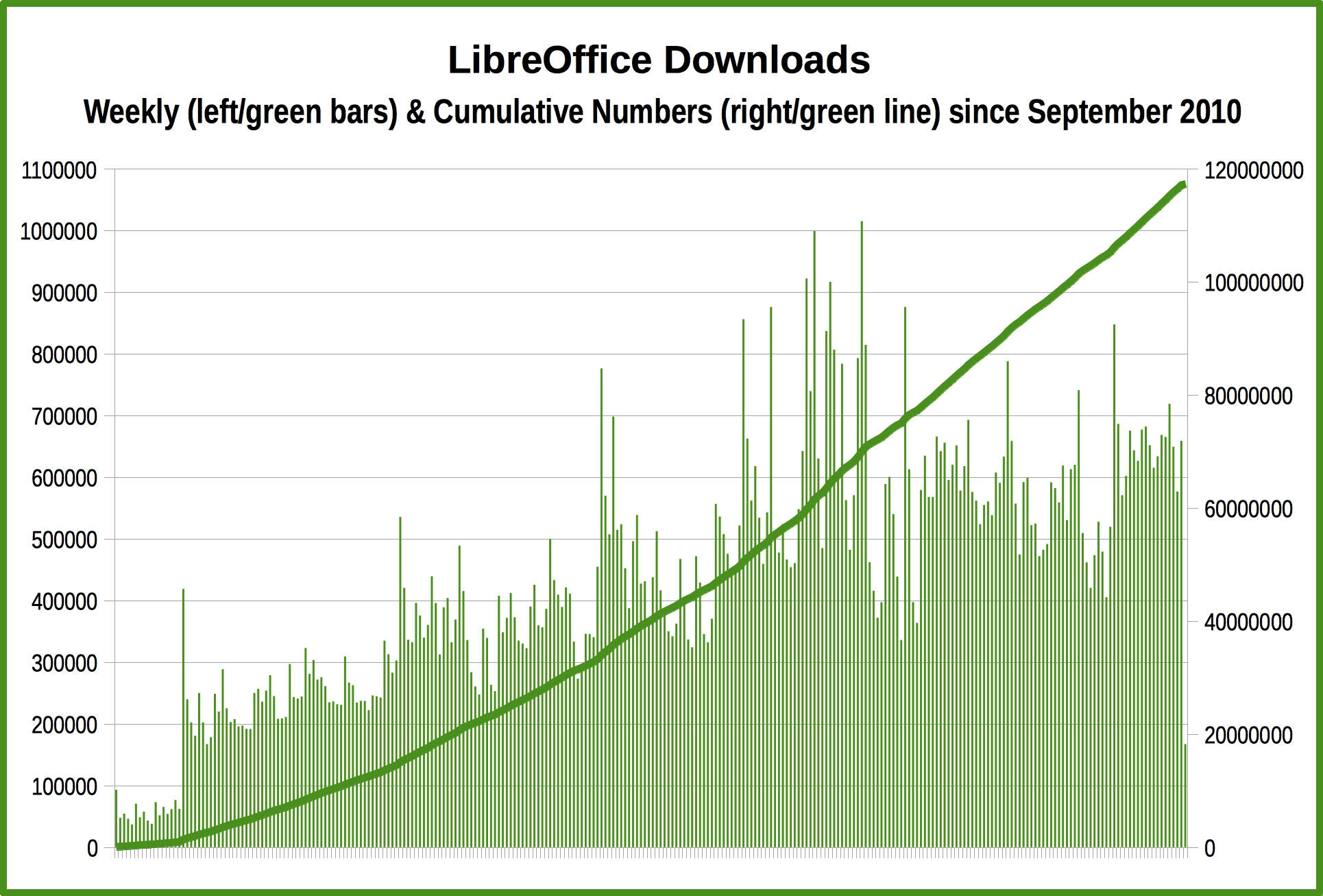
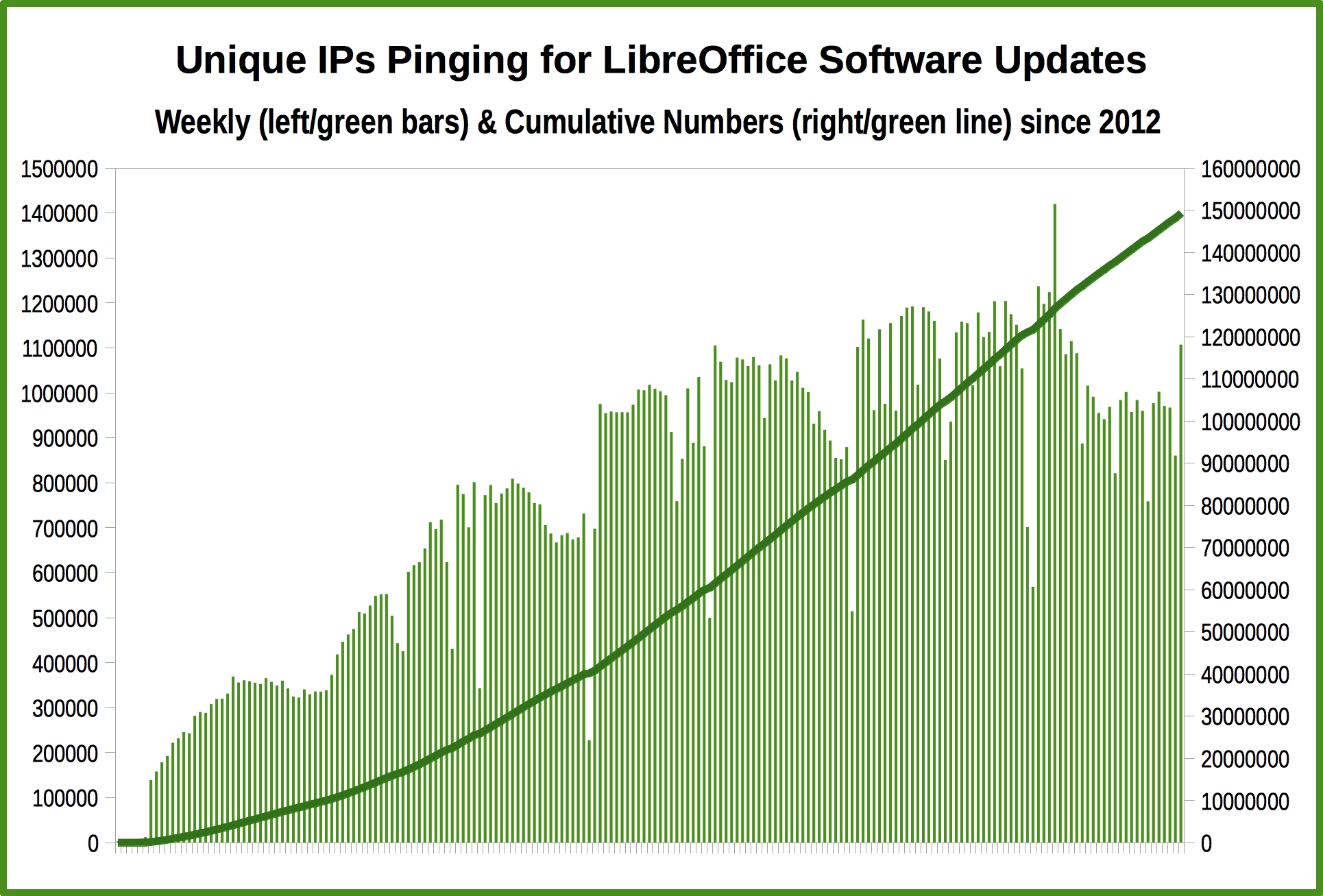
downloadsuniqueipsDownloads since September 2010 are close to 120 million, with a rather steady increase of weekly numbers. In 2013 there have been visible spikes after the launch of LibreOffice 4.0 and 4.1, as these versions were representing a significant growth in term of features over previous releases. Unique IPs pinging for updates are around 150 million since 2012 (when we have started counting them). Combined, the two charts provide a flavour of the growth of the installed base. Of course, all the usual caveats apply to the numbers, based on The Document Foundation own data.

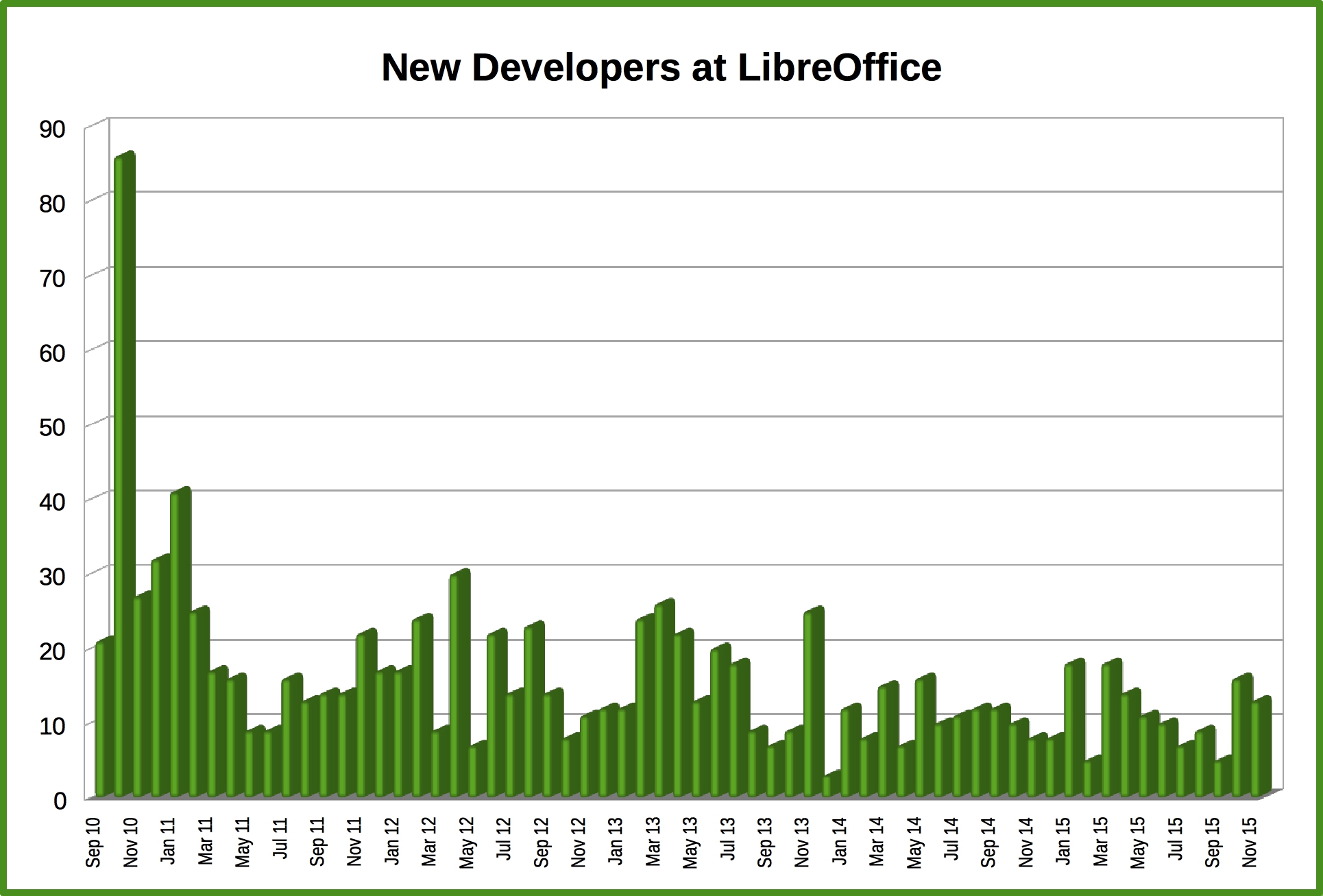
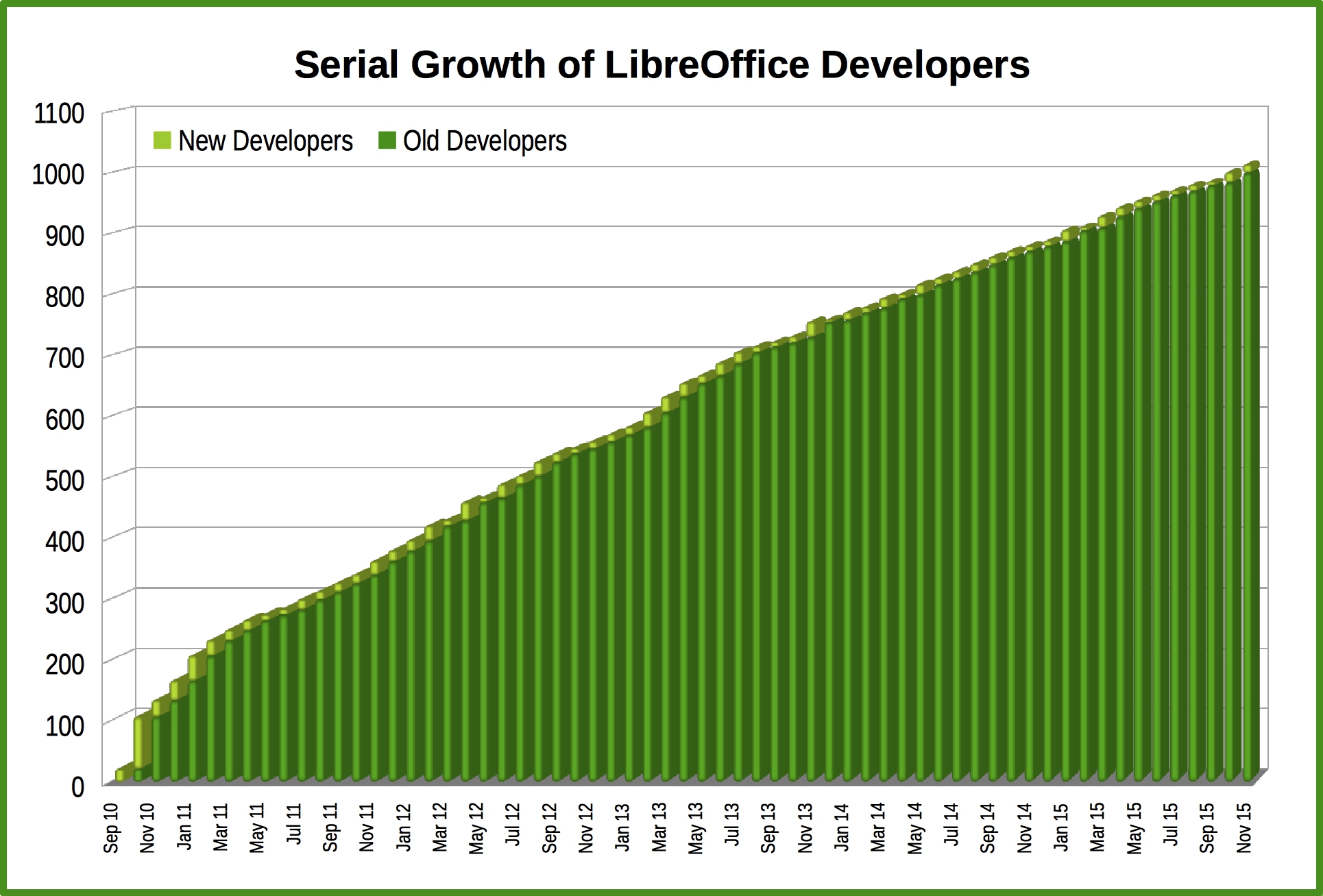
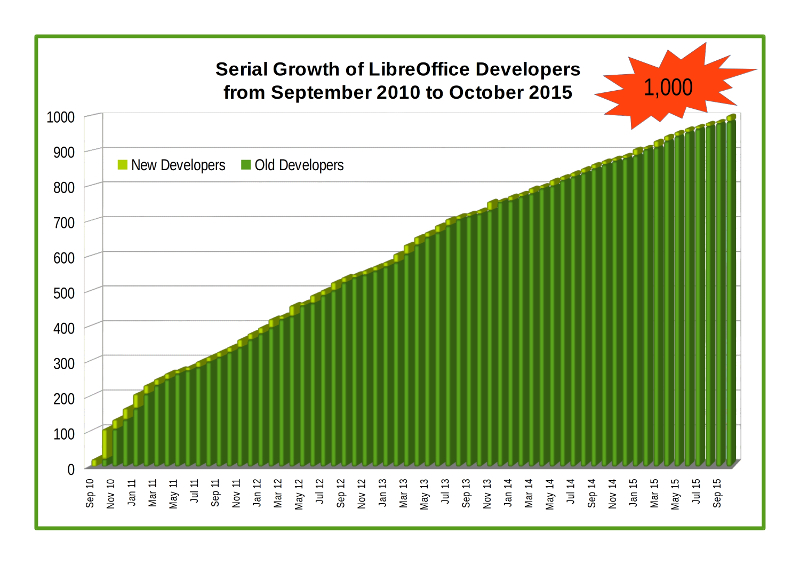
monthlygrowthserialgrowthWhen LibreOffice has launched, one of the most important challenges was the growth of developers working on the source code (because it was considered extremely hard to approach, based on the OOo experience). The numbers after 60+ months show that the issue was represented by the approach and not by the complexity of the source code. In fact, Libreoffice has attracted at least 3 new developers per month since September 2010: a result which can be considered rather extraordinary in the free software environment. At the end of October 2015, this combined serial growth has reached the figure of 1,000 developers. Charts are based on OpenHub data, crunched – of course – with LibreOffice Calc.

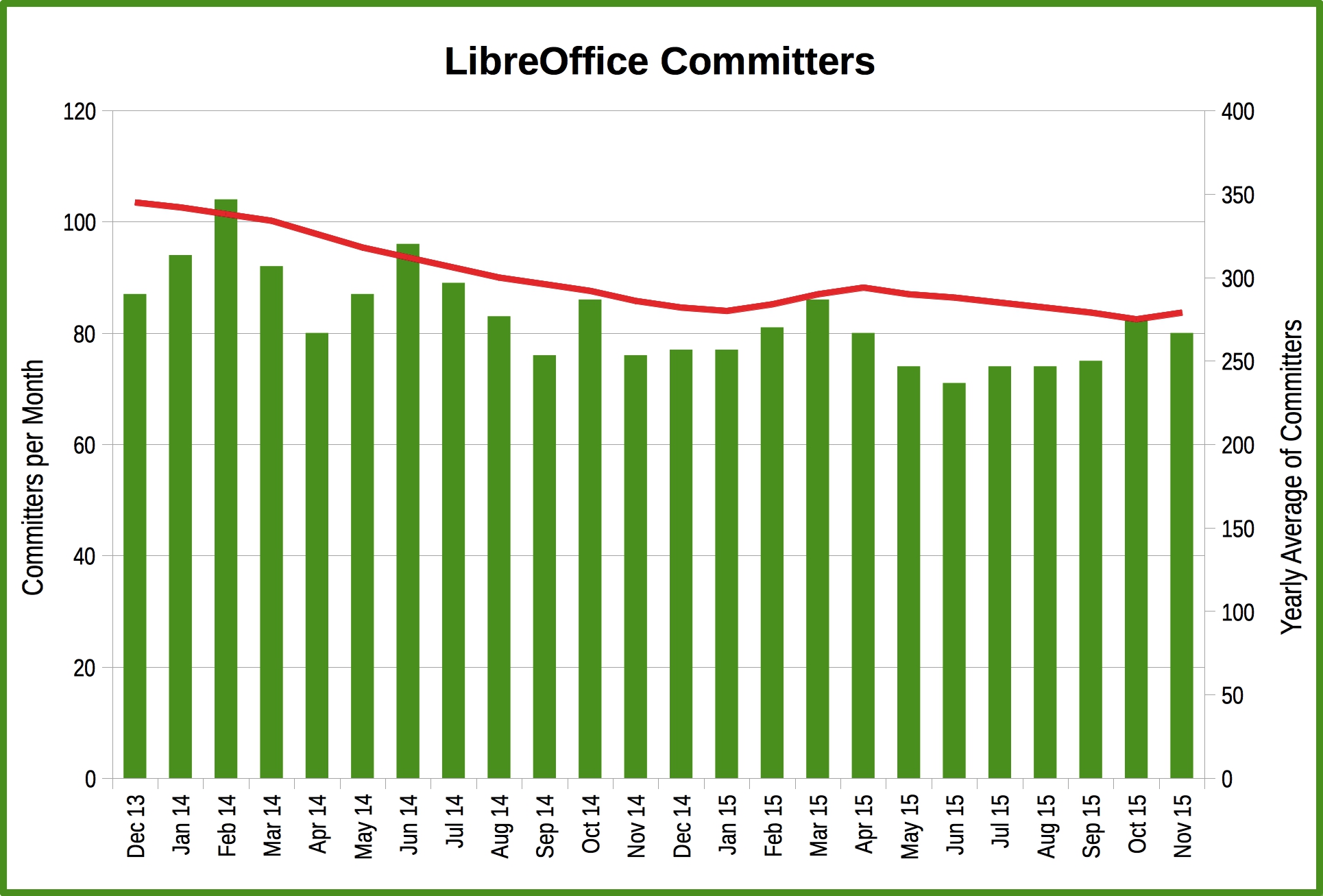
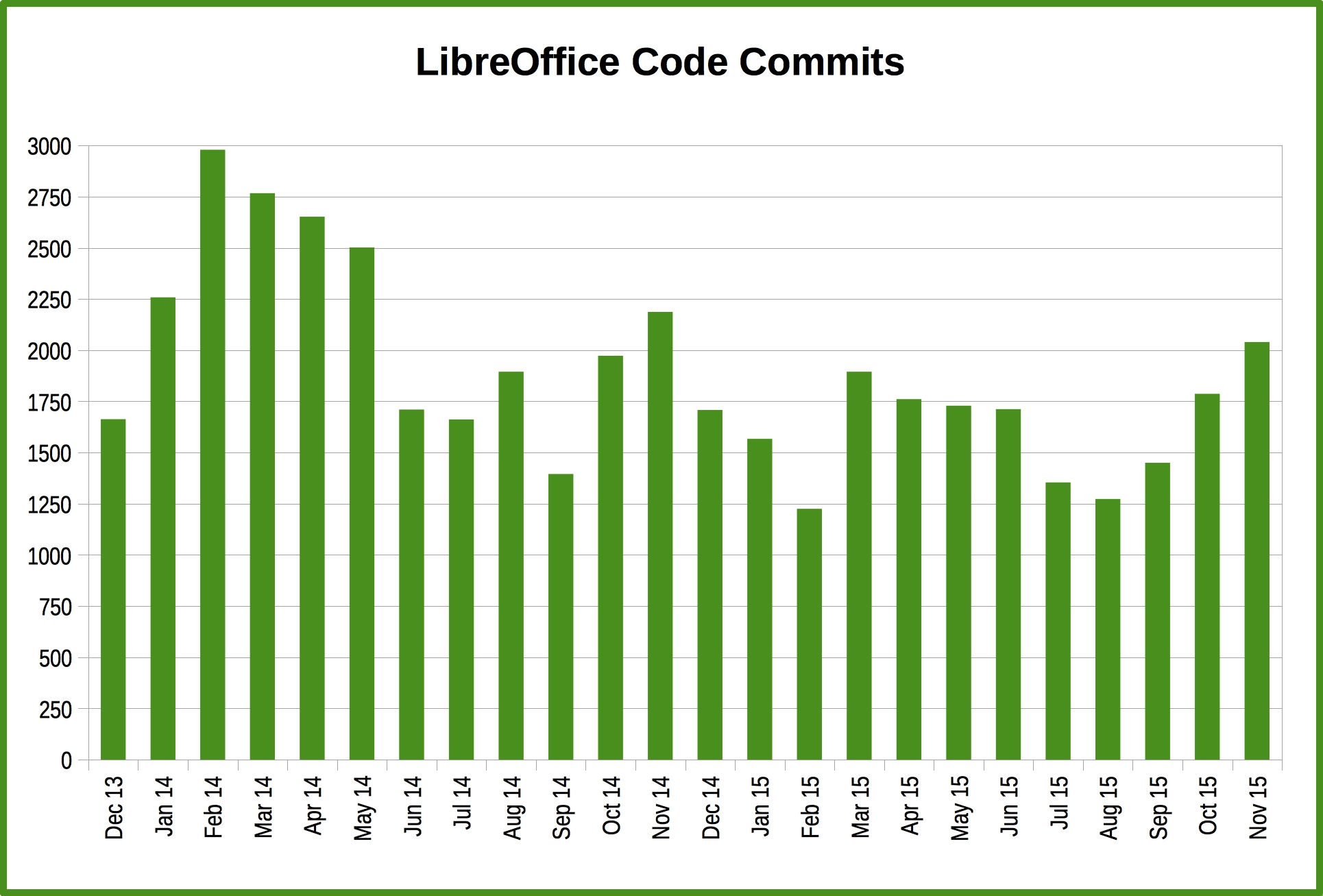
committerscommitsOf course, reaching 1,000 developers would be a meaningless achievement if the number of hackers contributing on a monthly basis were not enough to guarantee a continuity. These two charts show that over the last 24 months the number of developers contributing on a monthly basis has been around 80 (with a few small ups and downs), and the number of commits has always been higher than 1,250 per month (with peaks up to 3,000 in early 2014 and up to 2,000 on a regular basis). On a yearly basis, the number of active committers has slowly decreased from 350 to 275 (red line on the left chart, showing the yearly running average), but this is probably a consequence of the lower number of easy hacks which make the first step more challenging (an issue tackled with the hiring of a development mentor). Also these two charts are based on OpenHub data, crunched – of course – with LibreOffice Calc.

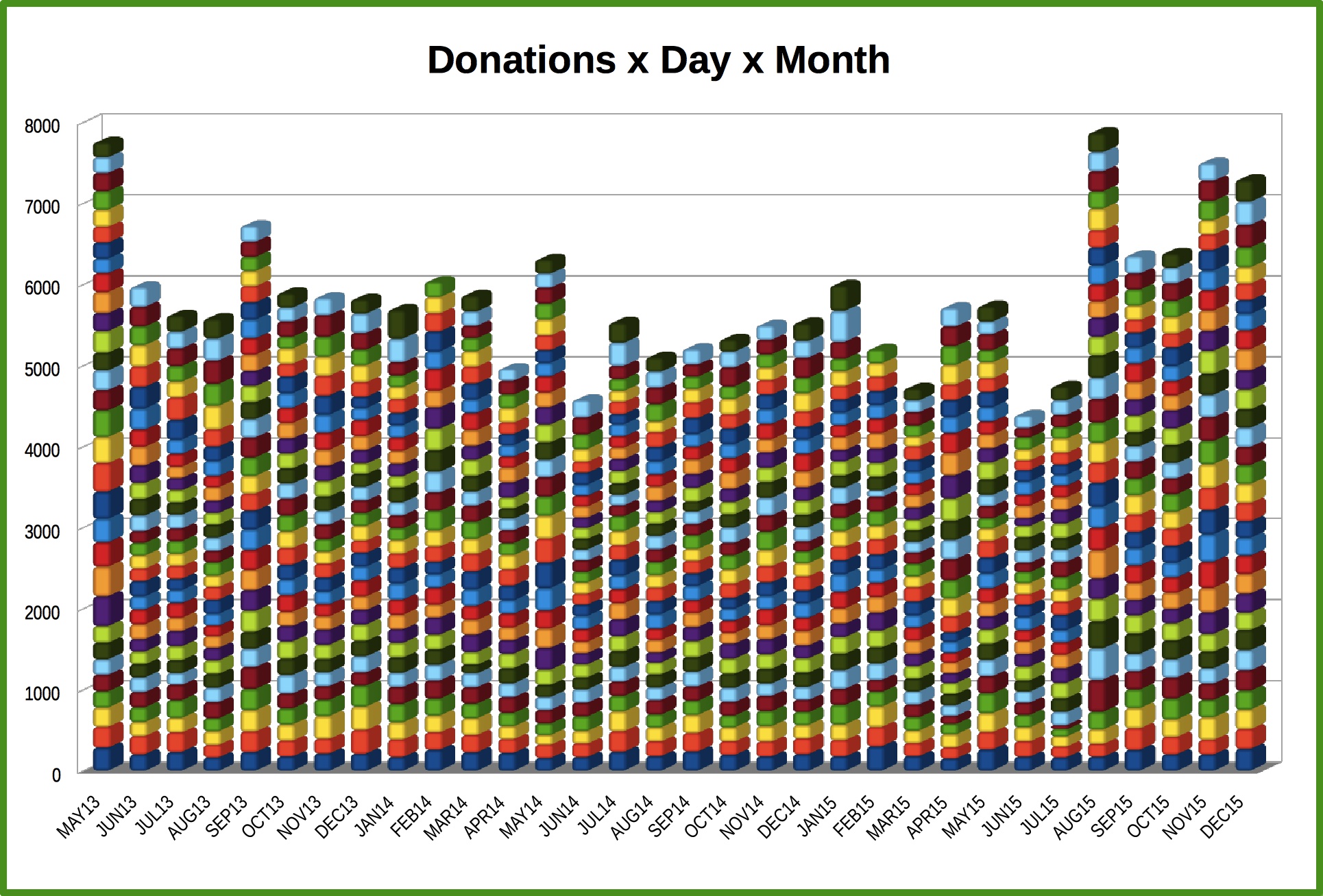
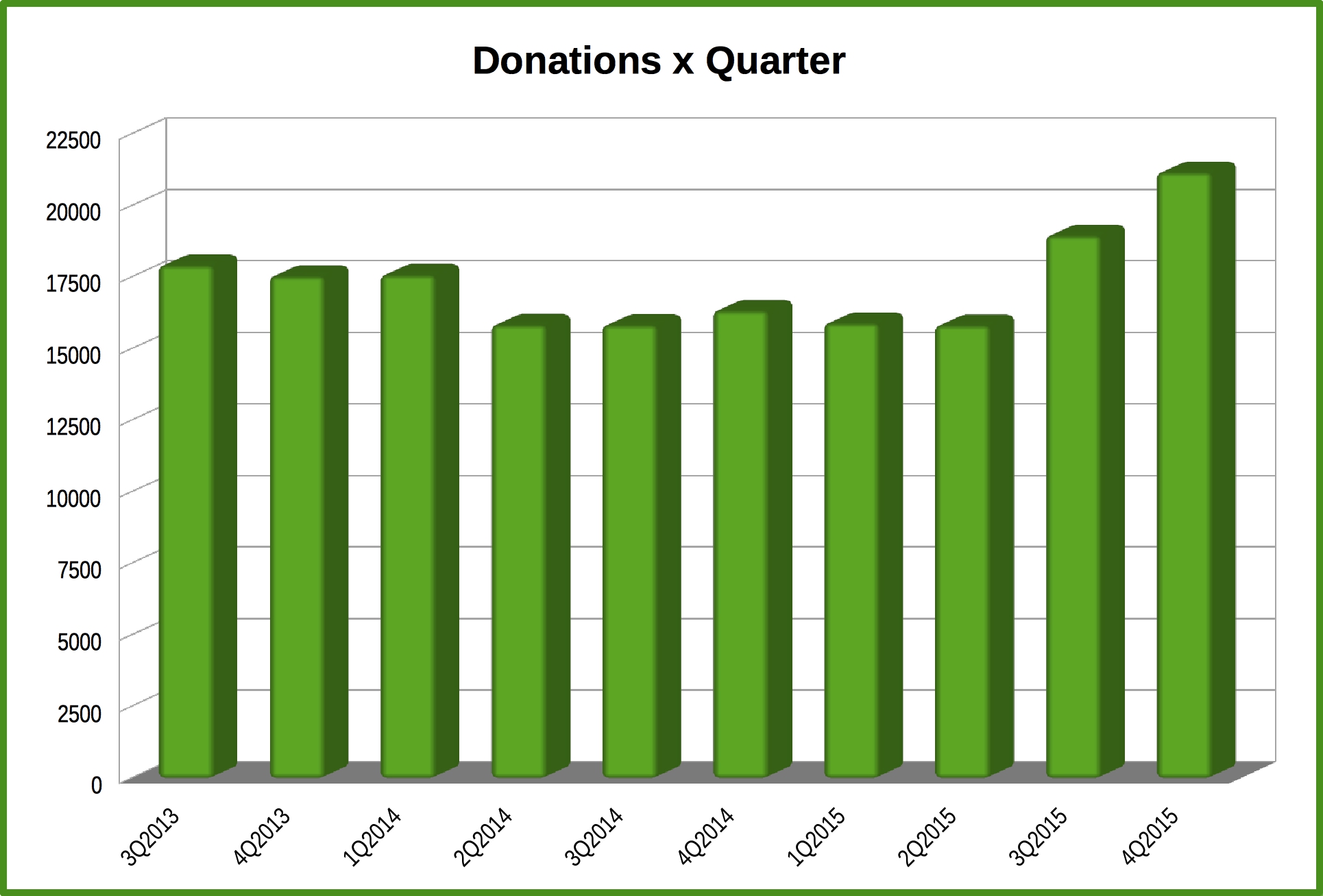
donationsxmonthdonationsxquarterAnother measurement of the LibreOffice success is based on donations. Most donations happen just after the download. Looking at the charts, it is rather clear that there has been a rather sharp increase in donations during the last two quarters (after the launch of LibreOffice 5.0 in early August 2015). Of course, these numbers do not represent the user attitude about LibreOffice (as we do not know anything about the demographics of the people who have donated), but the trend is encouraging.

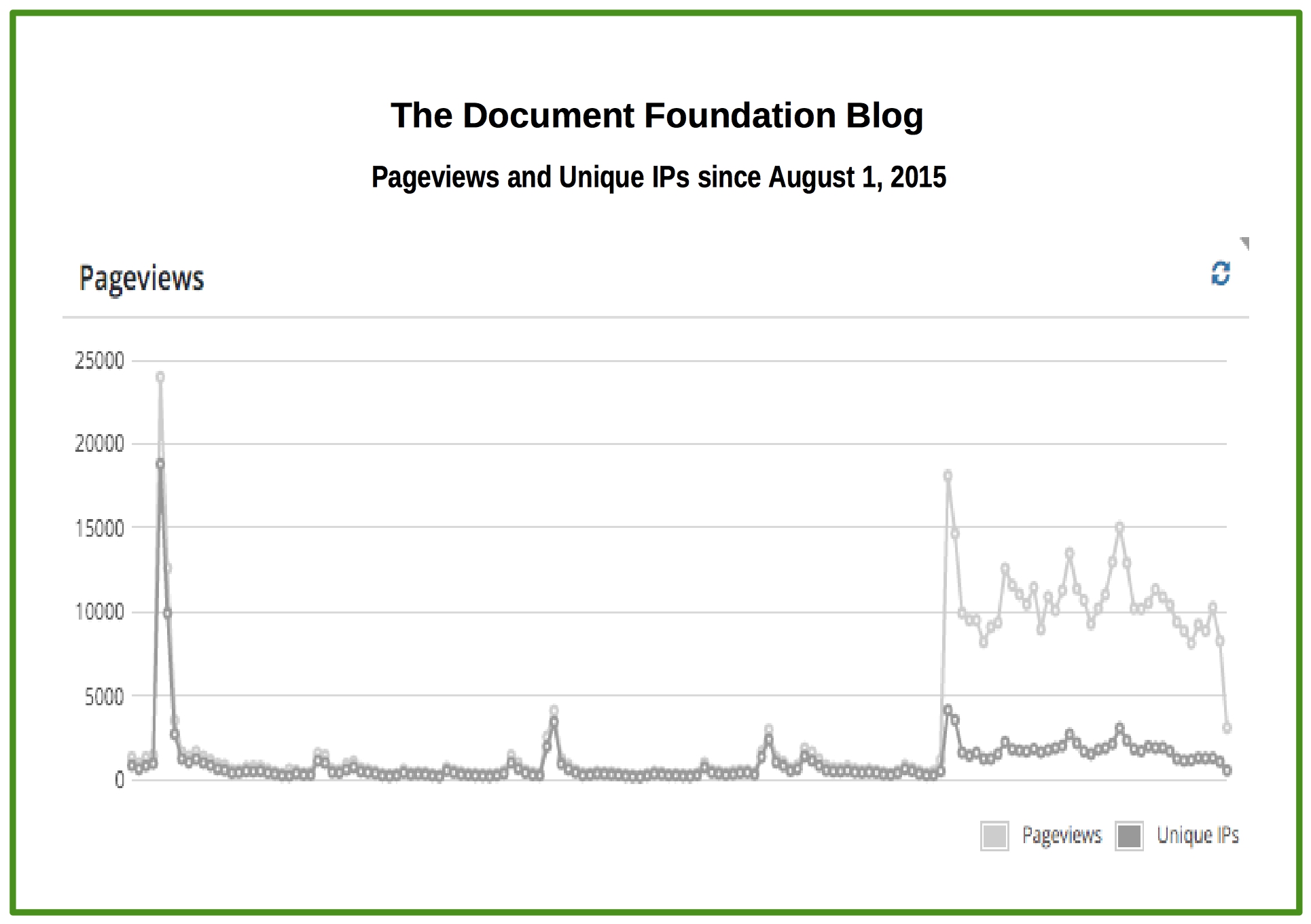
blogThe last chart shows Pageviews and Unique IPs from The Document Foundation blog, over the same timeframe (from August 1st to December 31, 2015). It is rather clear that there has been a spike for the launch of LibreOffice 5.0, and then – after almost three months of flat numbers – there has been a sharp increase in Pageviews starting from November (the same timeframe of the increase in donations of the last two months). Another encouraging trend.

[high resolution charts can be opened by double clicking on the thumbnail]


LibreOffice getting ready for the next 1,000 hackers

janiversensmallBerlin, November 23, 2015 – The Document Foundation announces a renewed effort to grow the developers community beyond the threshold of 1,000 hackers reached in October 2015 (source: OpenHub), with the addition of Jan Iversen – a senior developer with a passion for mentoring, and a long experience at Apache Software Foundation – to the team.

The extraordinary growth of LibreOffice developer’s community, with a monthly average of over 16 new hackers contributing to the code since September 2010, is the result of a global mentoring effort by some of the project founders. After five years and 1,000 new developers, though, the complexity has changed, and the project needs to invest on mentoring a new generation of coders.

LibreOffice has always been available on multiple operating systems – Windows, MacOS and Linux – and is on the verge of being available on multiple platforms: desktop, mobile and cloud. Because of this evolution, the project needs a wider range of developing skills, which can be achieved only with a renewed effort targeted to attract new code contributors.

“When LibreOffice started, the code-base we inherited was known for being extremely hard to contribute to, for both technical reasons and a lack of mentors reaching out to new hackers,” says Bjoern Michaelsen, a member of LibreOffice engineering steering committee and a director of the Document Foundation. “Today, the LibreOffice project is known for its welcoming atmosphere, and for the fun. We strive to continue on this path for the next 1,000 code contributors.”

Jan Iversen has added: “I am excited and proud to be part of the LibreOffice project. Helping to grow a project of this size, with an extremely high activity in term of development for the last five years, and at least three new contributors per month since September 2010, is a challenge I look forward to being part of.”

1000devssmall


First LibreOffice 5.0 Bug Hunting Session starts Tomorrow

Berlin, May 21, 2015 – The first LibreOffice 5.0 Bug Hunting Session starts tomorrow at 08AM UTC, to catch bugs and regressions on the first beta of the software, available from this link: http://dev-builds.libreoffice.org/pre-releases/. The session will last until May 24, 2015.

On those dates, mentors will be available from 08AM UTC to 10PM UTC to help less experienced volunteers to triage bugs, on the QA IRC channel and via email on the QA mailing list.

Those who cannot join during the bug hunting session are always welcome to help chasing bugs and regressions when they have time. There will be a second bug hunting session in June, to test LibreOffice 5.0 Release Candidate 1.

More detailed information on the bug hunting session are available here: https://wiki.documentfoundation.org/BugHunting_Session_5.0.0.0.

LibreOffice 5.0 will be released at the end of July 2015.

Tender to develop and incorporate usability metrics collection for LibreOffice (#201502-02)

The Document Foundation (TDF), the charitable entity behind the world’s leading free office suite LibreOffice, seeks for companies or individuals to

develop and incorporate usability metrics collection for LibreOffice

to start work as soon as possible.

In order to improve the user interface, human interaction and usability of LibreOffice, The Document Foundation is looking for an individual or company to, as a turnkey project, implement a usability metrics collection feature to be incorporated into the Windows, Linux and Mac OS X versions of the free office suite. The project consists of:

  1. planning and conception of features and clicks to track in close contact with our UX team, with preselection and prioritization of the features
  2. installation and configuration of a server part within TDF’s infrastructure, which is based on Mozilla’s UITelemetry (see and http://bwinton.github.io/d3Experiments/contextmenu.html for further details) and defines the format for the client part
  3. a client part, that not only counts how often features have been used, but also provides further metrics; some samples of items that need tracking are
    1. the location of the click action in the menu, as sometimes duplicates exist
    2. which context menu was used
    3. whether a certain feature was invoked by a single click, by click and hold, by a drop down click or by a multi click
    4. from which application clicking on the close document/window ‘X’ (.CloseDoc) and close application ‘X’ (.Quit) occurs
    5. whether the user used the enter key, mouse click or an accelerator to open a menu item
    6. how the app was opened (via command line, start menu, start center, or by opening a document)
    7. in which toolbar a button was clicked, as some buttons are in multiple toolbars, and users can add buttons to toolbars individually
    8. which slide transitions and object animations are used most in Impress
    9. the concrete action/command sequence: which action was used by the user, and which was the next action used after that (e.g. inserting an image and then adding a caption)
    10. which menu bar keystroke sequences are used (e.g. Alt+F + O)
    11. which icon theme, font list and theme name the user has active

      Work on the client part also involves storing collected metrics data locally in the user profile with transmission to the server part when connectivity is in place.
  4. an opt-in mechanism for the client part, so users have to actively enable the feature before any data is collected and transferred

With this feature, TDF – amongst other improvements – aims to:

  • improve the menus, toolbars and the sidebar
  • show the most popular inserted special characters for use in a future drop down
  • show the most popular bullet/numbering styles for use in a future drop down

Work is to be carried out in the source code of the current master branch of LibreOffice, as available in our git repository at http://anongit.freedesktop.org/git/libreoffice/core.git

Required Skills

Programming Languages

  • C++ for the LibreOffice client part
  • knowledge about Mozilla’s UITelemetry for the server part

Other Skills

TDF welcomes applications from all suitably qualified persons regardless of their race, sex, disability, religion/belief, sexual orientation or age.

We exclusively use free, libre and open source (FLOSS) software for development whereever possible and the resulting work must be licensed under MPLv2.

As always, TDF will give some preference to individuals who have previously shown a commitment to TDF, including but not limited to members of TDF. Not being a member, or never having contributed before, does not exclude any applicants from consideration.

The task offered is a project-based one-off, with no immediate plans to a mid- or long-term contractual relationship. It is offered on a freelance, project basis. Companies and individuals applying can be located anywhere in the world.

Bids on individual work packages (#1-#4) are welcome.

TDF is looking forward to receiving your applications, including your financial expectations (name the final price for the turnkey project), and the earliest date of your availability, via e-mail to Florian Effenberger at floeff@documentfoundation.org no later than April 1, 2015. You can encrypt your message via PGP/GnuPG.

Applicants who have not received feedback by April 30, 2015 should consider that their application, after careful review, could not be considered.