Release of LibreOffice 7.4.3 Community

Berlin, November 24, 2022 – LibreOffice 7.4.3 Community, the third maintenance release of LibreOffice 7.4, the volunteer-supported office suite for personal productivity on the desktop, is immediately available from https://www.libreoffice.org/download for Windows (Intel and Arm processors), macOS (Apple M1 and Intel processors), and Linux.

LibreOffice offers the highest level of compatibility in the office suite market segment, with native support for the OpenDocument Format (ODF) – beating proprietary formats for security and robustness – to superior support for MS Office files, to filters for a large number of legacy document formats, to return ownership and control to users.

A description of all new features of the LibreOffice 7.4.x releases is available in the Release Notes: https://wiki.documentfoundation.org/ReleaseNotes/7.4

A video summarizing the top new features in LibreOffice 7.4 Community is available on YouTube: https://www.youtube.com/watch?v=PC8M4UzqpqE and PeerTube: https://peertube.opencloud.lu/w/myZUTCytN28kuxDa5VXNgh.

LibreOffice Technology Platform

Products based on the LibreOffice Technology platform – the transactional engine shared by all LibreOffice based products, which provides a rock solid solution with a high level of coherence and interoperability – are available for major desktop operating systems (Windows, macOS, Linux and Chrome OS), for mobile platforms (Android and iOS), and for the cloud.

For enterprise-class deployments, TDF strongly recommends the LibreOffice Enterprise family of applications from ecosystem partners – for desktop, mobile and cloud – with a large number of dedicated value-added features and other benefits such as SLA (Service Level Agreements): https://www.libreoffice.org/download/libreoffice-in-business/. All code developed by ecosystem companies for enterprise customers is shared with the community and improves the LibreOffice Technology platform.

LibreOffice – thanks to its mature codebase, rich feature set, strong support for open standards, excellent compatibility and LTS options from certified partners – is the ideal solution for businesses that want to regain control of their data and free themselves from vendor lock-in.

Availability of LibreOffice 7.4.3 Community

LibreOffice 7.4.3 Community is available from: https://www.libreoffice.org/download/. Minimum requirements for proprietary operating systems are Microsoft Windows 7 SP1 and Apple macOS 10.12. LibreOffice Technology-based products for Android and iOS are listed here: https://www.libreoffice.org/download/android-and-ios/

Users still deploying the LibreOffice 7.3 family because of the additional testing and bug fixing, should switch immediately to LibreOffice 7.4.3, which has been extensively tested by millions of users worldwide, as the older version will reach the end of life and will not be maintained after November 30, 2022.

The Document Foundation does not provide technical support for users, although they can get it from volunteers on user mailing lists and the Ask LibreOffice website: https://ask.libreoffice.org
LibreOffice users, free software advocates and community members can support The Document Foundation with a donation at https://www.libreoffice.org/donate

Sign the open letter about the universal right to install any software on any device

Earlier in 2022, together with more than 100 European organisations and companies, The Document Foundation has signed the #OpenLetter about the universal right to install any software on any device. Join us and sign the letter today.

To: Legislators in the European Union

In copy: Citizens of the European Union

The universal right to freely choose operating systems, software and services

Software design is crucial for the ecodesign and sustainability of products and hardware. Free Software systems and services enable reuse, repurposing and interoperability of devices. The universal right to freely choose operating systems, software and services is crucial for a more sustainable digital society.

The ongoing digitization of infrastructures and services comes along with a continuously growing number of electronic devices that are connected to the Internet – be it in private, public or business environments. Many of these devices need more energy and natural resources to be produced than the energy they consume during their entire lifespan. And way too many of these devices are being wasted and not reparable simply because the software stops working or is not being updated anymore.

Once the pre-installed software stops users from continuing to use their hardware, restrictive ownership models prevent users from helping themselves to enjoy longer use of their devices. Restrictions span from physically locking down hardware, to technical obscurity by using proprietary software, to legal restrictions via software licenses and end user license agreements. This way, manufacturers often prohibit repairability, access and reuse of their devices. Even after purchase, customers often do not really own their devices. They are not able to do what they want with their very own devices. If you cannot install the software you want on your own device – you don’t own it.

We, the signees of this open letter,

  • recognize that free access to the hardware and software determines how long or how often a device can be used or reused.
  • declare the increased longevity and reusability of our devices to be inevitable for a more sustainable digital society.

That is why we ask legislators around Europe to make use of the historic chance and enable a more sustainable use of electronic products and devices with a universal right to install and run any software on any device. To this end, we demand that:

Users have the right to freely choose operating systems and software running on their devices

Our tablets, phones and other connected devices are general purpose computers. Replacing software and operating systems on these devices enables us to extend the initial lifespan of a device and to make full use of our hardware. For the ability to reuse and repurpose our resources in a creative and sustainable way we need the universal right to install and develop any operating system and software we want on any of our devices. Any legal, technical or other obstacles to reuse these devices for any purpose must not be allowed.

Users have the right to freely choose between service providers to connect their devices with

Users must have the free choice of providers offering software related services, meaning they can use the device from one manufacturer with the service provided by another. Many connected clients today go to waste simply because their online services go offline. Free choice of services allows these clients to be reused by connecting to another service.

Operating systems and embedded software determine possible interactions between generic sensors, modules and systems with their connected online services. For users to exercise free choice of services, they must be able to use the device from one manufacturer with any online service, which could be supplied by any other third party or by themselves. Connected services as well as the software on connected devices and applications must offer interoperability and full functionality of a device’s initial purpose with the use of Open Standards.

Devices are interoperable and compatible with open standards

Software designs and architectures determine accessibility and compatibility of hardware via standards, drivers, tools, and interfaces. Proprietary software and protocols hinder competition among manufacturers, undermine repairability of devices and create an artificial incompatibility of different devices within the same infrastructure. Interoperability of single devices however is crucial for the creation of sufficient, sustainable and long-lasting IT infrastructures. To enable interoperability, manufacturers must ensure that any data necessary to run a device’s primary function is compatible with and possible to import/export in open standards.

Source code of drivers, tools, and interfaces are published under a free license

Smaller components of a device often require specific drivers, tools, and interfaces to operate. Users need full access and free reusability of the source code of those drivers, tools, and interfaces to analyse and integrate a device within a set of interconnected devices from different manufacturers. Source code reusability is also key to exercise the full right to repair for any third-parties from professional repair shops to repair cafés to end users.

A free license is any license that gives everyone the four freedoms to use, study, share and improve the software, including Free Software and Open Source Software licenses. The obligation to publish drivers, tools, and interfaces under such a free license after market entry is key for full access to our devices and exercising the universal right to repair.

To sign the open letter, you can click on the following link: Open Letter about the universal right to install any software on any device


Welcome Stéphane Guillou, new QA Analyst for LibreOffice

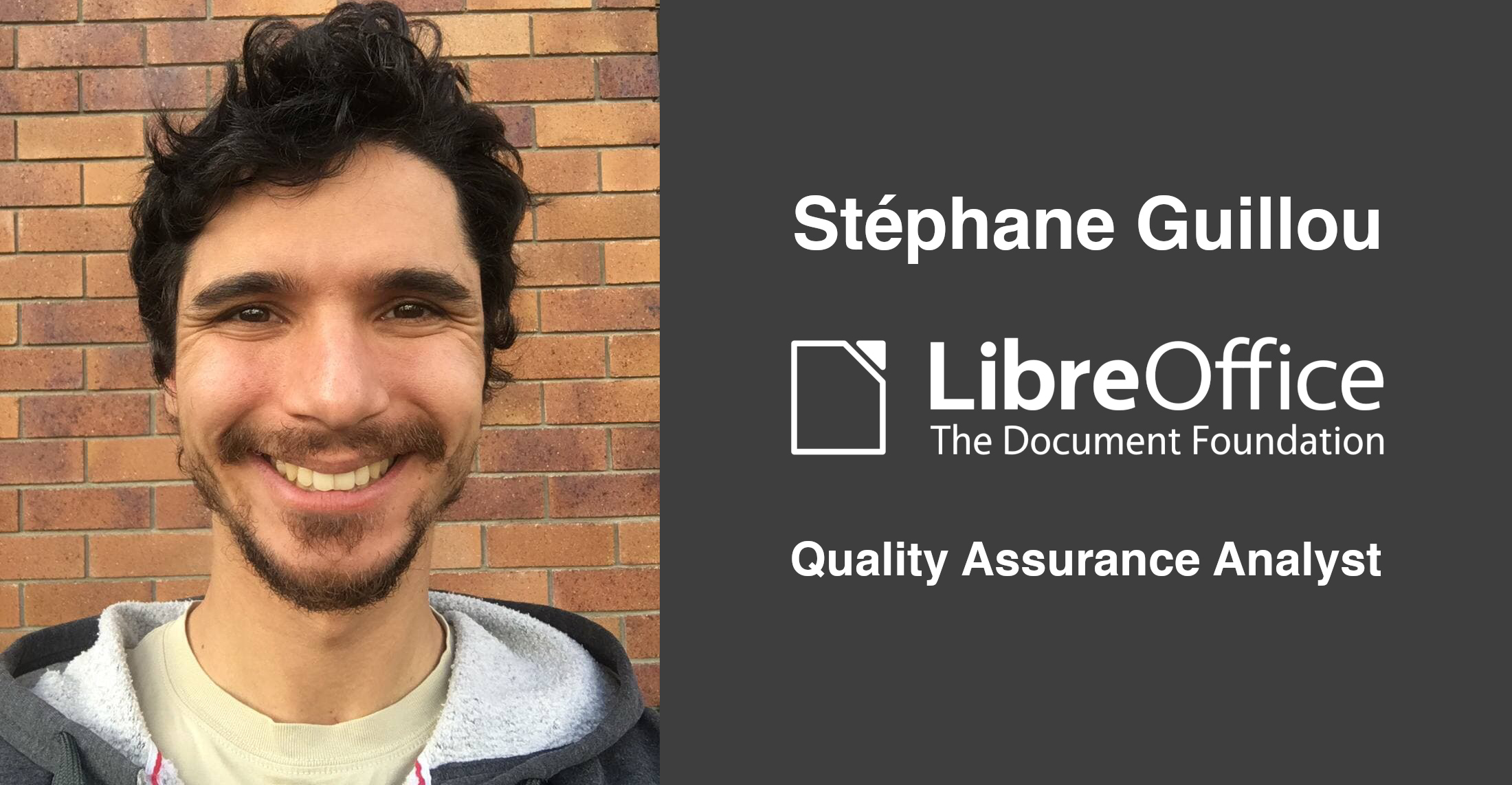
Photo portrait of Stéphane Guillou

We have a new team member at The Document Foundation, the non-profit entity behind LibreOffice! (That means we’re now 13 people.) Stéphane Guillou joins us as a Quality Assurance Analyst – so let’s get to know him better:

Tell us a bit about yourself!

I am from France, with roots also in Peru, but lived for the last 10 years in Australia with my awesome little family before coming back to France. We now live in Alsace, close to the forest in the Vosges mountains.

I studied plants, ecology and sustainability before working in agricultural research. I am still very passionate about plants and the environment, but my focus has moved towards supporting researchers in their data analysis, promoting Open Science principles and offering training about FLOSS research software, which I was able to do for the last 4 years at the University of Queensland’s Library, and before that as a certified instructor of the Carpentries organisation.

I am passionate about sharing information about Open Science, and contributing data to the Commons. You can for example find me on other wonderful projects like OpenStreetMap, iNaturalist and MusicBrainz.

When I am not parenting or working, I like spending time on electronic music, amateur radio and cycling.

What’s your new role at The Document Foundation?

I am the new Quality Assurance (QA) Analyst, and a lot of my time will be spent on triaging the issues users report on Bugzilla – our bug-reporting platform. There is a lot of activity on Bugzilla, and classifying and testing the reports is fundamental for us to focus on the most pressing issues, help the work developers are doing, and keep improving the software for everyone! Part of the work will also be to analyse and summarise the wealth of data available to help us see the bigger picture and make better decisions when allocating resources.

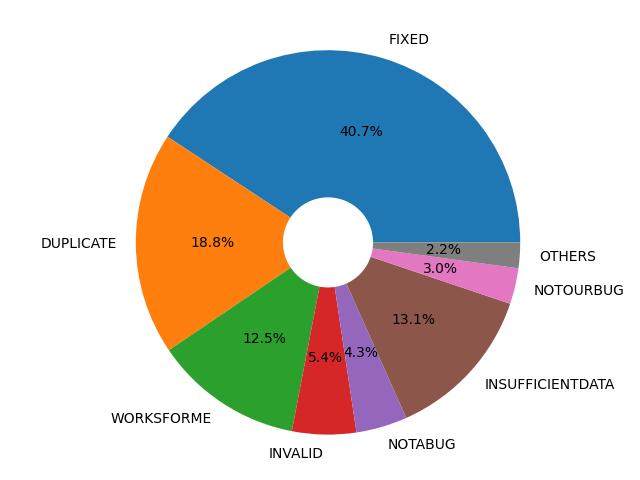
Pie chart showing the split between resolved bug statuses on Bugzilla. Four main categories are fixed (40.7%), duplicate (18.8%), insufficient data (13.1%) and works for me (12.5%).

Pie chart showing the split between resolved bug statuses on Bugzilla. Four main categories are “fixed” (40.7%), “duplicate” (18.8%), “insufficient data” (13.1%) and “works for me” (12.5%).

How did you get involved in LibreOffice, before you joined TDF?

I have used LibreOffice since it was first released in 2011, and have always liked reporting problems and helping out with the QA process in little bursts, just like I like doing with any FLOSS tool I use. I feel it’s a great way to give back to the community.

How can regular users of LibreOffice help out with the QA project?

Everyone can help our QA project by first using the software, and reporting problems when you encounter them. Have a look if the issue has been reported before, and if not, you might have found a new one! It’s important to not assume that someone has reported the issue before you. LibreOffice is a very customisable and rich office suite, so people use it in vastly different ways.

If you want to help some more, feel free to install development versions to test them, look at reports on Bugzilla to confirm issues and classify them, identify exactly when an issue arose (it’s called “bibisecting“), and share your learnings and processes with others! There is a wealth of tasks you can start on on our Wiki.

Thank you for your help building an office suite for all!

We’re really happy to have Stéphane on board! Donations from LibreOffice users help us to grow our team, maintain our infrastructure and support the communities working on LibreOffice. Support us here!

Quick tutorial – Docking Colour Palettes in LibreOffice Draw

Did you know? You can dock colour palettes in many places in LibreOffice Draw. Here’s a quick video from Harald Berger, from the German LibreOffice community:

Please confirm that you want to play a YouTube video. By accepting, you will be accessing content from YouTube, a service provided by an external third party.

YouTube privacy policy

If you accept this notice, your choice will be saved and the page will refresh.

LibreOffice Conference 2022 videos: Events, GSoC, CJK issues, graphics subsystems…

Here’s a new batch of talks from the recent LibreOffice Conference 2022! Watch the individual videos below, or click here to view the playlist.


LibreOffice Conference Latin America, Second Edition, with Gustavo Pacheco

Please confirm that you want to play a YouTube video. By accepting, you will be accessing content from YouTube, a service provided by an external third party.

YouTube privacy policy

If you accept this notice, your choice will be saved and the page will refresh.


Google Summer of Code 2022 panel, with Hannah Meeks, Tomaž Vajngerl and Miklos Vajna

Please confirm that you want to play a YouTube video. By accepting, you will be accessing content from YouTube, a service provided by an external third party.

YouTube privacy policy

If you accept this notice, your choice will be saved and the page will refresh.


A year of LibreOffice at Collabora, with Jan Holešovský

Please confirm that you want to play a YouTube video. By accepting, you will be accessing content from YouTube, a service provided by an external third party.

YouTube privacy policy

If you accept this notice, your choice will be saved and the page will refresh.


LibreOffice graphics subsystems, with Armin Le Grand

Please confirm that you want to play a YouTube video. By accepting, you will be accessing content from YouTube, a service provided by an external third party.

YouTube privacy policy

If you accept this notice, your choice will be saved and the page will refresh.


State of CJK issues of LibreOffice, 2022 edition, with Shinji Enoki

Please confirm that you want to play a YouTube video. By accepting, you will be accessing content from YouTube, a service provided by an external third party.

YouTube privacy policy

If you accept this notice, your choice will be saved and the page will refresh.

Month of LibreOffice, November 2022 – Half-way point…

So far, 203 sticker packs have been awarded in the Month of LibreOffice, November 2022. But we’re only half of the way through – so if your name (or username) isn’t on the list, join in, help to make LibreOffice even better, and get some cool swag! We’ll have 10 bonus pieces of merchandise to give away, to 10 lucky people…

How to take part

So, let’s get started! There are many ways you can help out – and as mentioned, you don’t need to be a developer. For instance, you can be a…

  • Handy Helper, answering questions from users on Ask LibreOffice. We’re keeping an eye on that site so if you give someone useful advice, you can claim your shiny stickers.
  • First Responder, helping to confirm new bug reports: go to our Bugzilla page and look for new bugs. If you can recreate one, add a comment like “CONFIRMED on Windows 10 and LibreOffice 7.4.2”.
  • Drum Beater, spreading the word: tell everyone about LibreOffice on Twitter or Mastodon! Just say why you love it or what you’re using it for, add the #libreoffice hashtag, and at the end of the month you can claim your stickers.
  • Globetrotter, translating the user interface: LibreOffice is available in a wide range of languages, but its interface translations need to be kept up-to-date. Or maybe you want to translate the suite to a whole new language? Get involved here.
  • Docs Doctor, writing documentation: Whether you want to update the online help or add chapters to the handbooks, here’s where to start.

Join in, learn new things, and have fun! We’ll post the final results in early December…