LibreOffice Named a 2026 “Best Value” Leader by Capterra

We are incredibly proud to share that LibreOffice has been officially recognized as a leader in value for 2026 by Capterra. As the digital landscape becomes increasingly defined by subscription models and rising costs, this recognition reinforces our mission to provide a powerful, professional-grade office suite that remains accessible to everyone, everywhere.

LibreOffice is a free and open-source office productivity suite that serves as the premier alternative to proprietary software like Microsoft Office. Developed by a global community and backed by the non-profit The Document Foundation, our platform includes a full range of applications: Writer (word processing), Calc (spreadsheets), Impress (presentations), Draw (vector graphics), Base (databases), and Math (formula editing). By prioritizing open standards and native support for the OpenDocument Format (ODF), LibreOffice ensures that users have total control over their data without being locked into expensive vendor ecosystems.

The “Best Value” recognition from Capterra is a direct reflection of our commitment to high-performance technology without the financial barrier. We are honored to be highlighted in the following category:

“Best Value” by Capterra in Document Management Software

What Users Are Saying About us:

“Changes and comments are easily readable during peer review, and saving in standard file types keeps co-authors in sync under varied editing environments.”
Reviewer Name: Rodel C R. Source: Capterra

“It enabled us to supply the entire staff with workplace tools at no incremental cost and allocate the budget to core telecom software instead.”
Reviewer Name: Ewan C. Source: Capterra

“The software allows users to create, edit and manage different types of documents at no cost which makes it suitable for people and organizations operating with financial limitations.”
Reviewer Name: Jonah F. Source: Capterra

About Gartner Digital Markets: Gartner Digital Markets is the world’s largest platform for finding software. More than 100 million people visit Capterra, GetApp, and Software Advice sites every year to read objective research and verified customer reviews that help them confidently choose the right software for their business. Thousands of B2B companies work with Gartner Digital Markets to build their brand, capture buyer demand, and grow their business. For more information, visit https://www.gartner.com/en/digital-markets

Disclaimer: The Gartner Digital Markets badges from Capterra and Software Advice are trademarks and service marks of Gartner, Inc. and/or its affiliates and are used herein with permission. All rights reserved. Gartner Digital Markets badges constitute the subjective opinions of individual end-user reviews, ratings, and data applied against a documented methodology; they neither represent the views of, nor constitute an endorsement by, Gartner, Inc. or its affiliates.
LibreOffice at FOSDEM 2026 in Brussels

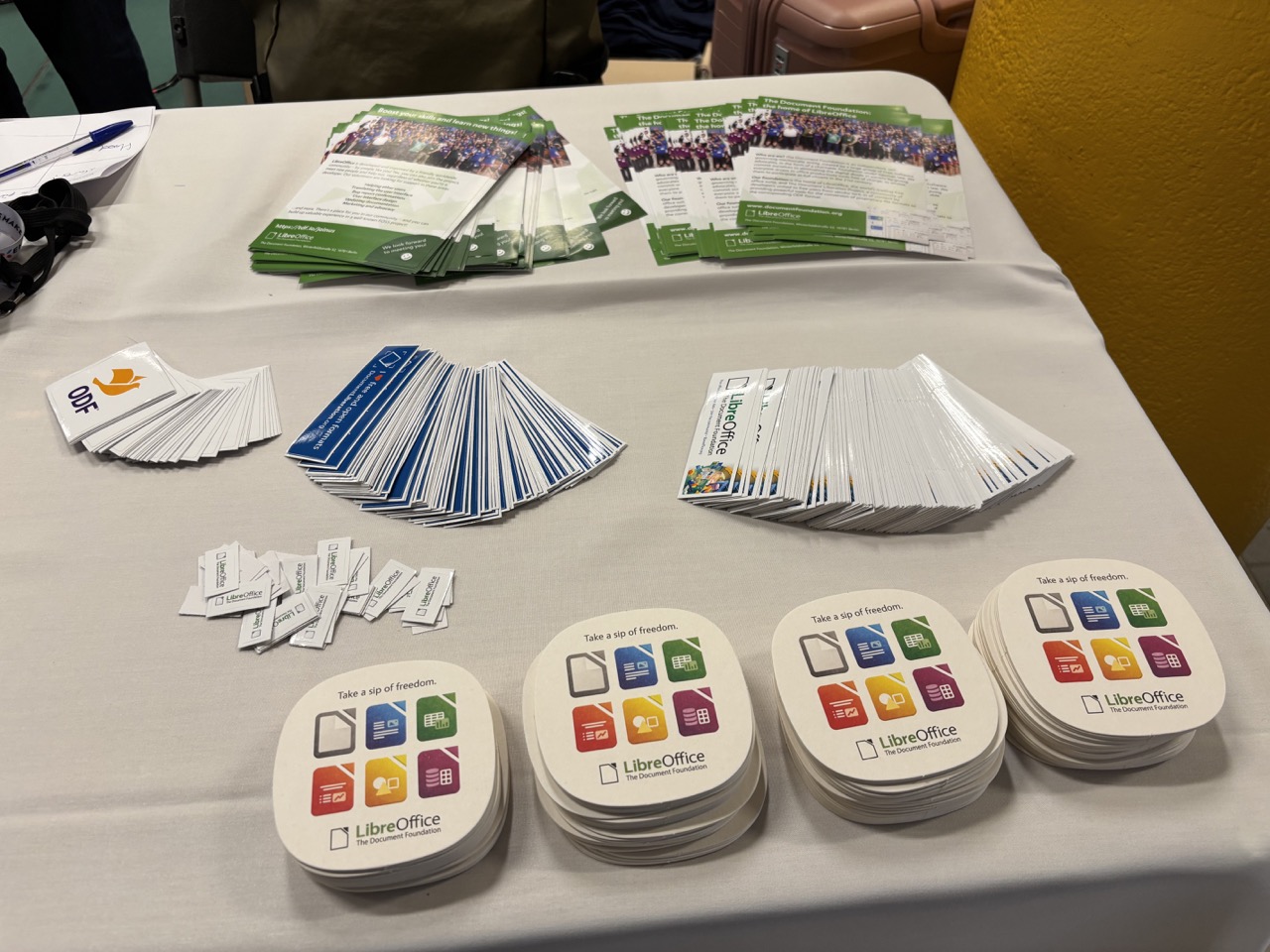
The LibreOffice community was at FOSDEM 2026, to talk to users, answer questions, and encourage people to join the project. And we had merch:

Please confirm that you want to play a YouTube video. By accepting, you will be accessing content from YouTube, a service provided by an external third party.

YouTube privacy policy

If you accept this notice, your choice will be saved and the page will refresh.

Why ODF and not OOXML

Many interpreted the last article in this series as an attack on Microsoft for using the OOXML format against users’ interests. However, this was only one of my objectives, as I also wanted to raise users’ awareness of fake open-source software, such as OnlyOffice, which partners with Microsoft in a strategy to lock users in.

Users are already aware of the advantages of standard, open formats because they access sites every day whose content is accessible thanks to the HTML format. This is a standard, open format that was first developed and then defended by its inventor, Tim Berners-Lee. He prevented Microsoft from transforming it into a proprietary format with Internet Explorer 6. This forced users to have two versions of a site: one in a standard format and one in a proprietary format.

Fortunately, Microsoft’s strategy failed in the case of HTML because the W3C – unlike the ISO – never recognised the changes to the format “forced” by Internet Explorer as valid. This was because Internet Explorer did not display sites in the standard format correctly. Ultimately, this forced the company to develop a browser that complies with all standards, thus allowing users to choose their preferred browser to access any site.

Had the same thing happened with OOXML, which was recognised by ISO as a standard despite never having been one, users today would be forced to use the Microsoft browser to view sites correctly and would have to tolerate problems with other browsers. The same applies if they want to read and write DOCX, XLSX and PPTX files with open-source software.

However, using a proprietary format for documents also has other drawbacks for users. In this way, they entrust the keys to their own content to someone they do not know, whose interests differ from their own. In the best case scenario, the content is shared, and in the worst case scenario, it is at risk, as the Chief Prosecutor of the International Court of Justice unfortunately learned when Microsoft closed his email account on the orders of the President of the United States.

The same could happen to users of Microsoft 365 if the proprietary format were modified to render it unreadable or readable only by those with a specific version of the software. Is this something that could never happen? Why live with doubt when a standard, open format is available that no country or company can use as a weapon and which anyone can access using software that handles it correctly?

LibreOffice currently handles ODF files perfectly and handles OOXML files better than Windows 365 and other software handle ODF files. Poor handling of ODF files “forces” users towards OOXML files, thus pushing them towards lock-in and protecting a business worth around $30 billion (because lock-in functions like a pair of handcuffs).

We would like all software to adopt ODF as the reference format and handle it correctly in order to offer users true freedom of choice based on software functionality — as would be right in a world based on free competition and innovation, at least in theory.

LibreOffice project and community recap: January 2026

Monthly recap banner

Here’s our summary of updates, events and activities in the LibreOffice project in the last four weeks – click the links to learn more…

Banner saying Updated Conflict of Interest policy

ODF logo

  • Then there was the LibreOffice Podcast, Episode #6 – discussing language support with Jonathan Clark from TDF. (The episode is also available on PeerTube.)

Please confirm that you want to play a YouTube video. By accepting, you will be accessing content from YouTube, a service provided by an external third party.

YouTube privacy policy

If you accept this notice, your choice will be saved and the page will refresh.

  • Finally, we prepared for FOSDEM 2026 which took place in Brussels. More about the community’s activities there soon!

LibreOffice merchandise at FOSDEM

Like what we do? Support our community with a donation – or join our community and help to make LibreOffice even better! Also keep in touch – follow us on Mastodon, Bluesky, X (formerly Twitter), Reddit and Facebook.

Video: New features in LibreOffice 26.2

Here’s a selection of new features in LibreOffice 26.2, which we released on Wednesday. (This video is also available on PeerTube.)

Please confirm that you want to play a YouTube video. By accepting, you will be accessing content from YouTube, a service provided by an external third party.

YouTube privacy policy

If you accept this notice, your choice will be saved and the page will refresh.

Why OOXML is not a standard format for office documents

Unfortunately, I keep reading about open-source software advocates who happily use Microsoft’s proprietary DOCX, XLSX and PPTX formats for their documents and therefore prefer proprietary software such as OnlyOffice to LibreOffice. Others write outrageous things such as: “OOXML is a standard format, and we have to accept it.”

I would therefore like to take this opportunity to clarify, once and for all, why OOXML has never been, is not, and will never be a standard format unless Microsoft decides to completely redesign its office applications.

I consider this impossible in light of past decisions, such as Excel’s inability to handle elements of the human genome properly. This forced the scientific community to change the names of these elements due to Microsoft’s refusal to fix an obvious Excel bug.

In other words, because of Microsoft, all of us citizens of the world have been affected by the change of the names of some elements of our genome, with all that this entails for scientific research and, consequently, for the treatment of genetic diseases. This is an enormously important fact that has not received sufficient publicity in the media, but it illustrates how willing Microsoft is to overlook everything for its own commercial interests.

But let’s get back to OOXML.

In theory, OOXML (Office Open XML) is an ISO/IEC standard (ISO/IEC 29500), despite heavy technical criticism being raised by many parties during the process and completely ignored by ISO/IEC. This shows that it is not a standard, let alone an open standard.

The following is a summary of these criticisms:

Complexity of specifications: the standard is extremely voluminous (~7,000 pages), making it virtually impossible for third parties to implement correctly. This contrasts sharply with competing standards such as ODF, which are much more concise.

Implementation inconsistencies: Microsoft Office applications do not implement the standardized version (ISO/IEC 29500 Strict), but use the “Transitional” variant, which includes compatibility features with legacy formats that contradict the stated goal of being a clean, modern, and above all open and standard format.

Proprietary dependencies: The specifications refer to several undocumented legacy behaviors of previous versions of Microsoft Office and require implementers to decode Windows-specific features to achieve compatibility.

Binary blob remnants: Despite being based on XML, OOXML incorporates binary data structures in many places, particularly for backward compatibility with legacy formats, and this compromises the transparency that XML should guarantee.

Platform-specific elements: The standard contains Windows-specific elements related to fonts, rendering, and other system behaviors that make any cross-platform implementation difficult or even impossible.

Controversy over the standardization process: The fast-track approval process adopted for OOXML by ISO/IEC was highly controversial, with allegations of procedural irregularities and vote manipulation raising legitimate doubts about the validity of the standard.

These issues meant that, although OOXML technically became a standard, it has always been a proprietary Microsoft format specification and not a truly vendor-neutral open standard.

In the coming weeks, I will explore some of the claims made in this post in detail, with all the relevant technical elements.

For now, anyone interested can take a look at this PDF presentation from 2018, referring to ISO/IEC 29500-1:2016 (and the corresponding ECMA 376), which lists some of the issues and provides technical details that clarify at least some of the claims.

ODF Advocacy - OOXML

Please be aware that some of the slides referring to ECMA 376 are related to an old version of the standard and as such may be obsolete. The presentation will be updated with references to the current version of ECMA 376.